
The fenugreek plant has a real but modest track record, and it’s worth being clear about where it sits. Its seeds have the best evidence for nudging blood sugar and cholesterol downward, weaker and mixed evidence for boosting breast milk supply and easing period cramps, and thin evidence for the testosterone claims plastered across supplement bottles. As a kitchen spice it’s very safe; at concentrated supplement doses it carries genuine cautions — and it is not safe to take in medicinal amounts during pregnancy. Here’s what holds up.
What the fenugreek plant is
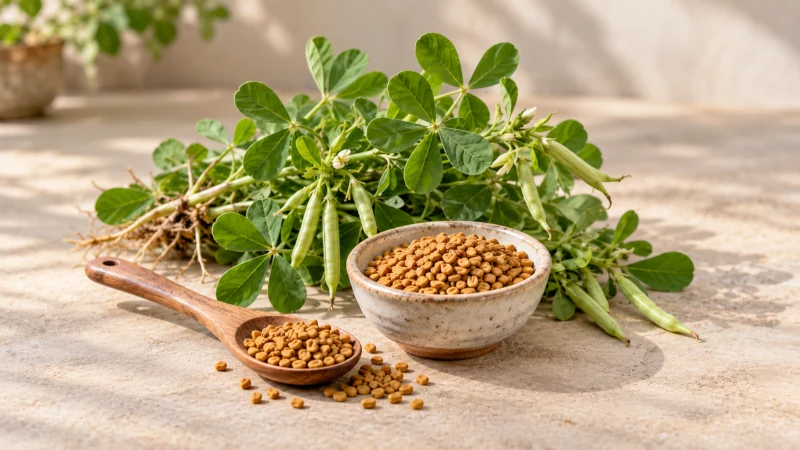
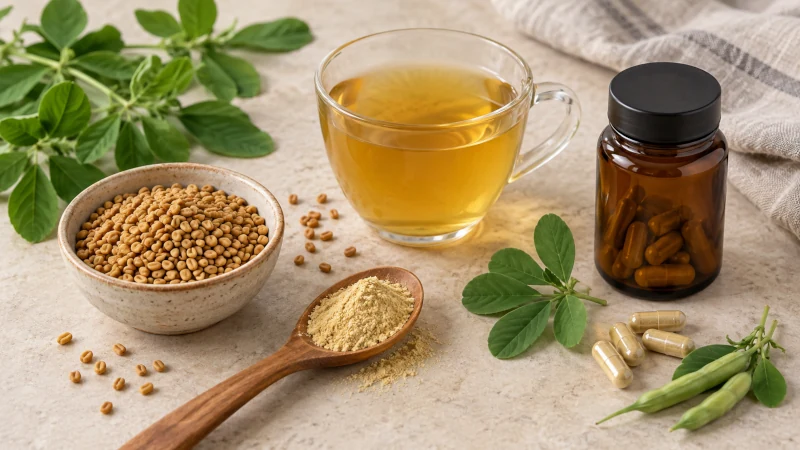
Fenugreek (Trigonella foenum-graecum) is a clover-like annual in the legume family — the same family as peanuts, chickpeas and soybeans, which matters later for allergies. It’s native to the Mediterranean, southern Europe and western Asia, and its golden, angular seeds smell and taste distinctly of maple syrup [NCCIH, 2025]. People have used it as food, spice and folk medicine for roughly 6,000 years, traditionally as a tonic, a mild laxative, a remedy for menstrual cramps, and to encourage milk production while breastfeeding [NCCIH, 2025]. The seeds are the part used medicinally; they’re rich in soluble fiber (mucilage), protein, and compounds like 4-hydroxyisoleucine, diosgenin and trigonelline that researchers think drive its effects on glucose and lipids [LiverTox, 2018].
What the fenugreek plant does: the evidence, graded
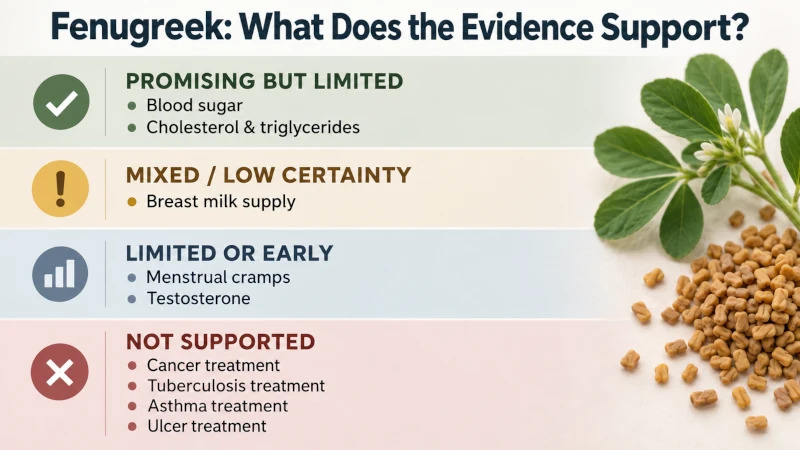
Most of the human research is on the seeds or seed extracts, and most trials are small. Here’s the honest summary before the detail:
| Use | What the evidence says | How strong |
| Lowering blood sugar (type 2 diabetes) | Meta-analyses find modest reductions in fasting glucose and HbA1c, but trials are small and often low-quality | Promising but limited |
| Lowering cholesterol / triglycerides | Meta-analyses show reductions in total cholesterol, LDL and triglycerides; small samples | Promising but limited |
| Increasing breast milk supply | Studies conflict; the best review calls the evidence very uncertain | Mixed / low-certainty |
| Easing menstrual cramps | Only a few low-quality studies; effect unclear | Limited |
| Raising testosterone / libido | A small, uncertain effect on total testosterone at best; no reliable free-testosterone benefit | Early / uncertain |
| Curing or treating disease (TB, cancer, asthma, ulcers) | No credible human evidence | Not supported |
Blood sugar and type 2 diabetes
This is fenugreek’s strongest card, and it’s still a modest one. A 2023 systematic review and meta-analysis of 10 randomized controlled trials (706 people) found that fenugreek significantly lowered fasting blood glucose, post-meal glucose and HbA1c in people with type 2 diabetes, with mild digestive side effects in some studies [Kim et al., 2023]. The likely mechanism is straightforward: the seeds are high in soluble fiber, which slows how fast sugar is absorbed from a meal.
The important caveat comes from the people who review this evidence for a living. The NIH’s complementary-health center concludes there simply isn’t enough high-quality evidence to say fenugreek is useful for diabetes, because many of the studies were small or poorly designed [NCCIH, 2025].
The NIH’s LiverTox monograph puts it bluntly: the benefits in diabetes and high cholesterol “have not been proven in rigorously designed” prospective trials [LiverTox, 2018]. So: a reasonable, evidence-backed adjunct to discuss with your doctor — not a replacement for medication, and not something to start on your own if you’re already on glucose-lowering drugs (see interactions). If you’re trying to understand your own numbers first, our guide to blood sugar levels covers what the readings mean and when they’re an emergency.
Cholesterol and triglycerides
The lipid evidence runs parallel to the glucose evidence — real signal, small trials. A 2020 systematic review and meta-analysis found that fenugreek supplementation reduced total cholesterol, LDL (“bad”) cholesterol and triglycerides [Heshmat-Ghahdarijani et al., 2020]. The 2023 diabetes review saw the same direction of effect on lipids [Kim et al., 2023]. But the pooled samples are small (a few hundred people), doses and preparations vary widely between studies, and no one has run the large, long trial that would settle it. Treat it as a plausible bonus rather than a reason to skip a statin your doctor has prescribed.
Breast milk supply
Fenugreek is one of the most popular herbal galactagogues (milk-supply boosters), and it’s also where hope tends to outrun data. A 2020 Cochrane review — the most rigorous look at oral galactagogues — grouped fenugreek with other herbal remedies and concluded the evidence is very uncertain: the studies were too clinically different to combine reliably, and the certainty of evidence was very low [Foong et al., 2020].
Surveys of nursing mothers show many feel it helps and many also report side effects [LactMed, 2023]. If you want to try it, typical milk-supply doses in the literature are 1 to 6 grams of seed daily [LactMed, 2023] — but discuss it with a lactation consultant or your doctor first, especially given the maple-syrup body odor and the possibility of gassiness in the baby.
Menstrual cramps
Fenugreek has a long traditional use for period pain, but the science is thin. Only a small number of studies have looked at it, the evidence is low quality, and its effect on menstrual cramps remains uncertain [NCCIH, 2025]. Not a reason to avoid it if it helps you, but not something to rely on over proven options.
Testosterone, libido and “T-boosters”
Fenugreek extract is a staple of “testosterone support” supplements, so the honest answer matters. A 2026 systematic review and meta-analysis of randomized placebo-controlled trials in men (8 core studies, 637 participants, mostly 500–600 mg/day of extract for 8–12 weeks) found that fenugreek may produce a small favorable effect on total testosterone — but the evidence is very uncertain, and it did not show a reliable benefit for free testosterone, the fraction that’s biologically active [Testosterone meta-analysis, 2026]. In plain terms: a possible small bump on one lab number, not a proven fix for low libido, energy or muscle. Anyone with genuine symptoms of low testosterone should be evaluated by a clinician rather than self-treating.
What fenugreek is not proven to do
The older version of this page — and a lot of the internet — credits fenugreek with treating tuberculosis, cancer (“tumors”), asthma, emphysema, ulcers and more. There is no credible human evidence for any of that, and the NIH is explicit that the evidence for fenugreek in conditions beyond the ones above is too limited to draw conclusions [NCCIH, 2025]. Where you see “cures,” read “unproven.” A plant can be genuinely useful and still not be a medicine cabinet.
How to use the fenugreek plant: forms and realistic doses
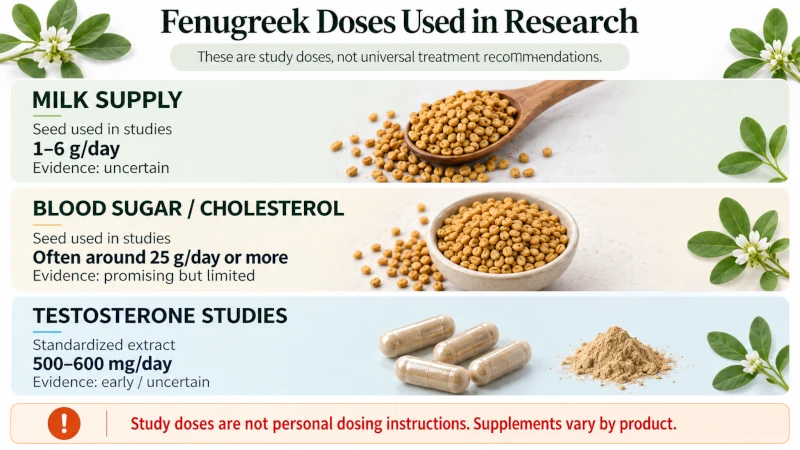
Fenugreek comes as whole or ground seeds, capsules/powder, teas, and liquid extracts, and doses in the research vary a lot by goal:
- For milk supply: studies typically used 1–6 grams of seed daily [LactMed, 2023].
- For blood sugar and cholesterol: effects generally show up at higher intakes — around 25 grams of seed or more per day [LactMed, 2023]. That’s a large amount, which is part of why capsules and standardized extracts are popular.
- For testosterone research: trials used 500–600 mg/day of a standardized extract [Testosterone meta-analysis, 2026].
Two practical points. First, supplements aren’t standardized across brands, so “one capsule” can mean very different amounts of active compound — read the label and don’t assume equivalence. Second, the seeds are bitter; in cooking, that’s usually the point, and a little honey can round out fenugreek tea (though honey is still sugar, which matters if you’re watching glucose). Start low, and if you take any regular medication, clear it with a pharmacist first.
Fenugreek on the skin: the traditional poultice
Traditionally, a paste made from boiled fenugreek seeds is applied to irritated skin, and the mucilage does make a soothing emollient. But “soothing” isn’t the same as “treating,” and there’s little rigorous human trial data for fenugreek specifically on wounds, boils or joint pain. If you’re weighing topical herbs, our evidence-graded rundown of herbs for skin issues is a more useful map of what actually has support — and, just as important, which plants to keep away from broken skin. Patch-test anything first, and don’t put a homemade poultice on a wound that’s spreading, deep, or not healing.
Side effects and who should avoid fenugreek
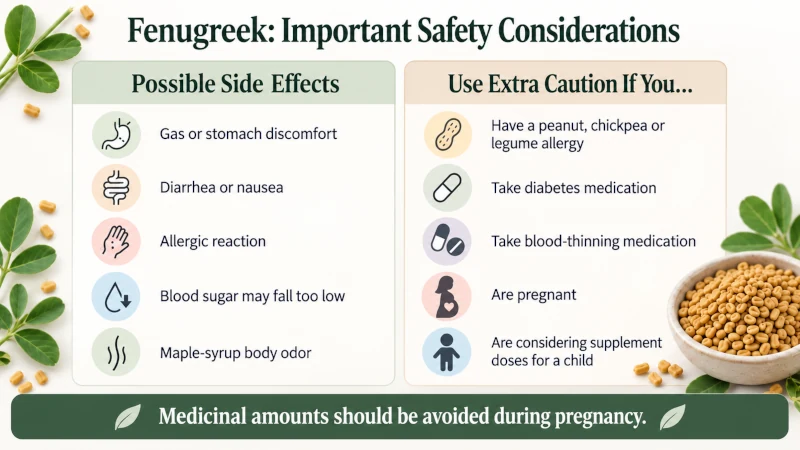
In food amounts, fenugreek is considered safe for adults and children. In larger, supplement-level amounts it’s possibly safe for adults, but the cautions become real [NCCIH, 2025]:
- Digestive upset is the most common complaint — diarrhea, gas, nausea and stomach discomfort, especially at higher doses [NCCIH, 2025].
- Allergic reactions, including serious ones, can occur. Because fenugreek is a legume, people allergic to peanuts, chickpeas or other legumes may cross-react [LactMed, 2023]. If you have a legume allergy, treat fenugreek with the same caution — our guide to foods that cause allergies explains cross-reactivity and the red flags of a severe reaction.
- A harmful drop in blood sugar (hypoglycemia) is possible at large doses, particularly if you’re already taking glucose-lowering medication [NCCIH, 2025].
- A maple-syrup odor in urine, sweat and body odor is a harmless but real quirk, caused by a compound called sotolon; in breastfeeding mothers it can pass to the baby’s skin and possibly the milk [LactMed, 2023].
Who should be most careful: anyone with a legume allergy, anyone on the medications below, pregnant women (see next section), and parents considering it for children in amounts beyond food — there isn’t enough information to call that safe [NCCIH, 2025].
Drug interactions worth knowing
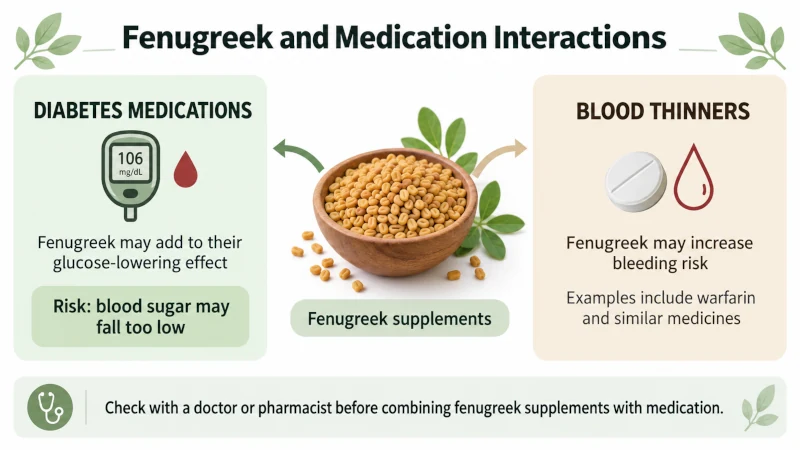
Talk to your doctor or pharmacist before combining fenugreek with prescription medicine — some herbs and drugs interact in harmful ways [NCCIH, 2025]. Two interactions are well enough documented to flag specifically:
- Diabetes medications. Because fenugreek can lower blood sugar, stacking it on insulin or other glucose-lowering drugs can push you too low [Drugs.com, 2025; NCCIH, 2025].
- Blood thinners. Fenugreek can interact with warfarin and increase bleeding risk, and it appears on interaction lists alongside aspirin, clopidogrel and similar drugs [LactMed, 2023; Drugs.com, 2025].
Pregnancy and breastfeeding
This is the clearest safety line on the page. Fenugreek is not safe during pregnancy in amounts greater than those normally found in food — its use has been linked to increased risk of birth defects in both animals and people [NCCIH, 2025]. Culinary amounts in cooking are a different matter, but medicinal doses and supplements should be avoided in pregnancy.
For breastfeeding, the picture is “uncertain rather than reassuring”: little is known about whether it’s safe to use fenugreek in amounts larger than food while nursing, and, as above, whether it reliably increases milk supply at all is unsettled [NCCIH, 2025; Foong et al., 2020]. If you’re considering it as a galactagogue, involve a lactation consultant or your doctor.
When to talk to a healthcare professional
Fenugreek is a supplement, not a treatment plan. Loop in a professional — don’t rely on self-care — if:
- you have diabetes or take any glucose-lowering medication, before adding fenugreek;
- you take a blood thinner, or any regular prescription medicine;
- you’re pregnant, planning a pregnancy, or breastfeeding;
- you develop signs of an allergic reaction — hives, swelling of the lips or throat, wheezing or trouble breathing — which is an emergency; or
- you’re using fenugreek for a symptom (persistent high blood sugar, low milk supply, low-libido symptoms) that isn’t improving, which deserves a proper assessment rather than a longer run at an herb.
| HEALTH DISCLAIMER: This article is for general education. It is not medical advice, a diagnosis, or a treatment plan, and it can’t account for your medications, allergies, or other conditions. Fenugreek can lower blood sugar, interact with blood thinners and diabetes drugs, and trigger allergic reactions in people sensitive to legumes. Do not use it in medicinal amounts during pregnancy. Talk to your doctor or pharmacist before starting fenugreek — especially if you are pregnant, breastfeeding, managing a health condition, or taking any medication — and never stop or change a prescribed medicine on your own. If you have signs of a severe allergic reaction (trouble breathing, or swelling of the throat or tongue), call emergency services immediately. |
Frequently Asked Questions
Does the fenugreek plant actually lower blood sugar?
It can help modestly. Meta-analyses of randomized trials show reductions in fasting glucose and HbA1c in people with type 2 diabetes, largely thanks to the seeds’ soluble fiber [Kim et al., 2023]. But the trials are small and often low quality, so the NIH doesn’t consider the case proven, and fenugreek shouldn’t replace prescribed treatment [NCCIH, 2025].
Does fenugreek increase breast milk supply?
Maybe, maybe not. The most rigorous review (Cochrane) found the evidence very uncertain [Foong et al., 2020]. Many mothers feel it helps; some also get side effects like a maple-syrup body smell or a gassy baby [LactMed, 2023]. Check with a lactation consultant before trying it.
Will fenugreek raise my testosterone?
At best a little, and unreliably. A 2026 meta-analysis found a small, very uncertain effect on total testosterone and no dependable effect on free testosterone [Testosterone meta-analysis, 2026]. It’s not a proven fix for low libido or energy.
Why does fenugreek make you smell like maple syrup?
A compound called sotolon. It can give urine, sweat and body odor a maple-syrup scent, and in nursing mothers it can reach the baby. It’s harmless, just surprising [LactMed, 2023].
Is fenugreek safe during pregnancy?
Not in medicinal amounts. It’s been linked to increased birth-defect risk and should be avoided beyond normal food amounts while pregnant [NCCIH, 2025].
Can I take fenugreek with my diabetes or blood-thinner medication?
Only after checking with your doctor. Fenugreek can add to the blood-sugar-lowering effect of diabetes drugs, and it can increase bleeding risk with warfarin and similar medicines [NCCIH, 2025; LactMed, 2023; Drugs.com, 2025].
References
- National Center for Complementary and Integrative Health (NCCIH). Fenugreek: Usefulness and Safety. NIH, updated February 2025. View source
- Kim J, Noh W, Kim A, Choi Y, Kim Y-S. The Effect of Fenugreek in Type 2 Diabetes and Prediabetes: A Systematic Review and Meta-Analysis of RCTs. Int J Mol Sci. 2023;24(18):13999. DOI 10.3390/ijms241813999 (PMID 37762302). View source
- Heshmat-Ghahdarijani K, et al. Effect of fenugreek consumption on serum lipid profile: A systematic review and meta-analysis. Phytother Res. 2020;34(9):2230–2245. DOI 10.1002/ptr.6690 (PMID 32385866). View source
- Foong SC, Tan ML, Foong WC, Marasco LA, Ho JJ, Ong JH. Oral galactagogues for increasing breast milk production in mothers of non-hospitalised term infants. Cochrane Database Syst Rev. 2020;5:CD011505. DOI 10.1002/14651858.CD011505.pub2 (PMID 32421208). View source
- Drugs and Lactation Database (LactMed). Fenugreek. NICHD, NIH; NBK501779. View source
- LiverTox: Clinical and Research Information on Drug-Induced Liver Injury. Fenugreek. NIDDK/NIH; NBK548826. View source
- Effects of oral fenugreek-derived preparations on testosterone-related outcomes in adult men: a systematic review and meta-analysis of RCTs. Front Nutr. 2026. DOI 10.3389/fnut.2026.1903508 (PMID 42688439). View source
- Drugs.com. Fenugreek — Uses, Side Effects & Warnings (secondary consumer source). View source


