
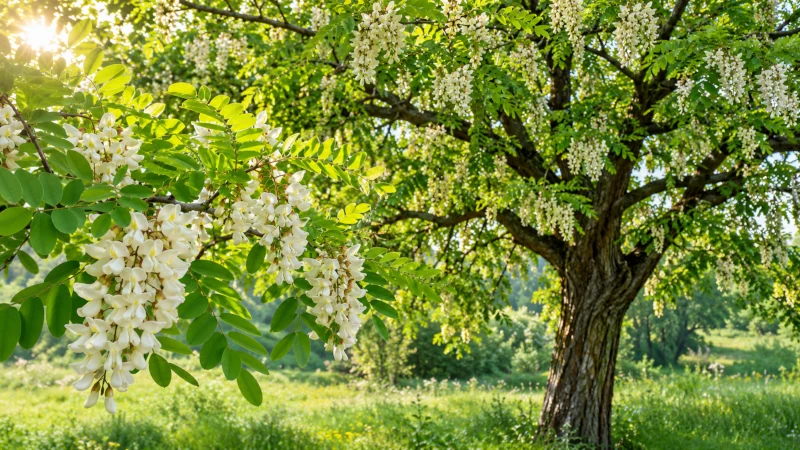
Most people meet the false acacia plant in one of two ways: as the pale, mild “acacia honey” on a supermarket shelf, or as a thorny street tree with drooping white flowers. Also called black locust (Robinia pseudoacacia), it has a long folk reputation for soothing heartburn, indigestion and sore throats. That reputation has never been tested in people. What is well documented is that the tree’s bark, leaves and seeds are poisonous, and that children who chew the sweet-tasting bark can become seriously ill. If you want something good from this tree, the honey is the safe, well-understood choice.
What is the false acacia plant?
Despite the name, false acacia is not an acacia. It belongs to the pea and bean family (Fabaceae), and its native range is the eastern and central United States [Kew, n.d.]. It has been planted across Europe and much of the temperate world for timber, erosion control and bee forage, and it spreads aggressively from seed and root suckers [Kew, n.d.]. NC State Extension notes it has become invasive in the Midwestern United States [NC State Extension, n.d.].
| Quick facts | |
| Scientific name | Robinia pseudoacacia L. |
| Common names | False acacia, black locust; robinier faux-acacia (French); acacia blanca (Spanish) |
| Family | Fabaceae (pea and bean family) |
| Native range | Eastern and central United States |
| Size | Usually 30–50 feet tall [NC State Extension, n.d.]; up to about 25 m (82 ft) [Kew, n.d.] |
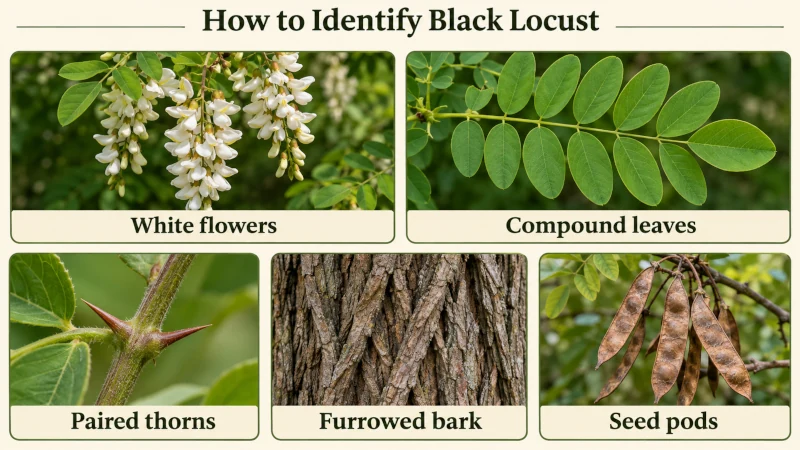
| Flowers | Fragrant, white, pea-like flowers in hanging clusters, April to June |
| Thorns | Short paired spines on young branches and suckers |
| Poisonous parts | Bark, leaves and seeds [NC State Extension, n.d.] |
The genus name honors Jean Robin and his son Vespasien, gardeners to the French royal court. The traditional date for the tree’s arrival in Paris is 1601, but accounts differ on who planted it: Kew credits Vespasien [Kew, n.d.], while the New York Botanical Garden credits Jean [NYBG, n.d.]. Either way, it was one of the first North American trees grown in Europe.
Traditional uses of false acacia
In folk medicine, especially in Asia, the plant has been used as a diuretic, anti-inflammatory, antispasmodic and sedative remedy [Uzelac et al., 2023]. Some popular herbal guides go further and recommend a tea of the flowers for heartburn, indigestion, ulcers and gallbladder complaints, or as a gargle for a sore throat [Pamplona-Roger, 2000 — UNVERIFIED]. Older herbal language describes the flowers as promoting bile flow, the same idea behind the “cholagogue” herbs covered in our evidence-ranked guide to herbs for the gallbladder and liver.
Those are traditional uses. We could not find any clinical trial in people that tested false acacia flowers or leaves for any of them.
What the research shows (and doesn’t)
The lab work is real, but it is early. A 2023 Croatian study identified 64 phenolic compounds in false acacia leaf and flower extracts, with flavonols and hydroxycinnamic acids the most common, and tested the extracts against bacteria and fungi in the lab. The authors called their results a first step toward possible pharmaceutical use [Uzelac et al., 2023]. A small Korean lab study found a flower extract had antioxidant activity, slowed blood clotting in plasma, and inhibited α-glucosidase, an enzyme involved in breaking down starch [J Appl Biol Chem, 2022].
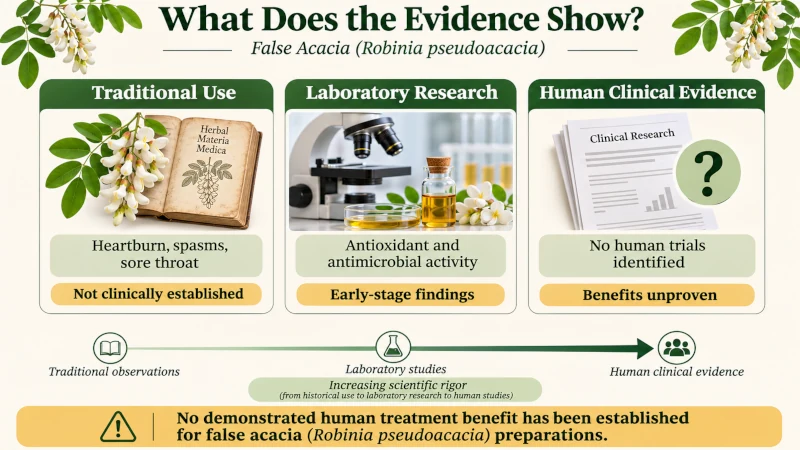
Test-tube effects like these often fail to show up in people, and none of these studies tells you what dose would be safe or useful. Here is how the claims stack up:
| Claim | Type of evidence | Where it stands |
| Soothes heartburn, esophagitis or ulcers | Traditional use only | Not established in people |
| Eases spasms or helps bile flow | Traditional use only | Not established in people |
| Sore-throat gargle | Traditional use only | Not established in people |
| Antioxidant or antimicrobial effects | Lab (test-tube) studies of extracts | Early-stage; no human data |
| Acacia honey as a food | Composition well studied | Safe food for most people over 1 year; it is still sugar |
Acacia honey: the part most people actually eat
Most honey sold as “acacia honey” in Europe and North America is made from false acacia nectar, not from true acacia trees. Kew describes the flowers as a nectar source that yields a high-quality honey gathered on both continents [Kew, n.d.].
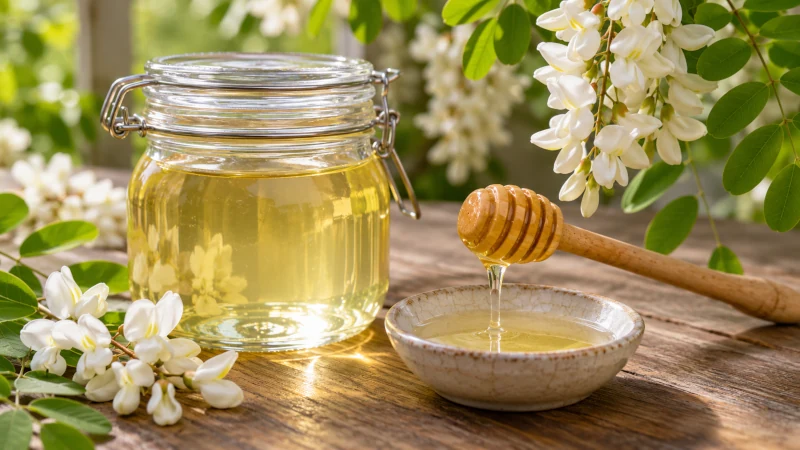
It is pale, mild and stays liquid for a long time. That is down to its sugar mix: a Hungarian analysis measured a fructose-to-glucose ratio of 1.58 in robinia honey, higher than in the milkweed honey it was compared with [Kasper-Szél et al., 2003]. Romanian researchers found the flavonoid acacetin only in robinia honey and proposed it as a marker of its botanical origin, at about 1.2 mg per kilogram [Bobiş et al., 2021]. That is a fingerprint for authenticity testing, not a meaningful dose of anything.
Nutritionally, acacia honey behaves like other honey. Use it as a sweetener rather than a remedy. Our guide to the health benefits of honey covers what the evidence supports, such as soothing a cough, and what it doesn’t. Never give any honey, acacia included, to a baby younger than 12 months, because it can cause infant botulism [CDC, 2026].
Is the false acacia plant poisonous?
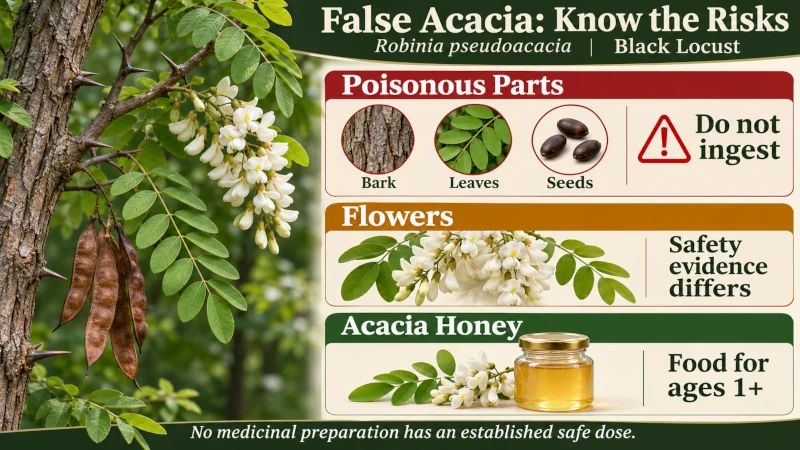
Yes. NC State Extension rates its poison severity as high and lists the bark, leaves and seeds as poisonous. Its toxic principles include robin (a plant protein toxin), robitin and robinine [NC State Extension, n.d.]. Robin and a related protein, phasin, belong to a class called toxalbumins, which stop cells from making proteins and can kill them [Poison Control, n.d.].
The bark is the usual culprit, partly because it tastes sweet; one older agricultural account compares the flavor to licorice [Royce, 1965]. The case reports follow a pattern. In 1886, 32 boys at a Brooklyn orphanage fell ill after chewing the inner bark [Emery, 1887]. In Spain, six schoolgirls became sick after sucking or chewing bark in a schoolyard, and all recovered [Artero Sivera et al., 1989]; in another Spanish report, three of seven poisoned boys developed neurological symptoms, including coma [Costa Bou et al., 1990]. Poison Control describes an 8-year-old who chewed a hand-sized piece of bark, vomited five times, had a raised liver enzyme and went home on day five [Poison Control, n.d.].
Livestock are at risk too, horses especially. A USDA fact sheet advises against tying horses to black locust trees [USDA NRCS, 2006].
Symptoms of poisoning
According to Poison Control, the most common symptoms after swallowing part of the tree are nausea, vomiting, weakness, flushing and lethargy. Most stomach symptoms start within six hours. Larger amounts, or more thorough chewing, can cause dilated pupils, a weak or irregular pulse, fever, fast heartbeat and breathing, agitation and seizures, and in severe cases paralysis, coma, bleeding in the gut, and liver or kidney damage [Poison Control, n.d.].
What about the flowers?
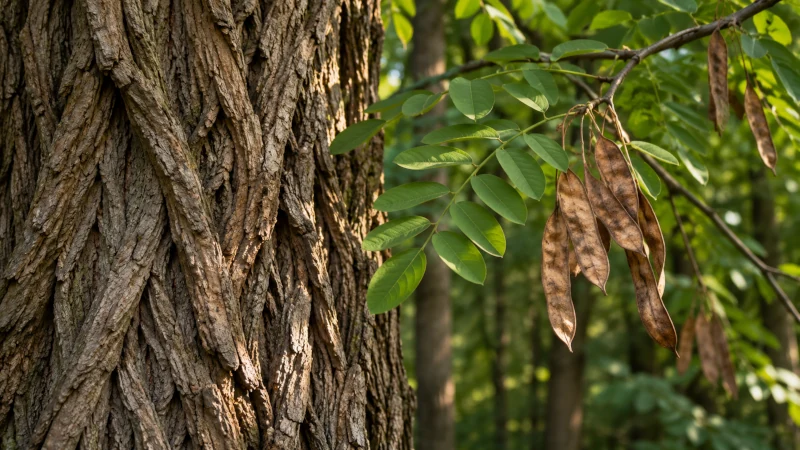
This is where trustworthy sources disagree. NC State lists the flowers as edible [NC State Extension, n.d.], and Poison Control says they appear nontoxic or substantially less toxic than the rest of the tree [Poison Control, n.d.]. In parts of Europe the blossoms are battered and fried as fritters. But the USDA grazing fact sheet lists the flowers among the poisonous parts for livestock [USDA NRCS, 2006]. “Less toxic” is not the same as “safe in any amount,” and nobody has established a safe medicinal dose.
The thorns
A thorn puncture usually causes only local pain, swelling and rash, but a few more serious outcomes have been reported [Poison Control, n.d.]. In one case, a timber worker developed extensive tissue death and a dangerous soft-tissue infection in his forearm after a black locust wood fragment pierced his skin [Browne et al., 2020].
Gum arabic comes from a different tree
Gum arabic, also called acacia gum, is often mentioned alongside false acacia, but it comes from true acacias, mainly Acacia senegal and Acacia seyal [EFSA, 2017]. It is a dried sap from the stems and branches and is used widely as a food additive (E 414). In its 2017 review, the European Food Safety Authority found no safety concern at reported uses. Adults tolerated up to 30 grams a day for up to 18 days, though some had flatulence [EFSA, 2017]. It is a useful ingredient, but it says nothing about the safety of false acacia bark, leaves or tea.
Should you make false acacia tea?
We don’t recommend it as a remedy. There is no tested dose and no clinical evidence of benefit, and a handful of picked “flowers” can easily include leaves, stalks or young pods.
If heartburn or an upset stomach is the reason you’re looking, better-studied options exist. Our guide to herbs for stomach issues sorts the few with real evidence from the many maybes, and foods to eat with gastritis explains gentler eating while the cause is treated. Burning that keeps coming back deserves a doctor’s visit, not a stronger tea.
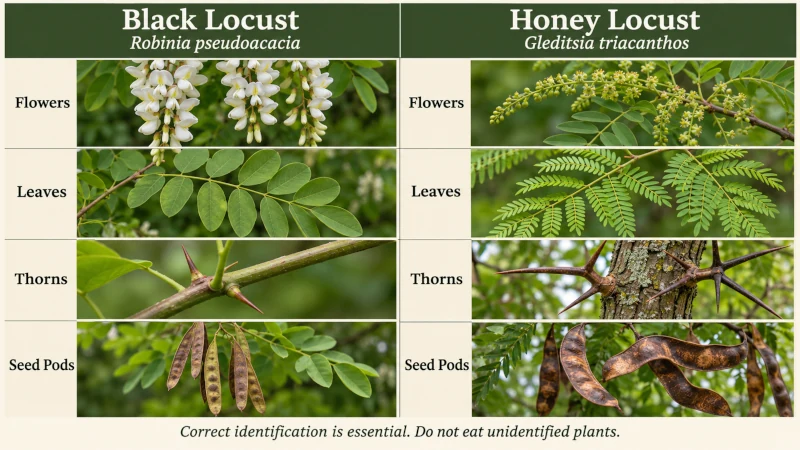
If you forage the blossoms for cooking, be certain of the tree (it is often confused with honey locust, Gleditsia triacanthos) [NC State Extension, n.d.]. Use only fresh flowers stripped from their stems, keep portions to ordinary food amounts, and never use the bark, leaves, seeds or pods.
Who should avoid false acacia
- Children. Most human poisonings involve kids chewing bark or seeds. Teach children not to chew twigs, bark or pods, and know which trees grow near your home and school [Poison Control, n.d.].
- Pregnant or breastfeeding people. There are no safety data for any medicinal use. Skip it.
- People on blood thinners or antiplatelet drugs. One lab study found a flower extract slowed clotting in plasma [J Appl Biol Chem, 2022]. Whether that matters in people is unknown, and no human interaction studies exist, so ask a pharmacist before using any false acacia preparation.
- People with liver or kidney disease. Poisoning can damage both organs [Poison Control, n.d.].
- Anyone allergic to honey or bee products. Acacia honey is still honey.
- Horses and other animals. Keep livestock away from trees, sprouts and fallen pods [USDA NRCS, 2006].
When to get help
If someone chews or swallows any part of the bark, seeds, pods, leaves or roots, contact Poison Control right away, even if they seem fine: call 1-800-222-1222 in the US or use the webPOISONCONTROL online tool [Poison Control, n.d.]. Don’t try to make the person vomit [Poison Control, n.d.].
Call 911 immediately if the person collapses, has a seizure, has trouble breathing or can’t be woken [Poison Control, n.d.].
See a doctor promptly for a thorn or wood puncture that becomes increasingly painful, swollen or red, or is accompanied by fever [Browne et al., 2020].
| HEALTH DISCLAIMER: This article is for general education only and is not medical advice. False acacia (black locust) bark, leaves and seeds are poisonous, and no medicinal use of the flowers or leaves has been tested in people. Do not use any part of the plant to treat heartburn, ulcers, gallbladder problems or any other condition, and do not stop or change prescribed treatment because of what you read here. If you are pregnant or breastfeeding, take blood thinners or other prescription medicines, or have liver or kidney disease, talk to your doctor or pharmacist before using any herbal product. If anyone swallows part of this tree, call Poison Control at 1-800-222-1222; for seizures, collapse or trouble breathing, call 911. |
Frequently Asked Questions
Is false acacia the same as acacia?
No. False acacia (Robinia pseudoacacia) is in the pea family and comes from North America [Kew, n.d.]. True acacias are a different group of trees; gum arabic comes from them, mainly Acacia senegal and Acacia seyal [EFSA, 2017]. Most “acacia honey,” confusingly, comes from false acacia.
Can you eat false acacia flowers?
They are eaten as fritters in parts of Europe, and NC State lists them as edible [NC State Extension, n.d.]. Poison Control calls them nontoxic or much less toxic than the rest of the tree [Poison Control, n.d.], while a USDA livestock fact sheet lists them as poisonous [USDA NRCS, 2006]. If you try them, keep to food amounts, be sure of the tree, and never eat bark, leaves, seeds or pods.
Is acacia honey healthier than regular honey?
There’s no good evidence that it is. It is mild, stays liquid longer because of its high fructose share [Kasper-Szél et al., 2003], and carries tiny amounts of flavonoids such as acacetin [Bobiş et al., 2021]. It is still mostly sugar, and no honey should be given to babies under 12 months [CDC, 2026].
What happens if a child chews black locust bark?
Typical symptoms are nausea, vomiting, weakness and flushing, usually within six hours; larger amounts can cause seizures and other serious effects [Poison Control, n.d.]. Call Poison Control at 1-800-222-1222 right away, and call 911 for a seizure, collapse or trouble breathing [Poison Control, n.d.].
Does false acacia tea help heartburn or ulcers?
Some herbal guides claim it does, but no study in people has tested it. Ulcers and persistent heartburn need a proper diagnosis. See our guide to herbs for stomach issues for options with real evidence.
References
- Royal Botanic Gardens, Kew. Plants of the World Online: Robinia pseudoacacia L. — General information (Kew Species Profiles). → View source
- N.C. Cooperative Extension. North Carolina Extension Gardener Plant Toolbox: Robinia pseudoacacia. → View source
- Yee K. Are black locust trees toxic? Poison Control, National Capital Poison Center. → View source
- Poison Control, National Capital Poison Center. First aid guidelines. → View source
- USDA Natural Resources Conservation Service, Illinois. Black Locust — Illinois Grazing Manual fact sheet (Poisonous Plants). → View source
- Uzelac M, Sladonja B, Šola I, et al. Invasive alien species as a potential source of phytopharmaceuticals: phenolic composition and antimicrobial and cytotoxic activity of Robinia pseudoacacia L. leaf and flower extracts. Plants. → View source
- Biological activities of ethanolic extract from Robinia pseudoacacia L. flower. J Appl Biol Chem. → View source
- Kasper-Szél Zs, Amtmann M, Takáts A, Kardos-Neumann Á. A comparative analysis of Hungarian robinia and milkweed honeys based on their chemical and physical characteristics. → View source
- Bobiş O, Bonta V, Cornea-Cipcigan M, Nayik GA, Dezmirean DS. Bioactive molecules for discriminating Robinia and Helianthus honey: HPLC–ESI–MS polyphenolic profile and physicochemical determinations. Molecules. → View source
- EFSA Panel on Food Additives and Nutrient Sources added to Food (ANS). Re-evaluation of acacia gum (E 414) as a food additive. → View source
- Emery ZT. Report of thirty-two cases of poisoning by locust bark. → View source
- Artero Sivera A, Arnedo Pena A, Pastor Cubo A. Estudio clínico-epidemiológico de una intoxicación accidental por Robinia pseudoacacia L. en escolares. → View source
- Costa Bou X, Soler i Ros JM, Seculi Palacios JL. Intoxicación por Robinia pseudoacacia. → View source
- Browne DT, Aguilo-Seara G, DeFranzo A Jr. The black locust tree: toxalbumin-induced tissue necrosis of the upper extremity. → View source
- Royce RD. Robinia: the false acacia. → View source
- New York Botanical Garden, Mertz Library. Can you tell me more about the black locust tree? LibAnswers. → View source
- Centers for Disease Control and Prevention. Foods and drinks to avoid or limit. → View source


