
If you’ve landed here after reading that the chickweed plant melts fat, cleanses the blood, and cures coughs, here’s the straight version first. Chickweed (Stellaria media) is a mild, edible wild green with a long history in folk medicine — but very little of that history has been tested in people. Its dependable value is as a nutritious spring salad green and a gentle, traditional skin soother. The bigger metabolic claims come almost entirely from animal and test-tube studies, and one widely used drug-information resource states plainly that there is “no good scientific evidence” behind using chickweed for diabetes, high cholesterol, or weight loss [WebMD].
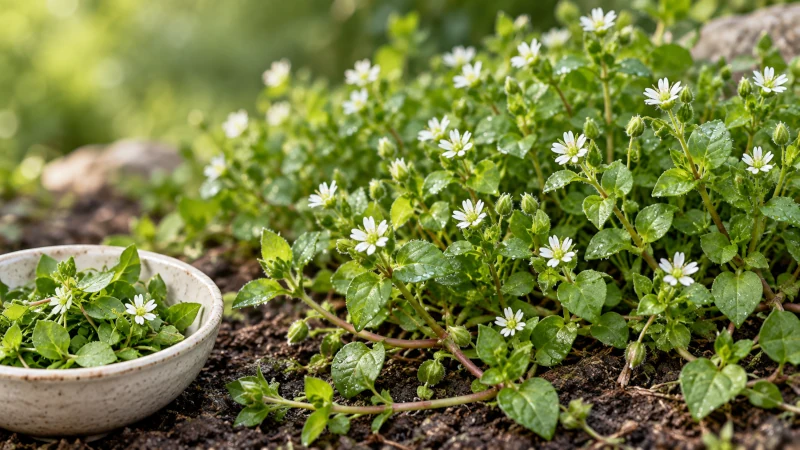
That doesn’t make the chickweed plant useless. It means the honest way to use it is as a pleasant, low-risk food and a traditional remedy — not as a treatment for anything serious. Here’s what it is, what’s in it, where the evidence is genuinely promising versus merely traditional, and how to use it without getting hurt.
What the chickweed plant is
Chickweed is a low, sprawling annual in the Caryophyllaceae family — the same botanical family as carnations and pinks [Herbal Reality]. You’ll know it by its weak trailing stems, small pointed oval leaves, and tiny white star-shaped flowers. The genus name Stellaria comes from the Latin for “star.” It grows in damp, disturbed soil almost everywhere and turns up in lawns and gardens in cool weather, which is why farmers file it under “weed.”
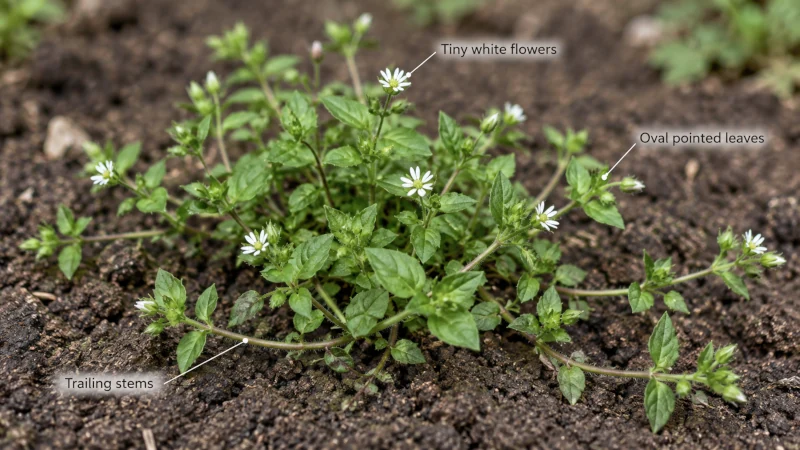
It is also genuinely good to eat. Raw or lightly cooked, chickweed tastes mild and green — closer to a garden lettuce than to a bitter or peppery weed — so foragers use the tender young stems and leaves in salads or wilt them briefly like spinach. People have eaten it as a spring green for generations, and it also appears as an infusion or topical preparation in traditional and homeopathic practice [Drugs.com, 2025].
What’s actually in chickweed
Chickweed’s reputation as a spring “tonic” green rests on a real nutrient profile — though the amounts swing with where and when it’s picked, and cooking or drying lowers some of them. Reported constituents include:
- Vitamin C. One natural-products database cites roughly 375 mg per 100 g in the fresh plant, while other summaries describe only small amounts — a good reminder that figures for wild greens vary widely [Drugs.com, 2025]; [WebMD].
- Flavonoids such as rutin and quercetin, plus carotenoids [Drugs.com, 2025]; [WebMD].
- Minerals including calcium, iron, phosphorus, and zinc [Singh et al., 2022].
- Saponins — soap-like compounds that foam in water. These are most often credited for chickweed’s soothing, coating effect on skin and mucous membranes [Herbal Reality]; [Drugs.com, 2025].
Two caveats keep this in perspective. “Contains vitamin C and minerals” is true of most leafy greens and doesn’t make chickweed a medicine. And those same saponins are part of why very large intakes can irritate the gut, which matters for the safety section below.
What the evidence actually shows
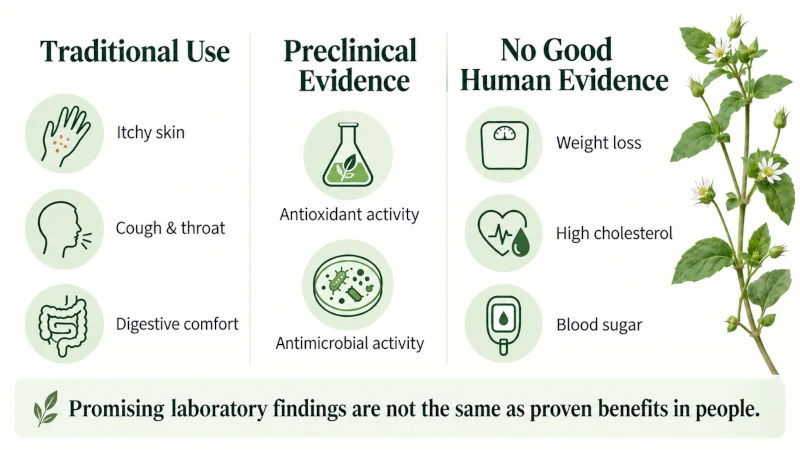
The gap between “traditional use” and “proven in people” is unusually wide for this plant, so it’s worth grading each claim rather than lumping them together.
| Use | What’s often claimed | What the evidence actually is |
| Soothing itchy, irritated skin (eczema, rashes, itching) | Topical relief | Traditional. Herbalists call it “specific for the relief of itching,” but this rests on practitioner experience, not controlled human trials. |
| Coughs, sore throat, chest irritation | Expectorant / demulcent | Traditional. Soothing demulcent use for “hot, dry, irritated” coughs; no human trials. |
| Digestive comfort | Emollient, mild laxative | Traditional. Long-standing folk use; not tested in people. |
| Weight loss / lowering blood fats | “Burns fat,” “lowers cholesterol” | Animal-only / insufficient. Effects appear in animal studies; WebMD says there is no good human evidence for obesity or high cholesterol. |
| Blood sugar / diabetes | “Anti-diabetic” | Animal-only / insufficient. Lab and animal signals only; no good human evidence. |
| Antimicrobial / antioxidant “tonic” | Broad immune or detox benefit | Preclinical. Test-tube findings not shown to treat disease in people. |
The pattern is consistent across every source I checked. Chickweed shows interesting activity in animals and test tubes, holds real traditional standing as a topical skin soother, and has essentially no controlled human trials behind any medicinal claim. A 2022 review in the Journal of HerbMed Pharmacology that pulled together its pharmacology drew on experimental animal models, not people [Singh et al., 2022]. Drugs.com is blunter still: most of the scientific literature on chickweed is actually about controlling it as a weed, and “there is no recent published clinical evidence to guide dosage” [Drugs.com, 2025].
The practical takeaway: enjoy it as food, and it’s reasonable to try it topically for minor itching. Don’t lean on it for cholesterol, blood sugar, or weight — and if you’re reading about “herbs for the chest,” the same honest grading applies to the whole category, which is worth understanding before you substitute any plant for real treatment (a look at the evidence for respiratory herbs covers this well).
How people use chickweed, with realistic expectations
As a food
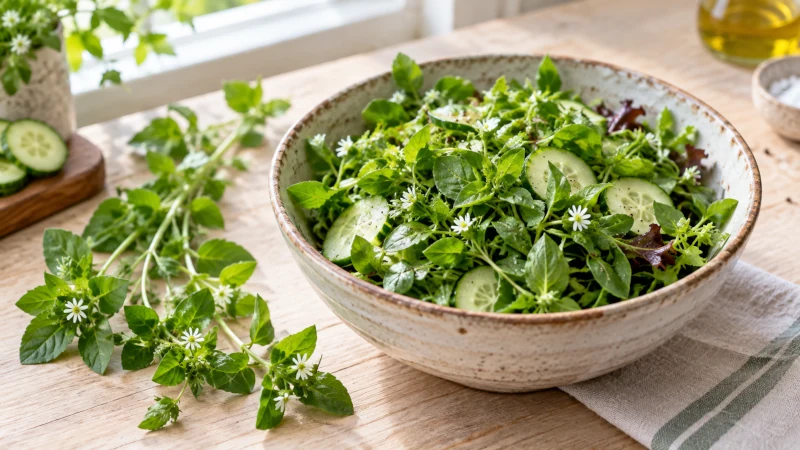
Tender young leaves and stems, raw in salads or briefly wilted into cooked dishes. This is the use with the least risk and the clearest logic — you’re eating a nutritious green rich in vitamin C, not dosing a drug.
As a tea or infusion
Chickweed is traditionally steeped and sipped for a soothing effect on the throat or digestive tract. If you find it comforting the way you might a demulcent food when your stomach is off — a role gentle foods can play in something like gastritis — that’s a reasonable use. Expect mild comfort at most, not a cure.
On the skin
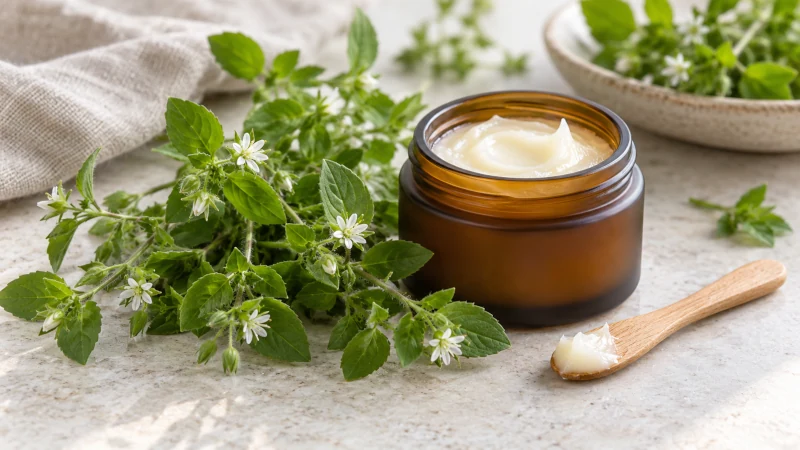
Fresh crushed plant, a cooled infusion added to a bath, or a chickweed cream or ointment, used traditionally for itchy, irritated skin. It sits among the gentler options in the wider world of herbs for skin, though, like most of them, its support is traditional rather than trial-tested. Patch-test any preparation first (see safety, below).
A note on “doses”
You’ll find very precise-sounding instructions online — so many grains, so many capsules, so many ounces of tea a day. There is no reliable evidence base for a medicinal dose of chickweed; both WebMD and Drugs.com state that an appropriate dose simply isn’t known [WebMD]; [Drugs.com, 2025]. Treat ordinary food amounts as the sensible default, and be skeptical of any source urging high “therapeutic” doses.
Safety, side effects, and who should be careful
Eaten as a food, chickweed is low-risk for most people. The cautions mostly attach to concentrated or high-dose use.
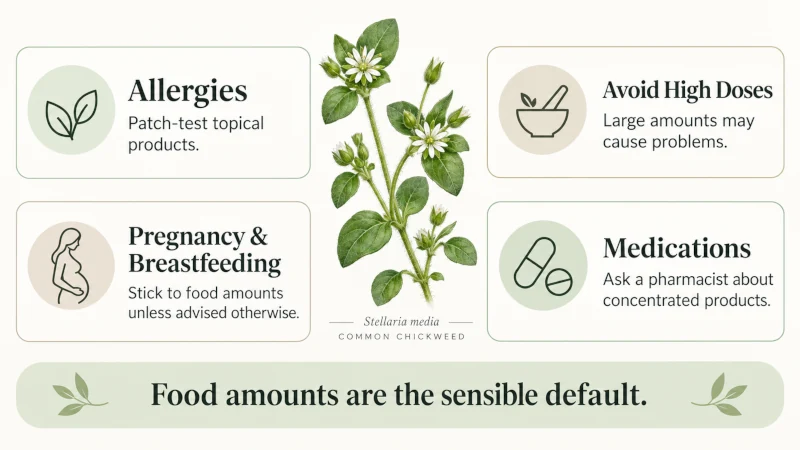
- Allergy. Some people react to chickweed, particularly anyone sensitive to other Caryophyllaceae plants. Stop if you notice rash, hives, or swelling, and patch-test any topical preparation on a small area first [WebMD]; [Herbal Reality].
- Large amounts can backfire. High intakes may cause stomach upset, and paralysis has been reported after eating very large quantities of the plant [Herbal Reality]; [Drugs.com, 2025]. This flatly contradicts the folk claim that chickweed is “safe in any dose” — with this plant, more is not better.
- Nitrates. Chickweed can accumulate nitrate, and nitrate poisoning has been documented in grazing animals that ate large amounts [Drugs.com, 2025]. One more reason to keep to normal food quantities.
- Pregnancy and breastfeeding. There isn’t enough reliable information to consider medicinal amounts safe; the standard advice is to stick to food amounts. Sources genuinely disagree beyond that, so the responsible move is to avoid concentrated preparations and ask your clinician [WebMD]; [Herbal Reality].
- Medication interactions. No interactions are well documented [Drugs.com, 2025]. “Not documented” isn’t the same as “proven safe,” so if you take prescription medicines — especially for diabetes or blood pressure — check with a pharmacist before using concentrated chickweed products.
- Who should be most cautious. Pregnant or breastfeeding people, young children, anyone with a known plant allergy, and anyone tempted to use chickweed in place of prescribed treatment for a real condition.
When to see a healthcare professional
Chickweed is, at most, for minor and self-limited things. Choose medical care over an herb if you have:
- Signs of an allergic reaction — swelling of the lips, tongue, or throat, difficulty breathing, or widespread hives. This is an emergency; call your local emergency number.
- A skin problem that’s spreading, blistering, oozing, or looks infected — warmth, pus, red streaks, or fever alongside the rash.
- A cough lasting more than about three weeks, or any coughing up of blood, breathlessness, chest pain, or wheezing.
- Diabetes, high cholesterol, or heart disease you’re thinking of managing with chickweed instead of your prescribed treatment. Talk to your clinician first. Swapping proven treatment for an unproven herb is the real hazard here — far more than the plant itself.
| Health disclaimer: This article is for general education and information only. It is not medical advice and is not a substitute for diagnosis or treatment from a qualified healthcare professional. Chickweed has little human research behind its medicinal uses, and individual circumstances differ. If you are pregnant or breastfeeding, give it to a child, take prescription medication, or have an ongoing medical condition, talk with your doctor, pharmacist, or a qualified medical herbalist before using chickweed as anything more than a food. If you have symptoms of a serious illness or an allergic reaction, seek medical care promptly. |
Frequently Asked Questions
Is the chickweed plant safe to eat?
For most people, yes — in ordinary food amounts. Young chickweed leaves and stems are a mild, edible green. The cautions are for concentrated or very high-dose use, which can upset the stomach and, in very large quantities, has been linked to more serious effects [Drugs.com, 2025]. Patch-test before using it on skin if you have plant allergies.
Does chickweed help you lose weight or lower cholesterol?
There’s no good human evidence for either. The anti-obesity and lipid-lowering effects you’ll read about come from animal studies, and WebMD states there is no good scientific evidence for using chickweed for obesity or high cholesterol [WebMD]; [Singh et al., 2022]. Treat it as a nutritious green, not a weight or cholesterol treatment.
Can chickweed soothe itchy skin?
Traditionally, yes — herbalists have long used it topically for itching and irritation, and it’s sometimes described as “specific for the relief of itching” [Herbal Reality]. That reputation rests on practitioner experience rather than controlled trials, so keep expectations modest and patch-test first. See a clinician if a rash is spreading, oozing, or looks infected.
How much chickweed should I take?
There’s no established medicinal dose. Both WebMD and Drugs.com say the appropriate dose isn’t known, so any precise “grains and capsules” figure you see online isn’t backed by evidence [WebMD]; [Drugs.com, 2025]. Food amounts are the sensible default.
Is chickweed safe during pregnancy or breastfeeding?
There isn’t enough reliable information to call medicinal amounts safe, and sources disagree, so the standard advice is to stick to food amounts and avoid concentrated preparations unless your clinician okays it [WebMD]; [Herbal Reality].
Does chickweed interact with medications?
No interactions are well documented [Drugs.com, 2025] — but that reflects a lack of study rather than proof of safety. If you take medicines for diabetes or blood pressure, check with a pharmacist before using concentrated chickweed products.
References
- WebMD. Chickweed. WebMD Vitamins & Supplements. View source
- Drugs.com. Chickweed. Natural Products database, updated November 10, 2025. View source
- Singh R, Chaudhary M, Chauhan ES. Stellaria media Linn.: A comprehensive review highlights the nutritional, phytochemistry, and pharmacological activities. Journal of HerbMed Pharmacology. 2022;11(3):330–338. DOI: 10.34172/jhp.2022.38. View source
- Herbal Reality. Chickweed (Stellaria media). View source


