
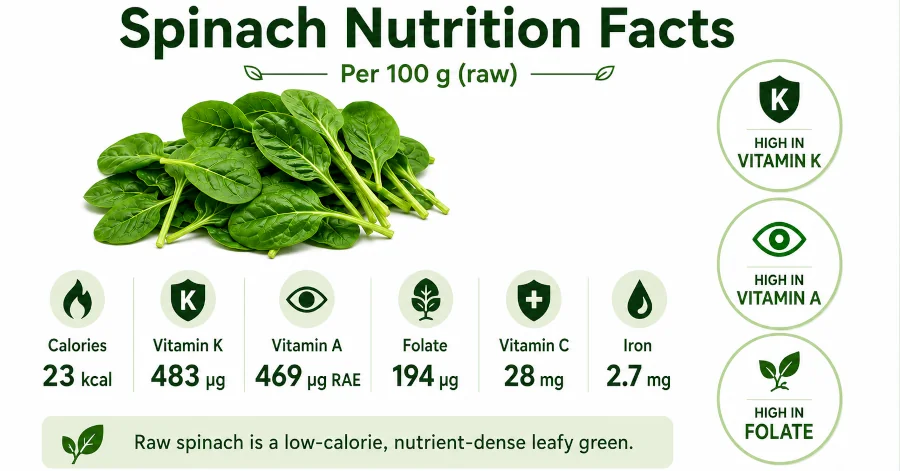
The spinach health benefits worth your attention come down to a short list of nutrients it carries in unusually high amounts: vitamin K, folate, the eye-protecting pigments lutein and zeaxanthin, plus useful magnesium and potassium — all for about 23 calories per 100 grams. [USDA FoodData Central, 2022] That density is real.
But a few of the claims spinach is famous for — that it floods you with iron, cures anemia, or saves your eyesight by itself — are either overstated or only loosely supported. Below, the strong evidence is separated from the weak, with two situations flagged where spinach genuinely calls for care: if you take a blood thinner, or if you’re prone to kidney stones.
Spinach nutrition at a glance
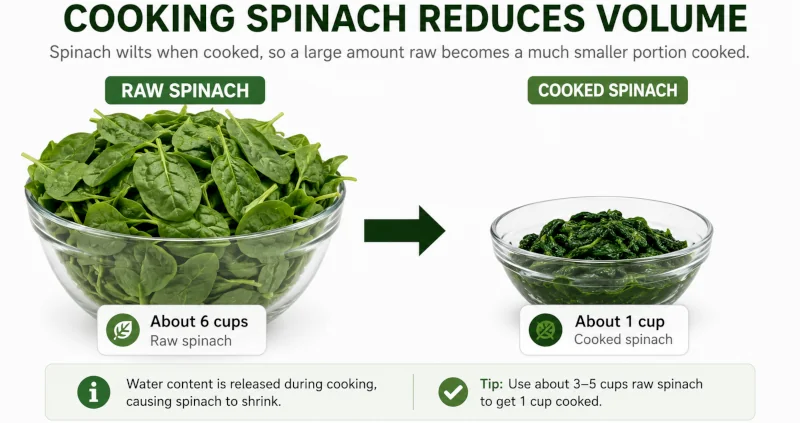
Most of spinach’s reputation rests on what a serving actually delivers. The figures below are for 100 grams of raw spinach — roughly three loosely packed cups. A single raw cup is only about 30 grams, so real-world portions are smaller than the headline numbers suggest. Cooked spinach is the opposite: it wilts to a fraction of its volume, so a cooked cup concentrates far more of everything.
| Nutrient | Per 100 g (raw) | % Daily Value |
| Calories | 23 kcal | — |
| Vitamin K | 483 mcg | ~400% |
| Vitamin A | 469 mcg RAE | ~52% |
| Folate (B9) | 194 mcg | ~48% |
| Vitamin C | 28 mg | ~31% |
| Magnesium | 79 mg | ~19% |
| Iron | 2.7 mg | ~15% |
| Potassium | 558 mg | ~12% |
| Calcium | 99 mg | ~8% |
| Fiber | 2.2 g | ~8% |
| Protein | 2.9 g | — |
Daily Values use FDA reference intakes for adults; nutrient amounts are from USDA FoodData Central for raw spinach. The standout is vitamin K, which matters for anyone on a blood thinner — more on that below.
What spinach is actually good for
Eye health: lutein and zeaxanthin
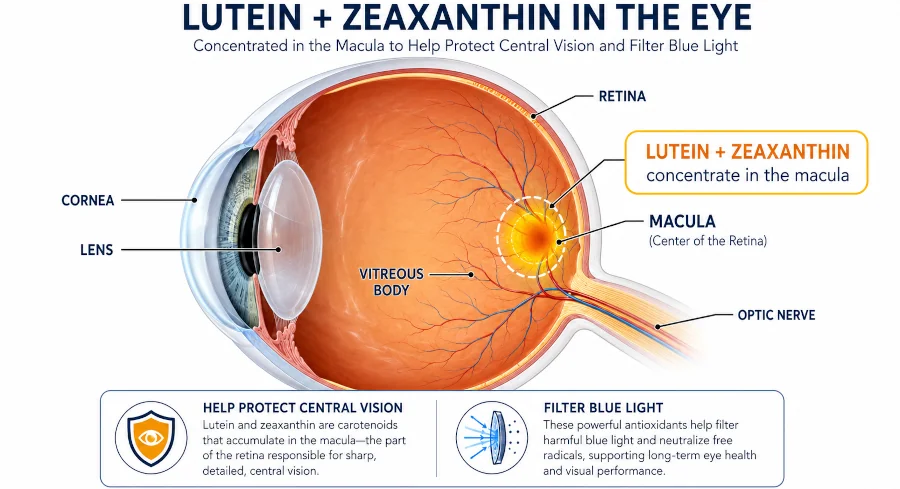
Spinach is one of the richest dietary sources of lutein and zeaxanthin, two carotenoids that gather in the macula — the part of the retina behind sharp central vision. The strongest clinical evidence for these pigments comes from AREDS2, a five-year trial run by the National Eye Institute. Substituting 10 mg of lutein and 2 mg of zeaxanthin into an antioxidant supplement lowered the risk of advanced age-related macular degeneration (AMD) progressing by about 26% compared with the older beta-carotene formula. [NEI, 2022]
Two details change how you should read that. The trial used concentrated supplements, not bowls of spinach. And it enrolled people who already had intermediate or advanced AMD — it did not show that the formula stops AMD from starting. [AREDS2 Research Group, 2013] Population studies do link diets high in lutein and zeaxanthin with lower long-term AMD risk, which is a fair reason to eat greens often. Just don’t expect spinach to act like a drug. The story for carrots is much the same: helpful within a varied diet, not a cure.
Folate and pregnancy
A 100-gram serving supplies roughly 194 micrograms of folate, the natural form of vitamin B9. [USDA FoodData Central, 2022] Folate is critical in the first weeks of pregnancy, when adequate levels help the neural tube close and lower the risk of defects such as spina bifida.
Here is the part that gets lost. The CDC is explicit that folic acid — the synthetic form in supplements and fortified foods — is the only form proven to prevent neural tube defects, and that most people can’t reliably reach the protective amount from food folate alone. [CDC, 2024] The recommendation for anyone who could become pregnant is 400 micrograms of folic acid daily, before and during early pregnancy. [CDC, 2025] So eat spinach for its folate and everything else it brings, but treat it as a supporting player — not a replacement for a prenatal or folic-acid supplement.
Iron and the Popeye myth
Popeye made spinach a byword for iron, and it does hold a respectable 2.7 mg per 100 grams. [USDA FoodData Central, 2022] The catch is absorption. Spinach iron is non-heme iron, the plant form your body takes up far less efficiently than the iron in meat — and spinach’s own oxalates and polyphenols bind to it, pulling absorption lower still. [Cleveland Clinic, 2024]
Pairing spinach with a source of vitamin C — tomatoes, peppers, citrus — measurably improves how much non-heme iron you absorb. What spinach won’t do is reverse iron-deficiency anemia on its own, and the old claim that it out-irons steak doesn’t survive the bioavailability data. Count it as one contributor to iron intake, not a treatment.
Heart health and blood pressure
Leafy greens are high in dietary nitrate, which the body converts into nitric oxide — a molecule that relaxes blood vessels. Short, acute studies have measured small drops in blood pressure and arterial stiffness within hours of a nitrate-rich spinach meal. The longer-term human evidence is weaker. In a 2020 randomized trial of 243 adults with elevated blood pressure, five weeks of leafy-green vegetables (or matched nitrate pills) produced no significant change in 24-hour blood pressure versus placebo. [Sundqvist et al., 2020]
Animal studies have also hinted that spinach compounds might curb cholesterol absorption, but that hasn’t been confirmed in people, so it stays in the early-evidence column. The honest read: spinach fits a heart-friendly, vegetable-heavy eating pattern, and its potassium and magnesium support normal blood pressure — but it is not a dependable stand-alone way to lower a high reading. If blood pressure or cholesterol is a concern, checking your numbers and working with a clinician beats leaning on any single food.
Fiber, fullness, and everyday nutrition
Set the headline nutrients aside and spinach is still an efficient way to eat more vegetables. It’s low in calories, adds insoluble fiber that helps keep digestion regular, and brings magnesium and potassium that many diets run short on. Because cooked spinach shrinks so much, it’s easy to fold a large amount into eggs, soup, or pasta without really noticing it.
What to realistically expect
Spinach is a genuinely nutrient-dense vegetable that supports eye, heart, and overall health as part of a varied diet. It is not a treatment for any condition, and the more dramatic claims — curing anemia, preventing blindness, melting away cholesterol — run ahead of what the human evidence shows.
The oxalate question (kidney stones)
Spinach is among the highest-oxalate foods there is: a half-cup of cooked spinach holds roughly 755 mg of oxalate. [Cleveland Clinic, 2024] Oxalate binds calcium and, in susceptible people, can feed the most common type of kidney stone — calcium oxalate. For most people with healthy kidneys this is no reason to avoid spinach; the body clears oxalate without trouble.
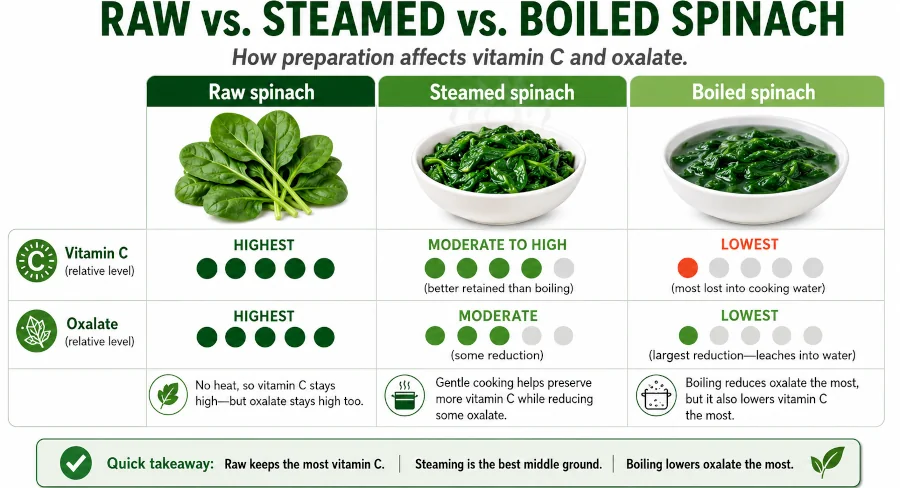
If you’ve had calcium-oxalate stones, the usual advice is to limit high-oxalate foods, pair them with a calcium source so the oxalate binds in the gut rather than the urine, and stay well hydrated. The same thinking applies to foods linked to kidney stones more broadly, and to gout, where both purines and oxalates can matter. Cooking spinach and discarding the water lowers its oxalate load somewhat — along with some of the water-soluble vitamins.
Spinach and blood thinners
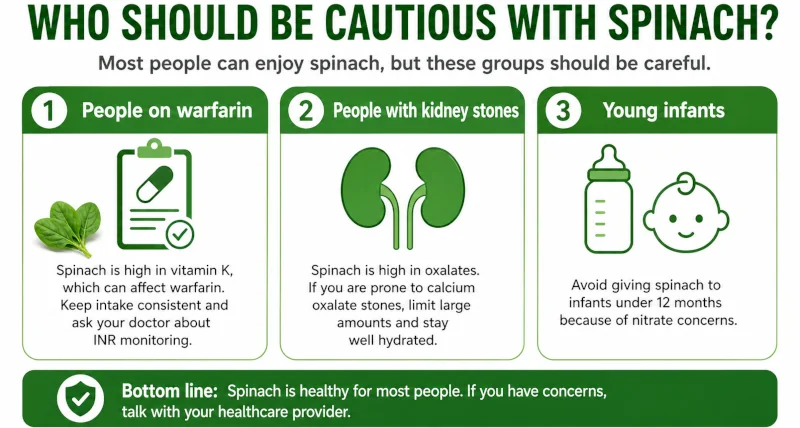
This is the caution that surprises people. A single 100-gram serving delivers roughly 480 micrograms of vitamin K — several times the daily target of 90–120 micrograms for adults. [NIH ODS, 2021] Vitamin K helps blood clot, which puts it in direct tension with warfarin (Coumadin) and other vitamin-K-antagonist blood thinners.
The goal for someone on warfarin isn’t to avoid spinach — it’s to keep vitamin K intake steady from day to day. Sudden swings (a big spinach salad one week, none the next) can push the INR out of range and change how well the drug works. [NIH ODS, 2021] If you take warfarin, talk with your prescriber or pharmacist before making spinach a daily habit, and keep your greens consistent.
Who should be cautious with spinach
- People on warfarin or other vitamin-K-antagonist anticoagulants. Keep vitamin K intake consistent and check with your clinician before changing how much spinach you eat.
- Anyone with a history of calcium-oxalate kidney stones or kidney disease. You may be advised to limit high-oxalate foods, pair them with calcium, and increase fluids.
- Very young infants. Spinach is naturally high in nitrate, so it usually isn’t recommended as a large or first food for young infants, and leftovers shouldn’t be reheated and re-served to them. Ask your pediatrician.
It’s worth a conversation with a healthcare professional if you’re planning a pregnancy, take a blood thinner, or have a personal history of kidney stones — the everyday food is fine for most people, but these situations are where the details matter.
How to get the most from spinach
- Eat it both raw and cooked. Raw spinach keeps more vitamin C and folate; cooking shrinks the volume, cuts some oxalate, and makes minerals like iron and calcium a little more available. Variety covers both.
- Add a little fat. Lutein, zeaxanthin, and vitamin A are fat-soluble, so a drizzle of olive oil or a few nuts helps you absorb them.
- Pair with vitamin C for iron. Tomatoes, peppers, lemon, or citrus alongside spinach improve non-heme iron uptake.
- Steam rather than boil for nutrients — boil and drain if you’re cutting oxalate. Discarding the cooking water removes oxalate but also some water-soluble vitamins, so let your goal decide the method.
| Health Disclaimer: This article is for general education and is not medical advice. It is not a substitute for diagnosis, treatment, or guidance from a qualified healthcare professional. Spinach is a food, not a remedy for any disease. If you take a blood thinner such as warfarin, have a history of kidney stones or kidney disease, are pregnant or planning a pregnancy, or have any ongoing medical condition, talk with your doctor or pharmacist before making spinach a regular, high-volume part of your diet. |
Frequently Asked Questions
Is it better to eat spinach raw or cooked?
Neither is clearly superior — they trade off. Raw spinach holds more vitamin C and folate, while cooking lowers oxalate and slightly improves how much iron and calcium you can absorb. Eating it both ways gives you the best of each.
Can I eat spinach every day?
For most people, yes. The two reasons to be careful are practical: if you take warfarin, keep the amount consistent day to day; if you’re prone to calcium-oxalate kidney stones, watch your portions and stay hydrated.
Does spinach really build muscle like Popeye?
No. The cartoon tied spinach to instant strength through its iron, but spinach iron is poorly absorbed and the protein content is modest. It’s a healthy, low-calorie vegetable — not a muscle-building shortcut.
Is spinach safe to eat during pregnancy?
Yes, as a washed, well-handled food it’s a good source of folate, potassium, and vitamin A. It does not replace a folic-acid or prenatal supplement, which the CDC recommends for preventing neural tube defects.
Does spinach lower blood pressure?
The evidence is mixed. Short-term studies show small effects from its nitrate content, but a larger five-week trial found no significant change in blood pressure. Spinach supports a heart-healthy diet but isn’t a reliable stand-alone treatment for hypertension.
References
- U.S. Department of Agriculture, FoodData Central — Spinach, raw (nutrient data). → View source
- National Eye Institute (NIH), 2022 — NIH study confirms benefit of AREDS2 supplements (lutein/zeaxanthin) for slowing age-related macular degeneration. → View source
- AREDS2 Research Group (Chew EY, et al.), 2013 — Lutein/zeaxanthin effects on AMD progression, JAMA Ophthalmology (AREDS2 Report No. 3). → View source
- Centers for Disease Control and Prevention, 2024 — Neural Tube Defects: folic acid and prevention. → View source
- Centers for Disease Control and Prevention — Folic Acid: Facts for Clinicians (400 mcg recommendation). → View source
- NIH Office of Dietary Supplements, 2021 — Vitamin K: Fact Sheet for Health Professionals (warfarin interaction, intake consistency). → View source
- Cleveland Clinic, 2024 — Health Benefits of Spinach (oxalate, non-heme iron, vitamin C pairing). → View source
- Sundqvist ML, et al., 2020 — A randomized clinical trial of leafy green vegetables and inorganic nitrate on blood pressure, Am J Clin Nutr (DOI 10.1093/ajcn/nqaa024). → View source
