
Valerian is one of the oldest sleep herbs still sold today, and plenty of people swear it helps them drift off. The honest picture of valerian root benefits is narrower than most labels suggest. The best evidence points to a modest improvement in how well people feel they slept, not a dependable treatment for insomnia, and research on anxiety and other uses is thin [NCCIH, 2025]; [Valente, 2024]. The good news is that valerian is generally safe for short-term use by most healthy adults, which is why many people decide a careful trial is reasonable.
What valerian is (and why it smells that way)

Valerian (Valeriana officinalis) is a tall perennial with clusters of small pale flowers. It is native to Europe and Asia and now grows in North America, and the medicine comes from its roots and underground stems [NCCIH, 2025]. Dried valerian root has a pungent smell that many people find unpleasant—often compared to sweaty socks [ODS, 2013]. Cats, on the other hand, tend to love it, much as they love catnip.
People have used it for a long time. Galen prescribed valerian for insomnia in the 2nd century, 16th-century herbalists used it for nervousness and heart palpitations, and in England during World War II it was used to ease the stress of air raids [ODS, 2013].
Nobody has pinned down exactly which compound does the work. Candidates include valerenic acid and related oils and a fragile group of compounds called valepotriates, which break down during storage. Lab studies suggest valerian may increase the activity of GABA, the brain’s main calming messenger, but its effects probably come from several constituents acting together [ODS, 2013].
Valerian root benefits: how strong is the evidence?
Here is how the main claimed uses hold up.
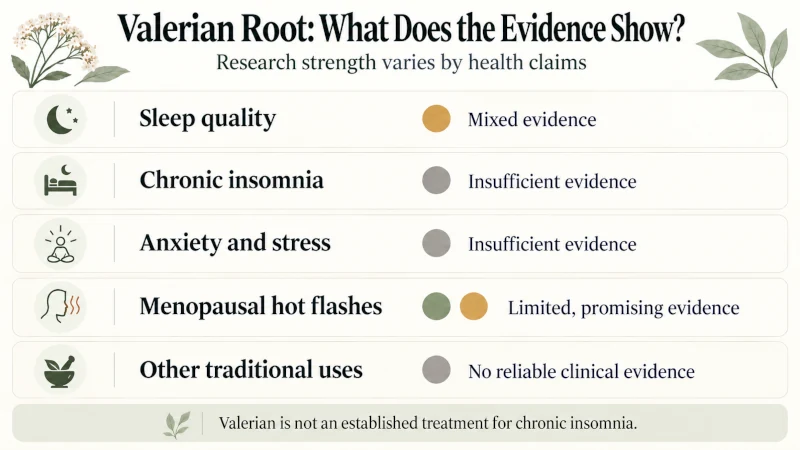
| Use | What the research shows | Evidence |
| Sleep quality (how rested you feel) | Some reviews find people report better sleep; objective sleep measures have not confirmed it | Mixed |
| Chronic insomnia | US sleep guideline recommends against it; a 2024 umbrella review found no evidence it treats insomnia | Insufficient |
| Anxiety | A Cochrane review found only one small trial | Insufficient |
| Menopausal hot flashes | A few small trials report fewer and milder hot flashes | Limited, promising |
| Menstrual cramps, PMS, depression, stress | Not enough research to say | Insufficient |
| Epilepsy, asthma, pain, high blood pressure, IBS | Traditional use only; no reliable clinical evidence | Traditional only |
Sleep: the main reason people try it
This is where most of the research sits, and where it disagrees with itself.
A 2020 systematic review pulled together 60 studies and ran a meta-analysis of 10 trials (1,065 people) on self-rated sleep quality. The authors concluded valerian may be a safe, effective sleep herb, and suggested that inconsistent results across trials come from extracts of uneven quality [Shinjyo, 2020]. A 2024 umbrella review reached a cooler verdict after examining eight systematic reviews: no evidence that valerian works for insomnia, a possible improvement in how people rate their sleep that objective measurements don’t back up, and underlying studies that were few, inconsistent, and of low quality [Valente, 2024].
Expert bodies split along the same line. In its 2017 guideline, the American Academy of Sleep Medicine recommended against valerian for chronic insomnia in adults [NCCIH, 2025]; [Merck Manual, 2025]. The European Medicines Agency, by contrast, accepts a specific ethanol-based valerian extract as having “well-established use” for mild nervous tension and sleep problems, based on clinical studies, and notes the effect was better after two weeks of use [EMA, 2017]. The two positions answer different questions: the EMA covers mild, short-term sleep problems with one specific extract, while the US guideline addresses chronic insomnia, where the effect has not held up.

What that means for you: if valerian helps, expect something subtle, more like falling asleep a little easier than a sedative effect, and give it a couple of weeks. In one month-long trial of a standardized 600 mg extract, the gap between valerian and placebo widened between day 14 and day 28 [ODS, 2013]. If you have true chronic insomnia, cognitive behavioral therapy for insomnia (CBT-I) and a conversation with your doctor are better first steps.
Valerian is often sold in blends, most commonly with hops. Our guide to the benefits of hops covers how those combinations have performed in trials.
Anxiety and stress
The anxiety evidence is weaker still. A Cochrane review found just one randomized trial, with 36 people who had generalized anxiety disorder, and concluded there was too little evidence to say whether valerian works or is safe compared with placebo or diazepam [Miyasaka, 2006]. The 2020 meta-analysis pooled eight small anxiety studies, but results were inconsistent [Shinjyo, 2020]; [Merck Manual, 2025]. NCCIH’s summary is blunt: there isn’t enough evidence to draw conclusions about anxiety, depression, or stress [NCCIH, 2025].
A cup of valerian tea on a stressful evening is unlikely to do harm for most adults. It should not replace treatment for an anxiety disorder. If you want a gentler herbal ritual, a calming nervine tea made from chamomile, lemon balm, and similar herbs is another option to discuss with your clinician.

Menopausal hot flashes
This is a small but intriguing area. In an Iranian trial, 68 menopausal women aged 45 to 55 took valerian root capsules or a placebo three times a day for eight weeks. Hot flashes became less severe and less frequent in the valerian group, with no meaningful change on placebo [Mirabi, 2013]. NCCIH notes that three small studies point in this direction but calls the evidence too limited to be sure [NCCIH, 2025]. The trial was short, relied on self-reported diaries, and reported its capsule dose inconsistently, so treat this as a lead worth discussing with your doctor rather than a settled benefit.
Traditional uses without good evidence
Older herbals, including an earlier version of this page, credit valerian with preventing epileptic seizures and asthma attacks, easing sciatica and rheumatic pain, lowering blood pressure, and treating irritable bowel syndrome, ulcers, and much more. Valerian has indeed been used for digestive spasms and seizures, but the scientific evidence does not support those uses [ODS, 2013].
A few of these deserve a direct warning. Never use valerian to replace or reduce anti-seizure medication. Valerian is not an asthma treatment; our article on natural asthma relief explains what can help alongside your inhalers. And if blood pressure is your concern, foods that lower blood pressure have far stronger evidence behind them than any calming herb.
How to take valerian
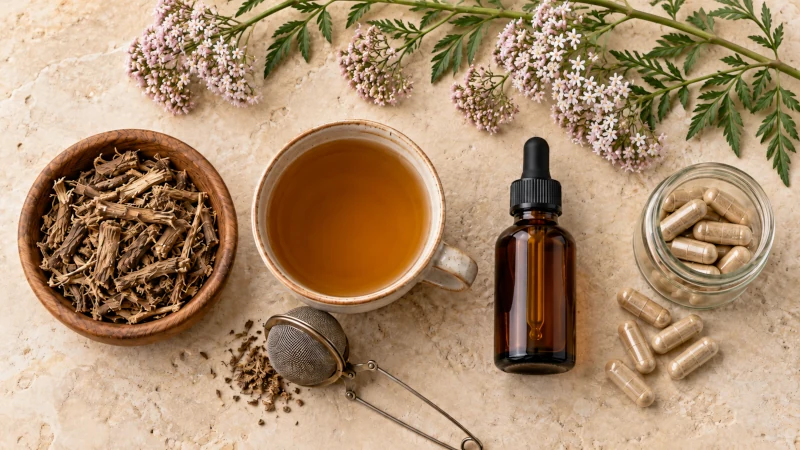
Valerian comes as dried root for tea, as tinctures, and as capsules or tablets containing dried root or extracts [ODS, 2013]. Products vary a lot. Supplements are not approved by the FDA before sale, and their makeup can differ between batches, so choose one that states the extract and amount per dose [ODS, 2013]; [NCCIH, 2025].
| Question | What the sources say |
| How much? | 300–600 mg a day has been used with apparent safety for up to six weeks [NCCIH, 2025]. Trials have used 400–900 mg of a water-based extract, or 600 mg of a standardized extract [ODS, 2013]. |
| When? | Sleep studies gave valerian in the evening, before bed [ODS, 2013]. Follow the dose on your product’s label. |
| Is more better? | No. In one small study, 900 mg left people sleepier the next morning than 450 mg [ODS, 2013]. |
| How long? | Give it about two weeks. If sleep or tension hasn’t improved, or gets worse, after two weeks of continuous use, check in with a doctor or pharmacist [EMA, 2017]. Long-term safety is unknown [NCCIH, 2025]. |
| Tea? | Tea is traditional, but the dose is hard to control. Herbalists advise steeping the root in hot water rather than boiling it, to keep the volatile oils. |
Side effects
Most people tolerate valerian well in the short term. Reported side effects include headache, stomach upset, mental dullness, vivid dreams, and—oddly for a sleep herb—excitability or uneasiness in some people [NCCIH, 2025]. Some people feel groggy the next morning, especially at higher doses, which can affect driving [Merck Manual, 2025]. The EMA advises not driving or operating machinery while using it [EMA, 2017].
Two less common problems are worth knowing about. If you take valerian for a long time and stop suddenly, withdrawal symptoms such as anxiety, irritability, heart rhythm disturbances, and insomnia have been reported, and in rare cases hallucinations [NCCIH, 2025]. Ask your clinician how to taper if you have used it for months. Liver injury has also been reported in very rare cases, most often when valerian was combined with other herbs [NCCIH, 2025].
Drug and supplement interactions
The main concern is stacking sedation. Valerian may add to the effects of [ODS, 2013]:
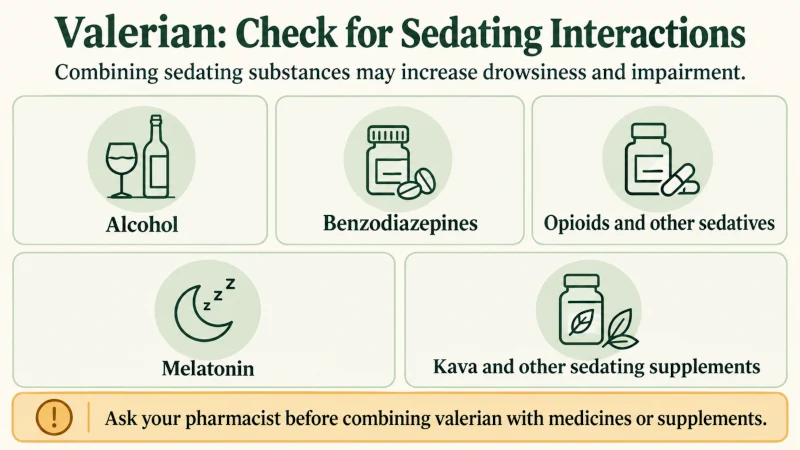
- alcohol
- benzodiazepines, such as alprazolam (Xanax), diazepam (Valium), and lorazepam (Ativan)
- barbiturates and other central nervous system depressants, including morphine and the anesthetic propofol, so tell your surgical team if you use it
- sedating supplements, including St. John’s wort, kava, and melatonin
Liver-enzyme interactions are less clear. Lab studies suggest valerian can block CYP3A4 and P-glycoprotein, two systems that clear many drugs, but no clinical studies have shown this changes how medicines work in people [Merck Manual, 2025], and the EMA found no interactions described in the literature at the time of its assessment [EMA, 2017]. Because the lab and clinical evidence disagree, the safest move is to show your pharmacist the full list of medicines and supplements you take before starting valerian.
Who should avoid valerian
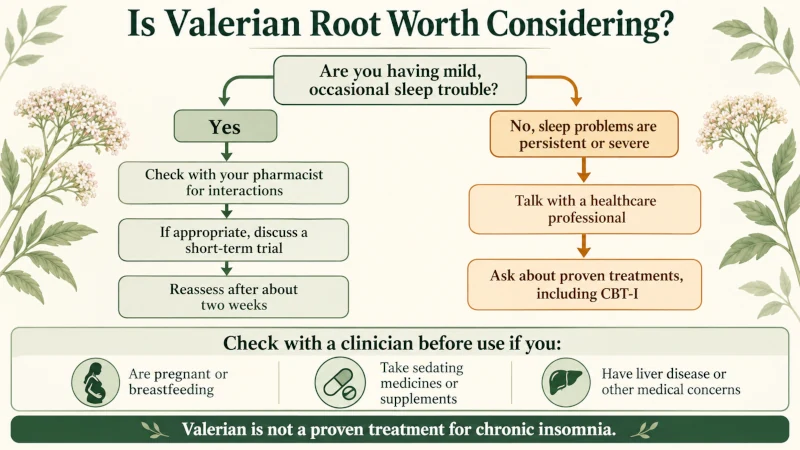
- Pregnant or breastfeeding people. Little is known about safety [NCCIH, 2025], and the EMA advises against use [EMA, 2017].
- Children. Sources differ: the EMA says not under age 12 [EMA, 2017], while the ODS fact sheet sets the line at under 3 [ODS, 2013]. Ask a pediatrician before giving valerian to any child.
- Anyone taking sedatives or drinking alcohol. See the interactions above.
- People who must be fully alert the next morning, such as for driving or operating machinery.
- People with liver disease, who should ask a doctor first given the rare reports of liver injury.
When to see a doctor
Valerian is meant for mild, occasional sleep trouble. See a doctor if poor sleep lasts more than a few weeks, keeps coming back, or affects how you function during the day. Also get checked if you snore loudly or wake up gasping, if your legs feel restless at night, or if poor sleep comes with low mood or ongoing worry. These can point to sleep apnea, restless legs syndrome, depression, or anxiety, which need their own treatment.
Stop valerian and seek prompt medical care if you notice yellowing of the skin or eyes, dark urine, or pain in the upper right abdomen (possible liver problems); a racing or irregular heartbeat or chest pain; or confusion or hallucinations. If you have thoughts of harming yourself, call or text 988 in the US, or your local emergency number.
| HEALTH DISCLAIMER: This article is for general education and is not a substitute for advice, diagnosis, or treatment from a qualified healthcare professional. Herbal supplements can cause side effects and interact with medicines. Talk with your doctor or pharmacist before using valerian, especially if you are pregnant or breastfeeding, giving it to a child, taking any prescription or over-the-counter medicine, or managing a health condition. |
Frequently Asked Questions
How long does valerian take to work?
Usually not overnight. The EMA notes the effect was better after two weeks of use [EMA, 2017], and in one 28-day trial the benefit over placebo grew between weeks two and four [ODS, 2013].
Can I take valerian every night?
Nightly use of 300–600 mg has been studied for up to six weeks. Safety beyond that is unknown, and stopping abruptly after long-term use has been linked to withdrawal symptoms [NCCIH, 2025].
Can I take valerian with melatonin?
Melatonin is on the list of supplements that may add to valerian’s sedating effect [ODS, 2013]. Many blends combine them, but check with a pharmacist first, especially if you take other medicines.
Will valerian make me groggy the next morning?
It can. In one small study, 900 mg caused next-morning sleepiness, while another found 600 mg did not meaningfully affect reaction time or alertness [ODS, 2013]. Start low and see how you feel before driving.
Is valerian tea as effective as capsules?
Nobody knows for sure. Tea is the traditional form, but most trials used measured extracts, and tea strength varies with how much root you use and how long you steep it [ODS, 2013].
References
- National Center for Complementary and Integrative Health. Valerian: Usefulness and Safety. View source
- NIH Office of Dietary Supplements. Valerian: Fact Sheet for Health Professionals. View source
- Valente V, Machado D, Jorge S, Drake CL, Marques DR. Does valerian work for insomnia? An umbrella review of the evidence. European Neuropsychopharmacology. View source
- Shinjyo N, Waddell G, Green J. Valerian root in treating sleep problems and associated disorders—a systematic review and meta-analysis. Journal of Evidence-Based Integrative Medicine. View source
- European Medicines Agency. Valerianae radix — herbal medicinal product. Final EU herbal monograph EMA/HMPC/150848/2015, Rev. 1 View source
- Miyasaka LS, Atallah ÁN, Soares B. Valerian for anxiety disorders. View source
- Mirabi P, Mojab F. The effects of valerian root on hot flashes in menopausal women. Iranian Journal of Pharmaceutical Research. View source
- Shane-McWhorter L. Valerian. Merck Manual Professional Version. View source


