
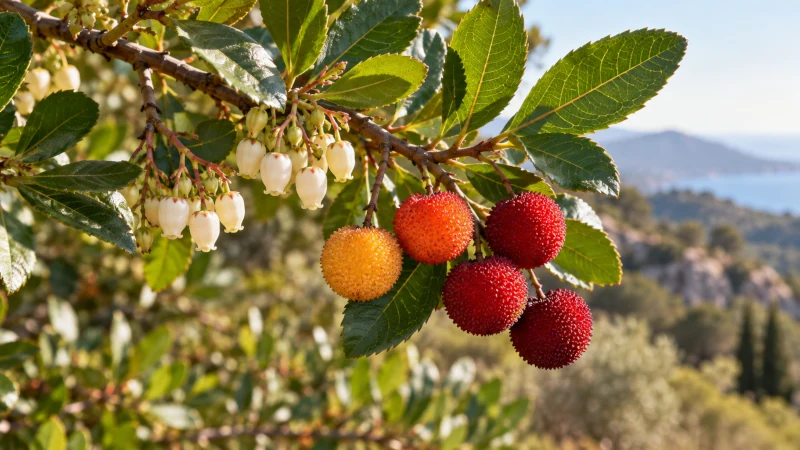
The strawberry tree, Arbutus unedo, gives you two very different things: a bright red autumn fruit you can eat, and leathery leaves that Mediterranean folk medicine has long used for urinary and digestive complaints. The fruit is a nutritious food. The leaves are where the medicinal claims live, and nearly all of the evidence behind them comes from lab dishes and animals, not people [Morgado et al., Journal of Ethnopharmacology, 2018].
So the honest summary of the arbutus plant’s health benefits is short: enjoy ripe fruit in normal amounts, treat the leaf tea as an untested traditional remedy, and never use either one in place of care for a urinary infection, a kidney stone, or diarrhea that won’t quit.
What is the arbutus plant?
Arbutus unedo is an evergreen shrub or small tree in the heath family (Ericaceae). Despite its common name, it isn’t related to garden strawberries. Its wild range rings the Mediterranean and runs up the Atlantic coast of France to western Ireland, usually on scrubby, rocky, sunny slopes [Trees and Shrubs Online, 2021].
Its giveaway is timing. Flower to ripe fruit takes about a year, so in autumn the same branch carries small white, urn-shaped flowers beside last year’s fruit turning from yellow to deep red [Trees and Shrubs Online, 2021] [Bebek Markovinović et al., Horticulturae review, 2022]. The fruit is round, about 2 cm across, with a bumpy, pebbled skin.
One naming note for US readers: the Pacific madrone (Arbutus menziesii) is a separate species in the same genus [Trees and Shrubs Online, 2021]. The research below is on A. unedo.
| Quick facts | |
| Scientific name | Arbutus unedo L. |
| Common names | Strawberry tree; madroño (Spanish); arbousier (French) |
| Family | Ericaceae (heath family) |
| Native range | Mediterranean basin, Atlantic France, western Ireland |
| Size | Shrub or small tree, up to about 12 m (39 ft) |
| Flowers | White, sometimes tinged pink or green; urn-shaped; autumn |
| Fruit | Round, warty, about 2 cm; ripens yellow to scarlet to crimson |
| Parts used traditionally | Fruit, leaves, bark, and roots |
Why Madrid’s coat of arms has one
If the tree looks familiar, you may have seen it in Madrid. A bear reaching into a strawberry tree, el oso y el madroño, is the city’s symbol, with origins going back to the reign of Alfonso VIII; a bronze statue of it has stood in the Puerta del Sol since 1967 [Tourism Madrid, 2026].
The species name is older still. Unedo comes from the Latin unum edo, “I eat one,” after Pliny the Elder’s remark that the fruit was so little prized that a person would eat only one [Trees and Shrubs Online, 2021]. Most of the harvest today is cooked or distilled rather than eaten fresh [Bebek Markovinović et al., Horticulturae review, 2022].
What’s in strawberry tree fruit and leaves
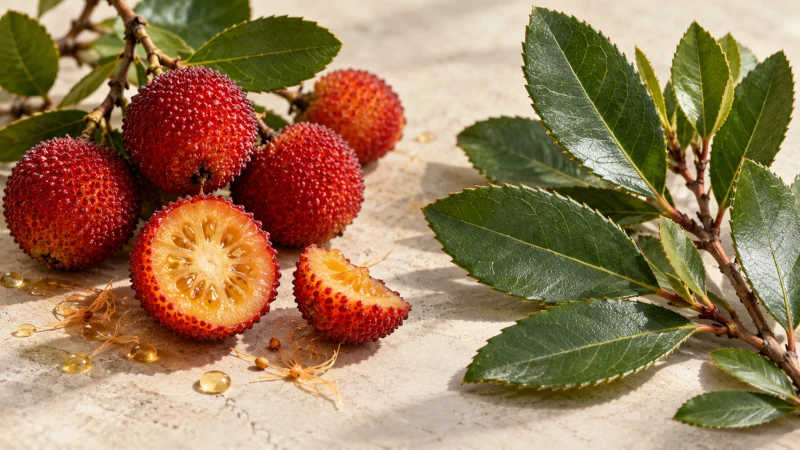
The fruit is sweet and energy-dense. Its sugars are mostly fructose and glucose, and it carries a good deal of fiber, much of it pectin, which is why it sets so easily into jam. Some analyses report 200–300 mg of vitamin C per 100 g of fresh fruit, with one sample of wild Croatian fruit testing higher, though values swing widely with location and ripeness. It also contains vitamin E, carotenoids, and a dense mix of polyphenols, including anthocyanins, catechins, and gallic acid derivatives [Bebek Markovinović et al., Horticulturae review, 2022].
The leaves are chemically richer than the fruit, with much higher polyphenol levels. Tannins make up most of those polyphenols, which accounts for the leaves’ astringent, mouth-drying bite. The leaves also contain arbutin, the compound behind bearberry’s (uva ursi’s) reputation as a urinary remedy. Arbutin turns up in the leaves, not the fruit, and bearberry leaves contain more of it [Bebek Markovinović et al., Horticulturae review, 2022].
Arbutus plant health benefits: what the evidence shows
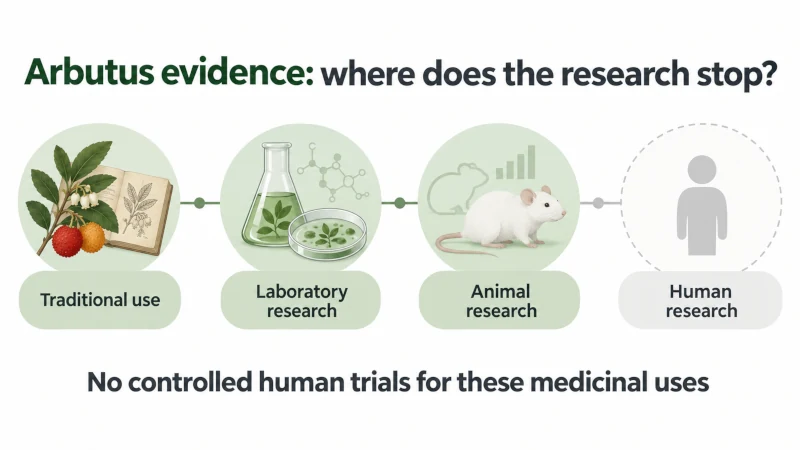
Arbutus has a long record in folk medicine. The fruit has been used as a diuretic, antiseptic, and laxative; the leaves as a diuretic, urinary antiseptic, astringent, and anti-diarrheal, and more recently for high blood pressure and diabetes. Lab and animal studies have found antibacterial, antioxidant, anti-inflammatory, blood-sugar-lowering, and blood-pressure-lowering activity in various extracts. The same review is plain about the gap: the effects still need to be confirmed in humans [Morgado et al., Journal of Ethnopharmacology, 2018].
| Claim | What has been studied | Evidence in people |
| Urinary tract infections | Arbutin’s breakdown product showed antibacterial activity in lab tests; bearberry (a relative with more arbutin) failed in a human trial | None for strawberry tree; traditional use only |
| Diarrhea | Tannin-rich leaves used traditionally; no clinical studies | None; traditional use only |
| Kidney stones | Leaf infusion showed stone-dissolving activity against calcium oxalate in a lab dish | None; lab only |
| Blood sugar | Leaf extracts slowed a carbohydrate-digesting enzyme in lab tests | None; lab only |
| Blood pressure | Leaf extract relaxed isolated rat blood vessels | None; animal tissue only |
| General nutrition | Fruit’s vitamin C, fiber, and polyphenol content measured | Nutrient content established; health outcomes not studied |
Urinary tract health: the arbutin connection
This use has the most plausible mechanism. In lab work on strawberry tree leaves, arbutin’s antibacterial effect, strongest against Enterococcus species, depended on an enzyme (beta-glucosidase) that frees hydroquinone from arbutin; hydroquinone does the antimicrobial work [Bebek Markovinović et al., Horticulturae review, 2022].
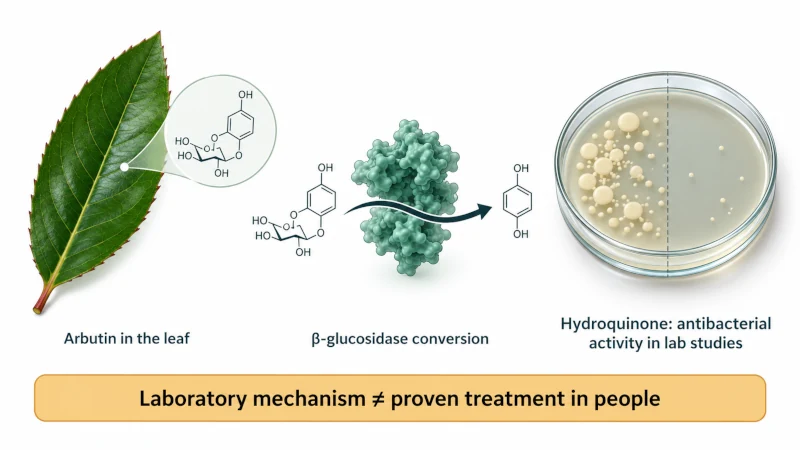
The trouble comes when you move from a lab dish to a person. Bearberry, which carries more arbutin, has been put to the test. In a UK trial of 382 women with symptoms of an uncomplicated urinary tract infection, bearberry extract did no better than placebo for symptoms and didn’t reduce antibiotic use, and NIH’s LiverTox summary concludes there is no convincing evidence bearberry treats urinary infections [NIH LiverTox: Uva Ursi, 2020]. If the better-stocked relative hasn’t delivered, strawberry tree leaf tea is a long shot.
A suspected urinary tract infection needs a diagnosis, because bladder infections can spread to the kidneys [NIDDK on bladder infection symptoms, 2024]. For the urinary herbs that do have human data, see our guide to herbal remedies for the urinary system. Everyday habits, mostly fluids, are covered in 11 foods for a healthy bladder and kidneys.
Diarrhea and digestion
The leaves’ tannins explain their traditional use against diarrhea: the leaves are astringent and have long served as a folk anti-diarrheal [Bebek Markovinović et al., Horticulturae review, 2022]. No clinical trial has tested them for it, so this stays in the traditional-use column.
The fruit pulls the other way. Folk medicine has used it as a laxative [Morgado et al., Journal of Ethnopharmacology, 2018], and the fruit’s tendency to ferment slightly can cause digestive upset [Bebek Markovinović et al., Horticulturae review, 2022]. If you’re in the middle of a bout of diarrhea, fluids come first; our guide to foods that help with diarrhea covers what to eat and when to call a doctor.
Kidney stones
In one lab study, a strawberry tree leaf infusion showed stone-dissolving activity against calcium oxalate, the most common stone material [Bebek Markovinović et al., Horticulturae review, 2022]. That is a test-tube result. There’s no evidence that drinking the tea dissolves or prevents stones in people, and sharp back or side pain, blood in the urine, or trouble urinating needs prompt medical attention [NIDDK on kidney stone symptoms, 2017]. Prevention is mostly about fluids and diet; see 12 foods that can raise kidney stone risk.
Blood sugar, blood pressure, and antioxidant claims
Leaf extracts have slowed a carbohydrate-digesting enzyme in lab tests and relaxed isolated rat blood vessels [Bebek Markovinović et al., Horticulturae review, 2022], and Mediterranean folk medicine has used the plant for diabetes and high blood pressure [Morgado et al., Journal of Ethnopharmacology, 2018]. None of this has been tested in controlled human trials, and a strong antioxidant reading in a test tube doesn’t tell you what happens after digestion. If you take medication for diabetes or blood pressure, check with your doctor before adding the leaf tea, since nobody has studied how the two combine.
How to eat the fruit
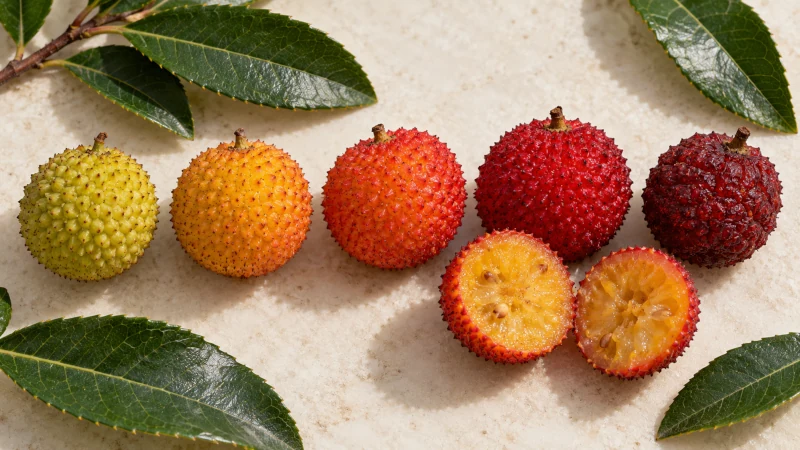
Strawberry tree fruit is eaten across the Mediterranean, most often as jam, jelly, or marmalade, and it’s distilled into strong spirits such as Portugal’s aguardente de medronho and Greece’s koumaro [Bebek Markovinović et al., Horticulturae review, 2022]. A few practical points:
- Eat it fully ripe, when it’s deep red and soft, and pick only from trees you can identify with confidence.
- Keep portions moderate. The fruit is high in sugar, and overripe fruit can start to ferment, sometimes while still on the tree, which can upset your stomach [Trees and Shrubs Online, 2021] [Bebek Markovinović et al., Horticulturae review, 2022].
- Count it as carbohydrate if you manage diabetes; its sugars are mainly fructose and glucose [Bebek Markovinović et al., Horticulturae review, 2022].
- Be wary of homemade spirits. The fruit’s pectin produces methanol during fermentation, and levels in traditionally made strawberry tree spirits vary, with many samples at or near the European legal limit [Bebek Markovinović et al., Horticulturae review, 2022].
Arbutus leaf tea: why there’s no dose here
You’ll find recipes online that give grams of leaf per liter and a number of cups a day. We don’t give one, because no dose of strawberry tree leaf has been tested for safety or effectiveness in people. There’s also a specific concern: arbutin breaks down to hydroquinone, which NIH notes is potentially carcinogenic, and that’s why bearberry is recommended only in short courses, not long-term [NIH LiverTox: Uva Ursi, 2020].
The closest regulatory benchmark is the European Union’s herbal monograph for bearberry leaf. It caps use at one week, advises against use under age 18 and in men without medical supervision, and says to see a doctor if symptoms last more than four days [EMA bearberry leaf monograph, 2018]. That’s European guidance for a related plant, not a US standard, but it’s a sensible ceiling. If you and your doctor decide to try strawberry tree leaf tea, keep it short and occasional, not a daily habit.
Early safety data are reassuring but thin. Rats given a water extract of the leaves daily for up to 28 days showed low DNA damage and preserved liver and kidney function [Bebek Markovinović et al., Horticulturae review, 2022]. Rats aren’t people, and four weeks isn’t long-term.
Side effects, interactions, and who should avoid it
Possible side effects
- Stomach upset. Nausea, vomiting, and stomach ache are reported with bearberry leaf [EMA bearberry leaf monograph, 2018], and overripe or excess strawberry tree fruit can cause digestive upset [Bebek Markovinović et al., Horticulturae review, 2022].
- Discolored urine. Bearberry leaf can turn urine greenish-brown [EMA bearberry leaf monograph, 2018].
- Eye damage with long-term use. A woman who drank bearberry tea several times a day for three years developed retinal damage (bull’s-eye maculopathy) [NIH LiverTox: Uva Ursi, 2020]. It’s one case report, but it’s a good reason not to make any arbutin-containing tea a daily habit.
Medication interactions
No drug interactions have been documented for strawberry tree, and the European bearberry monograph reports none either [EMA bearberry leaf monograph, 2018]. That reflects a lack of study as much as a clean safety record. Ask your pharmacist before using the leaves if you take diuretics, diabetes or blood pressure medication, or any drug your kidneys need to clear.
Pregnancy and breastfeeding
There are no safety data on strawberry tree leaf during pregnancy or breastfeeding. Bearberry isn’t recommended in either [EMA bearberry leaf monograph, 2018], and the same caution makes sense here, so skip the leaf tea. Ask your doctor before eating the fruit in more than ordinary food amounts, and pass on the spirits.
Who should skip the leaves
- Anyone pregnant or breastfeeding.
- Children and teens; bearberry isn’t recommended under 18 [EMA bearberry leaf monograph, 2018].
- People with kidney disease; kidney disorders are a formal contraindication for bearberry [EMA bearberry leaf monograph, 2018]. If you have chronic kidney disease, food choices are already a balancing act; see kidney-friendly foods that fit most CKD meal plans.
- Men with urinary symptoms, who need a medical evaluation first [EMA bearberry leaf monograph, 2018].
- Anyone who has reacted to bearberry or arbutin products [EMA bearberry leaf monograph, 2018].
When to see a doctor
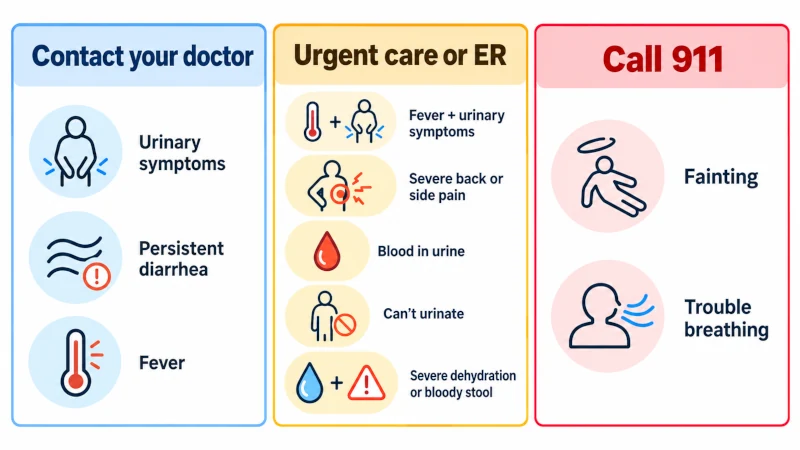
Arbutus isn’t a substitute for care. Contact your doctor or primary care office if you have:
- Any symptoms of a bladder infection: burning when you urinate, frequent or intense urges to go, lower belly pain, or cloudy, bloody, or strong-smelling urine [NIDDK on bladder infection symptoms, 2024].
- Diarrhea lasting more than 2 days, six or more loose stools a day, or a high fever [NIDDK on diarrhea symptoms, 2024]. If you’re pregnant, over 65, taking antibiotics, or have a weakened immune system, stay in touch with your doctor during any bout of diarrhea [NIDDK on diarrhea symptoms, 2024].
Go to urgent care or the ER the same day for:
- Fever and chills, nausea or vomiting, or pain in your back, side, or groin with urinary symptoms, which can mean the infection has reached a kidney [NIDDK on bladder infection symptoms, 2024].
- Sharp pain in your back, side, lower belly, or groin; blood in your urine; or being unable to urinate [NIDDK on kidney stone symptoms, 2017].
- Black, tarry, or bloody stools; severe belly or rectal pain; frequent vomiting; a change in mental state; or signs of dehydration such as extreme thirst, dark urine, or dizziness [NIDDK on diarrhea symptoms, 2024].
Call 911 for anything that feels like an emergency, such as fainting or trouble breathing.
| Health disclaimer: This article is for general education and is not medical advice. Strawberry tree fruit and leaves have not been tested as treatments in people, and nothing here replaces diagnosis or treatment from a doctor. Urinary symptoms, kidney stones, and persistent diarrhea can become serious quickly. Talk to your doctor or pharmacist before using any herbal preparation, especially if you are pregnant or breastfeeding, have kidney or liver disease, take prescription medication, or are considering it for a child. |
Frequently Asked Questions
Is arbutus fruit safe to eat?
For most healthy adults, yes, when it’s fully ripe and eaten in normal food amounts. It’s a traditional Mediterranean food, mostly made into jams and jellies [Bebek Markovinović et al., Horticulturae review, 2022]. It’s high in sugar, and overripe fruit can ferment and upset your stomach, so keep portions moderate.
Can strawberry tree fruit make you drunk?
Overripe fruit can start fermenting on its own, sometimes while still on the tree [Trees and Shrubs Online, 2021], which is where the fruit’s tipsy reputation comes from. How much alcohol the fresh fruit reaches hasn’t been well measured, and stomach upset is the more likely problem [Bebek Markovinović et al., Horticulturae review, 2022]. The spirits distilled from the fruit are a different matter: they’re strong alcoholic drinks.
Does arbutus leaf tea treat a urinary tract infection?
There’s no evidence it does. Its active compound, arbutin, shows antibacterial activity in lab tests, but bearberry, a relative with more arbutin, failed to beat placebo in a trial of 382 women [NIH LiverTox: Uva Ursi, 2020]. A suspected UTI needs a doctor’s assessment, since untreated bladder infections can spread to the kidneys [NIDDK on bladder infection symptoms, 2024].
Is the arbutus plant the same as bearberry (uva ursi)?
No. Both belong to the heath family and both contain arbutin, but bearberry (Arctostaphylos uva-ursi) is a small, low shrub whose leaves contain more arbutin and have been studied more [NIH LiverTox: Uva Ursi, 2020] [Bebek Markovinović et al., Horticulturae review, 2022]. Much of what’s known about arbutin’s safety comes from bearberry.
Is the strawberry tree the same as a madrone?
Not quite. The Pacific madrone (Arbutus menziesii) is a separate species in the same genus [Trees and Shrubs Online, 2021]. Research on Arbutus unedo doesn’t automatically apply to it, so don’t assume madrone leaves or fruit behave the same way.
References
- Morgado S, Morgado M, Plácido AI, Roque F, Duarte AP. Arbutus unedo L.: From traditional medicine to potential uses in modern pharmacotherapy. Journal of Ethnopharmacology. 2018;225:90–102. DOI 10.1016/j.jep.2018.07.004. PMID 29981432. View source
- Bebek Markovinović A, Brčić Karačonji I, Jurica K, et al. Strawberry Tree Fruits and Leaves (Arbutus unedo L.) as Raw Material for Sustainable Functional Food Processing: A Review. Horticulturae. 2022;8(10):881. DOI 10.3390/horticulturae8100881. View source
- Sutton J. Arbutus unedo. Trees and Shrubs Online, International Dendrology Society, 2021. View source
- Tourism Madrid (Madrid City Council). El Oso y el Madroño. esmadrid.com, View source
- European Medicines Agency, Committee on Herbal Medicinal Products. European Union herbal monograph on Arctostaphylos uva-ursi (L.) Spreng., folium. EMA/HMPC/750269/2016, View source
- National Institute of Diabetes and Digestive and Kidney Diseases. Uva Ursi. LiverTox: Clinical and Research Information on Drug-Induced Liver Injury. Updated March 28, 2020. NBK556475. View source
- National Institute of Diabetes and Digestive and Kidney Diseases. Symptoms & Causes of Bladder Infection in Adults. View source
- National Institute of Diabetes and Digestive and Kidney Diseases. Symptoms & Causes of Diarrhea. View source
- National Institute of Diabetes and Digestive and Kidney Diseases. Symptoms & Causes of Kidney Stones. View source


