
The best foods for healthy bladder and kidneys all do one of three quiet jobs: they keep your urine dilute, they give your kidneys steady minerals to work with, and they lower the load of waste your body has to filter. Water does most of that work. After water, it’s the water-rich, high-potassium, very-low-sodium fruits and vegetables that earn their place — plus cranberries, which have moderate evidence for preventing repeat urinary tract infections in women [NCCIH, 2024].
Here are 11 foods that show up consistently in kidney and urinary guidance, with what each one actually does, where the evidence is strong, and who should be careful. None of them treat kidney disease, dissolve a stone, or cure a urinary tract infection. What they do is support the everyday work your kidneys and bladder already handle.
The short version
- Drink enough water to keep your urine pale yellow. Fluid intake is the single most consistent prevention step across every kidney-stone type [NIDDK, 2017].
- The National Kidney Foundation suggests 2 to 3 quarts of fluid a day (8 to 12 cups) to produce at least 2.5 liters of urine — unless you have kidney failure or a fluid limit set by your doctor [NKF, 2025].
- Cranberries (juice or capsules) may cut the risk of recurrent UTIs in women by roughly 25 to 30 percent. They do not treat an active infection [NCCIH, 2024].
- Water-rich plants — watermelon, cantaloupe, pears, lemons, celery, asparagus, eggplant — help dilute urine and add citrate, potassium, and magnesium.
- If you’ve already had calcium oxalate stones, the foods to limit (spinach, rhubarb, nuts, chocolate, tea) often matter more than the foods to add [Mayo Clinic, 2025].
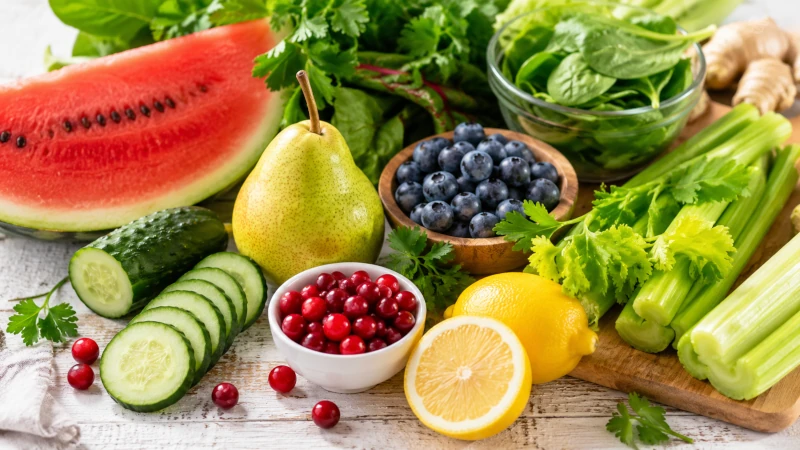
How food actually reaches your kidneys and bladder
Your two kidneys filter about 150 quarts of blood a day and turn 1 to 2 quarts of that into urine [NIDDK, Urinary Tract]. They pull out urea, uric acid, sodium, drug residues, and other waste, then route it down the ureters into your bladder. The harder they have to work — from dehydration, very high protein intake, heavy sodium, or concentrated minerals — the more room there is for stones, infections, or slow strain on filtering capacity.
Food touches three of those levers directly: how much water moves through the kidneys, how much sodium and protein they have to process, and how concentrated the stone-forming compounds (calcium, oxalate, uric acid) get in your urine. Every food below pulls on at least one.
Hydration first — the one habit with the strongest evidence
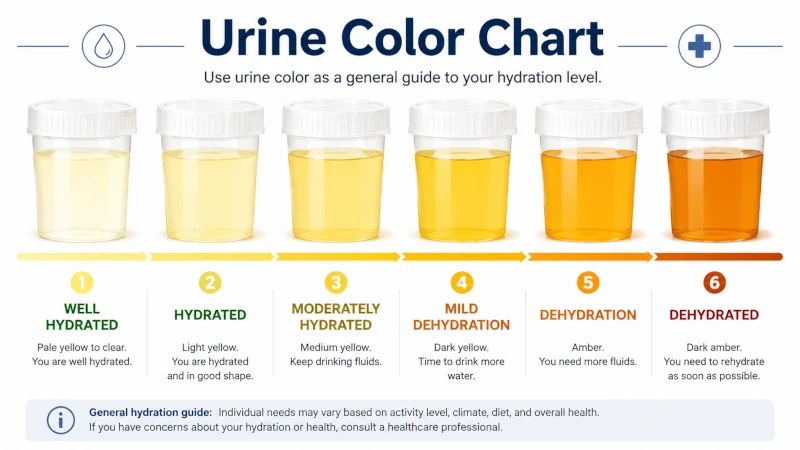
Before any single food, fluid is the dietary factor with the most consistent evidence for kidney health. The NIDDK frames it simply: unless you have kidney failure, aim for six to eight 8-ounce glasses of liquid a day [NIDDK, 2017]. The National Kidney Foundation puts the target a little higher for stone prevention — 2 to 3 quarts (8 to 12 cups), enough to make at least 2.5 liters of urine [NKF, 2025]. Both point the same direction. The easiest home gauge: aim for pale-yellow urine through the day. Dark yellow means you’re behind.
Water is the best choice. Lemonade and other citrate-rich citrus drinks add a small bonus, because citrate binds calcium in the urine and makes calcium oxalate crystals less likely to form [NKF, 2025]. Sugar-sweetened sodas go the other way — especially those with high-fructose corn syrup, which large studies link to higher stone risk [NKF, 2025].
One important exception: if you have kidney failure, advanced chronic kidney disease, congestive heart failure, or a fluid restriction set by a doctor, these general targets don’t apply to you. You need an individualized plan, not a generic number.
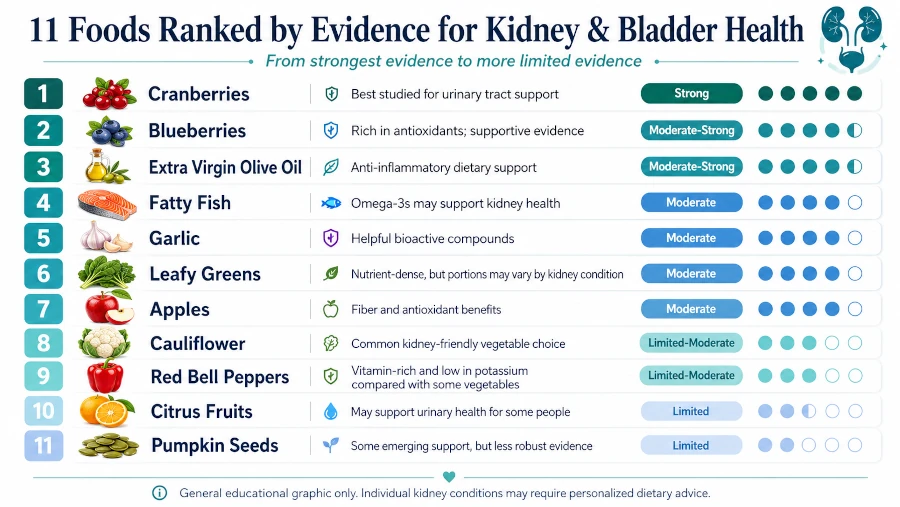
The 11 foods, and what each one really does
These are grouped by the job they do, not alphabetically. For each: what the evidence supports, what it doesn’t, and who should be careful. You can also browse the site’s broader urinary health section.
1. Cranberries — the strongest evidence for urinary health
Cranberries contain compounds called proanthocyanidins (PACs), which appear to stop Escherichia coli — the bacterium behind most lower UTIs — from sticking to the bladder wall. If the bacteria can’t attach, they’re more likely to be flushed out before they take hold [NCCIH, 2024].
The 2023 Cochrane review pooled 50 trials and more than 8,800 participants and concluded that cranberry products reduce the risk of recurrent, symptomatic UTIs in women with a history of them, in children, and in people prone to infections after certain procedures [Williams et al., 2023]. The NCCIH summarizes the size of that effect as roughly a 25 percent reduction, and in some cases more than 30 percent [NCCIH, 2024].
What cranberry does not do: treat an active infection. If you have burning on urination, urgency, lower-abdominal pain, fever, or back pain, see a clinician — that’s antibiotics territory, not juice [NCCIH, 2024].
Be careful if: you take warfarin (the evidence on an interaction is conflicting, so check first), you’ve had calcium oxalate stones (cranberry juice can be relatively high in oxalate), or you have diabetes and would be reaching for sweetened cranberry juice rather than unsweetened juice or capsules [NCCIH, 2024]. More on the berry in the guide to blueberry and cranberry benefits.
2. Blueberries — a close cousin, weaker UTI evidence
Blueberries share a lot of chemistry with cranberries — same genus, similar anti-adhesion compounds, plus a heavy dose of anthocyanins, the pigments behind the deep blue. But the UTI evidence is much thinner for blueberries; nearly all of the positive UTI research was done on cranberry specifically. Don’t treat them as interchangeable for that purpose.
Where blueberries do shine is general: very low in sodium, high in water and potassium, and one of the most antioxidant-dense foods per calorie. A handful a day fits cleanly into a kidney-supportive diet for most healthy adults. Details are in the blueberry health benefits article.
Be careful if: you’re on a potassium-restricted diet for advanced kidney disease — even healthy fruit needs to be portioned then, so check with a renal dietitian.
3. Lemons — citrate against calcium oxalate stones
Lemons stand out among fruits for how much citrate they deliver. Citrate binds calcium in the urine before it can pair with oxalate to form crystals, which is why urologists routinely point people who’ve had calcium oxalate stones — the most common type — toward citrus [Mayo Clinic, 2025]; [NKF, 2025].
A practical version: half a fresh lemon squeezed into a large glass of water, two or three times a day. Diluted, unsweetened lemonade does the same job. Pre-bottled lemon drinks loaded with high-fructose corn syrup do not, and may raise risk. More on the fruit in the lemon benefits article.
Be careful if: you have acid reflux or enamel wear — dilute the juice well and consider a straw. One clarification worth making, because it gets repeated wrongly online: the citrus famous for clashing with statins, calcium channel blockers, and some other drugs is grapefruit (and relatives like Seville orange and pomelo), which blocks a liver enzyme called CYP3A4. Lemons don’t have that effect to any meaningful degree. If you take a daily medication and want to add grapefruit, that’s the one to ask your pharmacist about.
4. Watermelon — about 92 percent water
Watermelon is roughly 92 percent water by weight, which makes it one of the easiest ways to nudge daily fluid up. It’s also very low in sodium, modest in calories, and a natural source of potassium and lycopene. For anyone trying to keep urine dilute — a near-universal recommendation across stone types — it’s a useful summer staple. The full guide to watermelon and the kidneys goes deeper.
Be careful if: you have stage 4 or 5 CKD and have to watch both potassium and fluid; watermelon’s potassium is moderate, but at that stage moderate counts. If you have diabetes, mind the portion — watermelon has a high glycemic index, though its glycemic load per serving is low because there’s little actual sugar by weight.
5. Cantaloupe — beta-carotene plus water
Cantaloupe is about 90 percent water, with more beta-carotene and vitamin C than watermelon. The kidney-relevant story is the same: high water, low sodium, useful potassium. There’s nothing magical here for kidney disease specifically — it’s a hydrating, nutrient-dense fruit, and that’s enough.
6. Honeydew and other melons — the same hydration role
Honeydew, Persian melon, and the rest of the muskmelon family all do one thing well: 88 to 92 percent water, low sodium, naturally sweet without added sugar. They earn their slot by serving the central goal, keeping urine dilute.
7. Pears — gentle, naturally low in sodium and oxalate
Pears are unusual: very low in oxalate, very low in sodium, very low in protein, with useful potassium and a mild diuretic nudge from their water content. That profile is why kidney dietitians often list pears among the safer fruit choices in the earlier stages of chronic kidney disease, where oxalate and potassium both matter.
Be careful if: you have fructose malabsorption — pears run higher in fructose than many fruits and can trigger symptoms. On dialysis with a fluid restriction, count pear juice as fluid.
8. Celery — a mild natural diuretic
Celery is about 95 percent water and carries compounds in its oils that have a mild diuretic effect — a small bump in urine output. It is not a treatment for high blood pressure, swelling, or stones, despite the traditional claims. What it offers is hydration, fiber, and very few calories. The celery article has the fuller profile.
Be careful if: you’re watching sodium closely — celery is one of the higher-sodium vegetables in raw form (around 30 mg per stalk), which adds up across a big serving.
9. Asparagus — diuretic, with one caveat
Asparagus contains asparagine, an amino acid tied to its mild diuretic effect. That same effect is why older nephrology texts advised people with active kidney inflammation (nephritis) to go easy on it — the extra urine production can be more than inflamed kidneys want during a flare. For healthy adults, normal amounts are fine.
Be careful if: you’ve had uric acid stones or have gout — asparagus is moderate in purines, which break down into uric acid, so keep portions small. It’s also a high-FODMAP food and can cause digestive symptoms in sensitive people.
10. Eggplant — water-rich, low sodium, low calorie
Eggplant is roughly 92 percent water and very low in sodium, calories, and protein — a useful background vegetable in kidney-supportive cooking, especially where it stands in for meat (a lighter eggplant parmesan, say). More in the eggplant benefits article.
Be careful if: you form calcium oxalate stones — eggplant carries modest oxalate, so keep portions reasonable, though most people don’t need to avoid it.
11. Hazelnuts — the caveat-heavy entry
Older European nutrition texts recommended a small daily handful of hazelnuts for people prone to uric acid stones, on the theory that their mineral profile has an alkalizing effect. The modern picture is more mixed. Hazelnuts are nutritionally strong — monounsaturated fat, magnesium, vitamin E — but most U.S. nephrology guidance puts nuts in general on the limit-list for people who form calcium oxalate stones, because nuts carry meaningful oxalate [NIDDK, 2017]; [Mayo Clinic, 2025].
So a reasonable read: if you’ve never had a stone, a small daily handful is fine and broadly good for you. If you form calcium oxalate stones, hazelnuts probably don’t belong on a daily list.
Quick reference: what each food brings
| Food | Main benefit | Strength of evidence | Watch out if you have… |
| Cranberries | Fewer recurrent UTIs (women, children) | Moderate (Cochrane 2023; NCCIH) | Warfarin; calcium oxalate stones |
| Blueberries | Antioxidants; low-sodium hydration | Limited for UTIs | Advanced CKD (potassium) |
| Lemons | Citrate inhibits calcium oxalate stones | Moderate (NKF; Mayo) | Reflux, enamel wear |
| Watermelon | Very high water (~92%) | General hydration support | Late-stage CKD; diabetes (portion) |
| Cantaloupe | High water + beta-carotene | General hydration support | Late-stage CKD |
| Other melons | Hydration, low sodium | General hydration support | Late-stage CKD |
| Pears | Low oxalate, sodium, protein | Strong for CKD-friendly eating | Fructose malabsorption |
| Celery | Mild diuretic; hydration | Limited | Sodium-restricted diets |
| Asparagus | Mild diuretic | Limited | Active nephritis; gout/uric acid stones |
| Eggplant | Low calorie, low sodium, high water | General supportive food | Calcium oxalate stones |
| Hazelnuts | Magnesium, healthy fats | Mixed | Calcium oxalate stone history |
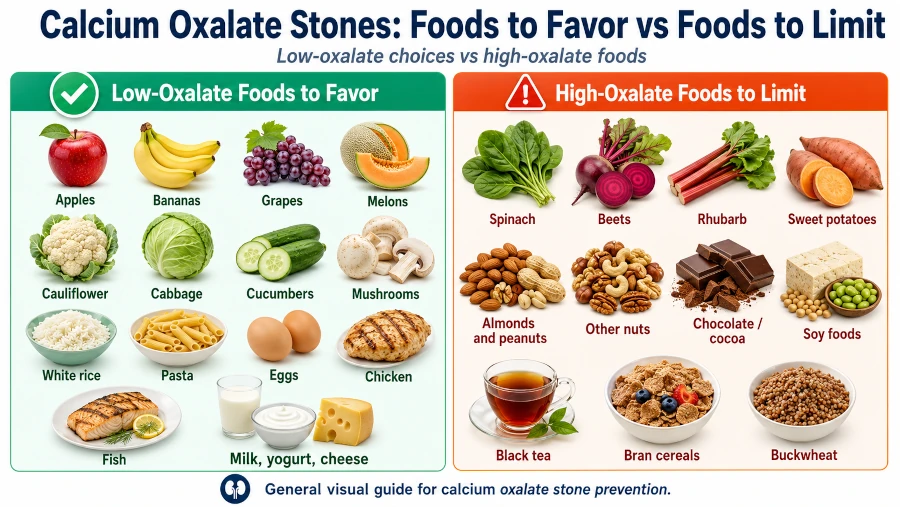
Foods to limit if you’ve already had a kidney stone
Once you’ve passed a stone, what you cut often matters more than what you add — and the right list depends on your stone type, which a doctor can pin down by analyzing a passed stone or running a 24-hour urine collection. Until you know, these are the groups most consistently flagged [NIDDK, 2017]; [Mayo Clinic, 2025]; [NKF, 2025]:
- High-sodium foods — canned soups, deli meats, fast food, frozen meals. Sodium drives calcium into the urine and raises risk for the most common stone type.
- Excess animal protein — large daily servings of red meat, organ meats, shellfish. These raise uric acid and make urine more acidic.
- High-oxalate foods, if you form calcium oxalate stones — spinach, rhubarb, beets, nuts, peanuts, chocolate, tea, wheat bran.
- Sugary drinks — especially sodas with high-fructose corn syrup, linked to higher stone risk in large cohort studies.
- High-dose vitamin C supplements — 1,000 mg a day or more can raise urinary oxalate [NKF, 2025].
For the full breakdown, see the companion guide on foods that cause kidney stones.
Who should talk to a doctor before changing their diet
Most foods on this list are safe for the general population. The picture shifts for several groups:
- Chronic kidney disease, stage 3 or higher. Potassium, phosphorus, fluid, and protein needs all change as function drops, and even healthy fruits can become a problem by stage 4 or 5 [NIDDK, CKD].
- People on dialysis. Fluid limits are strict — even watermelon and other high-water fruits count toward the daily total.
- A history of calcium oxalate stones. Several foods marketed as “kidney friendly” (nuts, spinach, dark chocolate) are actually moderate-to-high oxalate and may need limiting.
- People on warfarin or other blood thinners. Cranberry products may interact — the evidence is conflicting, so check before adding large amounts [NCCIH, 2024].
- Pregnancy or breastfeeding. Food amounts of cranberry, blueberry, lemon, and melon are considered safe; concentrated supplements should be cleared with a clinician first [NCCIH, 2024].
When to see a doctor
Food helps with day-to-day kidney and bladder health. It doesn’t replace medical evaluation. Get prompt care for any of these:
- Severe pain in the back, side, lower abdomen, or groin — especially pain that comes in waves [Mayo Clinic, 2025].
- Pink, red, or brown urine.
- Burning, urgency, or pain on urination lasting more than a day, or paired with fever or back pain (a possible kidney infection).
- Fever or chills alongside any urinary symptom.
- Nausea or vomiting with flank pain.
- Trouble passing urine, or feeling unable to empty your bladder.
- Swelling in the legs, feet, or around the eyes, or unexplained foamy urine — possible signs of a filtering problem.
For broader background, the kidney-friendly foods guide and the urinary system herbal remedies article both go further.

| Health disclaimer This article is for general education and isn’t a substitute for diagnosis, treatment, or personal advice from a qualified clinician. Diet for kidney and bladder health is highly individual — the right approach depends on your stone type (if any), kidney function, blood pressure, medications, and medical history. People with chronic kidney disease, kidney failure, diabetes, or recurrent stones should speak with a nephrologist or registered kidney dietitian before making significant changes. If you’re pregnant, breastfeeding, or taking prescription medication, check with your doctor before using any food or supplement to manage a urinary condition. Seek prompt care for severe flank pain, blood in the urine, high fever, or signs of a urinary tract infection. |
Frequently Asked Questions
Can I really “clean out” my kidneys by eating certain foods?
No. Healthy kidneys clean themselves — there’s no scientific basis for a kidney “detox” or “cleanse.” What food can do is dilute your urine, reduce stone-forming compounds, and ease the daily filtering load. Useful, but not a detox [NIDDK, 2017].
How much cranberry should I take to prevent UTIs?
Trials have generally used about 8 to 10 ounces (240–300 mL) of cranberry juice once or twice daily, or a standardized cranberry capsule, for at least one to three months. The benefit shows up mostly in women with recurrent UTIs. Unsweetened or lightly sweetened forms beat high-sugar ones [Williams et al., 2023]; [NCCIH, 2024].
Is lemon water actually good for kidney stones?
It can be, for one specific reason: lemons are high in citrate, and urinary citrate binds calcium so it can’t pair with oxalate. People who form calcium oxalate stones may benefit from regular lemon water. It won’t treat an existing stone or replace plain water, though [Mayo Clinic, 2025].
Do I really need eight cups of water a day?
Most adults do well on roughly 8 to 12 cups of total fluid daily, which produces around 2.5 liters of urine — the range urologists tie to lower stone risk. Some of that comes from food, especially the water-rich items on this list. People with kidney failure, heart failure, or a fluid restriction need a target set by their clinician instead [NKF, 2025].
Are bananas good or bad for kidneys?
It depends on your kidney function. Bananas are high in potassium — a plus if your kidneys and blood pressure are normal. But with stage 3 or higher CKD, daily bananas can push blood potassium too high and risk heart-rhythm problems. If you’ve been told to watch potassium, check with a renal dietitian.
Can any of these foods treat a bladder infection?
Cranberries have the most evidence, and it’s for preventing recurrent infections, not treating an active one. The rest support general urinary health by keeping urine dilute, but none of them treat an infection. An active UTI needs medical care [NCCIH, 2024].
References
- National Institute of Diabetes and Digestive and Kidney Diseases. (2017). Eating, Diet, & Nutrition for Kidney Stones. → View source
- National Institute of Diabetes and Digestive and Kidney Diseases. The Urinary Tract & How It Works. → View source
- National Institute of Diabetes and Digestive and Kidney Diseases. Chronic Kidney Disease (CKD). → View source
- Mayo Clinic. (2025). Kidney stones — Symptoms and causes. → View source
- National Kidney Foundation. (2025). Kidney Stone Diet Plan and Prevention. → View source
- National Center for Complementary and Integrative Health. (2024). Cranberry: Usefulness and Safety. → View source
- Williams G, Hahn D, Stephens JH, Craig JC, Hodson EM. (2023). Cranberries for preventing urinary tract infections. Cochrane Database of Systematic Reviews, 4(4):CD001321. → View source
