
Cherries are one of the better fruits you can eat, and one of the most overpromised. The sweet cherry tree, Prunus avium, gives us a low-calorie fruit with fiber, vitamin C, and some genuinely interesting research behind it, especially for gout. What it doesn’t give us is a cure, a detox, or a reason to eat two kilos in a day.
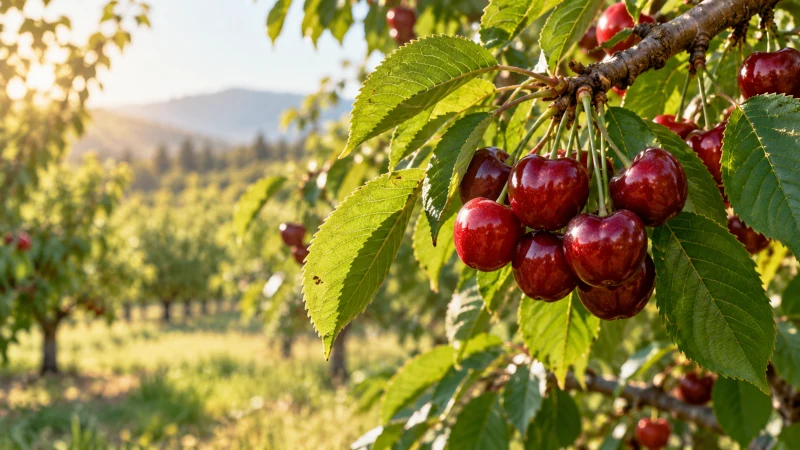
So here is the honest version. Eat cherries because they’re good food. If you have gout, they may be a useful addition to your treatment, not a substitute for it. And treat the traditional cherry tree remedies, stalk tea and anything involving crushed pits, with more caution than the old herbal books do.
Cherry tree at a glance
| Sweet cherry tree | |
| Scientific name | Prunus avium L. |
| Family | Rosaceae (the rose family) |
| Common names | Sweet cherry; traditionally also called wild cherry, mazzard, or gean |
| Native range | Europe to Afghanistan and northern Africa |
| Size | Usually 15 to 30 feet tall and wide in landscapes |
| Flowers and fruit | Fragrant white flowers in spring; a red or yellow drupe with one large pit in summer |
| Parts used traditionally | The fruit, and the fruit stalks (stems) brewed as a tea |
| Parts containing cyanogenic compounds | Leaves, flowers, fruit, and seeds, with the highest levels in the seeds and fruit stalks |
Botanical and safety details: [NC State Extension, n.d.].
One distinction matters before you read any cherry study. Sweet cherries (the Bing-type fruit sold fresh) and tart or sour cherries (usually sold as juice, concentrate, or dried) are different fruits. Most exercise-recovery research uses tart cherry products, while gout and sleep studies have used both. In a 2018 review of 29 human studies, 20 used tart cherries and only 7 used sweet ones [Kelley et al., 2018]. When a claim comes from tart cherry research, this page says so.
What’s in a cup of sweet cherries
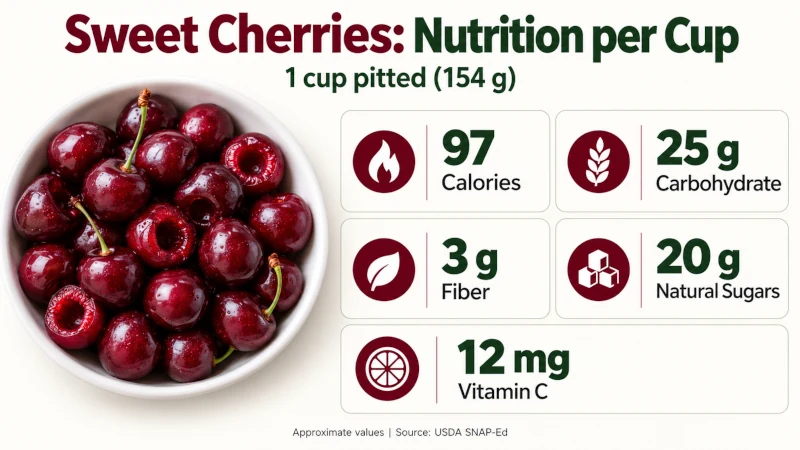
A cup of pitted sweet cherries (154 g) has about 97 calories, 25 g of carbohydrate, 3 g of fiber, 20 g of naturally occurring sugar, and 12 mg of vitamin C [USDA SNAP-Ed, n.d.]. That makes them a filling, water-rich snack with no added sugar.
Two claims from older herbal writing need correcting. First, cherries are not a standout potassium food. The National Kidney Foundation lists them among lower-potassium fruits, with less than 200 mg per half-cup serving [National Kidney Foundation, n.d.]. Second, their sugar is ordinary fruit sugar. It isn’t “metabolized even by people with diabetes” in some special way; it counts toward your carbohydrates like any other fruit.
Much of the research interest centers on cherries’ polyphenols, especially anthocyanins, the pigments in dark-red fruit. Studies have tested doses ranging from 45 to 270 cherries a day, or 55 to 720 mg of anthocyanins [Kelley et al., 2018], which is far more than most people eat.
Cherries and gout: the most promising evidence
Gout is where cherries have the most interesting human data. It is also where people most need to hear the limits.
What the research found
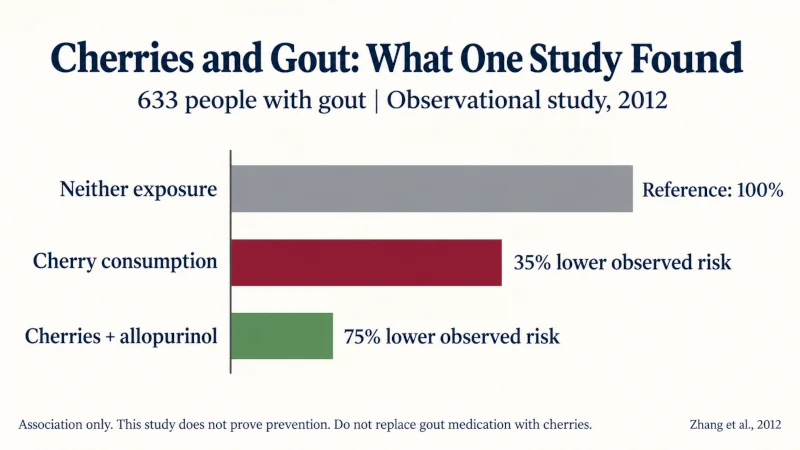
The best-known study followed 633 people with gout online for a year, tracking 1,247 flares. Researchers compared what people ate in the two days before a flare with other two-day periods. Eating cherries in those two days was linked to a 35% lower risk of a flare. When cherry intake was combined with allopurinol, a standard uric acid–lowering drug, the risk was 75% lower than in periods with neither. The apparent benefit grew up to about three servings over two days, then leveled off. A serving was half a cup, or roughly 10 to 12 cherries [Zhang et al., 2012].
A much smaller study points to a possible reason. Ten healthy women ate 45 fresh Bing cherries at breakfast. Over the next five hours their blood uric acid fell significantly, and the amount leaving in their urine rose. Two inflammation markers dipped slightly, but not by a statistically meaningful amount [USDA ARS, 2004].
What it doesn’t prove
The gout study was a case-crossover design that relied on people recalling what they ate. That can show an association. It can’t prove cherries prevent flares, and both the authors and the journal’s editorialists said randomized trials were needed [Zhang et al., 2012]. The broader research is mixed: a 2018 review found that tart cherry juice lowered uric acid in people with obesity but not in people with osteoarthritis [Kelley et al., 2018].
Mayo Clinic’s guidance puts it plainly: some studies suggest cherries may lower the risk of gout attacks, but changing your diet is not a cure, and most people with gout still need medication to bring uric acid down [Mayo Clinic, 2025]. Notice that the biggest effect in the study came from cherries plus allopurinol. Don’t stop or skip your prescription because you’ve started eating cherries.
If you’re dealing with flares, our guide to how gout is diagnosed and treated, using gout in the shoulder as an example explains what your doctor is looking for.
Inflammation, sleep, and exercise recovery
Beyond gout, the evidence comes mostly from short, small studies. The 2018 review is the most useful summary, and its numbers deserve to be read carefully [Kelley et al., 2018].
| Outcome | What the human studies found | How strong is it? |
| Oxidative stress markers | Improved in 8 of 10 studies | Limited. These are lab markers, not health outcomes. |
| Inflammation markers | Lower in 11 of 16 studies, including some with sweet Bing cherries | Limited to moderate; results vary by study. |
| Muscle soreness and strength after exercise | Better in 8 of 9 studies, all using tart cherry products | Promising, but for tart cherries only. |
| Sleep | Improved in 4 of 4 studies, using sweet or tart cherries | Early. Very few, small studies. |
| Blood pressure | Lower in 5 of 7 studies, mostly with single doses or specific groups | Mixed. Depends on cherry type and timing. |
| Blood sugar and cholesterol | No change in glucose, insulin, or most blood fats in healthy adults | Insufficient to claim a benefit. |
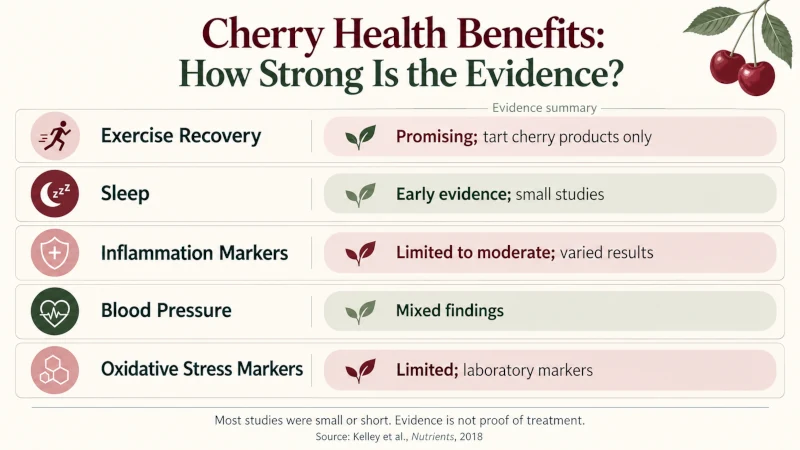
Most of these studies lasted under two weeks, the cherry products weren’t standardized, and the review’s authors said more research is needed to confirm the claims [Kelley et al., 2018]. A fair reading: cherries look helpful for some markers, but no one should expect them to treat a health condition.
Traditional claims that don’t hold up
Older herbal guides, including the source the earlier version of this page relied on, credited cherries with a lot. Here is where those claims stand.
- Weight loss. I found no trials showing cherries help people lose weight. They are low in calories, which makes them a sensible swap for sweets, but that is ordinary nutrition, not a special property.
- “Depurative” cleansing. Your liver and kidneys do the clearing. I found no human research showing a cherry regimen removes “impurities.”
- Bladder and kidney infections. Cherries and cherry stalk tea do not treat cystitis or pyelonephritis. A kidney infection can cause fever, chills, back or side pain, and nausea, and needs prompt medical care [CDC, n.d.]. Our review of herbal remedies for the urinary system covers which herbs have any evidence and which are tradition only.
- Constipation. A cup of cherries has 3 g of fiber [USDA SNAP-Ed, n.d.], and cherries are rich in sorbitol [Monash University, n.d.], a sugar alcohol that can loosen stools. That makes a mild effect plausible, but I found no studies testing cherries for constipation.
Cherry stalk tea: a traditional diuretic with thin evidence
In folk medicine, infusions and decoctions of cherry stems and leaves are used to increase urine output and are suggested for urinary infections, kidney stones, and gallstones. A 2021 review that collected these uses noted that the supporting work is mainly laboratory testing of antioxidant and enzyme activity, not human trials [Nunes et al., 2021].
There is also a safety question the old recipes ignore. NC State Extension lists the fruit stalks, along with the seeds, as the parts of the tree with the highest concentration of cyanogenic glycosides, compounds that can release cyanide [NC State Extension, n.d.]. I could not find data on how much of these compounds ends up in a cup of stalk tea or what amount is safe.
For that reason this page no longer recommends the traditional 50-gram decoction taken several cups a day. If you want to try stalk tea, talk to your doctor or pharmacist first, and skip it entirely if you are pregnant, breastfeeding, have kidney disease, or take a diuretic.
How to eat cherries for your health
The practical advice is refreshingly ordinary.
- Eat them as food. A half-cup to a cup is a reasonable serving. In the gout study, the apparent benefit topped out at about three half-cup servings over two days [Zhang et al., 2012], an amount that fits easily into a normal diet.
- Pick whole fruit over juice and sweetened products. Mayo Clinic advises people with gout to limit fruit juices, even unsweetened ones, and to cut back on added sugar [Mayo Clinic, 2025]. Pie filling and syrups don’t count as a cherry habit.
- Buy in season and store them cold. Fresh cherries are a summer fruit. Keep them in the refrigerator in a loosely sealed bag and wash them just before eating [USDA SNAP-Ed, n.d.].
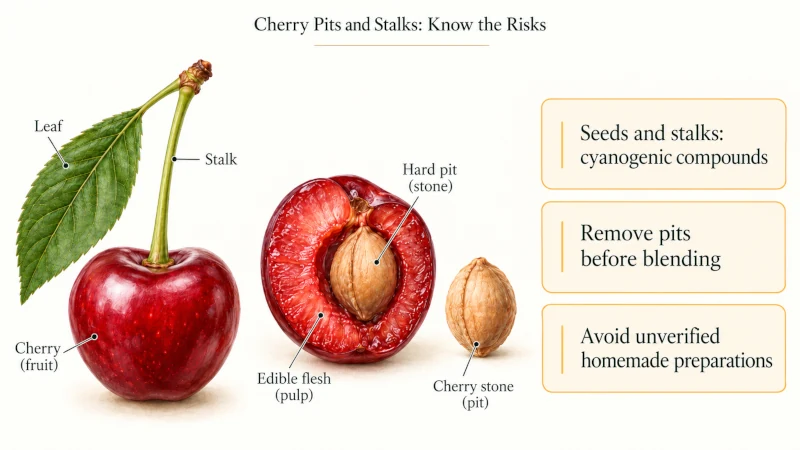
- Pit before blending. Remove pits before putting cherries in a blender or food processor, which can crack them [NC State Extension, n.d.].
About the old two-day “cherry treatment,” which called for half a kilogram of cherries four or five times a day as your only food: that works out to roughly 2 to 2.5 kg, or about 260 to 325 g of sugar a day, based on 20 g per 154 g cup [USDA SNAP-Ed, n.d.]. It also provides almost no protein or fat and a large dose of the fermentable sugars that cause bloating. There’s no evidence it does anything a normal serving doesn’t, so we’ve dropped it.
Safety: who should be careful
Pits, stalks, and cyanogenic compounds
Cherry seeds, stalks, leaves, and flowers contain amygdalin and prunasin, which can release cyanide. Accidentally swallowing a couple of whole pits will not poison you [NC State Extension, n.d.]. The concern is crushed or chewed pits in quantity, homemade preparations from seeds or leaves, and children or pets chewing on them. Symptoms of cyanide poisoning include gasping, weakness, dilated pupils, spasms, and convulsions [NC State Extension, n.d.].
Gas, bloating, and IBS
Cherries are high in two FODMAPs: excess fructose and sorbitol [Monash University, n.d.]. If you have irritable bowel syndrome or often get gas after fruit, a large bowl may not sit well. Smaller portions usually work better. Our article on probiotics for bloating and gas explains how gut bacteria ferment FODMAPs.
Pollen-food allergy
People allergic to birch pollen can react to raw pitted fruits, and cherries are pitted fruit. The usual symptoms are itching or swelling of the mouth, lips, and throat right after eating. Cooking or canning often reduces the reaction because heat breaks down the protein involved. Severe reactions are uncommon but possible [AAAAI, n.d.].
Diabetes, kidney disease, and medications
Diabetes. Whole fruit fits in a diabetes eating plan as part of the carbohydrate portion of your plate, while juice is grouped with sugary drinks [American Diabetes Association, n.d.]. Count a cup of cherries as about 25 g of carbohydrate [USDA SNAP-Ed, n.d.].
Kidney disease. The fruit itself is on the lower-potassium list [National Kidney Foundation, n.d.], but portions still matter if you’re on a potassium limit, and stalk tea is best avoided. Our guide to potassium and kidney health explains why the usual “eat more potassium” advice can be backward for people with kidney disease.
Medications. I did not find well-documented interactions between cherry fruit and medications. Because stalk tea is used as a diuretic, ask your pharmacist before combining it with diuretics, lithium, or blood pressure medication. That caution is precautionary, not based on reported cases. If you take allopurinol or another gout medicine, keep taking it.
Pregnancy and breastfeeding
Cherries as fruit are ordinary food. I found no safety data on cherry stalk tea in pregnancy or breastfeeding, so avoid it during those times.
When to see a doctor
- Get care right away if you have a fever and a joint that is hot and inflamed. That can be an infection rather than gout [Mayo Clinic, n.d.].
- Call your doctor for sudden, intense joint pain, especially a first episode [Mayo Clinic, n.d.].
- See a clinician for burning with urination, frequent urges, or blood in the urine, and promptly for fever, chills, back or side pain, or vomiting, which can signal a kidney infection [CDC, n.d.].
- Seek medical help for hives, vomiting, or trouble breathing after eating cherries [AAAAI, n.d.].
- Call Poison Help at 1-800-222-1222 (US, 24/7) if someone has eaten crushed pits or a homemade seed, leaf, or stalk preparation and feels unwell [HRSA, n.d.]. Call 911 for convulsions, collapse, or trouble breathing.
| HEALTH DISCLAIMER: This article is for general education and isn’t a substitute for advice from a doctor, pharmacist, or registered dietitian who knows your health history. Cherries are a healthy food, but they do not treat gout, urinary infections, or any other condition on their own. Talk to a healthcare professional before using cherry stalk tea or any herbal preparation, and before changing a prescribed medicine. If you are pregnant, breastfeeding, have kidney disease or diabetes, or take regular medication, ask first. |
Frequently Asked Questions
Are cherry pits poisonous?
They contain compounds that can release cyanide, but swallowing a couple of whole pits by accident won’t cause poisoning [NC State Extension, n.d.]. The risk comes from crushed or chewed pits in quantity. Pit cherries before blending them.
How many cherries should I eat a day for gout?
There’s no established dose. In the main study, a serving was half a cup (about 10 to 12 cherries), and the apparent benefit leveled off at around three servings over two days [Zhang et al., 2012]. Treat that as a food habit alongside your gout medication, not a replacement for it.
Is cherry stem tea safe?
No one has shown that it is. It’s a traditional diuretic with mostly laboratory evidence behind it [Nunes et al., 2021], and the stalks are among the parts of the tree highest in cyanogenic glycosides [NC State Extension, n.d.]. Ask a healthcare professional first, and avoid it if you’re pregnant, breastfeeding, or have kidney disease.
Are tart cherries better than sweet cherries?
It depends on what you’re after. The muscle-recovery studies used tart cherry products. Sweet and tart cherries have both been studied for inflammation markers and sleep [Kelley et al., 2018]. For everyday eating, sweet cherries are a perfectly good choice.
Can people with diabetes eat cherries?
Yes, as part of the fruit and carbohydrate portion of a meal [American Diabetes Association, n.d.]. A cup has about 25 g of carbohydrate and 20 g of sugar [USDA SNAP-Ed, n.d.]. Whole cherries are a better choice than cherry juice.
References
- American Academy of Allergy, Asthma & Immunology. Oral allergy syndrome (OAS) or pollen food syndrome. n.d. View source
- American Diabetes Association. Understanding carbs. n.d. View source
- Centers for Disease Control and Prevention. About urinary tract infections. n.d. View source
- Health Resources and Services Administration. The Poison Help line. n.d. View source
- Kelley DS, Adkins Y, Laugero KD. A review of the health benefits of cherries. Nutrients. 2018;10(3):368. doi:10.3390/nu10030368. View source
- Mayo Clinic. Gout diet: What’s allowed, what’s not. View source
- Mayo Clinic. Gout: Symptoms and causes. n.d. View source
- Monash University. High and low FODMAP foods. n.d. View source
- National Kidney Foundation. Potassium and your CKD diet. n.d. View source
- NC State Extension, North Carolina Extension Gardener Plant Toolbox. Prunus avium (sweet cherry). n.d. View source
- Nunes AR, Gonçalves AC, Falcão A, Alves G, Silva LR. Prunus avium L. (sweet cherry) View source
- USDA Agricultural Research Service. Agricultural Research magazine. View source
- USDA SNAP-Ed Connection. Seasonal produce guide: Cherries. n.d. View source
- Wiley. Eating cherries lowers risk of gout attacks by 35% View source
- Zhang Y, Neogi T, Chen C, Chaisson C, Hunter DJ, Choi HK. Cherry consumption and decreased risk of recurrent gout attacks. View source


