
Most Americans get barely half the potassium they need, and that gap matters: the potassium benefits with the strongest science behind them — steadier blood pressure and a lower risk of stroke — depend on getting enough of it consistently, mostly from food [NIH ODS, 2022] [Harvard Health, 2026]. Here’s the honest version, though. Potassium is genuinely important, but “more is always better” is wrong, and for some people it’s dangerous. If your kidneys are healthy, your body clears the extra potassium you eat without trouble. If they aren’t, or if you take certain blood pressure medications, even normal amounts can build to harmful levels [NIH ODS, 2022]. This guide covers what potassium does, how much you actually need, the foods that deliver it, and where the real cautions are.
What potassium actually does in your body
Potassium is the most abundant positively charged mineral inside your cells [NIH ODS, 2022]. It works as an electrolyte, carrying a small electrical charge that your cells use to do their jobs. Paired with sodium across the cell membrane, it helps generate the electrical signals that fire nerves and make muscles contract and relax — including the muscle that never rests, your heart [NIH ODS, 2022].
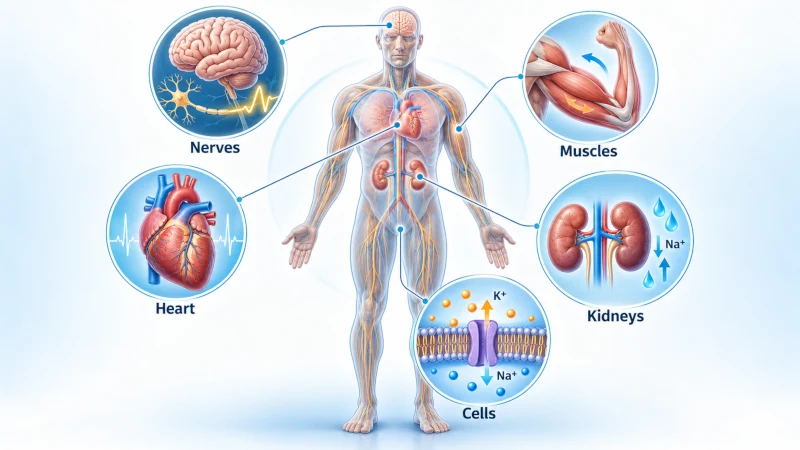
Beyond that electrical role, potassium helps your kidneys manage fluid balance and clear excess sodium, it’s needed for the pancreas to release insulin, and it participates in turning blood sugar into stored glycogen [NIH ODS, 2022]. Sodium, potassium, and chloride are often described as a team of electrolytes, and they do work closely together. But the old idea that potassium is simply “the most important” of the three oversimplifies things — each has distinct jobs, and it’s the balance between sodium and potassium, not either one alone, that tends to matter most for blood pressure.
How much potassium do you need?
There’s no single number for everyone. National expert committees set an Adequate Intake (AI), which varies by age and sex [NIH ODS, 2022]:
| Group | Adequate Intake (per day) |
| Men, 19+ | 3,400 mg |
| Women, 19+ | 2,600 mg |
| Pregnancy | 2,600–2,900 mg |
| Breastfeeding | 2,500–2,800 mg |
| Children, 1–3 yrs | 2,000 mg |
| Children, 4–8 yrs | 2,300 mg |
| Teens, 14–18 yrs | 2,300 mg (girls) / 3,000 mg (boys) |
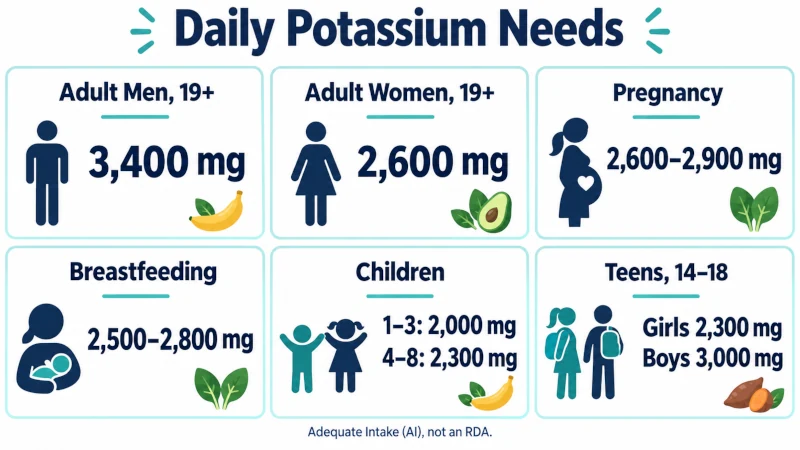
Source: NIH Office of Dietary Supplements [NIH ODS, 2022]
You’ll also see 4,700 mg on food labels — that’s the FDA’s Daily Value, a single reference figure used for labeling rather than a personal target [NIH ODS, 2022]. Either way, surveys show most people fall short: American men average about 3,016 mg a day and women about 2,320 mg, which is why potassium is flagged as a “nutrient of public health concern” [NIH ODS, 2022] [Harvard Health, 2026].
The World Health Organization takes a similar view, recommending that adults increase potassium from food and suggesting at least 3,510 mg a day to help lower blood pressure and cardiovascular risk [WHO, 2012].
Why you won’t see an “RDA” for potassium
If you’ve seen a page listing a precise “RDA” for potassium (some older sources cite figures like 1,875 mg), treat it with caution. Experts concluded the evidence wasn’t strong enough to set a formal Recommended Dietary Allowance, so they set an Adequate Intake instead [NIH ODS, 2022]. For the same reason, there is no Tolerable Upper Intake Level for potassium from food in healthy people — not because unlimited potassium is safe, but because healthy kidneys clear dietary excess, and the data weren’t sufficient to pin down an upper number [NIH ODS, 2022]. That distinction becomes important in the safety section below.
The real potassium benefits, graded by the evidence
Not all of potassium’s reputed benefits are equally proven. Here’s where the evidence is strong, where it’s mixed, and where it’s still early.
Blood pressure — the strongest case (though still nuanced)
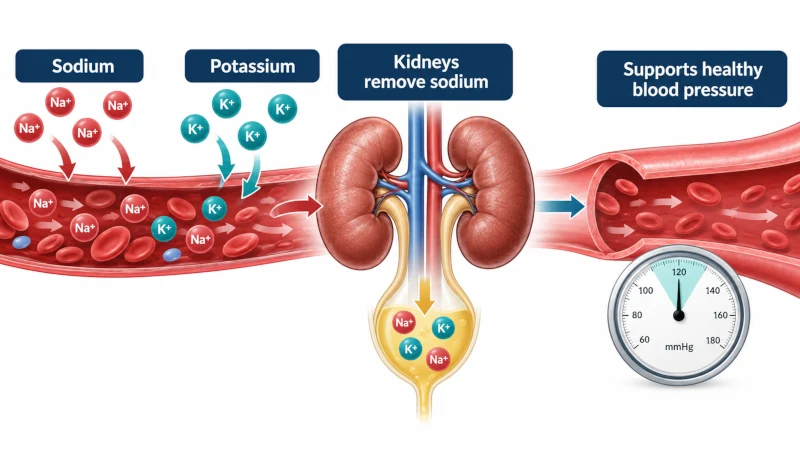
This is potassium’s best-supported benefit. A large body of research links low potassium intake — especially alongside high sodium — to a higher risk of high blood pressure [NIH ODS, 2022]. Getting more potassium appears to lower blood pressure partly by relaxing blood vessel walls and helping the kidneys flush out sodium, and the effect tends to be strongest in people who are “salt-sensitive” [NIH ODS, 2022].
The DASH eating pattern, built around potassium-rich fruits, vegetables, and low-fat dairy, lowered systolic blood pressure by about 5.5 mmHg and diastolic by about 3.0 mmHg in trials [NIH ODS, 2022]. An honest caveat: DASH also raises magnesium and calcium at the same time, so potassium’s individual contribution can’t be cleanly separated. For potassium specifically, a 2017 review of 25 randomized controlled trials in 1,163 people with hypertension found supplementation reduced systolic pressure by about 4.48 mmHg and diastolic by about 2.96 mmHg [NIH ODS, 2022] [Filippini et al., 2017].
The picture isn’t uniform, though. A Cochrane review of the six highest-quality trials found the reductions were not statistically significant, and a 2018 U.S. government review judged the observational link between potassium and blood pressure inconsistent [NIH ODS, 2022]. The fair summary: for people who already have high blood pressure and low potassium intake, eating more potassium-rich food is a well-supported, low-risk step — but it’s part of an overall dietary pattern, not a standalone cure. If blood pressure is your reason for reading this, it helps to understand how the three main electrolytes work together and how the sodium-potassium balance shapes your numbers.
Stroke and heart disease
Higher potassium intake has been linked to a lower risk of stroke. Pooled analyses of large populations found roughly a 21% to 24% lower stroke risk among people with higher intakes, with the lowest risk seen around 3,500 mg a day [NIH ODS, 2022]. The benefit for other cardiovascular disease was smaller and less consistent [NIH ODS, 2022]. On the strength of this evidence, the FDA permits a qualified claim that “diets containing foods that are a good source of potassium and that are low in sodium may reduce the risk of high blood pressure and stroke” [NIH ODS, 2022]. Much of this likely traces back to potassium’s effect on blood pressure, though some studies suggest additional mechanisms.
Kidney stones
Diets higher in potassium (from fruits and vegetables) are associated with a lower risk of calcium kidney stones in observational studies, and potassium citrate supplements can reduce stone recurrence [NIH ODS, 2022]. One important nuance: researchers attribute much of that benefit to citrate — which binds urinary calcium and raises urine pH — rather than to potassium itself [NIH ODS, 2022]. So this is a real but indirect and still-developing benefit, and potassium citrate for stones is a medical decision, not a DIY one.
Bone health
Some observational studies and small trials suggest potassium from fruits and vegetables may support bone mineral density, possibly by buffering the acid load of a typical Western diet [NIH ODS, 2022]. But trial results are mixed, and because potassium-rich diets also supply calcium and magnesium, potassium’s independent effect on bone isn’t established [NIH ODS, 2022]. Promising, not proven.
Blood sugar and type 2 diabetes
Because potassium is needed for insulin release, low levels could in theory impair blood sugar control, and observational studies have linked lower potassium status to higher rates of type 2 diabetes [NIH ODS, 2022]. This hasn’t been confirmed in randomized trials, so it remains an early-stage association rather than a demonstrated benefit [NIH ODS, 2022].
The best foods high in potassium
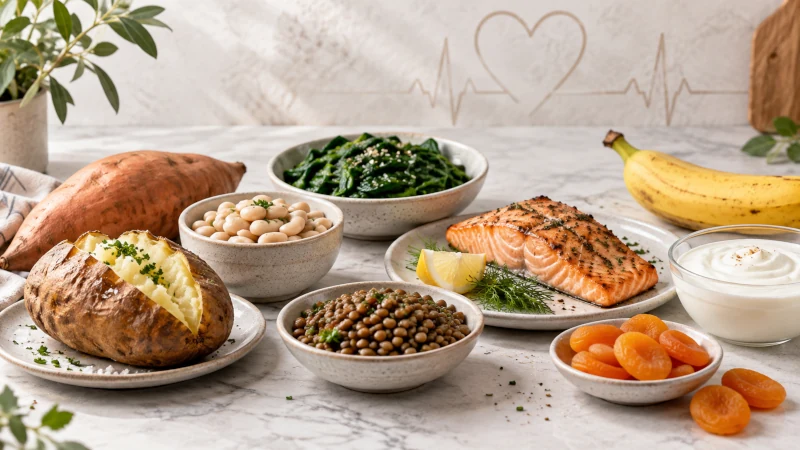
For most healthy adults, food is the better way to get potassium than pills — and it’s not hard, because potassium is spread across the plant and animal kingdoms. Bananas get the spotlight, but plenty of foods beat them. The potassium in whole foods also comes bound to compounds like citrate and phosphate (not the potassium chloride used in supplements and salt substitutes) and arrives alongside fiber and other nutrients [NIH ODS, 2022].
| Food (typical serving) | Potassium (mg) |
| Baked russet potato, with skin, 1 medium | 952 |
| Beet greens, cooked, ½ cup | 655 |
| Sweet potato, baked with skin, 1 medium | 542 |
| Salmon, cooked, 3 oz | 534 |
| Plain low-fat yogurt, 1 cup | 531 |
| White beans, cooked, ½ cup | 500 |
| Banana, 1 medium | 422 |
| Spinach, cooked, ½ cup | 419 |
| Dried apricots, ¼ cup | 378 |
| Lentils, cooked, ½ cup | 365 |
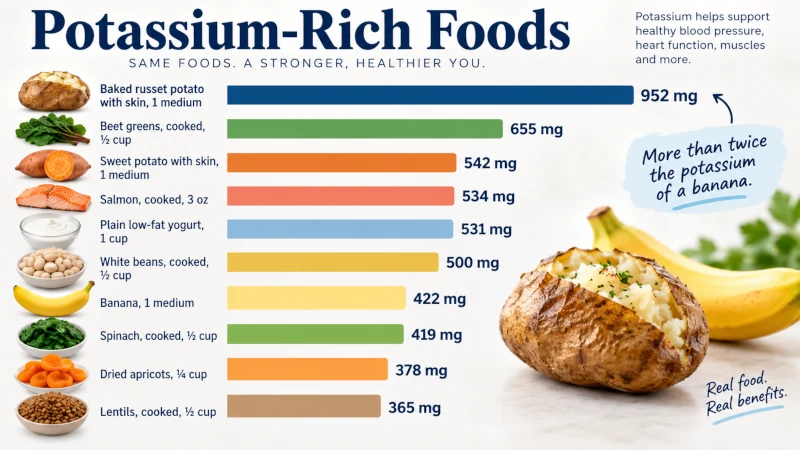
Source: Harvard Health / USDA FoodData Central [Harvard Health, 2026]
A practical note: much of a potato’s potassium sits in and just beneath the skin, so cooking it with the skin on (baked or “quick-baked,” not fried) keeps more of it [Harvard Health, 2026]. Beans, lentils, dark leafy greens, yogurt, and fish are all easy, high-return additions. Following a DASH or Mediterranean-style pattern does most of this work for you.
Signs your potassium may be low (hypokalemia)
Low blood potassium — hypokalemia — is uncommon from diet alone in healthy people with normal kidneys [NIH ODS, 2022]. It’s usually driven by something else: diuretics and certain other medications, vomiting, ongoing diarrhea, laxative overuse, or heavy sweating [NIH ODS, 2022]. Magnesium deficiency can also drive potassium down, which is one reason the two minerals are often addressed together [NIH ODS, 2022].
Mild hypokalemia can show up as constipation, fatigue, muscle weakness, and a general feeling of being unwell [NIH ODS, 2022]. More severe drops (roughly below 2.5 mmol/L) are a medical emergency and can cause muscle paralysis, poor breathing, and dangerous heart rhythm disturbances [NIH ODS, 2022].
Seek prompt medical care for heart palpitations or an irregular heartbeat, severe or spreading muscle weakness, or muscle paralysis — especially if you take a diuretic or have heart disease. Low potassium on a blood test despite a reasonable diet is a reason to talk with your clinician about the cause, not to start supplementing on your own.
When potassium becomes dangerous: too much (hyperkalemia)
This is where a lot of popular health writing gets it wrong. You may have read that “you can’t get too much potassium.” That is false, and for some people it’s a dangerous idea.
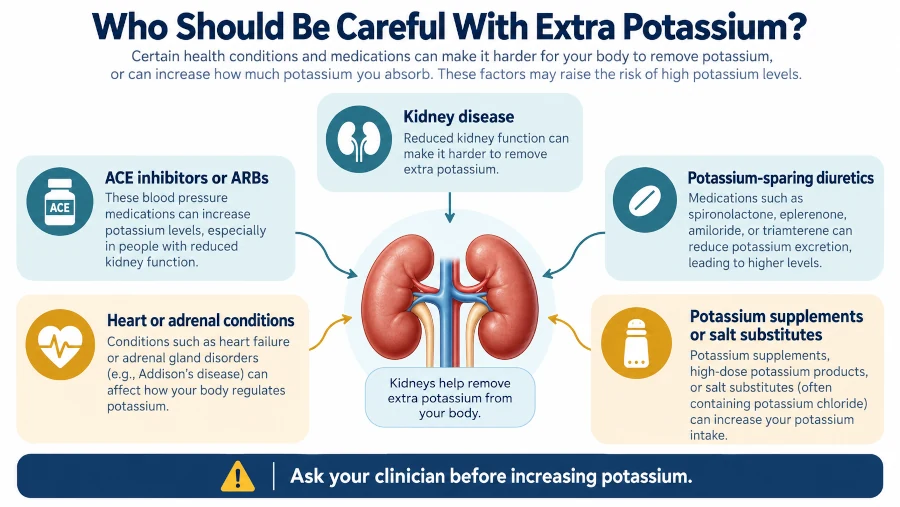
Here’s the accurate version. In healthy people with normal kidney function, high dietary potassium generally doesn’t cause harm, because the kidneys excrete the surplus — which is why no upper limit was set for food [NIH ODS, 2022]. But that safety depends entirely on working kidneys and normal medications. When potassium excretion is impaired, even ordinary amounts can accumulate to harmful levels — a condition called hyperkalemia [NIH ODS, 2022]. People at higher risk include those with:
- Chronic kidney disease
- Use of ACE inhibitors, ARBs, or potassium-sparing diuretics
- Type 1 diabetes, congestive heart failure, adrenal insufficiency, or liver disease [NIH ODS, 2022]
On top of that, very high doses of potassium supplements or potassium-based salt substitutes can overwhelm the kidneys’ capacity and trigger acute hyperkalemia even in otherwise healthy people [NIH ODS, 2022]. Hyperkalemia can be silent, but severe cases cause muscle weakness or paralysis, a burning or prickling sensation in the limbs, heart palpitations, and heart rhythm disturbances that can be life-threatening [NIH ODS, 2022].
Seek urgent care for a fast, irregular, or pounding heartbeat combined with muscle weakness, numbness or tingling, or shortness of breath — particularly if you have kidney disease or take one of the medications above. If you have any stage of kidney disease, the usual “eat more potassium” advice may be exactly backward for you, and you should get individualized guidance rather than following general recommendations.
Supplements, salt substitutes, and medication interactions
Most over-the-counter potassium supplements contain no more than 99 mg per serving — about 2% of the Daily Value — in part because higher-dose potassium chloride products have been associated with small-bowel injuries [NIH ODS, 2022]. Supplements can also cause minor stomach upset [NIH ODS, 2022]. For most people, food does the job better and more safely.
Salt substitutes deserve special mention because they swap potassium chloride for some of the sodium chloride in salt. That can help cut sodium, but the potassium load varies widely — from roughly 440 mg to 2,800 mg per teaspoon — which is a real hazard for anyone with kidney disease or on potassium-raising medications [NIH ODS, 2022]. Read the label, and check with a clinician before relying on one.
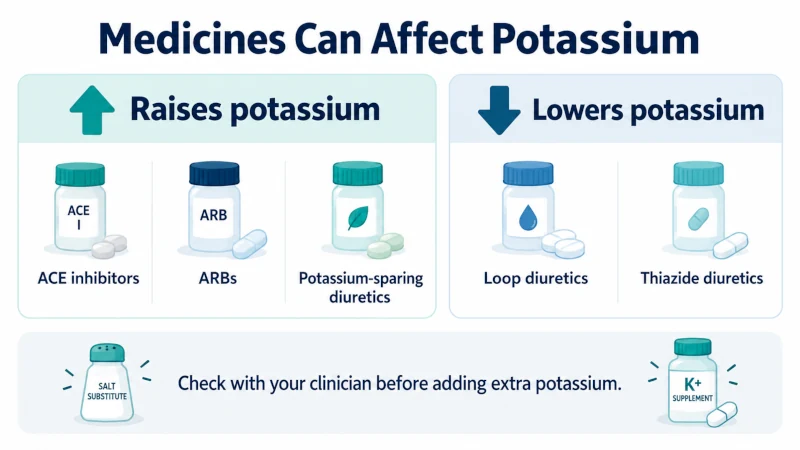
Several medications interact with potassium in ways that can be dangerous:
| Medication class (example) | Effect on potassium | What to know |
| ACE inhibitors (e.g., lisinopril) | Reduce excretion — can raise levels | Don’t add potassium supplements or high-potassium salt substitutes without your prescriber |
| ARBs (e.g., losartan) | Similar potassium-raising effect | Same caution as ACE inhibitors |
| Potassium-sparing diuretics (e.g., spironolactone, amiloride) | Actively retain potassium | Real risk of hyperkalemia; avoid supplemental potassium unless directed |
| Loop & thiazide diuretics (e.g., furosemide, HCTZ) | Increase potassium loss — can lower levels | Some people need more potassium, but only under monitoring |
Source: NIH Office of Dietary Supplements [NIH ODS, 2022]
Because potassium and magnesium interact — and magnesium depletion can drive potassium loss — clinicians sometimes check and correct both together [NIH ODS, 2022]. If you’re curious how magnesium fits into this picture, that’s a related read, but any decision to supplement either mineral belongs with your clinician, not the supplement aisle.
Potassium in pregnancy and breastfeeding
Potassium needs are slightly higher during pregnancy (about 2,600–2,900 mg a day) and breastfeeding (about 2,500–2,800 mg) [NIH ODS, 2022]. For healthy pregnancies, meeting those needs through food — fruits, vegetables, beans, dairy — is the goal, and WHO’s guidance to increase dietary potassium explicitly applies to pregnant and breastfeeding women (except those with impaired potassium excretion) [WHO, 2012]. As with anyone, potassium supplements during pregnancy or breastfeeding should only be taken on the advice of your healthcare provider.
When to talk to a healthcare professional
Reach out to a clinician before making big changes if you have kidney disease or reduced kidney function; take a blood pressure medication, especially an ACE inhibitor, ARB, or potassium-sparing diuretic; take diuretics or laxatives regularly; have heart disease, diabetes, adrenal, or liver conditions; or are considering a potassium supplement or salt substitute. And seek prompt medical attention for the red-flag symptoms above — palpitations or irregular heartbeat, severe muscle weakness or paralysis, or numbness and tingling with shortness of breath.
| Health disclaimer: This article is for educational purposes only and is not medical advice. It cannot account for your personal history, your kidney function, or your medications. Potassium needs and safe limits differ from person to person, and for people with kidney disease or on certain medications, “more potassium” can be harmful. Talk with a qualified healthcare professional before starting a potassium supplement or salt substitute, changing your diet significantly, or adjusting any medication. If you think you’re having a medical emergency — such as a severe irregular heartbeat with muscle weakness — call your local emergency number (911 in the U.S.). |
Frequently Asked Questions
How much potassium do I need per day?
For most adults, the Adequate Intake is 3,400 mg a day for men and 2,600 mg for women, with slightly higher amounts in pregnancy and breastfeeding [NIH ODS, 2022]. The 4,700 mg figure on food labels is the FDA’s Daily Value used for labeling, not a personal target. Most people fall short of these amounts [NIH ODS, 2022].
Can you get too much potassium?
From food, that’s rare if your kidneys work normally — the kidneys clear the excess, which is why no upper limit was set for dietary potassium [NIH ODS, 2022]. The real risk comes from supplements, potassium-based salt substitutes, or from kidney disease and medications that impair potassium excretion, any of which can push levels into dangerous territory (hyperkalemia) [NIH ODS, 2022].
What are the best foods for potassium?
A baked potato or sweet potato with the skin, beans and lentils, dark leafy greens like spinach and beet greens, salmon, plain yogurt, dried apricots, and yes, bananas [Harvard Health, 2026]. Whole foods also deliver potassium alongside fiber and other nutrients.
Is a potassium supplement a good idea for blood pressure?
For most people, getting potassium from food is safer and at least as effective, and the strongest evidence is for overall eating patterns like DASH rather than pills [NIH ODS, 2022]. Supplements carry more interaction risk, especially with blood pressure medications — so that’s a conversation to have with your clinician, not a self-prescription.
Should I use a potassium-based salt substitute?
It can lower sodium and raise potassium, but the potassium per teaspoon varies a lot (up to about 2,800 mg), and salt substitutes are not safe for people with kidney disease or on potassium-raising medications [NIH ODS, 2022]. Check with a clinician first.
What are the signs of low potassium?
Mild cases can cause constipation, fatigue, and muscle weakness; severe cases can cause paralysis and dangerous heart rhythms and need emergency care [NIH ODS, 2022]. Low potassium is usually caused by medications, vomiting, or diarrhea rather than diet alone.
References
- National Institutes of Health, Office of Dietary Supplements. Potassium — Fact Sheet for Health Professionals. Updated June 2, 2022. View source
- Harvard Health Publishing (Hendley J; reviewed by Fung T, ScD, RD). The best foods high in potassium — and why you need them. June 1, 2026. View source
- World Health Organization. Guideline: Potassium Intake for Adults and Children. Geneva: WHO; 2012 (NCBI Bookshelf NBK132453). View source
- Filippini T, Violi F, D’Amico R, Vinceti M. The effect of potassium supplementation on blood pressure in hypertensive subjects: A systematic review and meta-analysis. Int J Cardiol. 2017;230:127–135. PMID 28024910. View source
