
Buchu leaves come from a small South African shrub whose extract was once the best-selling patent medicine in the United States. The short answer most pages skip: no human clinical trials show that buchu treats urinary tract infections, kidney problems, or anything else taken by mouth, and the leaves carry real safety cautions, especially in pregnancy [Brendler & Abdel-Tawab, 2022; RxList, n.d.].
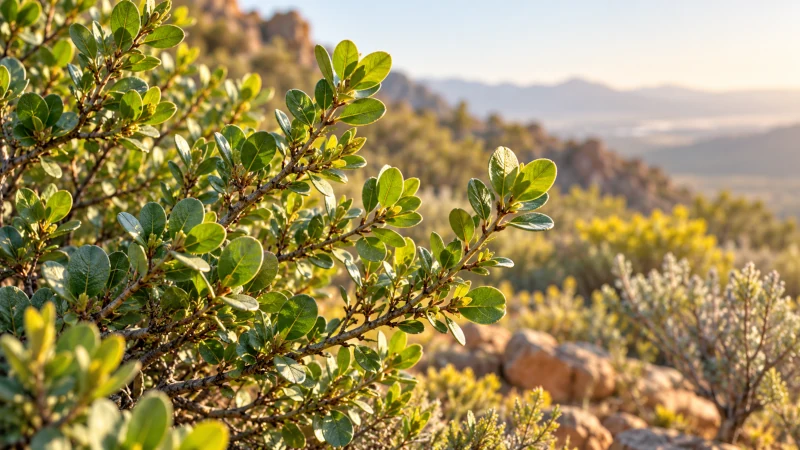
That does not make buchu worthless or its history a myth. It means the gap between its reputation and the evidence is wide. If you are dealing with burning, urgency, or pain when you urinate right now, buchu leaves should not stand in for a diagnosis. Here is what the plant is, what lab and animal research has found, who should avoid it, and the symptoms that mean it is time to see a clinician.
What are buchu leaves?
Today, “buchu” refers to two related shrubs sold commercially: round-leaf buchu (Agathosma betulina) and oval-leaf buchu (Agathosma crenulata). Both belong to the citrus family, Rutaceae, and are native to South Africa [Brendler & Abdel-Tawab, 2022]. Older books call the genus Barosma, and the “long buchu” some herbals list as a third species, Barosma serratifolia, is now treated as another name for A. crenulata [Brendler & Abdel-Tawab, 2022].
The leaves are small and leathery, dotted with oil glands on the underside. Crush one and you get blackcurrant, with something between rosemary and peppermint underneath [Drugs.com, 2026]. Much of that blackcurrant note comes from diosphenol, a compound produced only by this genus, which is why buchu oil is used to flavor sweets and drinks [Brendler & Abdel-Tawab, 2022].
| Quick facts | |
| Botanical names | Agathosma betulina (round-leaf); A. crenulata (oval-leaf); formerly Barosma |
| Family | Rutaceae (citrus family) |
| Native range | South Africa |
| Part used | Leaves |
| Notable compounds | Essential oil (diosphenol, pulegone, menthone, limonene); flavonoids such as diosmin, hesperidin and rutin |
| Common forms sold | Loose tea, capsules, tinctures, extracts, essential oil, “buchu water” |
From Khoisan remedy to patent medicine
The Khoisan peoples of southern Africa used buchu in ritual, as a perfume and anointing preparation, and as medicine long before anyone wrote it down. That knowledge belongs to them, a point the authors of the most detailed modern history of the plant make explicitly [Brendler & Abdel-Tawab, 2022]. European settlers picked it up, and by the 1800s buchu sat in pharmacopoeias across Europe and the United States as a treatment for urinary complaints.
In the US its fame owed a lot to advertising. Henry Helmbold sold “Extract Buchu” with claims ranging from diabetes to bladder irritation, and by 1865 it was reportedly the best-selling patent medicine in the country [Brendler & Abdel-Tawab, 2022].
Then antibiotics arrived. A 1949 British formulary noted that buchu had been superseded by sulfonamides and penicillin. It was dropped from the US Pharmacopeia in 1930 and from the National Formulary in 1960 [Brendler & Abdel-Tawab, 2022]. Germany’s Commission E later issued a negative monograph: because its claimed effectiveness had not been documented, buchu could not be recommended as a medicine, although using it to flavor tea blends was acceptable [Brendler & Abdel-Tawab, 2022].
What is in buchu leaves — and why the species matters
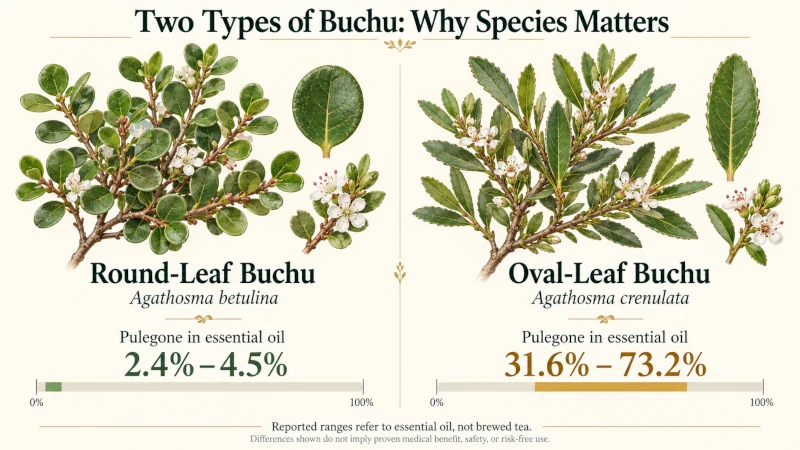
Buchu leaves hold roughly 1.5% to 3.5% volatile oil [Drugs.com, 2026]. Alongside diosphenol, that oil contains pulegone, the same liver-toxic compound found in much higher amounts in pennyroyal [Drugs.com, 2026]. How much pulegone you get depends heavily on which buchu you have.
| Round-leaf buchu (A. betulina) | Oval-leaf buchu (A. crenulata) | |
| Pulegone in the essential oil* | About 2.4%–4.5% | About 31.6%–73.2% |
| Diosphenol | Present, often in meaningful amounts | Traces only |
| What reviewers recommend | Preferred, because of lower pulegone | Use more caution, especially with the oil |
*Ranges from Collins et al. (1996), as summarized in Brendler & Abdel-Tawab (2022). Hybrids of the two species exist in cultivation and fall in between.
The catch for shoppers: labels rarely say which species is inside, hybrids are common in cultivation, and the review notes that buchu products sold as supplements are often adulterated [Brendler & Abdel-Tawab, 2022]. You usually cannot tell from the package how much pulegone you are getting.
Buchu leaves benefits: what the research actually shows
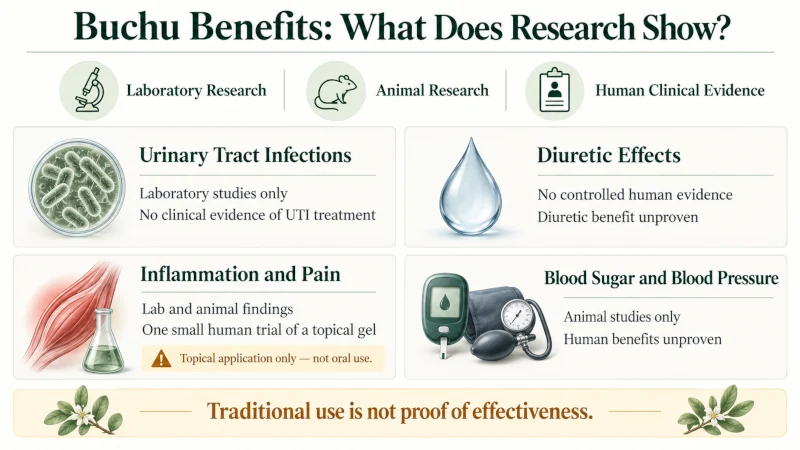
Almost everything known about buchu’s effects comes from test tubes and rodents. The most thorough recent review concluded that the clinical trials needed to test buchu’s traditional uses have not been done, and that studies so far have failed to confirm those uses [Brendler & Abdel-Tawab, 2022]. We found no human trials of oral buchu published since that review.
Urinary tract infections
This is buchu’s headline use, and the lab results are underwhelming. Extracts made with methanol and dichloromethane, solvents nobody uses at home, showed moderate activity against several bacteria and yeasts, at concentrations hundreds of times higher than the antibiotic controls needed. The essential oil did worse. Water and alcohol extracts, the closest thing to a tea or tincture, did not slow the growth of E. coli, the most common cause of bladder infections, at all [Brendler & Abdel-Tawab, 2022].
Put plainly: the forms people actually drink performed worst in the lab, and nothing has been tested in people with infections. Experts specifically advise against using buchu for kidney infections [RxList, n.d.].
The diuretic (“water pill”) claim
Older herbals call buchu an excellent diuretic. No controlled study supports that. Drugs.com’s professional monograph says there is no scientific evidence to justify buchu’s herbal uses and that any diuretic action of buchu tea is probably no greater than the caffeine in an ordinary cup of coffee or tea [Drugs.com, 2026]. It is also why the “strengthens the kidneys” language in older guides has no backing.
Inflammation and pain
Buchu extracts blocked some inflammation-related enzymes in lab dishes, though the essential oil’s activity was weak, and an alcohol extract reduced pain responses in mice [Brendler & Abdel-Tawab, 2022]. The only human data point is one small double-blind, placebo-controlled trial in 30 men: a gel containing round-leaf buchu oil, rubbed on the skin three times a day, reduced pain and swelling after exercise-induced muscle damage [Brendler & Abdel-Tawab, 2022]. That is a topical product for sore muscles. It says nothing about drinking buchu for inflammation of the prostate, colon, sinuses, or gums, all claims from older herbals.
Blood sugar, weight, and blood pressure
A commercial “buchu water” (a by-product of distilling the oil) normalized blood sugar in some diabetic rats, limited weight and belly-fat gain in rats on a high-fat diet, and brought their blood pressure back down [Brendler & Abdel-Tawab, 2022]. Those are interesting animal results. The extract’s exact composition was not disclosed, other labs have not repeated the work, and the reviewers judged the effects questionable in humans until clinical trials exist [Brendler & Abdel-Tawab, 2022]. If you have diabetes, buchu is not a substitute for your treatment plan.
Evidence at a glance
| Claimed use | Best available evidence | Verdict |
| Treating a UTI | Lab only; tea- and tincture-type extracts inactive against E. coli | Insufficient — not a substitute for diagnosis and treatment |
| Kidney infection | None; experts advise against it | Avoid — needs prompt medical care |
| Diuretic / fluid retention | No controlled human data; likely no stronger than caffeine | Unsupported |
| Internal inflammation (prostate, colon, sinuses) | Lab dishes and mice | Insufficient |
| Sore muscles (gel on the skin) | One small trial in 30 men | Limited |
| Diabetes, weight, blood pressure | Rat studies of one commercial extract | Insufficient (animal only) |
| Sexually transmitted infections | None | Not appropriate — get tested and treated |
| Food flavoring | Long-standing use in the flavor industry | Established use, not a health claim |
Sources: Brendler & Abdel-Tawab, 2022; Drugs.com, 2026; RxList, n.d.
Side effects and safety
Buchu is rated likely safe in food amounts and possibly safe in appropriate medicinal amounts, but possibly unsafe in larger amounts or when the oil is swallowed [RxList, n.d.]. The side effects reported most often are stomach and kidney irritation and heavier menstrual bleeding [Drugs.com, 2026; RxList, n.d.].
Pulegone and your liver
Pulegone damages the liver at high doses, and buchu essential oil given to rats in large amounts harmed the liver [Drugs.com, 2026; Brendler & Abdel-Tawab, 2022]. For context, European regulators reviewing pulegone in mint oils identified the liver and kidneys as its main targets and set a limit for medicines of 0.75 mg per kilogram of body weight per day, about 37.5 mg for a 50 kg adult. Cases of pennyroyal oil poisoning show moderate to severe toxicity after about 10 mL and deaths after more than 15 mL [EMA, 2016]. That statement is about mint oils, not buchu, but the chemistry is the same compound.
Here the sources lean in slightly different directions. The 2022 review points out that pulegone does not dissolve well in water, so its caution applies mainly to the oil rather than to water infusions [Brendler & Abdel-Tawab, 2022]. Natural Medicines data, by contrast, advise that people using buchu have their liver function monitored [RxList, n.d.]. Both agree on the practical rule: never swallow buchu essential oil, and skip buchu entirely if you have liver disease.
Drug interactions
Again, the references disagree. Drugs.com lists no well-documented interactions [Drugs.com, 2026]. Natural Medicines data, published via RxList, flag two moderate cautions [RxList, n.d.]:
- Lithium. If buchu acts like a mild water pill, it could reduce how well your body clears lithium and push levels up. Talk to your prescriber before using it.
- Blood thinners and antiplatelet drugs (warfarin, heparin, clopidogrel, aspirin, ibuprofen, naproxen and others). Buchu might slow clotting, which could raise the risk of bruising and bleeding.
Those warnings are theoretical rather than based on reported cases, but they are reasonable enough to take seriously. The same source advises stopping buchu at least two weeks before scheduled surgery [RxList, n.d.].
Who should avoid buchu
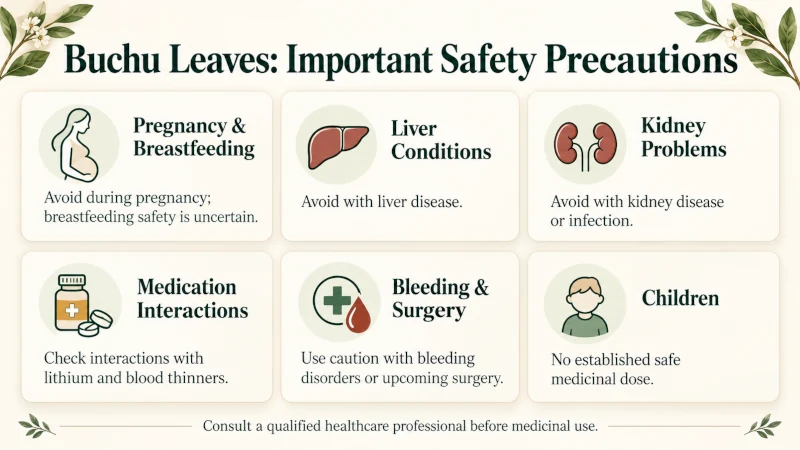
- Pregnant people. Buchu is rated likely unsafe in pregnancy, with reports linking it to miscarriage, and it has documented uterine-stimulant effects [RxList, n.d.; Drugs.com, 2026].
- Breastfeeding parents. Not enough is known; avoid more than food amounts [RxList, n.d.].
- Anyone with liver disease or who takes medicines that strain the liver, because of pulegone [Drugs.com, 2026].
- Anyone with a kidney infection, kidney disease, or a painful, inflamed urinary tract [RxList, n.d.; Drugs.com, 2026].
- People with bleeding disorders or upcoming surgery [RxList, n.d.].
- People taking lithium or blood thinners, unless a clinician has cleared it [RxList, n.d.].
- Children. There is no clinical evidence to guide any buchu dose [Drugs.com, 2026], so do not give it to kids.
How buchu leaves are used — and what to skip

Most people meet buchu as a loose-leaf tea, a capsule, or one ingredient in a “urinary support” blend. There is no evidence-based dose. Drugs.com notes that no recent clinical evidence guides dosing and that classical herbal texts used 1 to 2 grams of dried leaf a day [Drugs.com, 2026]. Treat that as history, not a recommendation.
Earlier versions of this page listed tea, tincture, extract and capsule doses along with a buchu tea blend. We have removed them, for these reasons:
- The blend contained comfrey leaf. Comfrey should never be swallowed in any form; our comfrey guide explains the liver risk.
- It paired buchu with uva ursi as a daily drink. European regulators accept uva ursi only as a traditional, short-term remedy for adult women, for no more than one week, after a doctor has ruled out serious problems, and never with kidney disorders [EMA, 2018]. Our guide to herbal remedies for the urinary system covers uva ursi and cranberry in more detail.
- It suggested urethral washes. Nothing supports this, and an inflamed urinary tract is a reason to avoid buchu altogether [RxList, n.d.]. Do not put herbal infusions into the urethra.
- The doses had no traceable source. Without clinical data, a precise-looking number gives false confidence.
If, after talking to a doctor or pharmacist, you still want to try buchu tea, choose a product that names Agathosma betulina on the label, use it briefly, and stop if you get stomach upset or your symptoms do not improve. Never use the essential oil internally.
Buchu, UTIs, and when to see a doctor

Antibiotics treat urinary tract infections, and a healthcare professional can tell you whether you have one and which antibiotic you need [CDC, 2026]. See a clinician if you have any UTI symptoms, such as [CDC, 2026]:
- Pain or burning when you urinate
- Needing to go often, or feeling you need to go when your bladder is empty
- Blood in your urine
- Pressure or cramping in the groin or lower belly
Get care promptly if you have fever, chills, lower back or side pain, or nausea and vomiting. Those can signal a kidney infection, which is more serious than a bladder infection [CDC, 2026]. Pregnancy raises UTI risk, so call your clinician about any urinary symptoms while pregnant [CDC, 2026]. A baby younger than 3 months with a temperature of 100.4 °F (38 °C) or higher needs a healthcare professional right away [CDC, 2026].
One more reason not to self-treat: UTI symptoms can look like a sexually transmitted infection, so ask whether you should be tested [CDC, 2026]. Older herbals recommended buchu for venereal disease. That advice is obsolete. Our overview of urinary symptoms that need a doctor lists the full set of red flags.
| HEALTH DISCLAIMER: This article is for general education and is not medical advice. Buchu has not been shown to treat any disease in people and is not a substitute for diagnosis or treatment from a qualified professional. Urinary symptoms can signal infections that need prompt antibiotic treatment. If you are pregnant or breastfeeding, have liver or kidney disease or a bleeding disorder, take lithium, a blood thinner or other prescription medicine, are preparing for surgery, or are considering any herbal product for a child, talk with your doctor or pharmacist first. Never swallow buchu essential oil. Seek care promptly if symptoms are severe, include fever or back pain, or get worse. |
Frequently Asked Questions
Can buchu leaves cure a UTI?
No. In lab tests, water and alcohol extracts of buchu did not inhibit E. coli, and no clinical trials have tested buchu in people with infections [Brendler & Abdel-Tawab, 2022]. Antibiotics treat UTIs, so see a clinician if you have symptoms [CDC, 2026].
Is buchu tea safe to drink?
In small, food-like amounts it is probably low-risk for most healthy adults. Larger medicinal amounts are less certain, and the essential oil should never be swallowed [RxList, n.d.]. Avoid it entirely if you are pregnant, breastfeeding, or have liver or kidney problems.
Is buchu safe during pregnancy?
No. It is rated likely unsafe in pregnancy, with reports linking it to miscarriage and documented uterine-stimulant effects [RxList, n.d.; Drugs.com, 2026].
What is the difference between round-leaf and oval-leaf buchu?
Round-leaf buchu (A. betulina) has far less pulegone in its oil than oval-leaf buchu (A. crenulata), so researchers prefer it [Brendler & Abdel-Tawab, 2022]. Many products do not say which one they contain.
Can I take buchu with lithium or blood thinners?
Check with your prescriber first. Natural Medicines data flag moderate cautions for both, although Drugs.com lists no well-documented interactions [RxList, n.d.; Drugs.com, 2026].
Why does buchu smell like blackcurrant?
Diosphenol, a compound found only in buchu, gives it that note, which is why the oil is used as a fruit flavoring in foods and drinks [Brendler & Abdel-Tawab, 2022].
References
- Brendler T, Abdel-Tawab M. Buchu (Agathosma betulina and A. crenulata): Rightfully forgotten or underutilized? View source
- Drugs.com. Buchu (professional natural products monograph). View source
- RxList. Buchu: health benefits, side effects, uses, dose & precautions. View source
- European Medicines Agency, Committee on Herbal Medicinal Products. Public statement on the use of herbal medicinal products containing pulegone and menthofuran. View source
- European Medicines Agency. Uvae ursi folium (bearberry leaf) — herbal medicinal product; summary for the public EMA/181295/2018. View source
- Centers for Disease Control and Prevention. Urinary Tract Infection Basics. View source


