
Mastic is the pale, piney resin that seeps from cuts in the bark of the mastic tree, Pistacia lentiscus, and people around the Mediterranean have chewed it, swallowed it, and spread it on skin for more than two thousand years. The honest summary of the mastic tree’s pros and cons is this: European regulators accept mastic as a traditional remedy for mild indigestion and minor skin inflammation, one small trial suggests it reduces plaque, and its fame as an H. pylori cure runs well ahead of the evidence [EMA, 2016a; Soulaidopoulos et al., 2022].

It also has a clean safety record, with a few firm exceptions: allergy, pregnancy, breastfeeding, and children.
| Quick answer Reasonable to try: short-term use for mild indigestion (up to 2 weeks).Interesting but unproven: plaque and gum health; Crohn’s disease; cholesterol.Don’t rely on it: clearing H. pylori. Prescribed treatment works far better.Skip it if: you’re pregnant or breastfeeding, under 18 (for oral use), or have reacted to mastic or mastic-based skin adhesives. |
What Is the Mastic Tree?
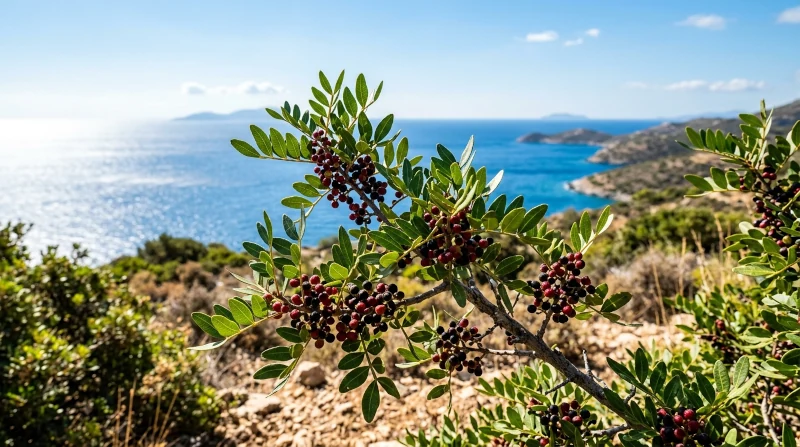
The mastic tree is an evergreen Mediterranean shrub. It grows wild across the region, but the resin is best known from the Greek island of Chios, where “Chios mastic” has been a Protected Designation of Origin product since 1997 [EMA, 2016b]. Growers there start cutting the bark in July; the resin drips out, hardens into translucent “tears,” and is hand-collected, cleaned, and stored cool. UNESCO added that know-how to its intangible cultural heritage list in 2014 [UNESCO, 2014].
| Quick facts | |
| Scientific name | Pistacia lentiscus L. (Chios resin is sometimes labeled var. or cv. chia) |
| Other names | Lentisk; mastiha (Greek); lentisco (Spanish); lentisque (French) |
| Parts used | The resin; the leaves in folk practice |
| Key compounds | Triterpenes (including mastic acids and oleanolic acid), an essential oil that is mostly alpha-pinene, and a sticky natural polymer, poly-β-myrcene [EMA, 2016b] |
| EU status | Traditional herbal medicine for mild indigestion and minor skin inflammation [EMA, 2016a] |
Mastic Tree Benefits: What the Evidence Shows
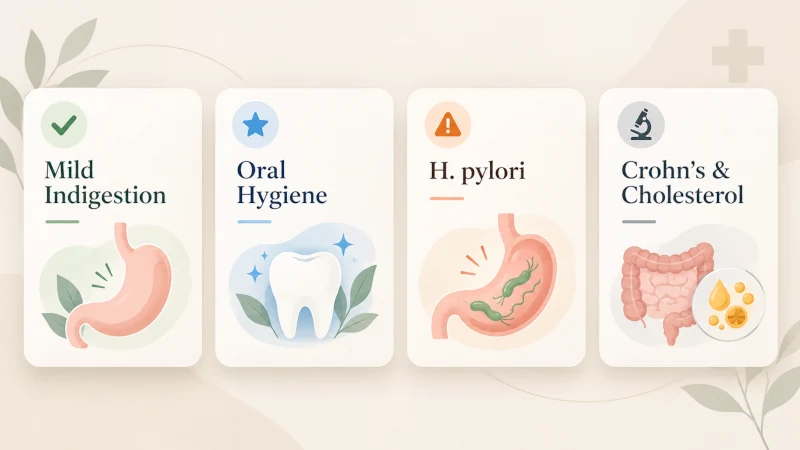
Mastic has a long list of reputed benefits and a short list of good studies. Here is how the main uses stack up.
| Use | Evidence | What it means for you |
| Mild indigestion | Accepted traditional use (EU) plus one placebo-controlled trial | Reasonable to try for up to 2 weeks |
| H. pylori infection | Strong lab data; disappointing small human trials | Not a substitute for antibiotics |
| Plaque and gums | One small pilot trial; lab studies | Promising, unproven |
| Minor skin inflammation | Accepted traditional use (EU) | Topical products only |
| Crohn’s disease, cholesterol | A few small trials; mixed results | Not enough to act on |
Mild indigestion
This is mastic’s best-supported use, and even here the support is modest. In 2016 the European Medicines Agency’s herbal committee adopted a monograph recognizing mastic as a traditional herbal medicine for mild dyspeptic disorders: that vague fullness, upper-belly discomfort, and burning most people call indigestion [EMA, 2016a].
“Traditional” is a specific regulatory label. It means the committee was satisfied by long, documented use and a plausible safety record, not by proof from clinical trials. The decision wasn’t unanimous, either. Four of 27 members dissented, arguing the evidence of traditional use didn’t support some of the indications and doses [EMA, 2016c].
The best human trial comes from Greece. Researchers randomly assigned 148 people with functional dyspepsia to mastic (350 mg three times a day) or a placebo for three weeks, and the mastic group reported significantly more relief from symptoms such as stomach pain and heartburn [Dabos et al., 2010a; Soulaidopoulos et al., 2022]. One trial from one team is a reason for interest, not certainty.
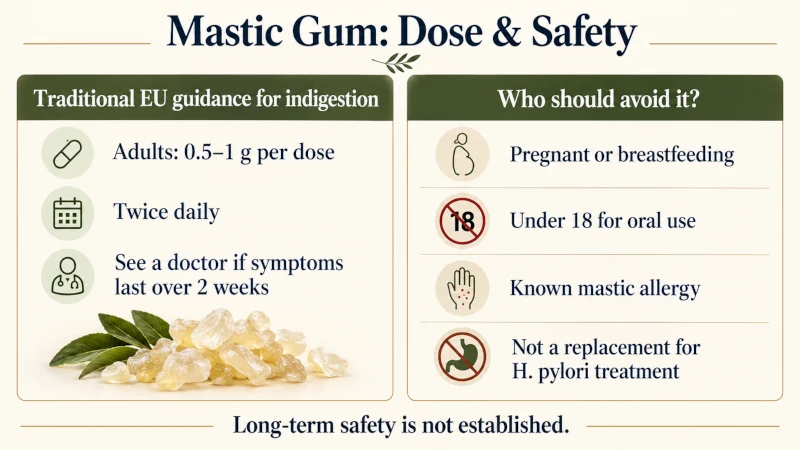
For adults, the EMA dose is 0.5–1 g of powdered resin twice a day. If your symptoms last longer than two weeks, stop and see a doctor [EMA, 2016a]. If you’d like to compare options, our guides to fennel for gas and bloating and herbs for the digestive system cover other traditional choices.
H. pylori: strong in the lab, weak as a treatment
Helicobacter pylori is the stomach bacterium behind most peptic ulcers, and mastic’s reputation here started in the lab, where its extracts kill the bacterium readily. Swallowing it is another story.
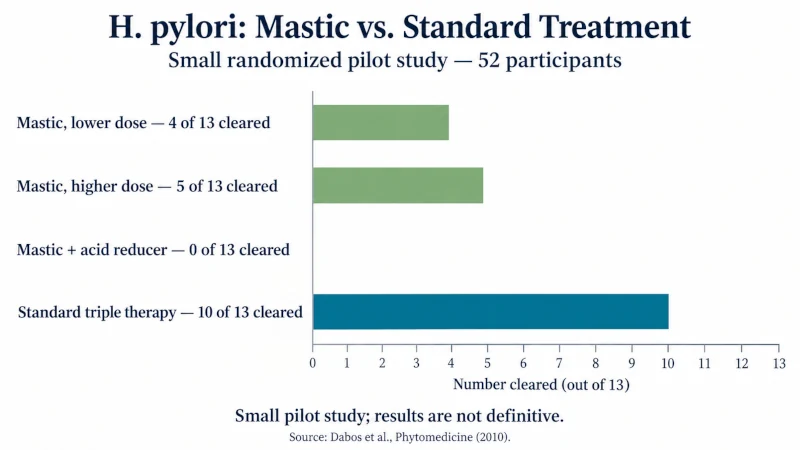
In one small study, eight people took 1 g of mastic four times a day for two weeks, with no effect on their infection [Soulaidopoulos et al., 2022]. A Greek pilot trial randomized 52 infected patients. Mastic alone cleared the infection in 4 of 13 people on the lower dose and 5 of 13 on the higher dose. Standard triple therapy (an acid-reducing proton pump inhibitor plus two antibiotics) cleared it in 10 of 13. Mastic combined with a proton pump inhibitor cleared it in no one, possibly because mastic works better in an acidic stomach [Dabos et al., 2010b; Soulaidopoulos et al., 2022].
You may also read that mastic works better once its sticky polymer is removed. That idea comes from a 2007 study in mice: a polymer-free extract given for three months cut H. pylori levels about 30-fold, but it didn’t eradicate the infection or calm the stomach inflammation [Paraschos et al., 2007]. That’s useful lab work, not a human treatment.
If you test positive for H. pylori, the treatment that works is a prescribed combination of antibiotics and a proton pump inhibitor, usually followed by a retest at least four weeks after you finish to make sure the infection is gone [NIDDK, n.d.-b]. An untreated infection can lead to ulcers, so this isn’t the place to experiment on your own.
Gums, plaque, and bad breath
Chewing mastic for oral hygiene is ancient. The first-century physician Dioscorides described it for oral care as well as indigestion and cough, and mastic gargling products have been sold since the 1950s [EMA, 2016b].
The modern evidence is thin but encouraging. In a small pilot study of 20 healthy dental students, chewing mastic gum lowered bacterial counts in saliva over four hours compared with a placebo gum. In a second part, 10 of them chewed either gum for a week without brushing; plaque and gum-inflammation scores were lower with mastic [Takahashi et al., 2003]. Lab studies also show activity against bacteria linked to gum disease, including Porphyromonas gingivalis [EMA, 2016b].
Some websites cite a 1985 study in which mastic cut plaque by 41.5 percent. We couldn’t trace that figure to any published paper, so we don’t rely on it.
In practice, mastic gum may be a pleasant extra, but it doesn’t treat gum disease. Early gum disease can often be reversed with daily brushing and flossing; advanced disease needs a dentist’s deep cleaning [NIDCR, n.d.]. For other add-ons to your routine, see what the science shows about prebiotic toothpaste.
Minor skin inflammation and small wounds
The EU monograph also recognizes mastic ointments and creams for minor skin inflammation and to help small wounds heal. These products contain 9–11% powdered resin and are applied in a thin layer up to three times a day by adolescents and adults [EMA, 2016a]. This is again traditional use rather than trial-proven. See a doctor if the skin looks infected or the problem lasts longer than a week.
Early research: Crohn’s disease and cholesterol
A handful of small Greek trials have tested mastic in inflammatory bowel disease, with mixed results. In a 10-person pilot in active Crohn’s disease, disease activity and inflammation markers fell over four weeks. A later six-month trial in 68 people with inactive disease didn’t show the hoped-for effect on key inflammation markers [Soulaidopoulos et al., 2022].
In an eight-week study of 156 people with high cholesterol, 1 g a day of crude mastic lowered total cholesterol by about 11.5 mg/dL from where it started, a modest change [Soulaidopoulos et al., 2022]. None of this is strong enough to justify using mastic for these conditions. If you live with Crohn’s disease or ulcerative colitis, talk to your gastroenterologist before adding any supplement.
The Cons: Side Effects, Allergy, and Unknowns
For an herbal product, mastic has an unusually quiet safety record. The EU monograph lists no known side effects and no reported drug interactions, and EMA’s reviewers found no side effects described in the literature despite widespread use [EMA, 2016a; EMA, 2016b]. Human trials, some using several grams a day, haven’t reported significant problems [Soulaidopoulos et al., 2022].
“No known side effects” is not the same as “proven safe.” Long-term safety hasn’t been well studied, and no one knows the maximum safe dose [Soulaidopoulos et al., 2022]. Proper genotoxicity testing is lacking, and in a 13-week rat study, liver weight rose at higher doses [EMA, 2016b].
Allergy is the clearest risk. Mastic is used in some medical skin adhesives, and allergic skin reactions have followed its use under post-surgical dressings [Soulaidopoulos et al., 2022]. In one patch-testing study reviewed by EMA, 13 of 18 people who were allergic to an adhesive product also reacted to gum mastic [EMA, 2024].
Who should avoid mastic
- Anyone who has reacted to mastic, or to a mastic-containing skin adhesive [EMA, 2016a; EMA, 2024].
- People who are pregnant or breastfeeding. There isn’t enough data, so it isn’t recommended [EMA, 2016a].
- Children and teens under 18 (oral use) and children under 12 (skin products). Safety hasn’t been established [EMA, 2016a].
- Anyone being treated for H. pylori or an ulcer, as a replacement for prescribed medicine.
- People with a pistachio or other tree-nut allergy, as a precaution. Mastic belongs to the same plant genus as pistachio. We found no good data on cross-reactions, so ask your allergist first.
Medication interactions
None have been reported [EMA, 2016a], but that partly reflects how little mastic has been studied. The H. pylori trial hint that acid-reducing drugs may blunt mastic’s effect is a good reason to tell your doctor or pharmacist about any supplement you take.
When to see a doctor or dentist
Indigestion with any of these needs prompt medical attention, not a herbal remedy [NIDDK, n.d.-a]:
- Chest, jaw, neck, or arm pain, or shortness of breath (call emergency services; this can be a heart attack)
- Black, tarry stools or bloody vomit
- Trouble or pain swallowing
- Frequent vomiting, or severe, constant belly pain
- Weight loss you didn’t try for, or loss of appetite
- Yellowing of the skin or eyes
Also see a doctor if indigestion keeps coming back or doesn’t improve. See a dentist if your gums bleed easily, look red or swollen, are pulling away from your teeth, or if you notice loose teeth or bad breath that won’t go away [NIDCR, n.d.].
How to Use Mastic Sensibly
Mastic comes as raw tears, powder, capsules, chewing gum, toothpaste, mouthwash, and skin creams. Raw tears soften into a waxy, gum-like mass as you chew.
If you use it for indigestion, stay within the EU guidance: 0.5–1 g twice a day for adults, for no more than two weeks without seeing a doctor [EMA, 2016a]. Check the label for how much mastic each capsule or piece actually contains, so you can stay within that range.
The leaves are a different matter. Folk remedies use a leaf-and-stem decoction as a mouth rinse, but no official dose exists and research is scant; in one lab study, only a leaf decoction showed weak antibacterial activity [EMA, 2016b]. We don’t recommend a dose for it.
Mastic in Food and Tradition
Most mastic is eaten rather than taken as medicine. In Greece it flavors mastiha liqueur, festive breads such as tsoureki and the New Year vasilopita, and many sweets. In Turkey it gives dondurma ice cream its texture and flavors Turkish delight, and it seasons desserts across the eastern Mediterranean. The Orthodox Church also uses it in myron, the holy oil used for chrismation.

| HEALTH DISCLAIMER: This article is for general education and isn’t a substitute for advice, diagnosis, or treatment from a qualified health professional. Mastic is a traditional remedy, not a proven treatment for any disease. If you have stomach symptoms that persist, a confirmed H. pylori infection or ulcer, inflammatory bowel disease, or gum problems, get them assessed. Talk to your doctor or pharmacist before using mastic if you are pregnant, breastfeeding, giving it to a child, taking prescription medicines, or have allergies. Stop using it and seek care if you develop a rash, swelling, or trouble breathing. |
Frequently Asked Questions
Is mastic gum the same thing as the mastic tree?
Mastic gum is the dried resin of the mastic tree. “Mastic gum” can mean raw resin tears, powder or capsules, or commercial chewing gum flavored with mastic, and these products aren’t interchangeable when it comes to dose.
Can mastic gum get rid of H. pylori?
Not reliably. In the best small trial, mastic alone cleared the infection in about a third of people, versus roughly three-quarters with standard antibiotic therapy Soulaidopoulos et al., 2022. Use the treatment your doctor prescribes and get retested afterward [NIDDK, n.d.-b].
How much mastic is safe to take?
The EU guidance for mild indigestion in adults is 0.5–1 g twice a day (1–2 g daily), for up to two weeks before checking with a doctor [EMA, 2016a]. Higher doses have been used in studies without obvious harm, but the maximum safe dose and long-term safety aren’t known [Soulaidopoulos et al., 2022].
Is mastic safe during pregnancy or breastfeeding?
It isn’t recommended. There isn’t enough safety data for either [EMA, 2016a].
Can chewing mastic every day help my gums?
Possibly a little. A small one-week study found less plaque and gum inflammation with mastic gum than a placebo gum [Takahashi et al., 2003]. It won’t replace brushing, flossing, and dental cleanings, and there are no long-term studies.
References
- European Medicines Agency, Committee on Herbal Medicinal Products. European Union herbal monograph on Pistacia lentiscus L., resin (mastic). EMA/HMPC/46758/2015. View source
- European Medicines Agency, HMPC. Assessment report on Pistacia lentiscus L., resina (mastic). EMA/HMPC/46756/2015. View source
- European Medicines Agency, HMPC. Opinion of the HMPC on a European Union herbal monograph on Pistacia lentiscus L., resin (mastic). EMA/HMPC/74864/2016. View source
- European Medicines Agency, HMPC. Addendum to assessment report on Pistacia lentiscus L., resina (mastic), periodic review. View source
- Soulaidopoulos S, Tsiogka A, Chrysohoou C, et al. Overview of Chios mastic gum (Pistacia lentiscus) effects on human health. View source
- Dabos KJ, Sfika E, Vlatta LJ, Frantzi D, Amygdalos GI, Giannikopoulos G. Is Chios mastic gum effective in the treatment of functional dyspepsia? A prospective randomised double-blind placebo controlled trial. J Ethnopharmacol. View source
- Dabos KJ, Sfika E, Vlatta LJ, Giannikopoulos G. The effect of mastic gum on Helicobacter pylori: a randomized pilot study. View source
- Takahashi K, Fukazawa M, Motohira H, Ochiai K, Nishikawa H, Miyata T. A pilot study on antiplaque effects of mastic chewing gum in the oral cavity. J Periodontol. View source
- Paraschos S, Magiatis P, Mitakou S, et al. In vitro and in vivo activities of Chios mastic gum extracts and constituents against Helicobacter pylori. Antimicrob Agents Chemother. View source
- UNESCO Intangible Cultural Heritage. Know-how of cultivating mastic on the island of Chios. View source
- National Institute of Diabetes and Digestive and Kidney Diseases. Symptoms & causes of indigestion. View source
- National Institute of Diabetes and Digestive and Kidney Diseases. Treatment for peptic ulcers (stomach or duodenal ulcers). View source
- National Institute of Dental and Craniofacial Research. Periodontal (gum) disease. View source


