
Sweet woodruff is a small woodland herb best known for the fresh-hay scent it gives German May wine. For centuries, people also used the woodruff plant as a folk remedy for nervous stomachs, restless nights, and bladder complaints. Here’s the honest picture: none of those uses has been tested in people, and the compound behind woodruff’s famous aroma, coumarin, can harm the liver if you take in too much of it [Drugs.com, 2026] [BfR, 2012]. As an occasional flavoring in small amounts, woodruff is fine. As a daily tea at the strengths old herbals recommend, it’s a poor bet.
What is the woodruff plant?
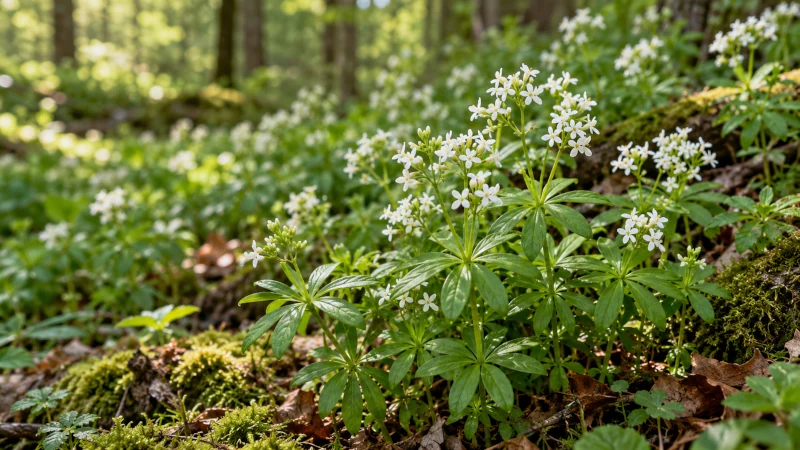
Sweet woodruff is a low-growing perennial in the madder family (Rubiaceae), the same family as coffee. Botanists now call it Galium odoratum; older books, and the U.S. food regulations, still use its earlier name, Asperula odorata [Drugs.com, 2026] [FDA, 21 CFR 172.510]. In German it’s Waldmeister, “master of the woods.” It thrives in partial to full shade and moist, rich soil [Razzivina et al., 2024].
| Quick facts | |
| Scientific name | Galium odoratum (L.) Scop.; synonym Asperula odorata L. |
| Common names | Sweet woodruff, woodruff, master of the wood, woodward, Waldmeister |
| Family | Rubiaceae (madder family) |
| Size | Up to about 30 cm (12 in) tall |
| Leaves | Narrow and lance-shaped, in whorls of roughly 5–8 around a square stem |
| Flowers | Small, white, star-shaped; April to June |
| Native range | Eurasia and North Africa; grown and naturalized in parts of North America |
| Part used | Dried above-ground parts |
| Key compounds | Coumarin (released as the plant dries), the iridoid asperuloside, flavonoids, tannins |
| Sources: [Drugs.com, 2026]; [Razzivina et al., 2024] |
Why woodruff smells like hay: coumarin explained
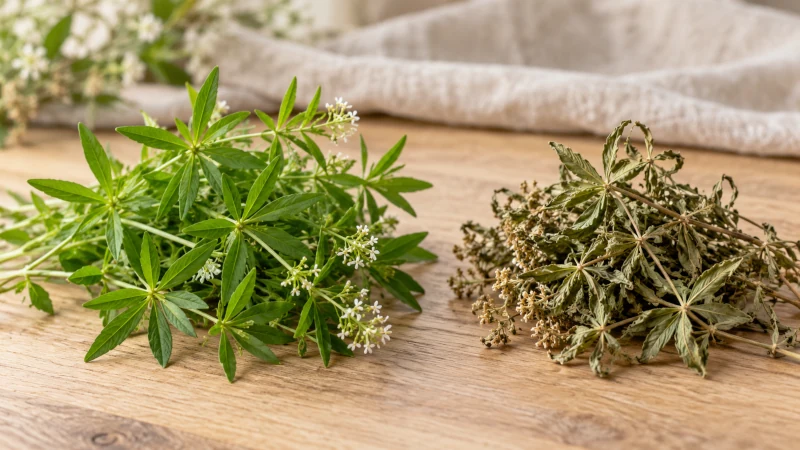
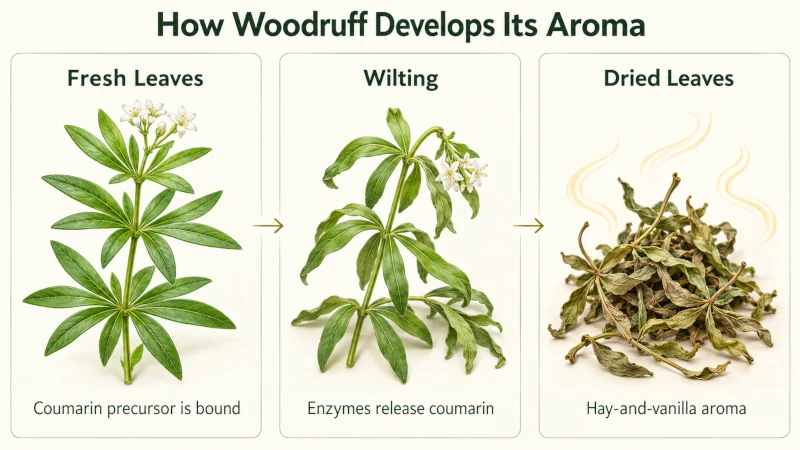
Pick a fresh sprig and it smells of very little. Let it wilt for a day and the scent of cut hay and vanilla appears. That shift is chemistry. In the fresh plant, coumarin is mostly bound to a sugar as an odorless glycoside, and enzymes set it free as the leaves dry [AGES, 2025]. Researchers trace that precursor to a compound called melilotoside [Razzivina et al., 2024]. It’s the reason May wine recipes tell you to wilt the herb first [AGES, 2025].
| A common error, corrected: You may read that woodruff’s active ingredient is asperuloside and that it “becomes coumarin.” Those are two different compounds. Asperuloside is an iridoid glycoside present in small amounts (around 0.05%). Coumarin is the main aroma compound, averaging roughly 1% of the dried plant, though levels vary widely; some samples have contained almost none [Drugs.com, 2026] [Razzivina et al., 2024]. |
Coumarin is not warfarin
The name causes plenty of confusion. Warfarin and phenprocoumon, prescription blood thinners, are synthetic coumarin derivatives: related molecules that behave differently. Austria’s food safety agency stresses that natural coumarin should be kept distinct from those drugs [AGES, 2025]. Calling woodruff an “anticoagulant,” as many herbal sites do, overstates what’s known.
The picture isn’t entirely settled, though. The Drugs.com professional monograph notes that excessive doses may lead to internal bleeding, mentions clotting abnormalities in animal studies, and advises monitoring people who take cardiovascular medicines [Drugs.com, 2026]. Those warnings come from older reference texts, not human trials. Practically: if you take a blood thinner, don’t use woodruff medicinally without your clinician’s okay.
Woodruff plant benefits: what’s traditional and what’s tested
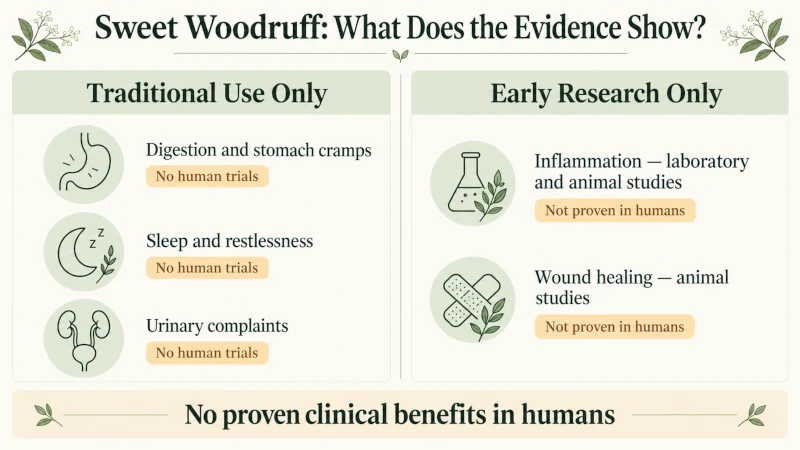
Traditional herbals credit sweet woodruff with a long list of actions: sedative, antispasmodic, diuretic, and sweat-inducing. It has been used for restlessness, insomnia, stomachache, migraine, and bladder stones, and applied to varicose veins, hemorrhoids, and inflamed skin [Drugs.com, 2026].
What’s missing is human research. The Drugs.com monograph states that the literature contains no clinical data on woodruff for any condition [Drugs.com, 2026]. Everything beyond tradition comes from lab dishes and rodents.
| Claimed use | What the evidence shows | Evidence level |
| Stomach cramps, “nervous” digestion | Traditional use; no human trials | Traditional only |
| Sleep, restlessness, anxiety | Traditional use; no human trials | Traditional only |
| Urinary infections, bladder or kidney stones | Traditional use; no human trials | Traditional only |
| Inflammation | Oral extract reduced paw swelling in rats; extract reduced pro-inflammatory immune cells from mice | Animal / lab only |
| Wound and burn healing | Topical extracts improved burn healing in rats | Animal only |
| “Blood thinning” / circulation | Not established; natural coumarin is distinct from anticoagulant drugs | Insufficient — and a safety question, not a benefit |
Sources: [Drugs.com, 2026]; [Kahkeshani et al., 2013]; [Razzivina et al., 2024]; [AGES, 2025]
Digestion, sleep, and calm
These are woodruff’s most familiar folk uses, and they have never been tested in a clinical trial [Drugs.com, 2026]. If you want a cup of something calming in the evening, chamomile, lemon balm, passionflower, and linden have more behind them, and our guide to blending a nervine tea safely covers amounts and cautions. Stomach pain that keeps coming back deserves a proper look from a doctor rather than another herbal experiment.
Urinary complaints
Woodruff was used as a diuretic and for bladder stones [Drugs.com, 2026], and some sites go further and suggest it for cystitis or kidney infections. Don’t substitute tea for care here. Burning urination with fever, chills, or pain in your back or side can signal a kidney infection, which needs prompt medical assessment.
Inflammation and wound healing: lab and animal results
In an older rat study, an oral woodruff extract cut experimentally induced paw swelling by 25%, compared with 45% for the anti-inflammatory drug indomethacin [Drugs.com, 2026]. A 2013 study applied methanol and water extracts to second-degree burns in rats and reported better healing, particularly with the water extract [Kahkeshani et al., 2013]. And a 2024 lab study found that woodruff extracts reduced the share of pro-inflammatory (M1) macrophages, a type of immune cell, taken from mice [Razzivina et al., 2024].
Reasonable early signals. None of them tells you whether a cup of tea or crushed leaves on a cut does anything for a person.
How much coumarin is too much?
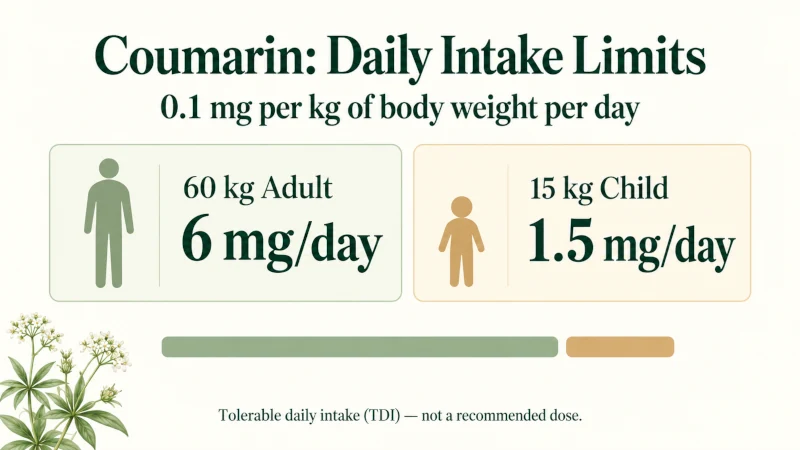
European food safety authorities set a tolerable daily intake (TDI) for coumarin of 0.1 mg per kilogram of body weight. That’s the amount you could take every day for life without appreciable risk, and it is meant to protect sensitive people too [BfR, 2012] [EFSA, 2008]. For a 60 kg (132 lb) adult that’s 6 mg a day. For a 15 kg (33 lb) toddler, it’s 1.5 mg.
The concern is the liver. When coumarin was given as a medicine, a small group of sensitive people developed liver damage within weeks — usually raised liver enzymes, occasionally hepatitis with jaundice. The effect was generally reversible after stopping [BfR, 2012]. Very high doses caused tumors in rats and mice, but there’s no indication that coumarin causes cancer in humans [BfR, 2012].
A short overshoot isn’t an emergency. EFSA concluded that taking in up to three times the TDI for one to two weeks is not a safety concern [EFSA, 2008]. The risk comes from regular, sustained excess. Coumarin also adds up across sources: cassia cinnamon, tonka beans, and fragranced lotions and perfumes all contribute [AGES, 2025] [BfR, 2012].
| Guidance | Amount | Source |
| Tolerable daily intake | 0.1 mg coumarin per kg body weight per day (6 mg for a 60 kg adult) | [BfR, 2012]; [EFSA, 2008] |
| Fresh woodruff, adults | No more than about 3 g of fresh woodruff per day | [AGES, 2025] |
| Everyday drinks guideline | About 2 g of fresh leaves per day (roughly two-thirds of the TDI for a 60 kg adult) | [AGES, 2025] |
| Homemade syrup | No more than about 20 g of fresh leaves per liter of syrup | [AGES, 2025] |
| May wine / punch | Under 5 ppm coumarin — roughly 3–3.5 g fresh woodruff per liter | [Drugs.com, 2026] |
The old infusion recipe, by the numbers
Some older herbal guides recommend an infusion of 40–50 g of dried woodruff per liter of water, two or three cups a day. Run the numbers. Dried woodruff averages around 1% coumarin by weight [Drugs.com, 2026] [AGES, 2025], so 40 g of dried herb could hold about 400 mg. Even if only part of that ends up in the cup, two or three cups a day could plausibly deliver many times — potentially dozens of times — the 6 mg a 60 kg adult should stay under. That’s our estimate from published averages; real content varies by plant and preparation. Either way, don’t follow that recipe.
May wine and woodruff syrup
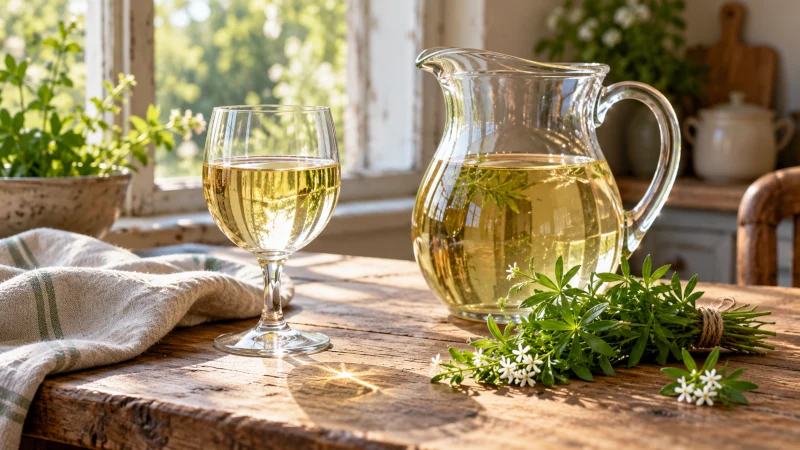
Maiwein, or Maibowle, is made by steeping wilted woodruff in white wine. At the traditional strength of about 3 g of fresh herb per liter, coumarin stays under 5 ppm [Drugs.com, 2026]. A glass on a spring afternoon isn’t the issue.
Homemade syrup can be. Some online recipes use 100 g of leaves for half a liter of syrup. AGES calculated that once diluted, half a liter of that drink would carry about 30 mg of coumarin — more than five times the daily limit for a 60 kg adult [AGES, 2025]. Stick to about 20 g of fresh leaves per liter of syrup, and be especially careful with drinks for children.
Regulators draw firm lines. In the U.S., the FDA permits sweet woodruff as a natural flavoring in alcoholic beverages only, and food with added coumarin is deemed adulterated [FDA, 21 CFR 172.510] [FDA, 21 CFR 189.130]. In the EU, isolated coumarin may not be added to food, while coumarin-containing plant parts can be used for flavor within limits — for example, 5 mg/kg in desserts and 50 mg/kg in traditional seasonal baked goods [BfR, 2012].
Side effects and medication interactions
At ordinary food-flavoring amounts, adverse effects are unlikely [Drugs.com, 2026]. Problems show up with larger amounts or long-term use:
- Liver strain. Long-term exposure may cause liver toxicity, and especially sensitive people can react to comparatively small amounts [Drugs.com, 2026] [BfR, 2012].
- Possible bleeding at excessive doses, according to reference monographs, even though natural coumarin itself isn’t classed with anticoagulant drugs [Drugs.com, 2026] [AGES, 2025]. The sources don’t fully agree, so treat this as a precaution.
- Interactions. The Drugs.com monograph advises monitoring people on cardiovascular medicines [Drugs.com, 2026]. If you take a blood thinner, an antiplatelet drug, or any medicine that affects the liver, check with your pharmacist before using woodruff as a remedy.
Who should avoid woodruff
Skip woodruff as a remedy, and keep food uses minimal, if any of these apply:
- Pregnancy or breastfeeding. Avoid it, because of concern over coumarin’s toxic potential [Drugs.com, 2026].
- Children. The safe limit scales with body weight, so a small child’s ceiling is a fraction of an adult’s [BfR, 2012]. No medicinal teas; go easy on homemade syrups.
- Liver disease, or a past reaction to a medicine that affected your liver, since the liver is coumarin’s main target.
- Blood thinners, antiplatelet drugs, or heart medicines — talk to your clinician first.
- Heavy cassia cinnamon users or people taking cinnamon supplements, which can already contain a lot of coumarin [BfR, 2012].
Don’t put woodruff in your eyes
Older remedy books suggest bathing the eyes in a woodruff decoction for blepharitis or conjunctivitis. Please skip it. As our guide to blepharitis and safe eyelid care explains, anything used in the eye should be sterile, and homemade washes made from herbal teas can irritate the eye. For crusty, sore eyelids, that guide lays out a daily routine that does help. If you’re trying to figure out whether a red eye is an allergy or an infection, see eye allergies vs. pink eye.
When to see a doctor
Get medical advice promptly if you notice:
- Yellowing of your skin or the whites of your eyes — a sign of liver inflammation [BfR, 2012]
- Unusual bruising or bleeding, especially if you take a blood thinner
- Urinary symptoms with fever, chills, or back or side pain
- Stomach pain or sleep trouble that keeps returning
Urgent: if a child swallows a large amount of woodruff syrup, concentrate, or dried herb, call Poison Help at 1-800-222-1222 (U.S.). Call 911 if they are hard to wake or have trouble breathing.
| HEALTH DISCLAIMER: This article is for general education and is not a substitute for medical advice, diagnosis, or treatment. Sweet woodruff has not been shown to treat or prevent any condition in people, and its coumarin content varies from plant to plant. Talk to your doctor or pharmacist before using any herb medicinally, especially if you are pregnant, breastfeeding, giving it to a child, managing liver disease, or taking prescription medicine. Never put homemade herbal preparations in or around your eyes. See our full medical advice disclaimer. |
Frequently Asked Questions
Is sweet woodruff safe to eat?
In small amounts as a flavoring, yes for most adults. Agencies suggest no more than about 3 g of fresh woodruff a day for adults [AGES, 2025]. The risk comes from regular, larger amounts because of its coumarin.
Why do recipes say to wilt woodruff first?
Fresh woodruff holds its coumarin in an odorless, sugar-bound form. Wilting or drying lets enzymes release it, which is when the hay-and-vanilla aroma appears [AGES, 2025].
Is woodruff a blood thinner?
Not in the way warfarin is. Natural coumarin is distinct from the synthetic coumarin-derived blood thinners [AGES, 2025], though reference monographs flag possible bleeding at excessive doses [Drugs.com, 2026]. If you take an anticoagulant, ask your clinician first.
Can I drink woodruff tea every day?
It isn’t a good idea. Strong infusions can easily exceed the tolerable daily intake of coumarin, 0.1 mg per kg of body weight [BfR, 2012], and there’s no human evidence the tea helps any condition [Drugs.com, 2026].
Is woodruff legal to use in food in the U.S.?
The FDA permits sweet woodruff as a natural flavoring in alcoholic beverages only, and food with added coumarin is considered adulterated [FDA, 21 CFR 172.510] [FDA, 21 CFR 189.130].
Can kids have woodruff syrup?
Occasionally and weakly made, if at all. Coumarin limits scale with body weight [BfR, 2012], and strong homemade syrups can contain several times an adult’s daily limit per half liter of drink [AGES, 2025].
References
- Drugs.com (Wolters Kluwer Health). Woodruff, Sweet — Natural Products monograph. View source
- U.S. Food and Drug Administration. 21 CFR 172.510 — Natural flavoring substances and natural substances used in conjunction with flavors. eCFR, View source
- U.S. Food and Drug Administration. 21 CFR 189.130 — Coumarin. View source
- Austrian Agency for Health and Food Safety (AGES). Coumarin. View source
- German Federal Institute for Risk Assessment (BfR). FAQ on coumarin in cinnamon and other foods. View source
- European Food Safety Authority, AFC Panel. Coumarin in flavourings and other food ingredients with flavouring properties. View source
- Razzivina V, Vasiljeva A, Kronberga A, et al. Phenolic content and anti-inflammatory activity of cultivated and wild-type Galium odoratum extracts in murine bone marrow-derived macrophages. View source
- Kahkeshani N, Farahanikia B, Mahdaviani P, et al. Antioxidant and burn healing potential of Galium odoratum extracts. Research in Pharmaceutical Sciences. View source
- PubChem, National Library of Medicine. Asperuloside (CID 84298). View source


