
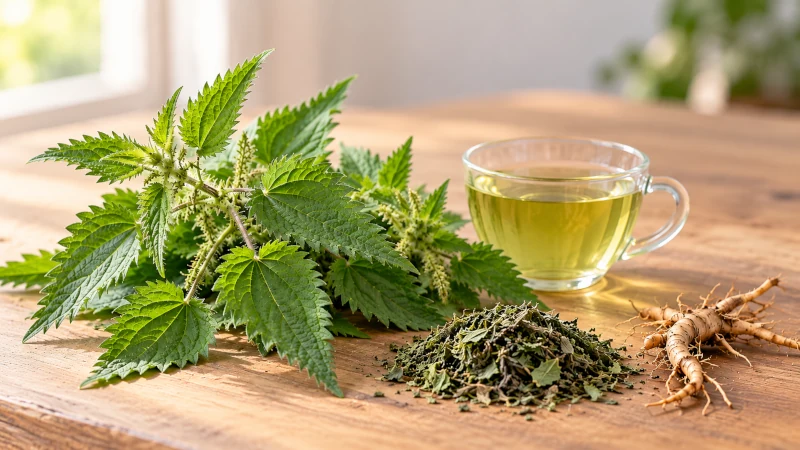
Most of what you’ll read about stinging nettle falls into one of two piles: it’s a useless weed, or it’s a miracle plant that fixes everything from baldness to low testosterone. Neither is true. The honest version is more useful. Nettle is a genuinely nutrient-dense plant with a handful of real, studied uses — easing urinary symptoms of an enlarged prostate, taking the edge off joint pain and hay fever, and nudging blood sugar as an add-on to proper care. It also carries a few famous claims that simply don’t hold up when you look at the trials.
One thing shapes everything below, so it’s worth saying up front: most of the good research on stinging nettle benefits used a concentrated extract or capsule, not the plant on your dinner plate or a mug of tea. The effects are real. They’re just milder in a teacup than the headlines suggest.
What stinging nettle actually is
Stinging nettle (Urtica dioica) is a leafy perennial that grows across temperate regions worldwide, usually in damp, nitrogen-rich ground near where people live [Kregiel et al., 2018]. Brush against a fresh plant and the tiny hairs on its leaves inject a mix of formic acid, histamine, acetylcholine and serotonin — the reason for the burning rash, which can last up to about half a day [NIDDK LiverTox, 2023].
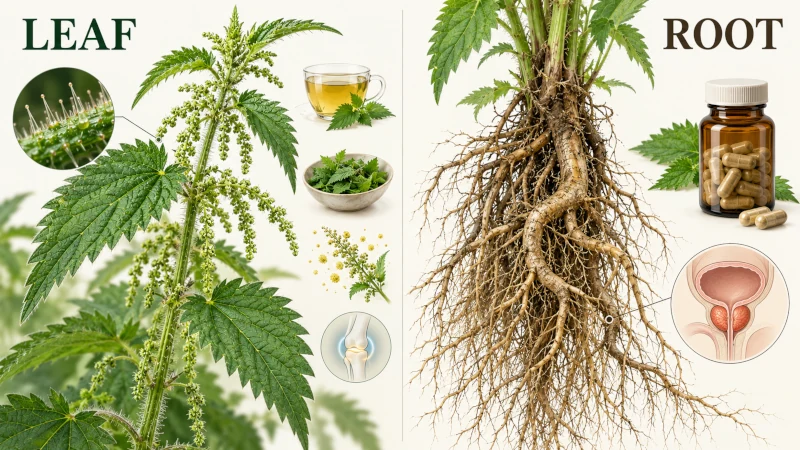
Here’s the reassuring part: drying, cooking, or steeping the leaves destroys those stinging compounds, which is why dried, cooked, or brewed nettle doesn’t sting and can be eaten safely [NIDDK LiverTox, 2023]. Raw fresh leaves are the exception — they shouldn’t be eaten.
One distinction runs through this whole topic. Nettle leaf and nettle root are not the same medicine. The prostate and urinary research almost always uses root extract in capsules; the allergy and anti-inflammatory work uses leaf. Tea and cooked greens sit on the leaf side of that line (nettle tea guide). When a headline says “nettle helps the prostate,” it nearly always means a standardized root extract — not a cup of tea.
Stinging nettle benefits, graded by evidence
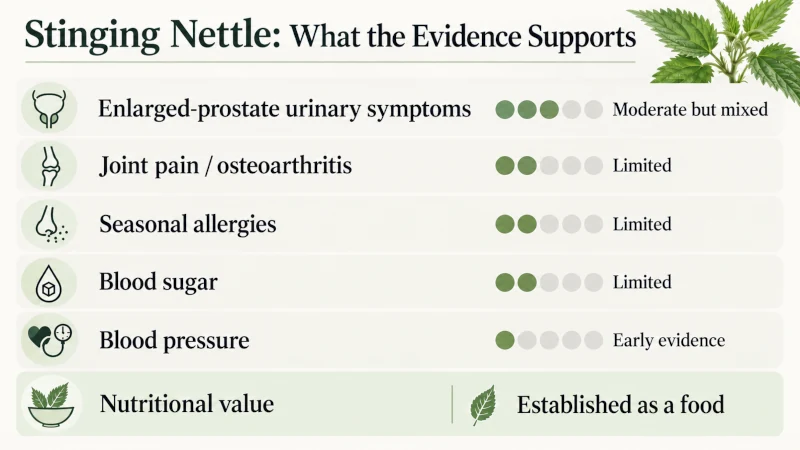
| Possible benefit | Evidence level | The honest caveat |
| Enlarged-prostate (BPH) urinary symptoms | Moderate but mixed | Root extract, often with saw palmetto — not leaf tea |
| Joint pain / osteoarthritis | Limited | Strongest for topical or short-term use |
| Hay fever / allergic rhinitis | Limited | Tested as freeze-dried capsules; roughly placebo-to-slightly-better |
| Blood sugar | Limited | Adjunct only; can interact with diabetes drugs |
| Blood pressure | Early / mostly animal | Human data thin; interaction risk is the bigger issue |
| Iron, protein, vitamins | Nutritional (established) | A cup of tea delivers little; eat the cooked greens |
Enlarged-prostate (BPH) urinary symptoms
This is nettle’s best-studied use, and also the one people most often get wrong by reaching for tea instead of root extract. Benign prostatic hyperplasia (BPH) is a non-cancerous enlargement of the prostate that causes urinary frequency, urgency, a weak stream, and getting up at night.
The evidence is real but genuinely split. In one large placebo-controlled trial of 558 men, root extract was linked to symptom improvement in 81% of the nettle group versus 16% on placebo, along with better urinary flow and a smaller prostate — and, notably, no change in PSA or testosterone [NIDDK LiverTox, 2023].
Memorial Sloan Kettering notes that nettle is usually combined with saw palmetto for this purpose, and that the combination has reduced nighttime urination and performed similarly to standard drugs like tamsulosin or finasteride for moderate-to-severe symptoms [MSK, 2021]. On the other side of the ledger, an earlier systematic review found no convincing evidence for nettle in BPH, and reviewers have questioned how rigorous some trials were [NIDDK LiverTox, 2023]. Nettle isn’t approved to treat any condition in the United States.
So: promising, occasionally impressive, but not settled — and the studied product is a standardized root extract, not tea. If you have urinary symptoms, that’s a conversation with a doctor, not a reason to self-treat.
Joint pain and osteoarthritis
Nettle has been used for aching joints since antiquity, and there’s some modern support — mostly for putting it on the skin rather than drinking it. Clinical trials back the topical use of nettle for arthritis, though larger studies are still needed to confirm the effect [MSK, 2021]. The most-cited experiment applied fresh nettle to the painful thumb joint. Worth knowing for balance: a later pilot study in people with chronic knee pain found no clear advantage over a non-stinging control. Treat joint relief as limited and best-evidenced for topical or short-term use.
Hay fever and seasonal allergies
The idea that a plant full of histamine could calm allergies sounds backwards, but the lab work is interesting: nettle leaf extract blocks the histamine-1 receptor and dampens the same COX-1 and COX-2 inflammatory pathways that antihistamines target [MSK, 2021]. In people, the picture is thinner. A small trial of freeze-dried nettle leaf beat placebo only modestly for hay-fever symptoms [Healthline, 2023], and MSK’s patient-facing verdict is blunt: evidence is lacking to support the allergy claim [MSK, 2021]. If you tolerate it, a cup or two during pollen season is reasonable — but it’s no substitute for a proven antihistamine when symptoms are bad.
Blood sugar
There’s early human evidence here, and it matters how you read it. In a trial of 92 people with type 2 diabetes that was poorly controlled on standard medication, nettle leaf extract (500 mg three times daily for three months) lowered fasting glucose, post-meal glucose and HbA1c more than placebo, with no adverse effects reported [NIDDK LiverTox, 2023]. MSK’s summary is measured: nettle might help with blood sugar control, but more study is needed [MSK, 2021].
Read that as a possible adjunct to real treatment, not a replacement for it — and here’s the safety flip side. Because nettle can lower blood sugar, combining it with insulin or other glucose-lowering drugs can push you too low. If you have diabetes, monitor your numbers, tell your prescriber before starting nettle, and — this is the important correction to a lot of what’s written online — never lower a prescribed diabetes medication dose on your own based on an herb (blood sugar levels).
Blood pressure
Most of the blood-pressure evidence comes from animal and test-tube studies, where nettle shows mild diuretic and vessel-relaxing activity; solid human data is lacking [Healthline, 2023]. The practical takeaway isn’t really the (small, unproven) benefit — it’s the interaction. Nettle’s mild diuretic effect can stack with prescription diuretics and blood-pressure drugs, a risk MSK specifically flags [MSK, 2021].
Nutrition: iron, protein and vitamins
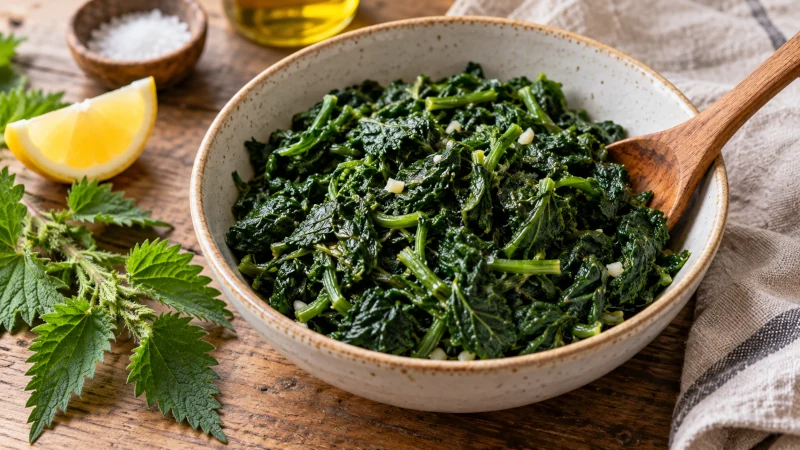
This is where nettle earns its “superfood” reputation legitimately. The leaves are a real source of vitamins A, C, K and the B group, plus iron, calcium, magnesium and potassium, and dried nettle-leaf powder can run around 30% protein by weight — high for a leafy green [Kregiel et al., 2018]. Cooked like spinach, it’s a genuinely nutritious vegetable.
Two honest caveats. First, nettle’s traditional reputation as a “blood builder” for anemia rests on its iron and chlorophyll content — plausible as nutrition, but not the same as a proven treatment for iron-deficiency anemia, which needs proper diagnosis and often supplementation. If iron is your goal, food is a more reliable lever; see our roundup of iron-rich foods. Second, a cup of nettle tea gives you only a small fraction of the leaf’s minerals, because most of them stay behind in the spent leaves [nettle tea benefits]. Want the nutrition? Eat the greens.
Claims that outrun the evidence
A few popular claims deserve a firm, friendly reality check.
“Nettle raises testosterone / boosts virility.” This is the big one, and it’s not supported. Nettle root has folkloric fame as a virility aid going back to antiquity, but the large prostate trial that measured hormones found no change in testosterone [NIDDK LiverTox, 2023]. Nettle root appears to act on how testosterone is handled in prostate tissue, which is a different thing from raising the hormone in your blood. As a rule, “testosterone-booster” herb claims run well ahead of the data — a pattern we cover in our guide to herbs for male stamina.
“Nettle detoxes the body.” Your liver and kidneys do that. A mild diuretic effect means more urine, which isn’t the same as removing toxins, and no major medical body endorses nettle as a detox therapy [nettle tea benefits].
“Nettle regrows hair and clears acne or eczema.” There’s lab and traditional interest, but human trials of nettle for hair loss, acne or eczema are essentially absent [nettle tea benefits]. File under plausible-but-unproven.
“Nettle stops diarrhea and dysentery.” This is old herbal lore without clinical backing, so we’ve dropped the historical “cures cholera diarrhea” claim from this page entirely.
“Nettle lets you cut your medication.” No. It may act as an adjunct for blood sugar, and combination products may sit alongside prostate care — but changing or stopping a prescription is a decision for your prescriber, not a supplement label.
How people use stinging nettle
You’ll find nettle as cooked greens, dried leaf for tea, capsules or tinctures of leaf or root, and topical creams.
- As food: cook young leaves like spinach — in soups, stews, or sautéed. Cooking removes the sting [Kregiel et al., 2018].
- As tea: steep 1–2 teaspoons of dried leaf in a cup of just-boiled water for 10–15 minutes. Traditional use runs to 1–3 cups a day; there’s no formally established dose for tea [nettle tea benefits].
- As a supplement: over-the-counter products are typically taken at 300–600 mg daily, though there’s no official recommended dose and products vary [NIDDK LiverTox, 2023]. Root extract is the form studied for prostate symptoms; freeze-dried leaf is what allergy trials used.
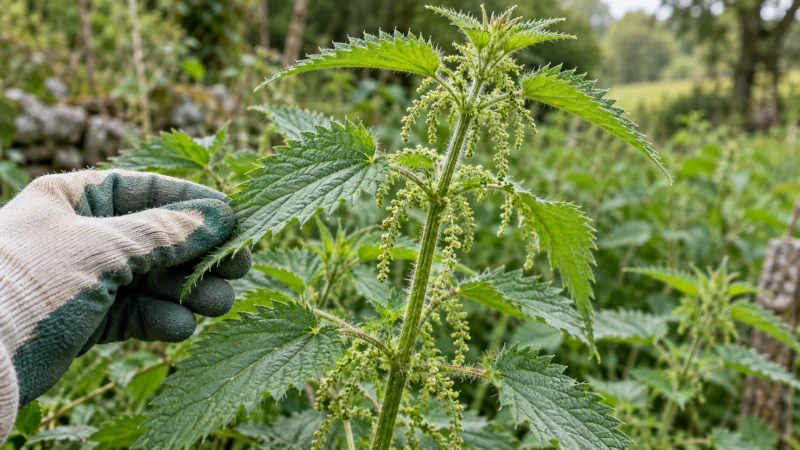
Two cautions on preparation. Never eat raw fresh leaves — they sting the mouth and gut [NIDDK LiverTox, 2023]. And urtication — the old practice of deliberately whipping a painful joint with fresh nettles — is a historical folk remedy, not a recommendation; it works by irritating the skin, and it hurts. If you forage, wear gloves until the leaves are dried or cooked, and pick from clean ground, never roadsides or sprayed areas.
Side effects and safety
For most adults, processed nettle is well tolerated. The NIH’s LiverTox database rates it unlikely to cause liver injury and reports no documented cases from oral nettle at typical doses [NIDDK LiverTox, 2023]. When side effects do occur, they’re usually mild: headache, nausea, mild stomach upset, diarrhea or constipation, more urination, and sweating [NIDDK LiverTox, 2023; nettle tea benefits]. Allergic reactions can happen, particularly in people allergic to nettle pollen or related plants, and can rarely be severe [Healthline, 2023].
A few unusual case reports are worth knowing about, precisely because they’re surprising: breast tissue enlargement in a man and nipple discharge in a woman who used nettle tea; low blood sugar in an older man taking nettle for prostate symptoms; and hives in a breastfed infant after the mother used nettle-boiled water on cracked nipples [MSK, 2021]. These are rare and not fully understood, but they’re real.

Who should avoid stinging nettle
- Anyone pregnant or trying to conceive. Nettle has traditional use as a uterine stimulant and pregnancy safety data is limited; major herbal authorities advise against it [Healthline, 2023; nettle tea benefits].
- Breastfeeding parents. Internal use during lactation is poorly studied, and there’s that infant-hives case report. This reverses a common (and mistaken) claim that nettle is “recommended while breastfeeding” — treat it as caution-advised, not encouraged [MSK, 2021; nettle tea benefits].
- Children — no established dose or safety data [nettle tea benefits].
- People with low blood pressure, kidney disease, or diabetes on medication — because of nettle’s diuretic and glucose-lowering effects [nettle tea benefits].
Drug interactions
Tell your doctor or pharmacist before combining nettle with:
- Diuretics and blood-pressure drugs — possible additive effects [MSK, 2021].
- Diabetes medications (insulin, sulfonylureas, and others) — possible additive drop in blood sugar [MSK, 2021].
- Warfarin and other anticoagulants — nettle leaf contains vitamin K, which can theoretically blunt warfarin [nettle tea benefits].
- Lithium — its diuretic action could affect lithium levels [nettle tea benefits].
- Iron supplements — nettle’s tannins can reduce non-heme iron absorption if taken together [foods rich in iron].
Red flags: when to see a professional
Don’t self-treat — see a doctor — if you have blood in your urine, painful urination, fever, or an inability to urinate; any abnormal bleeding; a severe allergic reaction or trouble breathing; signs of low blood sugar if you’re diabetic; or unexplained breast changes or nipple discharge while using nettle. And if you’re pregnant, planning to be, or nursing, clear any herbal product with your obstetric team first.
| Health disclaimer: This article is for general education only. It is not medical advice, a diagnosis, or a treatment plan, and it can’t account for your medications, conditions, or history. Stinging nettle is not a cure for any disease and is not a substitute for treatment prescribed for an enlarged prostate, diabetes, high blood pressure, allergies, or arthritis. Most nettle studies are small, mixed in quality, and used concentrated extracts rather than tea or food — so any real-world effect from tea or cooked greens is uncertain. Talk to your doctor or pharmacist before using nettle regularly if you are pregnant, breastfeeding, or planning a pregnancy, or if you take diuretics, blood thinners, blood-pressure, or blood-sugar medications. Never start, stop, or adjust a prescribed medication based on what you read here. Stop use and seek care if you develop hives, swelling, shortness of breath, or worsening urinary symptoms. |
Frequently Asked Questions
Does stinging nettle raise testosterone?
No good evidence supports that. The largest prostate trial that measured hormones found no change in testosterone [NIDDK LiverTox, 2023]. Nettle root seems to act on how testosterone behaves in prostate tissue, which isn’t the same as boosting the hormone in your blood.
Is nettle better for the prostate as tea or as a capsule?
The prostate research used standardized root extract in capsules, usually alongside saw palmetto — not leaf tea [MSK, 2021]. Tea may add some comfort, but if you have BPH, talk to a urologist about the studied form.
Can I drink nettle tea every day?
For most healthy adults, one to three cups a day is generally well tolerated [nettle tea benefits]. Check with your prescriber first if you take diuretics, blood-pressure, blood-sugar, or anticoagulant medications.
Is nettle safe during pregnancy or breastfeeding?
Avoid it in pregnancy — it has traditional uterine-stimulant activity and limited safety data — and be cautious while breastfeeding, where internal use is poorly studied [Healthline, 2023; MSK, 2021]. Ask your obstetric team.
Does nettle help with allergies?
Possibly, modestly. Lab studies show it blocks histamine pathways, and one small trial of freeze-dried leaf slightly beat placebo, but MSK considers the human evidence weak [MSK, 2021; Healthline, 2023]. It’s not a replacement for a real antihistamine.
Can nettle replace my diabetes or prostate medication?
No. At most it may act as an adjunct. Don’t change any prescription without your doctor [blood sugar levels].
References
- Memorial Sloan Kettering Cancer Center. Integrative Medicine — Nettle: Purported Benefits, Side Effects & More. Last updated Dec 7, 2021. → View source
- LiverTox: Clinical and Research Information on Drug-Induced Liver Injury. Stinging Nettle. NIDDK; updated Mar 3, 2023. Bookshelf NBK589898; PMID 37011125. → View source
- Kregiel D, Pawlikowska E, Antolak H. Urtica spp.: Ordinary Plants with Extraordinary Properties. Molecules. 2018;23(7):1664. DOI 10.3390/molecules23071664; PMC6100552; PMID 29987208. → View source
- Raman R (reviewed by Richter A). 6 Evidence-Based Benefits of Stinging Nettle. Healthline; updated Oct 24, 2023. → View source


