
If you’re looking for the best herbs for male stamina, here’s the honest headline before the list: a few herbs have real, if modest, research behind them, several popular ones are mostly hype, and none of them works as well as the unglamorous habits that protect your heart. That’s not a letdown — it’s the thing that saves you money and, occasionally, your health.
“Stamina” is a fuzzy word, so this guide sorts the herbs by how strong the evidence actually is: which ones may give you a small, real nudge, which rest on tradition more than data, and which come with safety catches worth knowing before you spend a cent.
What “male stamina” actually means
When men say their stamina has slipped, they usually mean one or more of four different things: daily energy and endurance, sexual desire, erectile function, and the ability to handle stress without running on empty. These are related but not identical, and no single herb addresses all of them. Being specific about which one you want to change makes it far easier to judge whether any supplement is doing anything — and whether the real problem is something a herb can’t fix.
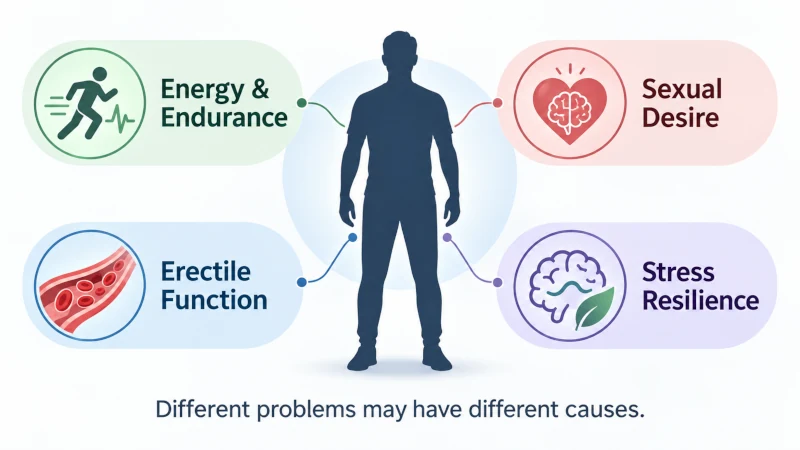
Two of these deserve special attention. Erectile function depends on healthy blood vessels, which is why a change there can be an early signal about your heart (more on that below). And stress quietly drains both energy and desire, which is where the best-studied herb on this list actually earns its place.
The best herbs for male stamina, graded by evidence
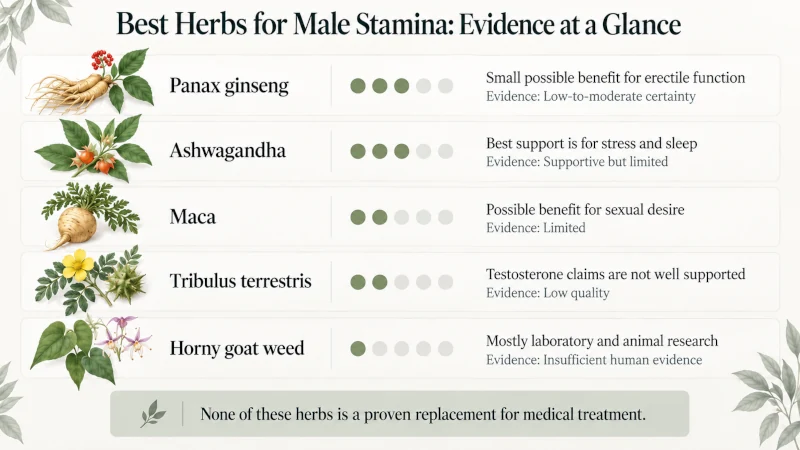
Here’s the short version. The sections below explain each one.
| Herb | What men take it for | What the evidence shows |
| Panax ginseng | Erections, energy | Mixed, low-to-moderate certainty. Possible small benefit for erectile function; not a substitute for proven ED treatment. |
| Ashwagandha | Stress, sleep, testosterone | Best-supported for stress and sleep. Limited but promising for testosterone and sperm quality over 2–4 months. |
| Maca | Libido, desire | Limited evidence of benefit for sexual desire from a few small trials. Mixed for semen quality. |
| Tribulus terrestris | Testosterone, libido, erections | Low-quality evidence. Some ED trials positive; no robust effect on testosterone. |
| Horny goat weed (icariin) | Erections | Mostly laboratory and animal data. Human trial evidence is very limited. |
Panax ginseng (Korean red ginseng): the most plausible case for erections
If any herb has earned a spot in this conversation, it’s Panax ginseng, especially the steamed-and-dried form sold as Korean red ginseng. A 2021 Cochrane review — the most rigorous look available — pooled nine placebo-controlled trials in 587 men with mild-to-moderate erectile dysfunction [Cochrane, 2021]. The finding is a useful lesson in reading between the lines: when erectile function was measured on validated questionnaires, ginseng did beat placebo, but the difference was small enough that reviewers rated it trivial, on mostly low-certainty evidence. At the same time, ginseng did appear to improve men’s own reported ability to have intercourse [Cochrane, 2021].
Two honest caveats. All the trials were short — 12 weeks or less — and none tested ginseng head-to-head against a proven ED drug, so there’s no basis for calling it a natural equivalent [Cochrane, 2021]. The U.S. National Center for Complementary and Integrative Health puts it plainly: some research suggests oral Asian ginseng may improve sexual function in men with ED, but most studies have been small and short [NCCIH, 2025]. Ginsenoside content also varies a lot between products, so two bottles labeled “ginseng” are not necessarily the same [NCCIH, 2025].
Realistic expectation: a possible modest help for milder erectile difficulties, not a reliable fix. If your erections have changed, that’s a reason to see a doctor, not only to buy a supplement.
Ashwagandha: strongest for stress, which is the point
Ashwagandha (Withania somnifera) is marketed hard as a testosterone and “male vitality” herb, but its best evidence is for something upstream of all that. According to NCCIH, some ashwagandha preparations may be effective for stress and sleep, while its effect on anxiety is unclear [NCCIH, 2023]. Since chronic stress and poor sleep are genuine drains on both energy and libido, that indirect route is nothing to dismiss.
On testosterone and fertility, the picture is more modest than the labels: NCCIH describes limited evidence that taking ashwagandha for two to four months may raise testosterone and improve sperm quality, and notes larger studies are still needed [NCCIH, 2023]. Many of those trials are small and tied to supplement-industry funding, so the “testosterone booster” framing runs ahead of the data. For the fuller picture, see our evidence-based guide to ashwagandha benefits.
Realistic expectation: a reasonable option if stress or stress-driven poor sleep is what’s sapping you. Any change in testosterone is likely small. Ashwagandha also carries a real safety catch covered in the safety section below.
Maca: a traditional libido herb with early, limited support
Maca (Lepidium meyenii), an Andean root, is used mainly for sexual desire. A systematic review of randomized trials found suggestive but limited evidence: of four eligible trials, two reported a benefit for sexual desire (in healthy men and in menopausal women), one found nothing in trained cyclists, and one showed a benefit in men with mild ED [Shin et al., 2010]. The reviewers were candid that the trials were too few and too small to draw firm conclusions [Shin et al., 2010]. For semen quality specifically, later evidence is mixed, and a pooled analysis did not find a clear effect on sperm concentration [Lee et al., 2022].
Realistic expectation: a low-stakes experiment for libido, not a proven treatment. It’s a food-grade root, which makes it one of the gentler options to try.
Tribulus terrestris: popular, but the testosterone claim doesn’t hold up
Tribulus is sold almost entirely on the promise that it raises testosterone. A 2025 systematic review of ten clinical trials in 483 men is the clearest answer we have, and it’s not the marketing story: Tribulus supplementation had only a low level of evidence for improving erectile function, and no robust evidence for raising testosterone [Vilar Neto et al., 2025]. Erectile function improved in three of the five studies that measured it (at doses of about 400 to 750 mg a day for one to three months), but eight of ten studies showed no meaningful change in male hormones [Vilar Neto et al., 2025].
Realistic expectation: if you’re buying Tribulus specifically to boost testosterone, the evidence doesn’t support it. There may be a minor, inconsistent effect on erections.
Horny goat weed (epimedium): interesting in a test tube, thin in humans
Horny goat weed (Epimedium) contains a compound called icariin that, in laboratory studies, inhibits PDE5 — the same enzyme that prescription ED drugs target [PLOS ONE, 2019]. That sounds impressive until you see the size of the gap: icariin blocks the enzyme far more weakly than sildenafil, and most of the promising results come from cell and animal studies rather than trials in people [PLOS ONE, 2019]. Well-designed human trials are essentially missing.
Realistic expectation: a plausible mechanism does not equal a proven benefit. Treat the human evidence as insufficient, and treat the safety and product-quality warnings below as especially relevant here — icariin supplements are among the products the FDA repeatedly finds spiked with hidden drugs.
What about L-arginine, L-citrulline, and yohimbe?
These come up constantly, but they’re supplements, not herbs. L-arginine and L-citrulline feed the body’s nitric-oxide pathway, which helps blood vessels relax — the same plumbing erections rely on. You can support that pathway with food and exercise; our guide to natural ways to support nitric oxide lays out what’s actually behind it. The critical safety point: do not combine these with nitrates or ED medications, because stacking blood-vessel-relaxing agents can drop blood pressure dangerously. Yohimbe is a different animal — an herb with genuine pharmacological punch and a real side-effect profile (anxiety, racing heart, blood-pressure swings) — and belongs in the “talk to a clinician first” category rather than the casual-experiment one.
What actually moves the needle: the boring stuff that works
Here’s the throughline the “vitality herb” lists skip. For men, energy and erectile problems are usually signals from the cardiovascular and metabolic system, not standalone issues a capsule can patch. The interventions with the strongest evidence aren’t herbs at all:
- Move most days. Aerobic exercise improves blood-vessel function, which directly supports erections and heart health. Mayo Clinic’s blunt version: any lifestyle change that improves heart health also improves penis health [Mayo Clinic].
- Reach and hold a healthy weight. Excess weight raises the risk of erectile problems; losing weight can improve them.
- Stop smoking and keep alcohol modest. Both damage the vessels erections depend on [Mayo Clinic].
- Manage blood pressure, blood sugar, and cholesterol. Protecting those vessels often improves sexual function as a side effect.
- Sleep and handle stress. Both shape hormones and desire — and this is the one area where a herb like ashwagandha has decent support, for the stress rather than the sex directly [NCCIH, 2023].
Do these, and a herb becomes a small add-on rather than a rescue. Skip them, and no herb will carry the load.
Safety, side effects, and who should avoid these herbs
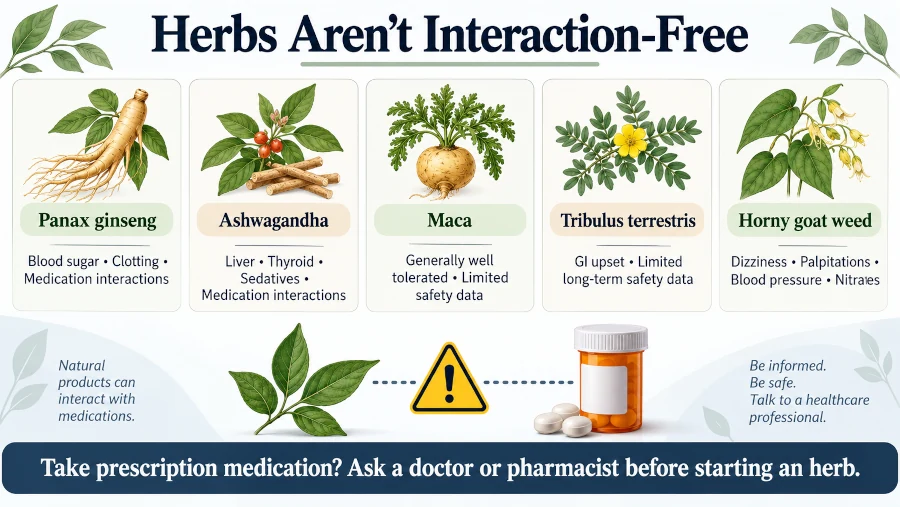
“Natural” does not mean risk-free or interaction-free. Supplements aren’t reviewed by the FDA for safety or effectiveness before sale, and the dose and purity on the label don’t always match what’s in the bottle [NCCIH, 2023]. A few specifics worth knowing:
| Herb | Common side effects | Key cautions and interactions |
| Panax ginseng | Insomnia (most common); occasionally rash | May lower blood sugar; may affect clotting and autoimmune conditions; may interact with medications; short-term use (up to ~6 months) appears safest. |
| Ashwagandha | Drowsiness, stomach upset, diarrhea | Rare but documented liver injury; can raise thyroid hormone; may interact with diabetes, blood-pressure, thyroid, sedative and immunosuppressant drugs. |
| Maca | Generally well tolerated in trials | Limited safety data; choose food-grade products. |
| Tribulus terrestris | Usually mild (GI upset) | Limited long-term safety data; hormone claims unproven. |
| Horny goat weed | Dizziness, palpitations | Frequently adulterated products; avoid with heart, blood-pressure and nitrate medications. |
Two cautions deserve emphasis. Ashwagandha has been linked, uncommonly but genuinely, to cases of liver injury — stop it and seek care if you notice yellowing skin or eyes, dark urine, persistent abdominal pain, or unusual fatigue [NCCIH, 2023]. It should also be avoided by people who are pregnant or breastfeeding, who have thyroid or autoimmune conditions, who are scheduled for surgery, or who have hormone-sensitive prostate cancer [NCCIH, 2023].
Asian ginseng is also not recommended during pregnancy or breastfeeding, and people with diabetes should check with a clinician because it may lower blood sugar [NCCIH, 2025]. If supplements are shared in your household, those pregnancy and breastfeeding cautions matter beyond the person the product was bought for. Whenever you take a prescription medication or manage a chronic condition, ask a doctor or pharmacist before starting any of these.
The supplement-quality problem no label warns you about
This is the part most “stamina herb” articles leave out, and it’s the most important. The FDA warns that many products sold for sexual enhancement — including pills marketed as male “energy” or “stamina” supplements — are likely to be contaminated with hidden drug ingredients, most often the same prescription PDE5 inhibitors (sildenafil, tadalafil) found in Viagra and Cialis [FDA, 2026]. These aren’t listed on the label, which means you can swallow a real drug without knowing the dose or the risks. Combined with nitrates — common in heart medications — they can drop blood pressure to dangerous levels, and the agency notes these products can lead to serious health problems and hospitalization [FDA, 2026].
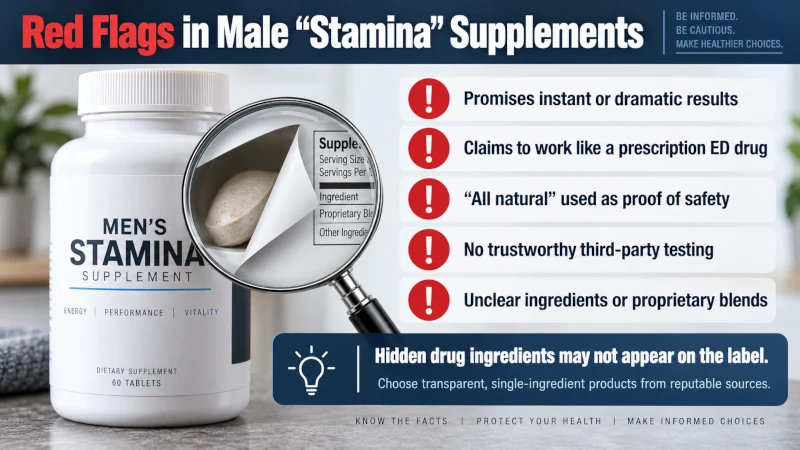
The FDA’s own list of flagged products is, in its words, only a small fraction of what’s out there, and a product’s absence from the list doesn’t mean it’s safe [FDA, 2026]. So the practical rules are simple: be wary of anything promising fast, dramatic, drug-like results; treat “all natural” claims on sexual-performance products with suspicion; prefer single-ingredient products with third-party testing (such as USP or NSF); and run anything past a pharmacist if you take medication.
When to skip the herbs and see a doctor
Some symptoms aren’t candidates for self-treatment. See a healthcare professional promptly if you have new or worsening erectile dysfunction, a persistent drop in energy or libido that doesn’t track with an obvious cause, or trouble conceiving after a year of trying.
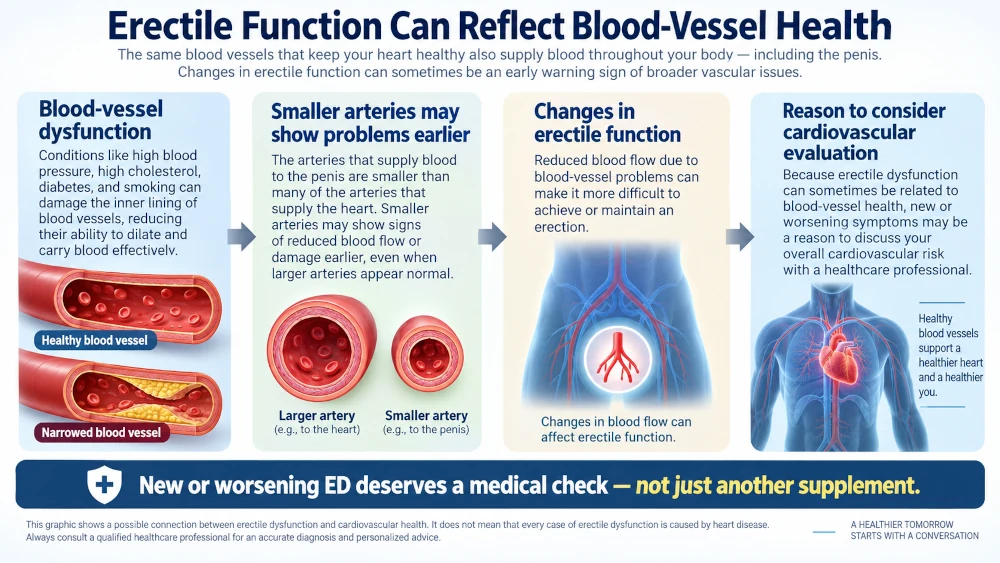
New erectile dysfunction is worth singling out. Because the small arteries of the penis narrow before the larger ones supplying the heart, ED can be an early warning sign of cardiovascular disease [Mayo Clinic]. Mayo Clinic notes that men with ED that has no obvious cause and no heart symptoms should be screened for heart disease — ideally before starting any ED treatment [Mayo Clinic].
There’s a second, urgent reason to involve a doctor rather than an anonymous online product: if you take nitrates for chest pain, many ED treatments (and the hidden drugs in tainted supplements) are unsafe to combine with them [Mayo Clinic]. Used this way, a change in stamina isn’t just a nuisance to paper over — it’s information about your health that’s worth acting on.
For the wider picture on men’s herbal options and where the evidence stands, see our companion guide to the best herbs for men; for a traditional tonic with a long folk history and its own safety notes, our overview of fo-ti covers what tradition claims versus what’s established.
| Health Disclaimer: This article is for general education only. It is not medical advice, diagnosis, or treatment, and it is not a substitute for guidance from a qualified healthcare professional. The herbs and supplements described here are dietary supplements, not treatments for any disease. Talk to your doctor or pharmacist before starting any supplement — especially if you take prescription medication (including nitrates, blood-pressure, diabetes, blood-thinning, or sedative drugs), have a health condition such as a liver, thyroid, autoimmune, heart, or hormone-sensitive disorder, or are scheduled for surgery. Stop use and seek prompt medical care for warning signs such as chest pain, fainting, a dangerous drop in blood pressure, or signs of liver trouble (yellowing skin or eyes, dark urine, persistent abdominal pain, unusual fatigue). |
Frequently Asked Questions
What is the single best herb for male stamina?
There isn’t one that fits every meaning of “stamina.” Panax ginseng has the most plausible evidence for erectile function, though the effect is modest and uncertain [Cochrane, 2021]. For stress-driven fatigue and poor sleep, ashwagandha has the best support [NCCIH, 2023]. Match the herb to the specific problem rather than expecting one pill to do everything.
How long do these herbs take to work?
Unlike prescription ED drugs, herbs generally act gradually. Most trials that found any benefit ran for weeks to a few months — ashwagandha studies typically 6 to 12 weeks, Tribulus and maca trials one to three months. If a product promises an immediate, dramatic effect, that’s a warning sign, not a feature.
Do any of these actually raise testosterone?
At most modestly and unreliably. Ashwagandha has limited evidence for a small testosterone increase over two to four months [NCCIH, 2023]. Tribulus, despite its reputation, showed no robust testosterone effect across ten trials [Vilar Neto et al., 2025]. If you suspect low testosterone, get a blood test and talk to a doctor rather than self-treating.
Are “male stamina” supplements safe to buy online?
Not automatically. The FDA repeatedly finds sexual-enhancement and stamina products spiked with hidden prescription drugs like sildenafil, which can be dangerous — especially with nitrates — and can send people to the hospital [FDA, 2026]. Favor single-ingredient products with third-party testing, and be skeptical of “all natural” performance claims.
Can these herbs treat erectile dysfunction?
Some may modestly help milder cases — ginseng has the best (still limited) evidence [Cochrane, 2021]. But they aren’t equivalent to proven ED treatments, and new or worsening ED can be an early sign of heart disease, so it deserves a medical check rather than a supplement alone [Mayo Clinic].
Can I take more than one at once, or with my medications?
Combining herbs multiplies the chance of interactions, and several here affect blood sugar, blood pressure, sedation, thyroid function, or the liver. Don’t stack them or add them to prescription drugs without checking with a doctor or pharmacist first [NCCIH, 2023].
References
- Lee HW, Lee MS, Kim T-H, et al. Ginseng for erectile dysfunction. Cochrane Database of Systematic Reviews, 2021, Issue 4. Art. No.: CD012654. DOI: 10.1002/14651858.CD012654.pub2. — View source
- National Center for Complementary and Integrative Health. Asian Ginseng: Usefulness and Safety. Updated February 2025. — View source
- National Center for Complementary and Integrative Health. Ashwagandha: Usefulness and Safety. Updated March 2023. — View source
- Shin BC, Lee MS, Yang EJ, Lim HS, Ernst E. Maca (L. meyenii) for improving sexual function: a systematic review. BMC Complementary and Alternative Medicine, 2010;10:44. (PMID 20691074 / PMC2928177.) — View source
- Lee HW, Lee MS, Qu F, Lee J-W, Kim E. Maca (Lepidium meyenii Walp.) on semen quality parameters: a systematic review and meta-analysis. 2022. (PMC9468664.) — View source
- Vilar Neto J de O, de Moraes WMAM, Pinto DV, et al. Effects of Tribulus (Tribulus terrestris L.) supplementation on erectile dysfunction and testosterone levels in men — a systematic review of clinical trials. Nutrients, 2025;17(7):1275. DOI: 10.3390/nu17071275. — View source
- Icariin PDE5 inhibition (laboratory study). PLOS ONE, 2019. (PMC6754136; DOI not independently confirmed, cited by PMC ID; human evidence very limited.) — View source
- U.S. Food and Drug Administration. Sexual Enhancement and Energy Product Notifications. Content current as of September 2, 2026. — View source
- Mayo Clinic. Erectile dysfunction: A sign of heart disease? — View source
