
The home remedies that work for a black eye are simple: cold for the first day or two, gentle warmth once the swelling settles, a propped-up head at night, and time. Those are the natural remedies for black eye care that eye doctors and major medical centers actually recommend. Most black eyes fade on their own within about two weeks [MedlinePlus, 2025]. Creams like arnica have some evidence for ordinary bruises, but none has been tested on black eyes, and nothing clears one overnight.

The bruise itself is rarely the real risk. A blow hard enough to discolor the skin can also injure the eye or crack the thin bones around it, and those injuries need a doctor, not a cold pack [Mayo Clinic black eye first aid, 2024]. Check the warning signs below before you treat anything.
What a black eye is
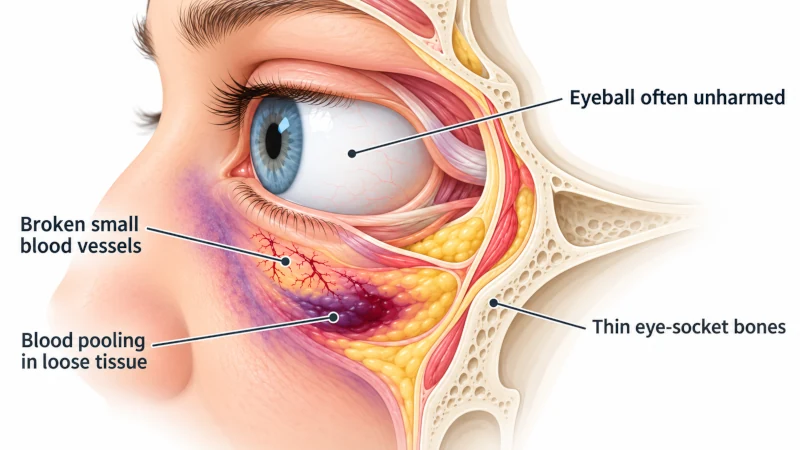
A black eye is a bruise. A blow to the face breaks tiny blood vessels in the skin around the eye, and because that skin is loose, blood and fluid collect easily. That’s why the swelling can look far worse than the injury feels [American Academy of Ophthalmology, 2016]. Despite the name, the eye itself is often unharmed [Cleveland Clinic, 2025].
The colors tell you your body is clearing the blood. The skin usually starts black and blue, then shifts to purple, green, and yellow over several days [MedlinePlus, 2025]. On darker skin, the bruise may look purple, dark brown, or black [Cleveland Clinic, 2025].
Not every black eye comes from a punch or a ball. Wisdom tooth removal and dental implant surgery can leave bruising under the eye a couple of days later, as blood and fluid track through the loose facial tissue [American Academy of Ophthalmology, 2016]. If that’s what happened, call the surgeon who did the procedure.
Warning signs: when a black eye needs a doctor
Medical sources draw the line in slightly different places. Mayo Clinic lists specific symptoms that should send you for care [Mayo Clinic black eye first aid, 2024]. Cleveland Clinic goes further and recommends having any injury-related black eye checked, ideally soon after it happens [Cleveland Clinic, 2025]. If you’re torn, getting examined is the safer call. Even a light blow can cause a serious injury such as a retinal detachment, which is why the American Academy of Ophthalmology advises contacting an ophthalmologist or the ER when a black eye comes with pain or vision changes [AAO guide to eye injuries, 2023].
Go to the ER or call 911
- Fainting, loss of consciousness, or a seizure [Cleveland Clinic on orbital fractures, 2023]
- Vomiting or dizziness after the blow [American Academy of Ophthalmology, 2016]
- A sudden, severe headache, or trouble walking, talking, or seeing [Cleveland Clinic on orbital fractures, 2023]
- Blood or fluid leaking from the nose or ears [Cleveland Clinic on orbital fractures, 2023]
- Bruising around both eyes after a head injury, often called “raccoon eyes.” It can appear a day or two after an injury that didn’t seem serious and may mean a skull fracture [American Academy of Ophthalmology, 2016]
- Anything that cut or went into the eye [MedlinePlus, 2025]
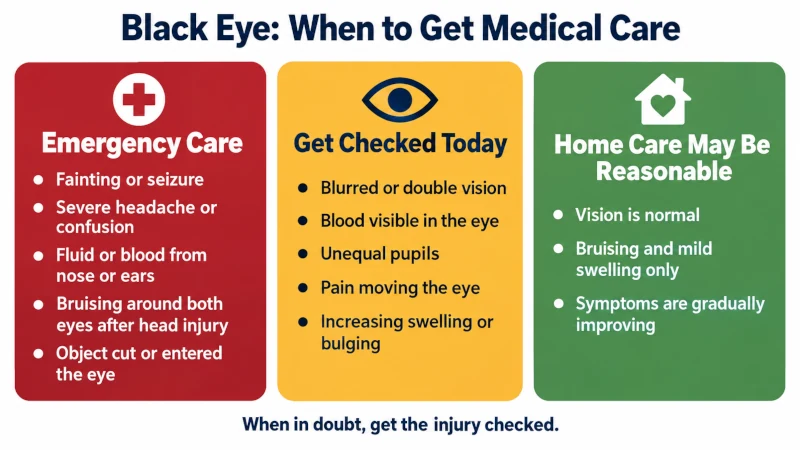
See an eye doctor or urgent care the same day
- Any change in vision, including blurred or double vision [Mayo Clinic black eye first aid, 2024]
- Blood in the white or colored part of the eye [Mayo Clinic black eye first aid, 2024]
- A pupil that doesn’t match the other one in size or shape [American Academy of Ophthalmology, 2016]
- Pain when you move your eye, or a numb cheek or teeth. These are signs of an orbital fracture, a break in the thin bones of the eye socket [American Academy of Ophthalmology, 2016]
- Trouble moving the eye, or severe pain around it [Cleveland Clinic, 2025]
- An eye that bulges, or redness and swelling that keep getting worse [Nemours KidsHealth, 2021]
A bright red patch on the white of the eye is sometimes just a broken surface blood vessel, but after a blow it deserves an exam. Our guide to red-eye look-alikes, including subconjunctival hemorrhage, explains how that condition differs from more serious causes.
Also get it checked if…
- It’s a child. Nemours KidsHealth advises calling your child’s doctor to talk through how the injury happened; the doctor may want to see them [Nemours KidsHealth, 2021].
- You take a blood thinner or daily aspirin, or bruise easily. Don’t stop the medicine on your own; call the doctor who prescribed it and mention the injury.
- The bruising appeared with no injury or surgery. Black eyes that show up out of nowhere, often on both sides, can be a sign of a serious medical condition [Cleveland Clinic, 2025].
| If someone hurt you You deserve care and safety. The National Domestic Violence Hotline is free, confidential, and open 24/7: call 1-800-799-7233 or text START to 88788. If you’re in immediate danger, call 911 [National Domestic Violence Hotline]. |
Natural remedies for black eye backed by solid guidance
Cold compress for the first 24 to 48 hours
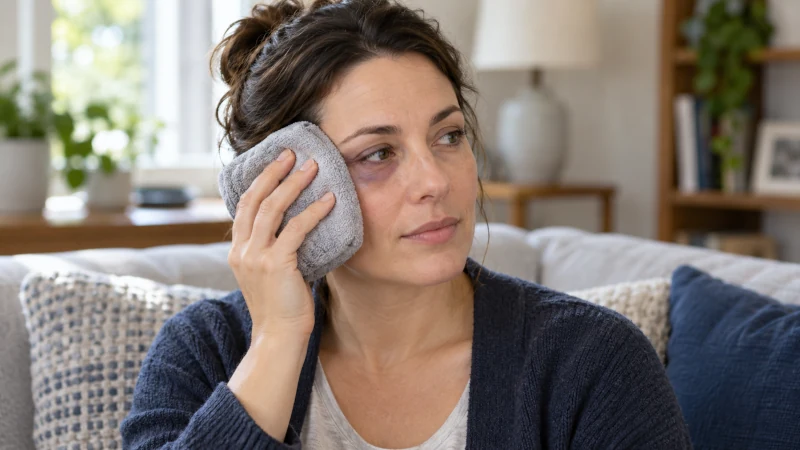
[Well established] Cold is the one remedy every major source agrees on. It helps slow bleeding under the skin and limits swelling [Cleveland Clinic, 2025], so start as soon as you can after the injury [Mayo Clinic black eye first aid, 2024].
- Wrap an ice pack, a bag of crushed ice, or a bag of frozen peas or corn in a thin towel. Frozen vegetables mold nicely to the face [American Academy of Ophthalmology, 2016].
- Hold it on for 15 to 20 minutes at a time, as often as once an hour [American Academy of Ophthalmology, 2016].
- Rest it on the cheekbone and brow with gentle pressure. Don’t press on the eyeball itself [Mayo Clinic black eye first aid, 2024].
- Repeat several times a day for a day or two [Mayo Clinic black eye first aid, 2024].
For children, Nemours suggests shorter sessions of 5 to 10 minutes, with at least a 15-minute break before the next one [Nemours KidsHealth, 2021].
Gentle warmth once the swelling stops growing
[Expert guidance] After the first day or two, warmth can help. Mayo Clinic suggests warm compresses once the swelling has gone down, several times a day for a day or two [Mayo Clinic black eye first aid, 2024]. Nemours suggests switching after about a day or two [Nemours KidsHealth, 2021]. A practical rule: switch once the swelling has clearly stopped getting bigger. Use a warm, damp washcloth that feels comfortable on the inside of your wrist. Eyelid skin is thin, so warm beats hot.
Sleep with your head up
Add an extra pillow at night and sleep on the uninjured side of your face [Nemours KidsHealth, 2021]. For eye-socket fractures, Cleveland Clinic advises keeping your head above heart level to help prevent more swelling [Cleveland Clinic on orbital fractures, 2023]. It costs nothing and does no harm for an ordinary bruise either.
Choose your pain reliever carefully
This is where guidance is genuinely uneven. For children with a black eye, Nemours recommends acetaminophen (Tylenol) and advises against ibuprofen (Advil, Motrin) and aspirin, because they can increase bleeding [Nemours KidsHealth, 2021]. The American Academy of Ophthalmology gives the same warning about aspirin, ibuprofen, and other NSAIDs after a cut or puncture to the eye, since they thin the blood [AAO guide to eye injuries, 2023]. Mayo Clinic’s first-aid page for adults doesn’t address pain relievers at all.
For a simple bruise, acetaminophen is the more cautious choice while bleeding under the skin is still the issue. Follow the label, and ask a pharmacist which option suits you if you have liver or kidney disease or take other medicines.
Go easy on nose-blowing
The eye socket sits right next to your sinuses. If a bone cracked, blowing your nose can push air into the tissue around the eye and make the swelling worse. That’s why doctors treating orbital fractures tell patients not to blow their nose while the injury heals [Cleveland Clinic on orbital fractures, 2023]. Until a fracture has been ruled out, dab rather than blow.
Protect the area, and skip the steak
Don’t press on or rub the injured eye [MedlinePlus, 2025], and avoid activities that could lead to another hit to the face while it heals [Cleveland Clinic, 2025].
The raw steak from old movies is a bad idea. There’s no scientific basis for it, and bacteria on raw meat carry a real infection risk [American Academy of Ophthalmology, 2016]. If the bruise bothers you in public, concealer or foundation can make it less noticeable while it fades [Cleveland Clinic, 2025].
Arnica, vitamin K, and bromelain: what the evidence shows
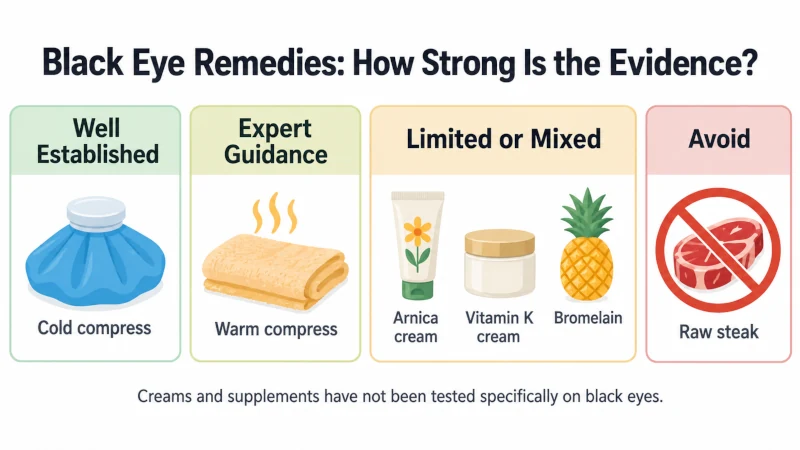
Here is how the popular extras stack up. None of them has been studied on black eyes specifically.
| Remedy | Best evidence available | Evidence grade |
| Cold compress | Consistent guidance from AAO, Mayo Clinic, Cleveland Clinic | Well established (first aid) |
| Warm compress | Guidance from Mayo Clinic and Nemours | Expert guidance |
| Arnica gel or ointment (topical) | One small randomized trial on laser-induced arm bruises; mixed results after surgery | Limited, mixed |
| Homeopathic arnica tablets | Mixed trials; a hand-surgery trial found no benefit | Weak |
| Vitamin K cream | Small trials on laser-induced bruises | Limited |
| Bromelain supplement | Small studies after wisdom tooth surgery | Limited |
| Raw steak | None; infection risk | Avoid |
Arnica
[Limited, mixed] The best trial behind arnica for bruising involved healthy adults, not black eyes. Researchers used a laser to create four small, identical bruises on each volunteer’s upper arms, then assigned a different ointment to each bruise, applied twice a day for two weeks. After two weeks, 20% arnica had improved bruising more than plain petrolatum and more than a 1% vitamin K and retinol cream, but it did no better than 5% vitamin K [Leu et al., British Journal of Dermatology, 2010].
Other results are less encouraging. Memorial Sloan Kettering’s review notes that studies after surgery are mixed, and that arnica ointment didn’t help after eyelid surgery (blepharoplasty) [Memorial Sloan Kettering, 2022]. Homeopathic arnica tablets fare worse: in a trial of 64 adults having carpal tunnel surgery, arnica did no better than placebo for pain or bruising [Stevinson et al., 2003].
If you want to try a topical arnica product, know the cautions [Memorial Sloan Kettering, 2022]:
- Skin reactions: it can cause irritation, swelling, and allergic contact dermatitis.
- Plant allergies: skip it if you’re allergic to sunflowers, marigolds, ragweed, or other plants in the same family.
- Blood thinners: it may increase bleeding risk with warfarin and similar drugs.
- Never swallow herbal arnica. Case reports after oral use include internal bleeding, a racing heart, and coma.
- Pregnancy and breastfeeding: avoid it. A newborn developed a serious blood reaction after the nursing mother drank arnica tea.
Keep any cream on the bruised cheek and brow, well away from the eye itself.
Vitamin K cream
[Limited] In the same arm-bruise trial, 5% vitamin K cream performed about as well as 20% arnica [Leu et al., British Journal of Dermatology, 2010]. That’s a small study on laser bruises, so treat vitamin K cream as a reasonable cosmetic experiment rather than a proven treatment, and keep it away from the eye.
Bromelain
[Limited] Bromelain is a group of enzymes from the pineapple stem and fruit. A small number of studies suggest oral bromelain may ease some symptoms after wisdom tooth surgery; for most other uses, there’s very little research [NCCIH, 2024]. Nobody has tested it on black eyes. The most common side effects are stomach upset and diarrhea. If you take any medicine, check with your doctor or pharmacist first, and little is known about its safety during pregnancy or breastfeeding [NCCIH, 2024]. Skip it if you’re allergic to pineapple. Our guide to what pineapple and bromelain can and can’t do covers the enzyme in more depth.
How long does a black eye take to heal?
Most black eyes fade within about two weeks [MedlinePlus, 2025]. If other parts of the face or head were injured, healing can take longer [Cleveland Clinic, 2025]. There’s no way to heal one overnight, but steady icing in the first 24 hours is the single most useful thing you can do [Cleveland Clinic, 2025].
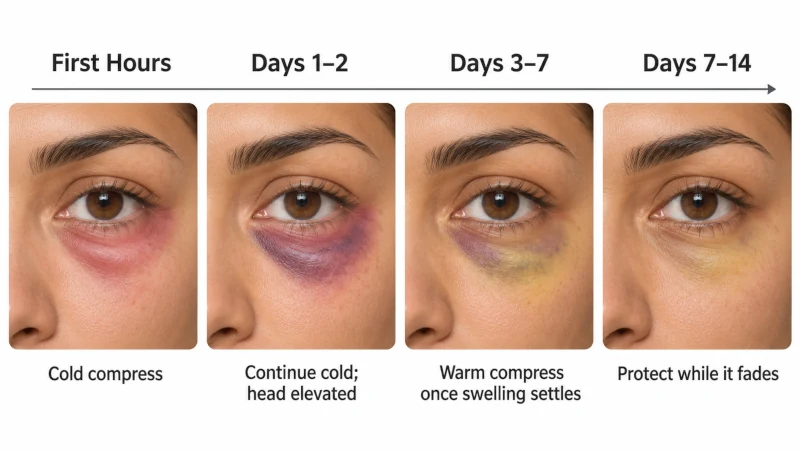
| Time since injury | What you’ll likely see | What to do |
| First few hours | Red skin; swelling that may worsen over an hour or two | Start cold compresses; check the warning signs |
| Days 1–2 | Dark blue, purple, or black | Keep icing; sleep with your head up |
| Days 3–7 | Purple turning green | Switch to warm compresses once swelling has stopped growing |
| Days 7–14 | Yellow, then fading | Protect the area from another hit |
Color sequence based on MedlinePlus (2025) and Cleveland Clinic (2025). Timing varies from person to person.
If the bruise isn’t clearly fading after two weeks, or it spreads or darkens instead, have it checked. For other eye problems, browse our eye and vision health guides.
| Health Disclaimer: This article is for general education only and is not medical advice, diagnosis, or treatment. A black eye can hide an injury to the eye, the eye socket, or the head that only an in-person exam can rule out. Get emergency care for vision changes, blood in the eye, bruising around both eyes, vomiting, confusion, fainting, or fluid from the nose or ears. If you’re pregnant or breastfeeding, take a blood thinner or other medicine, or are treating a child, talk with a doctor or pharmacist before using arnica, bromelain, or any other supplement or cream described here. |
Frequently Asked Questions
What’s the fastest way to get rid of a black eye?
Cold, early and often. Hold a wrapped ice pack or bag of frozen peas on the cheekbone and brow for 15 to 20 minutes, up to once an hour, for the first day or two [American Academy of Ophthalmology, 2016]. Nothing makes a black eye disappear overnight, and most take about two weeks to fade.
Should I use ice or heat on a black eye?
Ice first, heat later. Use cold compresses for the first day or two to limit swelling, then switch to warm compresses once the swelling has gone down [Mayo Clinic black eye first aid, 2024].
Does arnica work on a black eye?
It hasn’t been tested on black eyes. One small trial found 20% arnica ointment helped laser-induced arm bruises fade more than petrolatum [Leu et al., British Journal of Dermatology, 2010], but other studies are mixed. Keep it away from the eye, and skip it if you’re pregnant, breastfeeding, or allergic to ragweed-family plants.
Can I take ibuprofen for a black eye?
For children, Nemours recommends acetaminophen and advises against ibuprofen and aspirin because they can increase bleeding [Nemours KidsHealth, 2021]. For adults with a simple bruise, acetaminophen is the more cautious choice. Ask a pharmacist if you’re unsure, and don’t stop a prescribed blood thinner or daily aspirin without talking to your doctor.
Can a black eye show up days after an injury?
Yes. Bruising around both eyes that appears a day or two after a head injury can be a sign of a skull fracture and needs medical care right away [American Academy of Ophthalmology, 2016]. A single black eye can also appear a couple of days after dental surgery.
References
- American Academy of Ophthalmology. “5 Things to Know About a Black Eye.” View source
- American Academy of Ophthalmology. “Recognizing and Treating Eye Injuries. View source
- American Academy of Ophthalmology. “What Is an Ophthalmologist?” View source
- Cleveland Clinic. “Black Eye.” View source
- Cleveland Clinic. “Orbital Fractures.” View source
- Leu S, Havey J, White LE, Martin N, Yoo SS, Rademaker AW, Alam M. “Accelerated resolution of laser-induced bruising with topical 20% arnica: a rater-blinded randomized controlled trial.” British Journal of Dermatology. 2010;163(3):557–563. DOI: 10.1111/j.1365-2133.2010.09813.x. PMID: 20412090. View source
- Mayo Clinic Staff. “Black eye: First aid.” Mayo Clinic. View source
- MedlinePlus Medical Encyclopedia. “Eye emergencies.” U.S. National Library of Medicine. View source
- Memorial Sloan Kettering Cancer Center. “Arnica.” About Herbs, Botanicals & Other Products. View source
- National Center for Complementary and Integrative Health. “Bromelain: Usefulness and Safety.” View source
- National Domestic Violence Hotline. “Get Help.” View source
- Nemours KidsHealth. “Black Eyes.” View source
- Stevinson C, Devaraj VS, Fountain-Barber A, Hawkins S, Ernst E. “Homeopathic arnica for prevention of pain and bruising: randomized placebo-controlled trial in hand surgery.” Journal of the Royal Society of Medicine. 2003;96(2):60–65. DOI: 10.1177/014107680309600203. PMID: 12562974. View source


