
If your eyes feel dry or gritty, or keep watering for no clear reason, you may have seen the problem described as “dry tear ducts.” It is a common phrase, but it isn’t a diagnosis an eye doctor would make, and it points at the wrong part of the eye. Tear ducts don’t make tears. Their job is to drain tears away from the eye and into the nose [Mayo Clinic, 2025].
That matters because the two most likely explanations behave very differently. Dry eye is a problem with the tears on the surface of the eye. A blocked or narrowed tear duct (sometimes called a clogged tear duct) is a drainage problem: tears are made normally but can’t escape, so the eye tends to water, crust over, or get infected again and again [Mayo Clinic, 2025].
This guide focuses on tear drainage. If your main symptoms are burning, grittiness, blur that comes and goes, or irritation that’s worse with screens or dry air, our complete guide to dry eye syndrome covers causes and relief in depth.
| Quick answer: Tear glands make tears. Tear ducts — the puncta, canaliculi, lacrimal sac and nasolacrimal duct — drain them into the nose. “Dry tear ducts” usually describes dry eye, not a duct problem. A blocked tear duct typically causes the opposite of dryness: watering, tears spilling onto the cheek, crusting, mucus or pus, and sometimes swelling near the inner corner of the eye. Painful, red swelling between the eye and the nose — especially with fever — needs prompt medical care. |
What Are Tear Ducts?
Your tear system has two halves: the parts that produce the tear film and the parts that drain it away. The lacrimal glands, which sit under the upper eyelids, make most of the watery tears. Each blink spreads them across the eye, and the excess drains through a small chain of channels into the nose, where it is absorbed [Mayo Clinic, 2025].
| Structure | Where it is | What it does |
| Lacrimal gland | Under the upper eyelid, toward the outer side | Produces most of the watery part of tears [Mayo Clinic, 2025] |
| Meibomian glands and conjunctiva | Edges of the eyelids; the clear lining of the eye and lids | Add the oil and mucus layers that keep tears stable and spread evenly [AAO] |
| Puncta | Two tiny openings at the inner corners of the upper and lower lids | Entry points for drainage [Mayo Clinic, 2025] |
| Canaliculi | Small channels leading from each punctum | Carry tears toward the lacrimal sac [Mayo Clinic, 2025] |
| Lacrimal sac | Between the inner corner of the eye and the side of the nose | Collects draining tears [ASOPRS] |
| Nasolacrimal duct | A passage through the bone beside the nose | Empties tears into the nasal cavity [Mayo Clinic, 2025] |
The first two rows are the production side. Everything from the puncta down is the drainage side — what most people mean by “tear ducts.” Blinking also acts as a pump, pushing used tears into the puncta and down toward the nose [ASOPRS]. A blockage can happen at any point along this route [Mayo Clinic, 2025].
Can Tear Ducts Actually Become “Dry”?
Not in the way the phrase suggests. Because tear ducts carry tears away, a problem with them usually leaves more tears on the eye, not fewer. When the eye feels dry, the issue is almost always the tear film itself: too few tears, or tears that don’t have the right balance of water, oil and mucus [AAO].
Two things make this confusing:
- Dry eyes can water. When dryness irritates the eye’s surface, the eye responds by making extra tears [AAO] [Merck Manual, 2025]. So a watery eye doesn’t rule out dry eye.
- Tear duct plugs are a dry-eye treatment. Eye doctors sometimes place tiny plugs in the puncta so that natural tears stay on the eye longer [AAO]. Slowing drainage on purpose is a way to treat dry eye — not a sign the ducts have dried out. Our dry eye syndrome guide explains when plugs are used.
Dry Eye vs. Blocked Tear Duct

No single symptom proves either one, and some people have both. Allergies, infections and eyelid problems can blur the picture further. Still, the patterns below often point in one direction.
| Clue | More typical of dry eye | More typical of a blocked tear duct |
| Main sensation | Stinging, burning, scratchy or gritty, like something is in the eye [AAO] | A wet, brimming eye [Mayo Clinic, 2025] |
| Tears spilling onto the cheek | Less typical; watering tends to come in bursts | Common — tears running down the cheek suggest blocked drainage [Merck Manual, 2025] |
| Blurry vision | Blur that comes and goes, especially while reading [AAO] | Blur from a film of excess tears [Mayo Clinic, 2025] |
| Discharge and crusting | Strings of mucus [AAO] | Mucus or pus discharge; crusted eyelids [Mayo Clinic, 2025] |
| Swelling or tenderness near the nose | Not typical | Can occur; painful swelling at the inner corner suggests infection [Mayo Clinic, 2025] [Merck Manual Dacryocystitis, 2026] |
| What makes it worse | Wind, smoke, dry heat, long reading or screen sessions [Merck Manual, 2025] [AAO] | Colds, allergies and nasal congestion, which can block the duct’s outlet in the nose [Merck Manual, 2025] |
| Repeated eye infections | Not typical | Common — stagnant tears encourage infection [Mayo Clinic, 2025] |
| One eye or both | Usually both | Can be one or both; constant watering in one eye is worth having checked [Mayo Clinic, 2025] |
A useful rule of thumb from the Merck Manual: if tears don’t run down your cheek, dry eye is often the cause; if they do, a drainage problem becomes more likely [Merck Manual, 2025]. It’s a starting point for a conversation with an eye doctor, not a diagnosis. If the left column sounds like you, see how dry eye is treated.
Symptoms of a Blocked or Narrowed Tear Duct
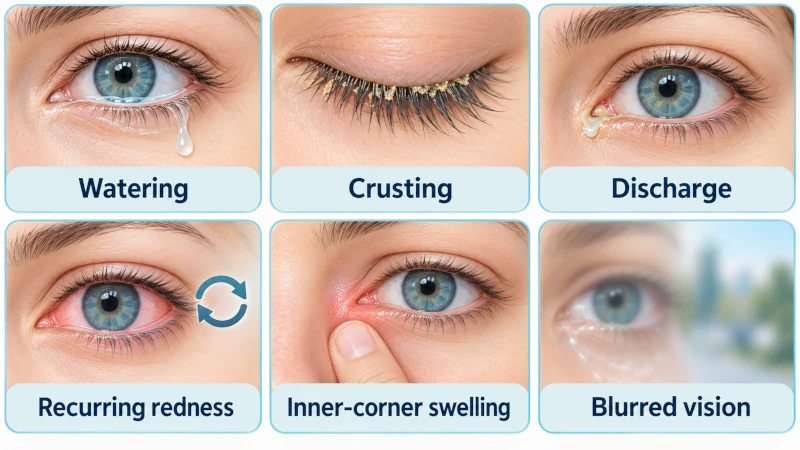
A drainage blockage can be partial or complete [Mayo Clinic, 2025]. A narrowed duct (doctors call this stenosis) may still let some tears through. A complete blockage traps tears in the lacrimal sac, where they can sit, stagnate and become infected [ASOPRS].
Common signs include:
- A very watery eye, with tears pooling or spilling over [Mayo Clinic, 2025]
- Mucus building up at the inner corner of the eye or along the lashes [ASOPRS]
- Crusting of the eyelids, often worst on waking [Mayo Clinic, 2025]
- Mucus or pus coming from the lids and eye surface [Mayo Clinic, 2025]
- Redness of the white of the eye, or “pink eye” that keeps coming back [Mayo Clinic, 2025]
- Blurred or distorted vision from the extra tears [Mayo Clinic, 2025] [ASOPRS]
- Redness, tenderness or swelling between the inner corner of the eye and the side of the nose [ASOPRS]
Because tears that can’t drain become stagnant, bacteria, viruses and fungi can grow more easily, which is why repeated infections are such a common clue [Mayo Clinic, 2025]. Redness and discharge also overlap with conjunctivitis and other eye problems; our guide to conditions that can be mistaken for pink eye explains how they differ.
What Causes Tear Duct Blockage in Adults?
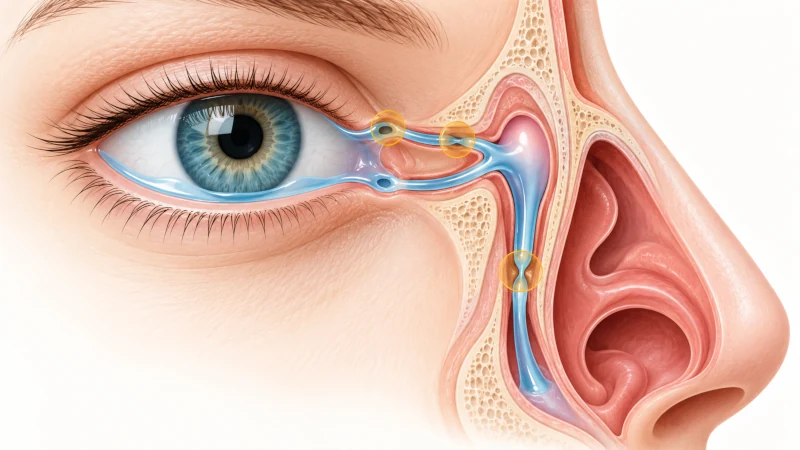
In older adults, the most common cause of unexplained watering is simple age-related narrowing of the nasolacrimal duct, often with no other abnormal findings [Merck Manual, 2025]. Other recognized causes include:
- Age-related changes. The puncta can narrow over time, as well as the duct itself [Mayo Clinic, 2025] [Merck Manual, 2025].
- Long-standing inflammation or infection of the eyes, the drainage system or the nose [Mayo Clinic, 2025], including repeated conjunctivitis and inflammatory diseases such as sarcoidosis or granulomatosis with polyangiitis [Merck Manual Dacryostenosis, 2026].
- Facial injury. Fractures of the nose or face can damage or scar the drainage path [Mayo Clinic, 2025] [Merck Manual Dacryostenosis, 2026].
- Previous surgery on the eye, eyelid, nose or sinuses, which can leave scarring [Mayo Clinic, 2025].
- Nasal and sinus congestion. Colds, allergic rhinitis and sinusitis can block the outlet in the nose even when the duct itself is intact [Merck Manual, 2025]. If sinus trouble keeps recurring, our guide to natural remedies for sinusitis covers what helps at home — but easing sinus symptoms won’t open a duct that is structurally narrowed.
- Certain medicines and cancer treatments. Long-term use of some glaucoma eye drops, chemotherapy and radiation (especially to the head or face) can narrow the drainage system [Mayo Clinic, 2025] [Merck Manual, 2025].
- Stones or debris lodged in the duct [Merck Manual, 2025] [Mayo Clinic, 2025].
- Eyelid position. A lower lid that turns outward (ectropion) or inward (entropion) can keep tears from reaching the puncta, causing watering without any actual blockage [Merck Manual, 2025].
- Growths (uncommon). Rarely, a tumor in the nose or along the drainage system presses on it [Mayo Clinic, 2025]. A hard lump near the inner corner of the eye is one sign doctors watch for [Merck Manual, 2025]. This isn’t a likely explanation for most people, but it is one reason persistent watering deserves an exam rather than years of putting up with it.
Why Can a Blocked Tear Duct Cause Watery Eyes?
Your eyes make tears all the time, and the drainage system quietly removes the excess. When that drain narrows or closes, the tears have nowhere to go except over the edge of the lower lid and down the cheek. Doctors call this overflow epiphora [Merck Manual, 2025].
Dry eye produces watering in a different way. Here the drain works, but irritation from dryness triggers a sudden surge of reflex tears [Merck Manual, 2025] [AAO]. The flood can briefly overwhelm normal drainage, yet the eye surface stays poorly protected — which is why dry, watery eyes often still feel scratchy. Merck notes that when dryness is behind the tearing, lubricating the eye can paradoxically reduce the watering [Merck Manual, 2025]. Both mechanisms can happen together.
It also helps to keep perspective: overall, the most common reasons for watery eyes are colds and allergies [Merck Manual, 2025]. Watering that comes and goes with a cold usually settles on its own; watering that persists for weeks, especially with crusting or discharge, is more likely to involve drainage.
Tear Duct Infection and Dacryocystitis
Dacryocystitis is an infection of the lacrimal sac. It is usually caused by staphylococcal or streptococcal bacteria and typically develops because the nasolacrimal duct below the sac is blocked [Merck Manual Dacryocystitis, 2026].
- Acute dacryocystitis causes pain, redness and swelling over the lacrimal sac, between the inner corner of the eye and the nose. Sometimes an abscess forms [Merck Manual Dacryocystitis, 2026].
- Chronic dacryocystitis more often shows up as a lump below the inner corner of the eye along with ongoing conjunctivitis. The bulge may not be painful, but pus can come out of the punctum [Merck Manual Dacryocystitis, 2026].
This is a condition for a clinician to manage. Treatment usually involves antibiotics — by mouth for mild cases and intravenously for severe ones — along with warm compresses; an abscess may need to be drained. Chronic or recurrent infection is usually treated with surgery that creates a new drainage route into the nose [Merck Manual Dacryocystitis, 2026]. Repeated infection can also spread to the tissues around the eye (orbital cellulitis), a more serious problem [Merck Manual, 2025].
Avoid squeezing a swollen tear sac, using leftover antibiotic drops, or trying home remedies for a suspected infection. Get it examined instead.
How Tear Duct Problems Are Diagnosed
An eye doctor will ask how long the watering has lasted, whether tears run down your cheek, and about eye drops, past infections, facial injuries, surgery and radiation [Mayo Clinic Treatment, 2025] [Merck Manual, 2025]. The exam usually includes your eyelids, puncta and lid position, gently feeling the lacrimal sac for tenderness or swelling, and sometimes looking inside the nose [Mayo Clinic Treatment, 2025] [Merck Manual, 2025]. Depending on what they find, tests may include:
- Dye disappearance test. A drop of harmless dye goes in each eye. If most of it is still on the eye after about five minutes, drainage may be blocked [Mayo Clinic Treatment, 2025].
- Irrigation and probing. Saline is flushed through the drainage system, or a slender instrument is passed into the puncta to find the blockage. If fluid backs up instead of reaching the nose, that points to narrowing or obstruction [Mayo Clinic Treatment, 2025] [Merck Manual, 2025]. In some people, probing itself relieves the problem [Mayo Clinic Treatment, 2025].
- Imaging. Contrast dye passed through the system can be viewed on X-ray, CT or MRI to locate the blockage and its cause [Mayo Clinic Treatment, 2025]. These tests are mainly used when surgery is being planned or an abscess is suspected [Merck Manual, 2025].
Because dry eye and poor drainage can coexist, your doctor may also check your tear film [Merck Manual, 2025].
Treatment for Blocked or Narrowed Tear Ducts
Treatment depends on the cause, where the blockage is, and how severe it is; more than one approach is sometimes needed [Mayo Clinic Treatment, 2025]. Options include:
- Treating infection. Antibiotic drops or pills when infection is present [Mayo Clinic Treatment, 2025].
- Watchful waiting. After a facial injury, a clinician may suggest waiting a few months, since drainage can return as swelling settles [Mayo Clinic Treatment, 2025].
- Treating the underlying cause when possible, such as an inflammatory condition or an eyelid that has turned out of position [Merck Manual Dacryostenosis, 2026] [Merck Manual, 2025].
- Dilation and irrigation. For narrowed puncta, the opening is widened with a small probe and the duct flushed. It’s a simple office procedure that often gives at least temporary relief [Mayo Clinic Treatment, 2025], and dilation is usually curative for narrowing confined to the puncta or canaliculi [Merck Manual Dacryostenosis, 2026]. A minor “snip” procedure can also reopen a tight punctum [ASOPRS].
- Stenting (intubation). A thin silicone or polyurethane tube is threaded through the drainage system and usually left for about three months to hold it open [Mayo Clinic Treatment, 2025].
- Balloon catheter dilation. A tiny balloon is inflated within the narrowed duct; in adults it may be used for partial blockages [Mayo Clinic Treatment, 2025].
- Dacryocystorhinostomy (DCR). This surgery creates a new opening from the lacrimal sac directly into the nose, bypassing the blocked duct [ASOPRS]. Surgeons regard it as the standard treatment for a completely blocked nasolacrimal duct; unlike in infants, adult blockages generally can’t be opened with a probe alone [ASOPRS]. It can be done through a small skin incision beside the nose (external) or through the nostril with a camera (endoscopic). The endoscopic route leaves no scar but has had lower success rates than the external approach [Mayo Clinic Treatment, 2025].
- Glass tube bypass (CDCR). When the canaliculi themselves are closed, a small glass tube can connect the corner of the eye to the nose [ASOPRS] [Merck Manual Dacryostenosis, 2026].
- Tumor treatment, in the uncommon cases where a growth is responsible [Mayo Clinic Treatment, 2025].
DCR is typically an outpatient procedure. Some nosebleeding for a couple of days is common, most people recover in less than a week, and bleeding or infection are uncommon. The new opening can occasionally narrow again and need further surgery, and outcomes can’t be guaranteed — but most people notice less watering and discharge once the right procedure addresses the blockage [ASOPRS].
Blocked Tear Ducts in Babies
Blocked tear ducts are common in newborns and are a separate situation from adult blockage. More than 5% of infants have symptoms, usually in the first month, and about 90% clear on their own during the first year [AAPOS, 2025]. Signs include tears pooling or spilling onto the cheek and crusting or yellow-green discharge on the lashes [AAPOS, 2025].
A pediatrician or pediatric ophthalmologist may show you how to do tear duct massage, and antibiotic drops are used only for significant discharge. If the blockage hasn’t improved by about 12 months, or symptoms are severe, a probing procedure may be recommended [AAPOS, 2025]. Seek care promptly for a red, swollen, painful bump near the inner corner with fever (an emergency), or a bluish bump at the inner corner in a young baby [AAPOS, 2025]. Any persistently watery eye in an infant should be checked, partly to rule out less common causes such as childhood glaucoma [AAPOS, 2025].
Can You Treat a Blocked Tear Duct at Home?
Home care can keep you comfortable and lower the chance of infection, but it won’t reliably open a narrowed adult tear duct. The treatments that do are performed by eye doctors [ASOPRS] [Mayo Clinic Treatment, 2025]. Reasonable steps include:
- Good eye hygiene. Wash your hands before touching your eyes, avoid rubbing them, replace eyeliner and mascara regularly and never share them, and clean contact lenses as directed [Mayo Clinic, 2025].
- Warm compresses, if your clinician recommends them. Warm compresses are sometimes part of treatment, especially alongside antibiotics for an infected tear sac [Merck Manual Dacryocystitis, 2026] [ASOPRS]. They can soothe, but on their own they don’t clear a structural blockage. Don’t press hard on a swollen, painful area.
- Massage only as instructed. Tear duct massage is a technique taught for babies [AAPOS, 2025]. Adults shouldn’t try to probe or forcefully massage a duct without guidance.
What not to put in your eyes: anything used in the eye must be sterile [FDA, 2026]. Skip homemade saline, oils, honey, herbal drops or washes, breast milk and other non-sterile liquids — the FDA specifically notes honey can burn the eye [FDA, 2026]. Stop any eye drop that causes pain, discharge or a change in vision [FDA, 2026], and don’t reuse old prescription drops.
If dryness is also part of the picture, everyday relief measures are covered in our complete guide to dry eye syndrome.
When to See an Eye Doctor

Make an appointment with an optometrist or ophthalmologist if:
- Your eye waters constantly for several days [Mayo Clinic, 2025]
- You get eye infections often, or one that keeps returning [Mayo Clinic, 2025]
- You have repeated, unexplained episodes of tearing [Merck Manual, 2025]
- Mucus, discharge or crusting keeps coming back
- You notice swelling, tenderness or a lump near the inner corner of the eye — especially a firm one [Merck Manual, 2025]
- Watering blurs your vision, interferes with reading or driving, or makes contact lenses hard to wear
- Symptoms continue despite simple care
- A baby’s watery eye hasn’t improved by around 12 months [AAPOS, 2025]
It helps to bring a list of your eye drops and other medicines, plus any history of eye or nasal surgery, facial injury or radiation [Mayo Clinic Treatment, 2025].
When Eye Symptoms Need Prompt or Emergency Care
| Get same-day medical care for: A painful, red, swollen area between the eye and the nose, which can signal a tear sac infection [Merck Manual Dacryocystitis, 2026] Fever with that swelling, or redness and swelling that spread to the eyelid or cheek [Merck Manual, 2025] A baby with a red, swollen, painful bump near the inner corner and fever [AAPOS, 2025] Increasing pain, swelling or worse vision after recent eye, eyelid or tear duct surgery — call your surgeon’s office [ASOPRS] |
| Get emergency care right away if: A chemical gets in your eye — flush with a gentle stream of cool tap water for at least 15 minutes, then seek help [MedlinePlus, 2025] Something has scratched, cut or entered the eye [MedlinePlus, 2025] Your eye is painful and red, or eye pain comes with nausea or headache [MedlinePlus, 2025] You notice any change in vision, such as blurred or double vision [MedlinePlus, 2025] There is bleeding that won’t stop [MedlinePlus, 2025] |
Mild watering with a cold, an allergy flare or a windy day doesn’t need emergency care [Merck Manual, 2025].
| Health Disclaimer: This article is for general education and is not a substitute for professional medical advice, diagnosis or treatment. Watery, crusty or irritated eyes have many causes, and only an eye examination can tell whether the problem is dry eye, a drainage blockage or something else. Do not try to open a tear duct yourself, put homemade or non-sterile substances in your eyes, or treat a suspected eye infection at home. Seek prompt care for painful swelling near the inner corner of the eye, fever, eye pain, vision changes, injury or chemical exposure. |
For more eye topics, browse our Eye & Vision health guides.
Frequently Asked Questions
Can dry tear ducts cause watery eyes?
Tear ducts don’t really dry out — they drain tears. Watery eyes usually come from one of two things: reflex tearing, where dryness irritates the eye and triggers extra tears, or a blocked tear duct that stops tears from draining. Tears that regularly run down the cheek point more toward a drainage problem [AAO] [Merck Manual, 2025].
How do I know if I have dry eye or a blocked tear duct?
Burning, grittiness and blur that comes and goes suggest dry eye. Constant watering, crusting, discharge, repeated infections or swelling near the inner corner suggest a drainage problem. Only an eye exam — sometimes including a dye test or flushing the duct — can confirm which you have, and some people have both [Merck Manual, 2025] [Mayo Clinic Treatment, 2025]. For dryness, see our dry eye syndrome guide.
What does a blocked tear duct feel like?
Usually more wet than painful: an eye that brims with tears, sticky lashes, crusting on waking, and blurry vision from the extra fluid. Pain, tenderness, redness or swelling between the eye and the nose suggests the tear sac may be infected and should be checked promptly [Mayo Clinic, 2025] [Merck Manual Dacryocystitis, 2026].
Can a blocked tear duct clear on its own?
In babies, usually — about 90% clear within the first year [AAPOS, 2025]. In adults it depends on the cause. Swelling after a facial injury may settle over a few months [Mayo Clinic Treatment, 2025], but age-related narrowing tends to persist and may need a procedure if symptoms are bothersome.
What causes blocked tear ducts in adults?
The most common cause is age-related narrowing of the duct. Others include chronic inflammation or infection, facial injury, previous eye or nasal surgery, some glaucoma eye drops, chemotherapy or radiation, and, rarely, a growth pressing on the drainage system [Merck Manual, 2025] [Mayo Clinic, 2025].
When should I see an eye doctor for watery eyes?
If your eye waters constantly for several days, infections keep coming back, or you notice crusting, discharge, or swelling near the inner corner [Mayo Clinic, 2025]. Get same-day care for painful red swelling near the nose or fever, and emergency care for eye pain, vision changes, injury or chemical exposure [Merck Manual Dacryocystitis, 2026] [MedlinePlus, 2025].
References
- Allen RC. “Dacryocystitis.” Merck Manual Professional Version. View source
- Allen RC. “Dacryostenosis.” Merck Manual Professional Version. View source
- American Academy of Ophthalmology. “What Is Dry Eye?” EyeSmart. View source
- American Association for Pediatric Ophthalmology and Strabismus. “Nasolacrimal Duct Obstruction.” View source
- American Society of Ophthalmic Plastic and Reconstructive Surgery. “Blocked Tear Ducts – Adults: Dacryocystorhinostomy (DCR).” View source
- Brady CJ. “Tearing (Epiphora).” Merck Manual Professional Version. View source
- Mayo Clinic Staff. “Blocked tear duct: Diagnosis & treatment.” Mayo Clinic. View source
- Mayo Clinic Staff. “Blocked tear duct: Symptoms & causes.” Mayo Clinic. View source
- MedlinePlus Medical Encyclopedia. “Eye emergencies.” View source
- U.S. Food and Drug Administration. “What You Should Know about Eye Drops.” View source


