

Laser treatment can remove a skin tag, but it isn’t the method most dermatologists reach for first. Skin tags are harmless. When people want them gone, the standard office options are snipping them off, freezing them, or burning them with a fine electric needle [AAD, 2023]. Laser skin tag removal is a newer option with a much smaller evidence base. In the largest head-to-head trial so far, plain surgical scissors healed better and hurt slightly less [Haase et al., 2025].
That doesn’t make laser a bad choice. Some people want a procedure with no bleeding and no bandage, and lasers do offer that. You should just go in knowing what the research shows, what can go wrong, and which questions to ask.
First, Make Sure It’s Actually a Skin Tag
A skin tag (medical name: acrochordon) is a soft, skin-colored or slightly darker bump, often hanging from a thin stalk. Tags form where skin rubs against skin, clothing, or jewelry. Common spots are the neck, underarms, eyelids, groin, and under the breasts [AAD, 2023]. They’re very common: about 50% to 60% of adults get at least one [StatPearls, 2025]. They are harmless and don’t become harmful over time [Harvard Health, 2020].
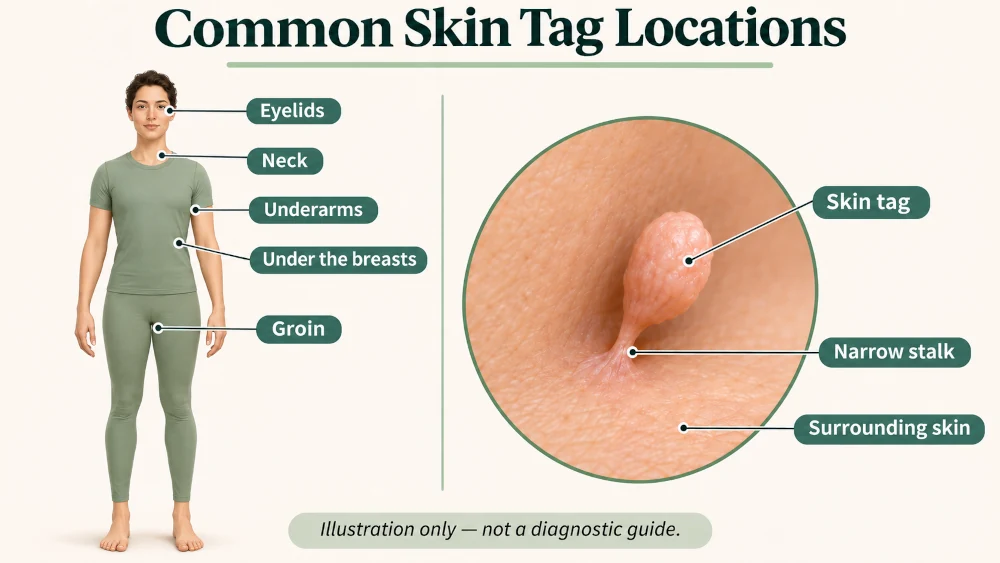
The catch is that some other growths can look like skin tags, including warts, moles, and occasionally skin cancer [Cleveland Clinic, 2021]. This matters more with laser than with snipping. A cut-off tag can be sent to a lab, but some lasers destroy the tissue in place and leave little or nothing to examine. Have a clinician confirm the diagnosis first. That goes double for any growth that has changed color, grown suddenly, bled, or hurts [Harvard Health, 2020].
There’s another reason to get a proper look. Multiple skin tags are linked to obesity, type 2 diabetes, and insulin resistance [StatPearls, 2025]. A sudden crop of new tags can be a sign that something is going on inside the body [AAD, 2023]. If you have several, it’s reasonable to ask your doctor about a blood sugar check. Our guide to normal and high blood sugar levels explains what the results mean.
How Laser Skin Tag Removal Works
A laser delivers concentrated light that turns into heat in the tissue. Depending on the device, that heat either vaporizes the tag on the spot or damages it so it dies and falls off over the following days. Only a few lasers have actually been studied on skin tags.
The Lasers You May Hear About
- CO2 (carbon dioxide) laser. This is an ablative laser that vaporizes tissue. StatPearls lists it as an option for smaller skin tags [StatPearls, 2025].
- 532 nm green-light lasers (such as LBO). These are non-ablative: the tag is left in place and dies off. This is the type tested against scissors in the randomized trial discussed below [Haase et al., 2025].
- Picosecond 532 nm Nd:YAG and 755 nm alexandrite lasers. These cleared neck tags in a single session in a pilot report. That report involved only one patient [Park et al., 2023].
- Pulsed dye lasers. These are mainly designed for blood-vessel problems such as port-wine stains, rosacea, and cherry angiomas [Baylor College of Medicine, n.d.]. They aren’t among the skin tag methods listed by the AAD or StatPearls. If a clinic suggests one for skin tags, ask why.
What the Appointment Looks Like
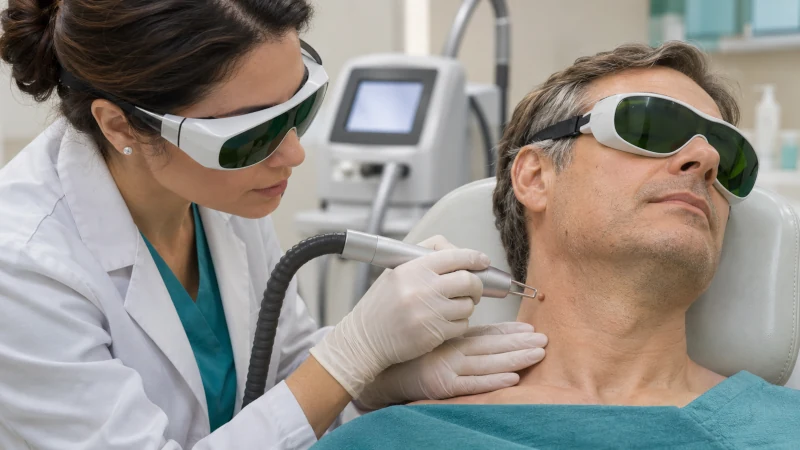
Expect a short office visit. The clinician examines the tags, cleans the skin, and may numb the area first. In one published case, topical numbing cream kept pain to a low level [Park et al., 2023]. Everyone in the room should wear goggles matched to that laser’s wavelength. If the tag is near your eye, ask about a metal corneal shield. Laser light can pass through a closed eyelid [AAO EyeWiki].
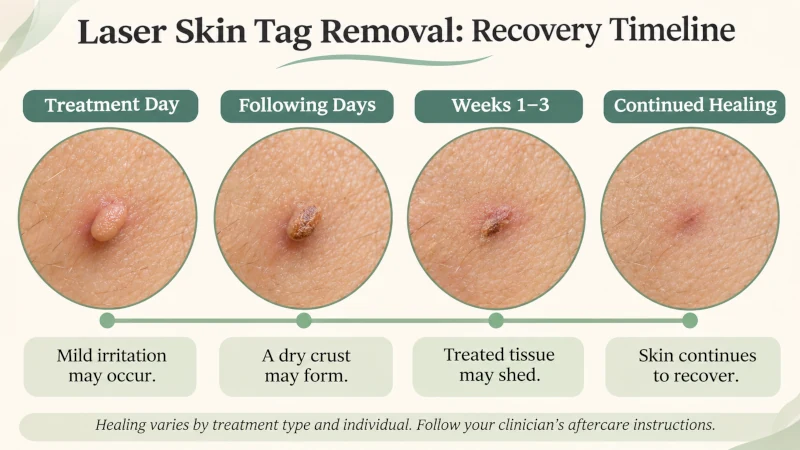
Afterward, the spot usually crusts. In the pilot case, crusts fell off on their own within one to two weeks [Park et al., 2023]. In the larger trial, some laser-treated tags stayed on as dead tissue for up to three weeks before dropping off [Haase et al., 2025].
Laser vs. Snipping, Freezing, and Cautery: What the Evidence Shows
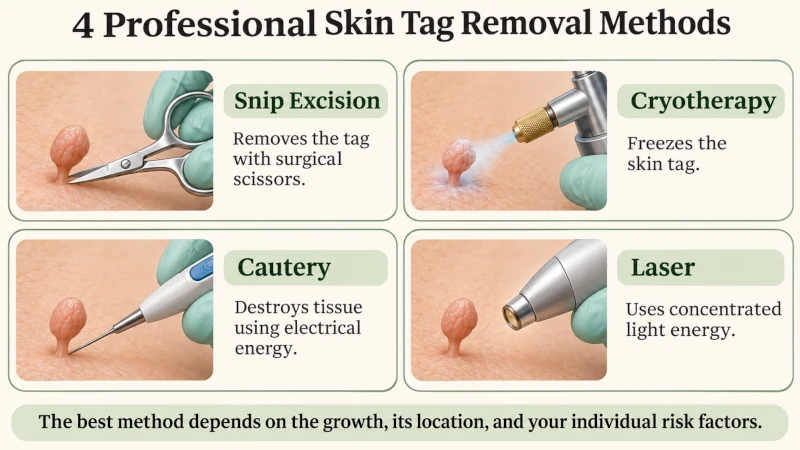
| Method | How it works | What to expect |
| Snip excision | The area is numbed, the tag is cut off with sterile scissors or a blade, and a solution stops the bleeding [AAD, 2023] | A little bleeding. In the trial it healed better and hurt less than laser, and most patients preferred it [Haase et al., 2025] |
| Cryotherapy (freezing) | Liquid nitrogen freezes the tag, sometimes followed by snipping [AAD, 2023] | Can leave lighter or darker skin at the site [StatPearls, 2025] |
| Electrodesiccation / cautery | A fine electrified needle destroys the tag [AAD, 2023] | A scab that heals in 1–3 weeks [AAD, 2023]. Most specialists prefer radiocautery [StatPearls, 2025] |
| Laser | Light energy vaporizes the tag or makes it die off | No bleeding and no dressing. In the trial it was slower to heal, slightly more painful, and caused more pigment change [Haase et al., 2025] |
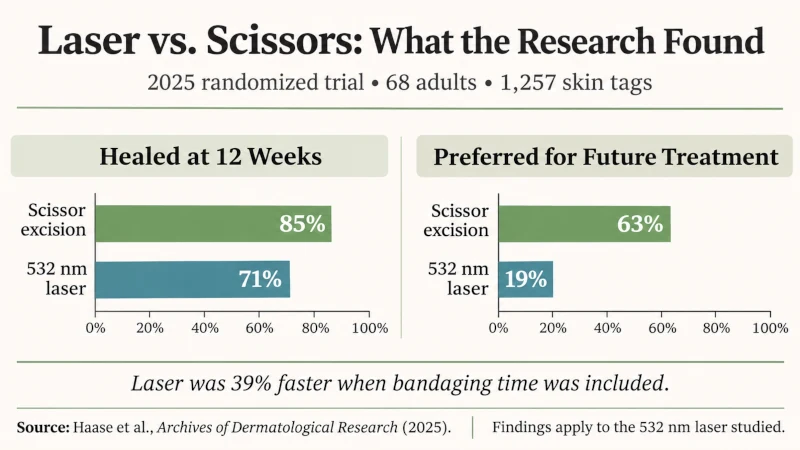
The trial is the most useful evidence here, so it’s worth knowing what it did. Researchers in Germany treated 68 adults with 1,257 skin tags on the neck or underarms. Each person got scissors on one side and a 532 nm laser on the other, and the person judging the results didn’t know which was which. At 12 weeks, 85% of scissor-treated sites had healed, compared with 71% of laser sites. Patients rated laser as slightly more painful, and laser sites had more redness and more patches of lighter or darker skin. Laser was 39% faster once bandaging time was counted. When asked what they would choose next time, 63% picked scissors and 19% picked laser [Haase et al., 2025].
The authors concluded that scissor excision remains the gold standard for tags on a stalk. They also said more research is needed on very small, scattered tags and on other types of laser. That gap is real. Nearly everything else published on laser skin tag removal comes from small or single-patient reports [Park et al., 2023].
| Evidence at a glance Well established: Skin tags are harmless, and removal in a doctor’s office by snipping, freezing, or cautery is routine and low-risk. Limited but direct: One randomized trial found a 532 nm laser removed tags but did worse than scissors on healing, pain, and pigment change. Early-stage: Picosecond and alexandrite lasers have been reported in a single patient. CO2 laser is listed as an option for small tags, with little comparative data. Not supported: Claims that laser stops skin tags from coming back or is scar-free. |
Risks and Side Effects of Laser Skin Tag Removal
Serious problems are uncommon when a trained clinician does the procedure. Still, these are the ones to know about:
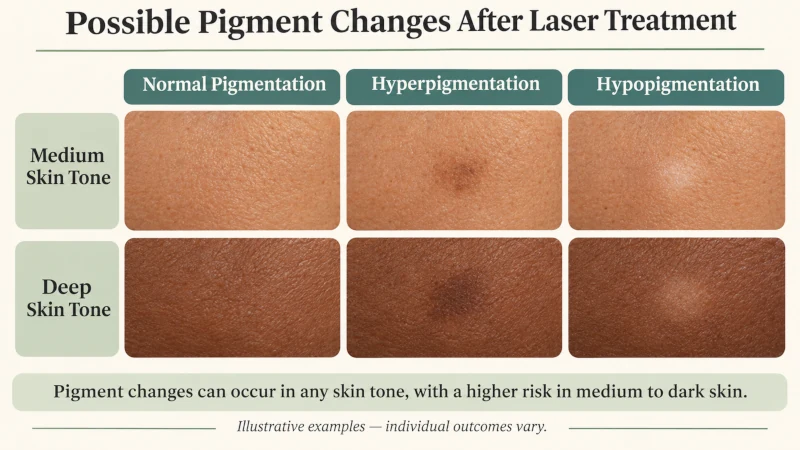
- Skin color changes. Darker or lighter patches are among the more frequent laser complications. The risk is highest in medium to dark skin (Fitzpatrick types III to VI) [StatPearls, 2026].
- Scarring. This can result from burns, treatment that goes too deep, poor healing, or infection. The neck scars more easily than the face [StatPearls, 2026].
- Infection. Any broken skin can become infected. Careful aftercare lowers the risk [AAD, 2023].
- Incomplete removal. In the trial, laser had a lower response rate than scissors (about 84% vs. 93%) [Haase et al., 2025]. Some tags may need another session.
- Eye injury. This risk only applies near the eyes. The eyelids don’t protect the eye from laser light, and misdirected beams have caused real injuries [AAO EyeWiki].
- A missed diagnosis. If the growth wasn’t a skin tag after all, destroying it without a lab check can delay the right diagnosis.
Who Should Think Twice About Laser
None of these automatically rule you out. They are things to bring up before treatment, and sometimes they are a reason to choose a different method.
- Medium to dark skin. Your risk of pigment change is higher [StatPearls, 2026]. Ask how much experience the clinician has with your skin type and whether snipping would be safer for you.
- A history of keloids or raised scars. Abnormal healing is one of the main causes of laser scarring [StatPearls, 2026].
- Recent isotretinoin (for acne). The usual advice is to wait 6 to 12 months after stopping before laser resurfacing [StatPearls, 2026]. Skin tag treatment is a smaller procedure, but tell your clinician anyway.
- Cold sores, if treatment is near the mouth. Laser work around the mouth can trigger a herpes outbreak [StatPearls, 2026]. Ask whether you need an antiviral beforehand.
- Blood thinners or a bleeding disorder. Bleeding is a recognized complication of skin tag removal [StatPearls, 2025]. Mention any medicines that affect clotting. Don’t stop a prescribed blood thinner on your own.
- Eczema, a rash, or infection at the site. Your clinician may want the skin to settle first. If eczema is the issue, a steady eczema skincare routine can help get it under control.
- Pregnancy. Skin tags are more likely during pregnancy [AAD, 2023]. We found no studies on laser skin tag removal during pregnancy, so ask whether waiting until after delivery makes sense.
- Tags on or near the eyelid. See a dermatologist or ophthalmologist who regularly treats eyelids, and confirm that proper eye shielding will be used [AAO EyeWiki].
Recovery and Aftercare
Removal usually takes one office visit, and most people don’t need a follow-up appointment [AAD, 2023]. Your clinician’s instructions come first. In general:
- Keep the area clean and follow the wound-care steps you’re given. This is the main way to prevent infection [AAD, 2023].
- Let crusts fall off on their own. Expect roughly one to three weeks [Park et al., 2023] [Haase et al., 2025].
- Protect the area from sun before and after treatment. This lowers the risk of pigment change [StatPearls, 2026].
- Call your clinician if redness spreads, the area becomes warm, swollen, or starts to ooze pus, or you develop a fever.
Cost and Insurance
Prices depend on the number of tags, where they are, the type of laser, and who does the procedure. Clinics set their own fees, so ask for a written total before you agree to treatment. Insurers generally treat removal for looks alone as cosmetic and rarely cover it [AAD, 2023]. Removal may be medically justified if a tag bleeds, becomes irritated, hurts, or affects your vision [AAD, 2023]. Check with your insurer whether that changes your coverage. Snipping or cautery is often a simpler visit than laser, so compare quotes for more than one method.
Skip the At-Home Removers
Creams, serums, patches, and freeze kits sold for skin tags are not a safe shortcut. The FDA has stated that no over-the-counter drugs can legally be sold for skin tag removal, and it has sent warning letters to companies selling them [FDA, 2022]. The AAD says the FDA warns people not to use these products because of the harm they can cause [AAD, 2023]. Cleveland Clinic dermatologists note that home freeze kits can damage nearby skin, and removal creams and patches can cause burning and skin ulcers [Cleveland Clinic, 2026]. Wart removers don’t work on skin tags and can leave scars [AAD, 2023].
Natural remedies have little support either. The evidence for tea tree oil and apple cider vinegar is mostly anecdotal [Harvard Health, 2020], and tea tree oil commonly causes allergic skin reactions [Cleveland Clinic, 2026]. Our review of herbs for skin conditions covers where tea tree oil does and doesn’t have evidence.
Will Skin Tags Come Back?
A tag that is completely removed is unlikely to grow back. New tags can still form elsewhere [Cleveland Clinic, 2021]. That’s true whichever removal method you choose. Laser doesn’t prevent new tags. New ones are more likely if the things that drive them, such as excess weight, don’t change [StatPearls, 2025]. Keeping a healthy weight and avoiding collars or jewelry that rub may help [Cleveland Clinic, 2021].
Questions to Ask Before You Book
- Who will do the procedure, and are they a board-certified dermatologist?
- Which laser will you use, and why is it a better fit for my tags than snipping or cautery?
- How often do you treat people with my skin type, and what pigment changes have you seen?
- Will you confirm these are skin tags first, and will any tissue be sent to a lab if something looks unusual?
- What is the total cost, and what does a second session cost if a tag doesn’t clear?
- If any tags are near my eyes, what eye protection will you use?
When to See a Doctor
Book a visit, ideally with a dermatologist, if:
- A tag bleeds, gets irritated, or hurts, or a tag near your eye affects your vision [AAD, 2023].
- A growth changes color or size, or you can’t tell whether it’s a skin tag, a wart, or something else [Harvard Health, 2020].
- Many new tags appear suddenly [AAD, 2023].
- A tag twists on its stalk and becomes swollen, dark, or painful [StatPearls, 2025].
Get prompt medical care after any removal if bleeding won’t stop with steady pressure, or if spreading redness comes with a fever.
| Health Disclaimer This article is for general education. It is not medical advice and does not replace an exam by a qualified clinician. Skin tags can resemble other growths, including skin cancer, so have any new or changing growth checked before you treat it. Talk to a licensed healthcare professional, ideally a board-certified dermatologist, about whether laser or another method is right for you. Do not try to remove skin tags at home. |
Frequently Asked Questions
Does laser skin tag removal hurt?
Most people feel a brief sting or heat. Numbing cream or an injection usually keeps it mild. In the one randomized trial, patients rated laser as slightly more painful than scissor removal [Haase et al., 2025].
Is laser better than freezing or cutting off a skin tag?
Not according to current evidence. Laser avoids bleeding and bandages. In a head-to-head trial, though, scissor removal healed better, caused less pigment change, and was preferred by most patients [Haase et al., 2025].
How long does it take to heal after laser skin tag removal?
Usually one to three weeks. Crusts shed within one to two weeks in a published case [Park et al., 2023], and some treated tags took up to three weeks to fall off in the larger trial [Haase et al., 2025].
Will laser skin tag removal leave a scar?
It can, though it often doesn’t. Scars and pigment changes are possible with any laser. The risk of pigment change is higher in darker skin, and the neck scars more easily than the face [StatPearls, 2026].
Can I remove a skin tag at home with a laser device or cream?
Don’t. No over-the-counter drug can legally be sold to remove skin tags [FDA, 2022], and at-home products can burn, scar, or miss a skin cancer [Cleveland Clinic, 2021]. We also found no good evidence supporting home light devices for skin tags.
Does insurance cover laser skin tag removal?
Rarely, if it’s for appearance alone [AAD, 2023]. Ask your insurer whether tags that bleed, get irritated, or affect vision are treated differently.
References
- AAO EyeWiki. Ocular Injuries Due to Cosmetic Laser. American Academy of Ophthalmology. View source
- American Academy of Dermatology (AAD). Skin tags: Why they develop, and how to remove them. View source
- Baylor College of Medicine. Laser treatment with pulsed dye laser. View source
- Cleveland Clinic. Skin Tags (Acrochordons). View source
- Cleveland Clinic Health Essentials. How To Get Rid of Skin Tags (expert: Pamela Ng, MD). April 15, 2026. View source
- Haase O, Winkelmann-Schirmer C, Mrowka P, Krengel S. Removal of skin tags: scissor excision versus non-ablative 532nm-LBO-laser in a randomized intraindividual controlled observer-blinded clinical trial. View source
- Harvard Health Publishing (Liu K). Skin tag removal: Optional but effective. View source
- Park JH, Jeong JY, Ryu HJ, Kim IH. A pilot split-neck case study to compare the efficacy of the long-pulsed 755 nm laser and the 532 nm picosecond laser for acrochordon removal. View source
- StatPearls. Laser Complications. StatPearls Publishing. View source
- StatPearls. Skin Tag (Acrochordon). View source
- U.S. Food and Drug Administration. Warning letter to Ariella Naturals View source


