Here’s the honest version: the main pine nuts benefits come from a lot of nutrition packed into a very small seed. A single handful is loaded with manganese, delivers vitamin E, magnesium, copper and mostly-unsaturated fat, and works as a satisfying, protein-carrying snack.
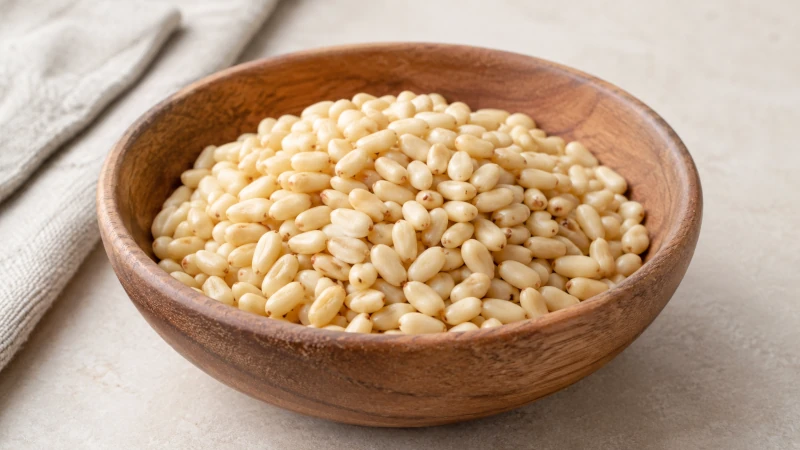
What pine nuts are not is a cure for anything. Some of the flashier claims you’ll read — that they melt fat or lower cholesterol on their own — trace back to studies on pine nut oil, or to rats, or to a single small trial. So enjoy them for what they reliably are: a genuinely nutritious food that happens to be pricey and easy to over-toast.
What are pine nuts, exactly?
Pine nuts are the edible seeds of pine trees — sold as pignoli, pinoli, piñón, or pignon depending on where you are. Botanically they’re seeds rather than true nuts, tucked between the woody scales of a pine cone rather than grown inside a fruit.
Around 20 pine species produce seeds big enough to bother harvesting, and that harvest is the reason for the eye-watering price: a pine can take up to 25 years to produce edible seeds, which then have to be extracted and shelled (Healthline, 2021). Asian varieties tend to be short and stubby; the Mediterranean Pinus pinea seeds are longer and slimmer.
That price tag matters for how you should think about them. Pine nuts are a garnish-sized food — a spoonful on a salad, a base for pesto — not something most people eat by the cupful. Any realistic read on their benefits has to start there.
Pine nuts nutrition at a glance
For such a small seed, the nutrient density is the genuinely impressive part. Pine nuts are mostly fat — the healthy, largely unsaturated kind — which makes them calorie-dense: a one-ounce (28 g) handful runs to roughly 190 calories, nearly all of it from fat (USDA FoodData Central, record 170591; see verification note). Alongside that fat you get a real hit of minerals and a useful dose of vitamin E.
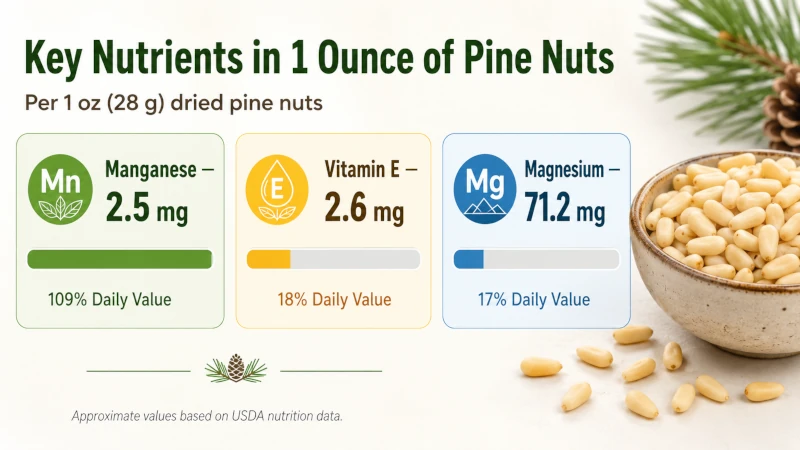
The standout is manganese. One ounce provides about 109% of the Daily Value — one of the most concentrated food sources around (Healthline, 2021). Manganese helps your body form connective tissue and bone and supports normal metabolism.
Nutrition snapshot (per 1 oz / 28 g)
| Nutrient | A handful gives you | Why it matters |
| Calories | ~190, mostly from fat | Energy-dense — portion counts |
| Fat | Mostly unsaturated | The heart-diet-friendly kind |
| Manganese | ~109% Daily Value | Bone, connective tissue, metabolism |
| Vitamin E | Meaningful source | Fat-soluble antioxidant |
| Mg, copper, iron, zinc, vit. K | Useful amounts | Everyday mineral & vitamin support |
| Omega-3 (ALA) | ~31 mg | Plant omega-3 (see brain section) |
Nutrient figures are per Healthline’s reading of USDA FoodData Central record 170591 (Healthline, 2021). If you track minerals, pine nuts also contribute dietary magnesium, though seeds like these are a supporting player, not your main source.
The real pine nuts benefits, graded by evidence
Heart health — promising but early
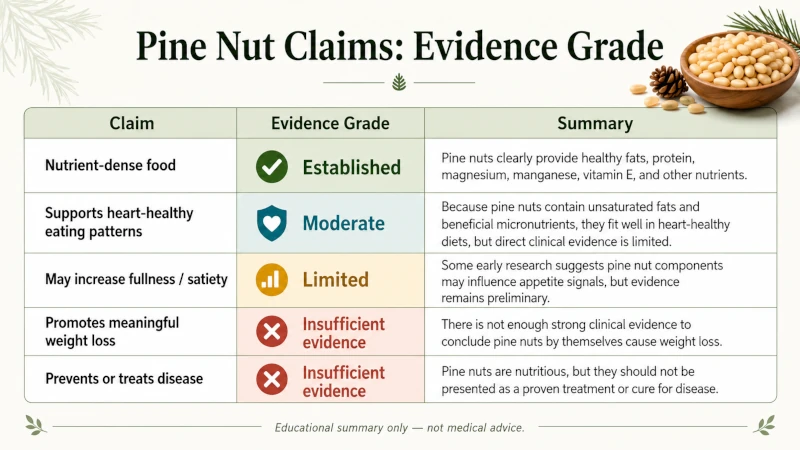
Pine nuts contain pinolenic acid, a polyunsaturated fatty acid found almost exclusively in pine nut oil. In animal studies, pinolenic acid appears to prompt the liver to pull more LDL (“bad”) cholesterol out of the blood, the kind of mechanism that could support heart health (Healthline, 2021). The caveats: most of that work is in rats, the mechanism isn’t nailed down, and it concerns concentrated oil rather than the handful of seeds you’d actually eat.
What’s on firmer ground is the bigger picture. Unsaturated fats like those in pine nuts fit the eating pattern associated with better heart health, and nuts in general are a staple of a heart-healthy foods list. So pine nuts can reasonably be part of a heart-smart diet — just don’t expect a spoonful to move your numbers on its own. If you’re tracking cholesterol at home, a periodic cholesterol check tells you far more than any single food.
Evidence grade: limited/early for pine nuts specifically; established for the broader “nuts in a good diet” pattern.
Blood sugar — indirect evidence
Here the case is built mostly by association. Swapping a refined-carb snack for unsaturated fats can help steady blood sugar, and a 2014 review found that eating about 2 ounces of tree nuts daily for eight weeks improved fasting glucose and insulin sensitivity in people with type 2 diabetes (Healthline, 2021). That review looked at tree nuts broadly, not pine nuts alone. Pine nuts’ high manganese content is also loosely tied to lower diabetes risk in large observational studies. Useful signals — but observational and not pine-nut-specific.
Evidence grade: mixed/indirect. Reasonable to include pine nuts in a blood-sugar-friendly diet; not a treatment.
Appetite and weight — one small study, mostly about the oil
This is the claim most likely to be oversold. It rests largely on a single 2008 trial in which 18 overweight women took Korean pine nut oil (as free fatty acids) versus a placebo. The oil raised the satiety hormones CCK and GLP-1 — GLP-1 stayed measurably higher, with about 25% more total release than placebo — and nudged down how much food the women expected to eat afterward (Pasman et al., 2008). The authors’ own framing was cautious: pine nut oil may act as an appetite suppressant.
Read the fine print. It’s a small study, it used concentrated oil rather than whole nuts, and “expected to eat less” is not the same as “lost weight.” Whole pine nuts do carry protein, fiber and fat that help a snack feel satisfying, which is a fair, modest claim. The traditional use of Siberian pine nut oil as an appetite curb is interesting, but tradition and one study aren’t proof.
Evidence grade: early and oil-specific. Whole-nut satiety is plausible; appetite-suppressant marketing is not established.
Brain and mood — a modest omega-3 contribution
Pine nuts supply a plant omega-3 called ALA (alpha-linolenic acid) — roughly 31 mg per ounce (Healthline, 2021). Omega-3s matter for the brain, and diets richer in them are associated with slower cognitive decline. But there’s a real bottleneck: ALA is the “starter” omega-3, and your body converts only a very small fraction of it into the EPA and DHA forms that do the heavy lifting in brain tissue (NIH Office of Dietary Supplements, 2022). Adequate ALA intake is about 1.6 g a day for men and 1.1 g for women — so an ounce of pine nuts is a small contribution, not a fish-oil substitute.
If mood or cognitive health is your reason for reaching for omega-3s, oily fish (or a properly sourced supplement) does far more, and persistent low mood deserves real support rather than a dietary tweak — see this overview of anxiety and depression for when to seek help.
Evidence grade: insufficient for pine nuts alone. A minor omega-3 source, not a brain treatment.
How to buy, store, and eat pine nuts
- They go rancid fast. All that unsaturated fat is delicate. Keep pine nuts airtight in the fridge (a few months) or freezer (longer), and smell them first — a paint-like or bitter odor means they’ve turned.
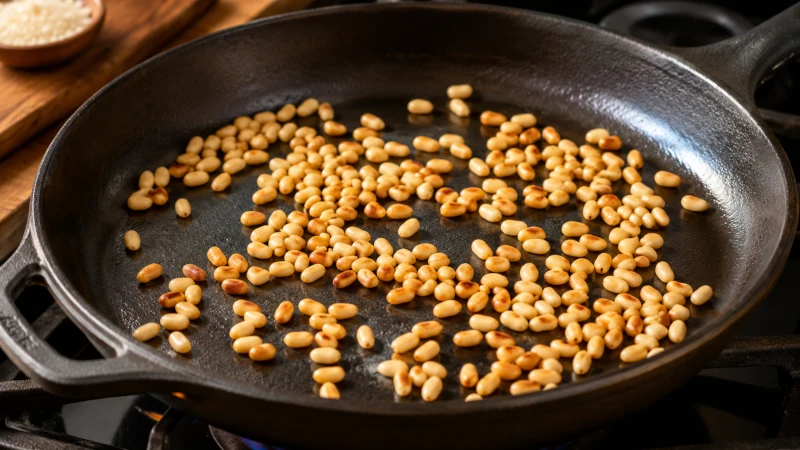
- Toast gently. They scorch in seconds. Dry pan, medium heat, constant stirring; pull them the moment they’re golden.
- Use them where they shine. Pesto, a scatter over salad or roasted vegetables, folded into rice, or on hummus or oatmeal. A little goes a long way.
Safety, side effects, and who should be careful
For most people pine nuts are perfectly safe in normal food amounts. Two issues are worth knowing about.
Pine mouth: the metallic-taste aftereffect
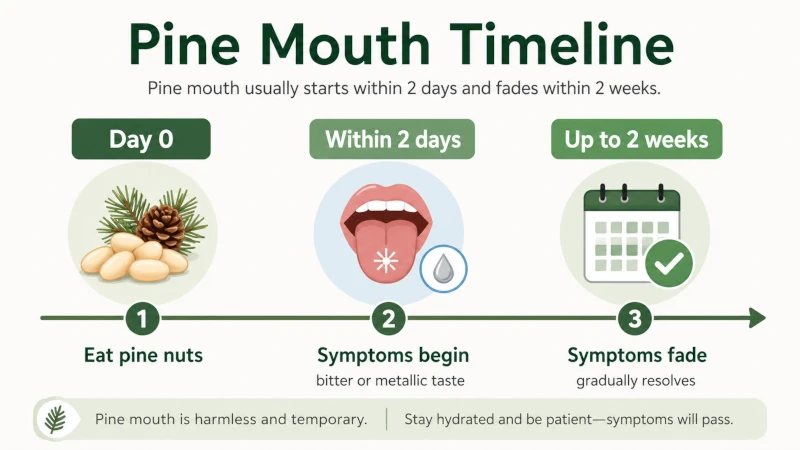
“Pine mouth” (sometimes called pine nut syndrome) is a temporary taste disturbance: a bitter or metallic taste that shows up a day or two after eating pine nuts and can linger up to two weeks. It’s unpleasant but harmless and resolves on its own. The first cases were reported around 2001, and the exact cause still isn’t pinned down, though it’s been linked to certain pine species rather than to spoilage (Healthline, 2021). There’s no treatment to speed it up — it simply fades. Many people react to one batch and not another.
Allergy and other cautions
- Allergy. Pine nut allergy is uncommon but real, and reactions can be serious, including anaphylaxis in sensitive people (Healthline, 2021). If you have a known tree nut allergy, treat pine nuts with caution and check with your allergist first.
- Calories. They’re energy-dense. If you’re watching weight, measure a portion rather than eating from the bag.
- Pregnancy and breastfeeding. Pine nuts are a normal food and generally considered fine in usual culinary amounts. Concentrated pine nut oil supplements are a different matter — there’s no good safety data, so skip supplement-strength products unless your clinician okays them.
- Children. Whole nuts and seeds are a choking hazard for young children; grind or finely chop them for little ones.
When to talk to a professional
Get medical advice — and seek urgent care for the emergency signs below — if you notice any of these after eating pine nuts:
- Call emergency services (911 in the US) for signs of a severe allergic reaction: trouble breathing, swelling of the lips, tongue or throat, chest tightness, a spreading hives rash, dizziness or fainting. Anaphylaxis is a medical emergency.
- A metallic or bitter taste that lasts well beyond two weeks, or comes with other unexplained symptoms — worth mentioning to your doctor to rule out other causes.
- Any digestive upset that’s severe or persistent.
And if you’re eating pine nuts specifically to manage cholesterol, blood sugar, or weight, talk with a doctor or registered dietitian about a whole-diet plan. A single food, however nutritious, isn’t a substitute for one.
| Health Disclaimer This article is for general educational and informational purposes only and is not a substitute for professional medical advice, diagnosis, or treatment. Pine nuts are a food, not a medicine, and the research on their specific health effects is still limited and often based on pine nut oil or animal studies rather than whole nuts. Do not use pine nuts or pine nut oil to treat any medical condition. If you have a nut allergy, a chronic condition, or are pregnant or breastfeeding, talk with your doctor or a registered dietitian before making significant dietary changes or using any concentrated pine nut oil supplement. If you have signs of a severe allergic reaction after eating pine nuts, call your local emergency number immediately. |
Frequently Asked Questions
Are pine nuts actually a nut?
Not in the botanical sense — they’re the edible seeds of pine trees, sold as pignoli or piñón. For allergy purposes, though, they’re treated like tree nuts, so people with nut allergies should be cautious (Healthline, 2021).
Do pine nuts really suppress appetite?
There’s a kernel of evidence, but it’s thin. A small 2008 study found that Korean pine nut oil raised satiety hormones and reduced how much overweight women expected to eat afterward (Pasman et al., 2008). That’s concentrated oil in 18 people, not whole nuts and not proven weight loss. Whole pine nuts can help a snack feel more filling — a more modest, realistic claim.
Why do pine nuts sometimes leave a metallic taste?
That’s “pine mouth,” a temporary and harmless taste disturbance that can start a day or two after eating and last up to two weeks. The cause isn’t fully understood, and it fades on its own without treatment (Healthline, 2021).
How many pine nuts should I eat?
There’s no official serving, but about a one-ounce handful (roughly 190 calories) is sensible given how calorie-dense they are. They work best as a garnish or ingredient rather than a by-the-handful snack.
Are pine nuts good for your heart?
They fit a heart-healthy eating pattern thanks to their unsaturated fats, and their pinolenic acid shows cholesterol-related effects in animal studies — but that’s early, oil-focused research. Think of pine nuts as one helpful part of a good diet, not a cholesterol treatment (Healthline, 2021).
Can I eat pine nuts while pregnant?
Yes, in normal food amounts they’re generally considered fine and add useful minerals. Concentrated pine nut oil supplements are a different story — there’s no solid safety data, so check with your clinician first.
References
- Hallal, F. (2021, Sep 10). 4 Impressive Health Benefits of Pine Nuts. Medically reviewed by Katherine Marengo, LDN, RD. Healthline. View source
- Pasman, W. J., et al. (2008). The effect of Korean pine nut oil on in vitro CCK release, on appetite sensations and on gut hormones in post-menopausal overweight women. Lipids in Health and Disease, 7, 10. View source
- NIH, Office of Dietary Supplements. (2022, Jul 18). Omega-3 Fatty Acids — Fact Sheet for Consumers. View source
- USDA, FoodData Central. Nuts, pine nuts, dried (record 170591). View source
