
Peach palm is a starchy, orange-to-red fruit that grows in dense clusters on a spiny Amazonian palm and has fed people across Central and South America for thousands of years. You may see it sold as pejibaye in Costa Rica, chontaduro in Colombia, or pupunha in Brazil. It is prized less as a sweet snack than as a filling, energy-dense food — closer to a chestnut or a firm sweet potato than to a peach. One thing matters before you try it: peach palm is not safe to eat raw. The fruit has to be cooked first, and the reason is worth understanding.
What peach palm is
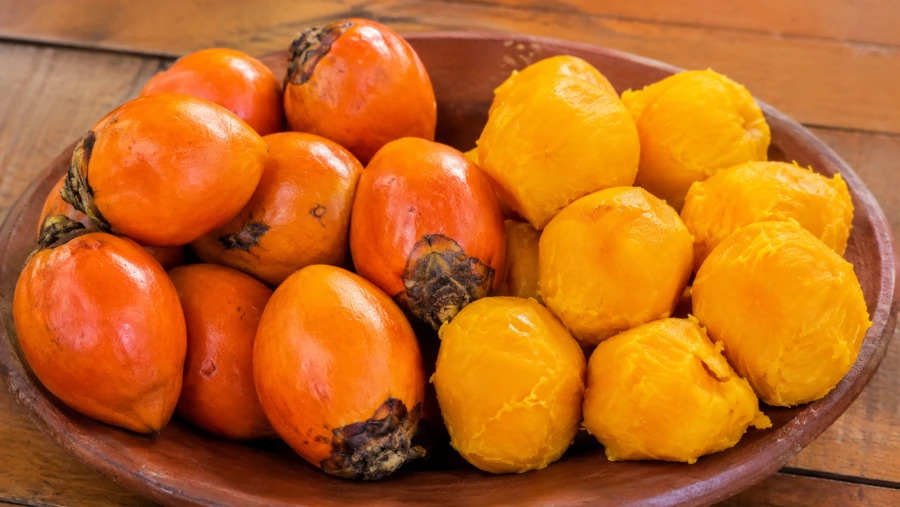
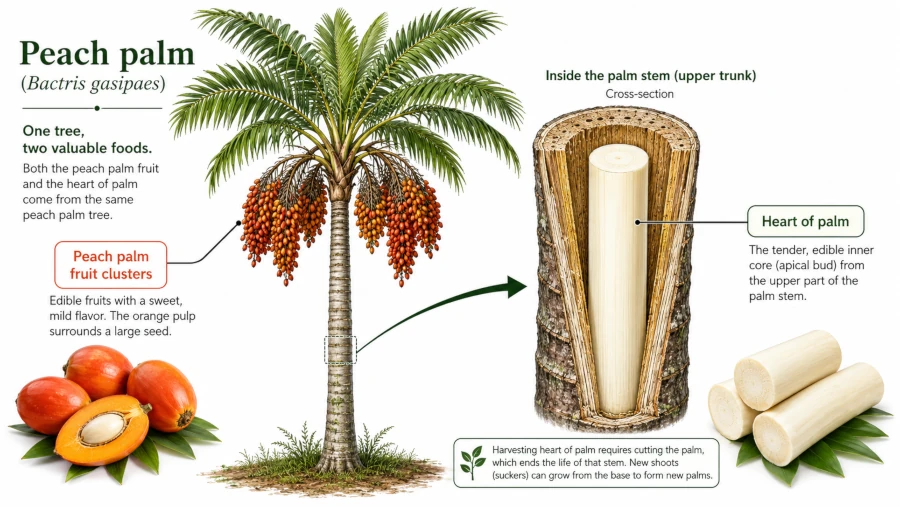
The plant is Bactris gasipaes, a member of the palm family (Arecaceae). It is the only palm in the Americas that Indigenous peoples domesticated specifically for its fruit, a process stretching back several thousand years [Costa Rica Tree Atlas]. Today it is grown commercially in Costa Rica, Colombia, Ecuador, Venezuela, Brazil, and Peru [UF/IFAS, 2020].
Each fruit is a small drupe, usually 1 to 2 inches across, with a thin skin that ripens yellow, orange, or scarlet and a single seed inside — though some fruit are seedless. The pulp is dry, mealy, and mildly sweet. The same palm gives two foods: the fruit, and heart of palm (palmito), the tender inner core of young stems that Costa Rica exports in large quantities [UF/IFAS, 2020].
What’s in peach palm
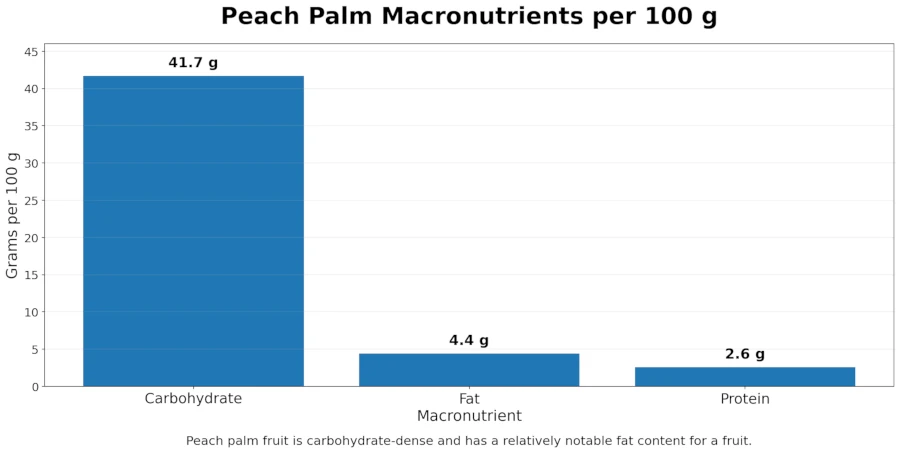
Peach palm stands out among fruits for being high in starch and unusually high in fat. Most of its calories come from carbohydrate, largely starch, which is why it fills you up the way a starchy vegetable does rather than a juicy fruit. It also carries more fat than nearly any common fruit, plus modest protein that, notably, includes all the essential amino acids [SciELO, 2016].
Its makeup varies a lot from one variety and region to the next, so published figures sit in ranges rather than fixed numbers. The values below come from University of Florida/IFAS data for 100 grams of fruit. The fruit supplies small amounts of calcium, phosphorus, and iron — useful, though iron-rich foods like lentils deliver far more per serving.
| Nutrient | Typical range per 100 g (3.5 oz) |
| Water | 25–82% |
| Carbohydrate | 14–85% of dry weight, mostly starch |
| Fat | 3–8 g (high for a fruit) |
| Protein | Small amounts, but contains all essential amino acids |
| Fiber | 0.8–1.4 g |
| Vitamin C | 15–41 mg |
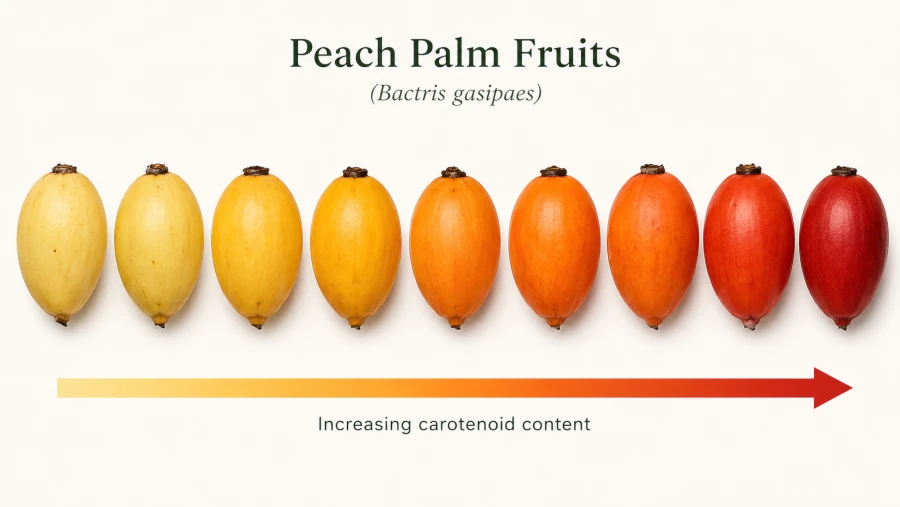
| Carotene (provitamin A) | 0.3–70 mg, rising with deeper orange-red color |
| Calcium | 9–40 mg |
| Phosphorus | 34–55 mg |
| Iron | 0.9–2.3 mg |
Source: UF/IFAS HS312 (Crane); Morton, Fruits of Warm Climates, 1987.
The wide carotene range is the most interesting line in that table. The orange and red color comes from carotenoids — mainly beta-carotene and gamma-carotene, with some lycopene — and the deeper the color, the more the fruit usually holds [ACS Omega, 2024]. These pigments are sturdy: studies of pejibaye found that more than 85% of its carotenoids survived cooking [Blanco & Muñoz, 1992]. Some of that beta-carotene converts in your body to vitamin A, but only partly — one Costa Rican study measured a conversion efficiency of roughly 14 to 50% [Blanco & Muñoz, 1992]. So it is a real source of provitamin A, not the megadose some websites claim.
Where the evidence actually stands
Most of what circulates online about peach palm — that it lowers blood pressure, prevents cancer, or drives weight loss — runs ahead of the evidence. There are no large human trials testing the fruit against any disease. What can be said with more confidence is narrower, and still worth knowing:
- It is an efficient source of energy. Starch supplies about 4 calories per gram, and peach palm is dense in it, which is why traditional diets lean on the cooked fruit as a staple carbohydrate [SciELO, 2016]. For people with high calorie needs — active children, hard physical laborers, or someone rebuilding weight after an illness — a starchy, nutrient-bearing food like this earns its place.
- It delivers provitamin A. The carotenoids in orange and red fruit add to vitamin A intake, which supports vision and immune function [Blanco & Muñoz, 1992].
- It carries fiber and minerals. The fruit adds modest fiber along with iron, calcium, and phosphorus to a meal [UF/IFAS, 2020].
Peach palm’s carotenoids and phenolic compounds do show antioxidant and anti-inflammatory activity in laboratory and animal studies — work that has mostly used the peel and other byproducts, not the amount of fruit a person would actually eat [Foods review, 2025]. That is a promising research direction, not a health claim you can bank on at the dinner table.
Why you can’t eat peach palm raw
This is the part the prettier write-ups skip. Raw peach palm contains two things you do not want: needle-like calcium oxalate crystals, concentrated mostly in the peel, and a trypsin inhibitor, a compound that interferes with protein digestion [UF/IFAS, 2020]; [Costa Rica Tree Atlas]. Eaten raw, the fruit can irritate the mouth and throat and cause digestive upset.
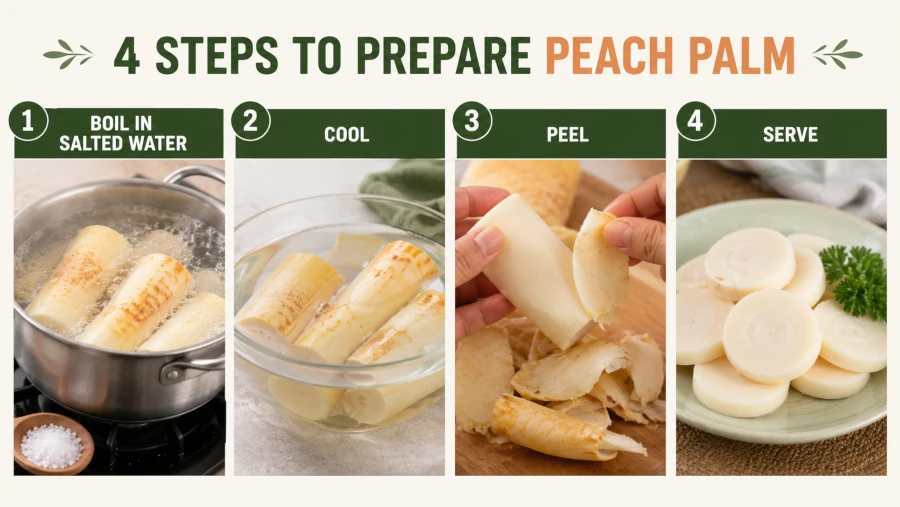
Cooking fixes both. Boiling the fruit in water deactivates the trypsin inhibitor and breaks down the oxalate crystals, which is why every traditional preparation starts with a pot of salted water [Albino peach palm study, 2023]. Treat “cook it first” as a rule, not a suggestion.
How to cook and eat it
The standard method is simple: simmer whole, unpeeled fruit in salted water until soft, then peel and eat. Traditional cooks boil anywhere from 30 minutes to about 3 hours depending on the fruit; a pressure cooker cuts that down considerably [UF/IFAS, 2020]; [Costa Rica Tree Atlas]. Once cooked, the peel slips off and the pulp is ready. From there it is flexible:
- Eaten warm, halved and pitted, often dipped in mayonnaise, butter, or cheese — the classic Costa Rican street-food version.
- Mashed with cornmeal, egg, and milk, then fried into small cakes.
- Dried and ground into flour for baking, or pressed for its edible oil.
Cooked fruit keeps in the refrigerator for five to six days [UF/IFAS, 2020].
Who should be careful
For most people, properly cooked peach palm is just food. A few groups should pay closer attention.
- People who form kidney stones. Most of the oxalate sits in the peel, which is removed, and boiling leaches out more — but cooking does not always eliminate it entirely. If you have had calcium-oxalate stones, keep portions modest.
- Anyone watching sodium. Imported chontaduro sold in brine can be high in salt; one jarred product’s label carried a large share of the day’s recommended sodium [EWG]. Rinse it well, or choose fresh fruit and salt it yourself.
- Babies and toddlers. Cooked peach palm is a traditional food for young children, but whole pieces and the seed are a choking hazard — mash it for little ones.
- People with food allergies. Allergy to peach palm appears uncommon, but any new food can provoke a reaction in a sensitive person. Try a small amount first.
On pregnancy and breastfeeding: as an ordinary cooked food, peach palm is eaten normally in the regions where it grows, and no research flags a specific problem. There is, however, no safety data on concentrated peach palm extracts or supplements, so stick to the cooked fruit as food.
Realistic expectations
Peach palm is a nourishing traditional food, not a remedy. Think of it the way you would a sweet potato or a chestnut: a wholesome, filling source of carbohydrate with some useful vitamins and minerals attached. It will not melt fat or replace any treatment — and despite what you may read, it is not a weight loss food, since it is calorie-dense by design. Eaten as part of a varied diet and cooked properly, it is simply a good food with a long history behind it.
When to talk to a professional
If you have a history of kidney stones, follow a sodium- or potassium-restricted diet, or have a known food allergy, check with your doctor or a registered dietitian before making peach palm a regular part of your meals. And if eating it ever causes mouth or throat irritation, swelling, or trouble breathing, stop and seek medical care — that points to either undercooked fruit or an allergic reaction.
| Health Disclaimer: This article is for general education and information only. It is not medical advice and is not a substitute for diagnosis or treatment from a qualified healthcare professional. Peach palm must be cooked before eating; never consume the raw fruit. If you are pregnant or breastfeeding, have a history of kidney stones, follow a sodium- or potassium-restricted diet, or have a known food allergy, talk to your doctor or a registered dietitian before adding peach palm to your routine. Stop eating it and seek medical care if you notice mouth or throat irritation, swelling, or difficulty breathing. |
Frequently Asked Questions
Is peach palm safe to eat raw?
No. Raw peach palm contains calcium oxalate crystals and a trypsin inhibitor that can irritate the mouth and throat and upset digestion. Always boil it in salted water first, then peel and eat.
What does peach palm taste like?
Mild, starchy, and slightly nutty — often compared to a cross between a firm sweet potato, a chestnut, and squash. It is filling rather than sweet or juicy.
Is peach palm good for weight loss?
Not really. It is calorie-dense and high in starch, which suits people who need energy more than those trying to cut calories. It can fit a balanced diet, but it is not a weight-loss food.
How long do you boil peach palm?
Traditionally 30 minutes to about 3 hours, depending on the fruit, until the pulp is soft enough that the peel comes off easily. A pressure cooker shortens this considerably.
Is heart of palm the same as peach palm fruit?
They come from the same plant but are different parts. Heart of palm (palmito) is the tender inner core of the young stem; the fruit is the orange drupe that grows in clusters.
Does cooking destroy the vitamin A in peach palm?
No. The carotenoids that supply provitamin A are heat-stable — studies found more than 85% survived cooking — so the boiling needed for safety does not waste them.
References
- Crane, J. H. Pejibaye (Peach Palm) Growing in the Florida Home Landscape, HS312. University of Florida IFAS Extension. → View source
- Blanco, A., & Muñoz, L. (1992). Content and bioavailability of carotenoids from peach palm fruit (Bactris gasipaes) as a source of vitamin A. Archivos Latinoamericanos de Nutrición, 42(2), 146–154. → View source
- Restrepo-Osorio, J., et al. (2024). Peach Palm Fruit (Bactris gasipaes) Peel: A Source of Provitamin A Carotenoids. ACS Omega. → View source
- Bezerra, C. V., & Silva, L. H. M. (2016). The fruit of peach palm (Bactris gasipaes) and its technological potential: an overview. Food Science and Technology (SciELO). → View source
- Nutritional and Technological Properties of Albino Peach Palm (Bactris gasipaes) from the Amazon: Influence of Cooking and Drying (2023). PMC. → View source
- Unlocking the Potential of Peach Palm (Bactris gasipaes Kunth) for Plant-Based Foods: A Review of Nutritional, Techno-Functional, and Bioactive Attributes (2025). PMC. → View source
- Pejibaye. Costa Rica Tree Atlas. → View source
- EWG Food Scores: La Fe Brine Chontaduro Peach Palm Fruit. Environmental Working Group. → View source
