
Dandelion and burdock are both edible, both easy to find growing wild, and both have centuries of folk use behind them. Some of that reputation holds up. Dandelion has a real, human-tested diuretic effect. Burdock shows modest evidence for a few specific things, including skin appearance and blood sugar in small studies. But neither plant is a proven treatment for cancer, diabetes, or infection, whatever the older herbals claim — and both come with real safety caveats that are easy to miss if you only read the marketing copy on a tea box.
Here’s what dandelion and burdock actually do, what’s still unproven, and who should be careful with them.
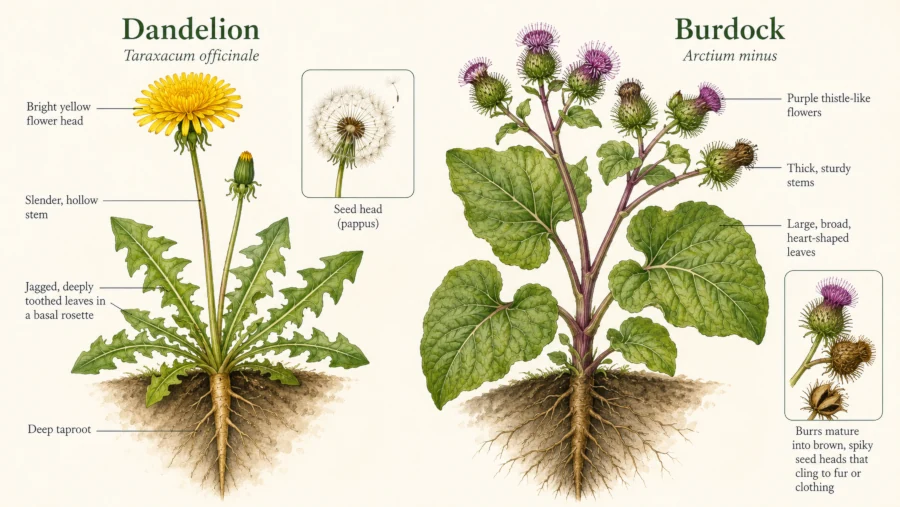
Dandelion (Taraxacum officinale) gets its English name from the French dent-de-lion, “lion’s tooth,” a nod to the jagged edges of its leaves. It’s native to Europe and Asia and now grows across most of the temperate world. Burdock (Arctium lappa) is native to Europe and Northern Asia and has a similarly wide spread; in Japan it’s cultivated as a root vegetable called gobo.
How Burdock Burrs Led to Velcro
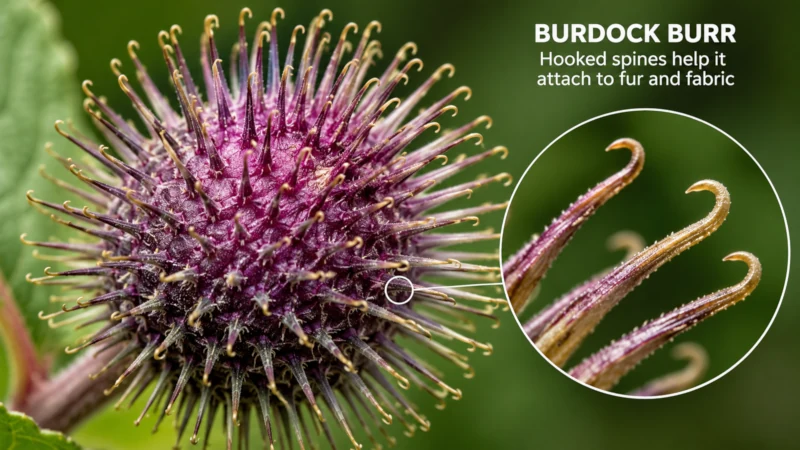
Burdock’s most famous contribution to modern life has nothing to do with medicine. In 1941, Swiss engineer George de Mestral came home from a walk in the countryside covered in burdock burrs and got curious about why they stuck so well. Under a microscope, he found each burr covered in tiny hooks that latched onto anything with a loop. That observation became the hook-and-loop fastener now sold as Velcro [Smithsonian Lemelson Center].
If the phrase “dandelion and burdock” sounds familiar for a different reason, it’s probably the drink. Dandelion and burdock has been consumed in the British Isles since the Middle Ages, originally as a light mead that evolved into the carbonated soft drink sold today, traditionally made by fermenting the roots of both plants [Wikipedia, 2026]. It shares its origins with root beer and sarsaparilla. Modern commercial versions use the plants mainly as flavoring, so don’t treat a can of it as an herbal remedy.
What’s Actually in Them: Nutrition
As food, both plants are genuinely nutrient-dense.
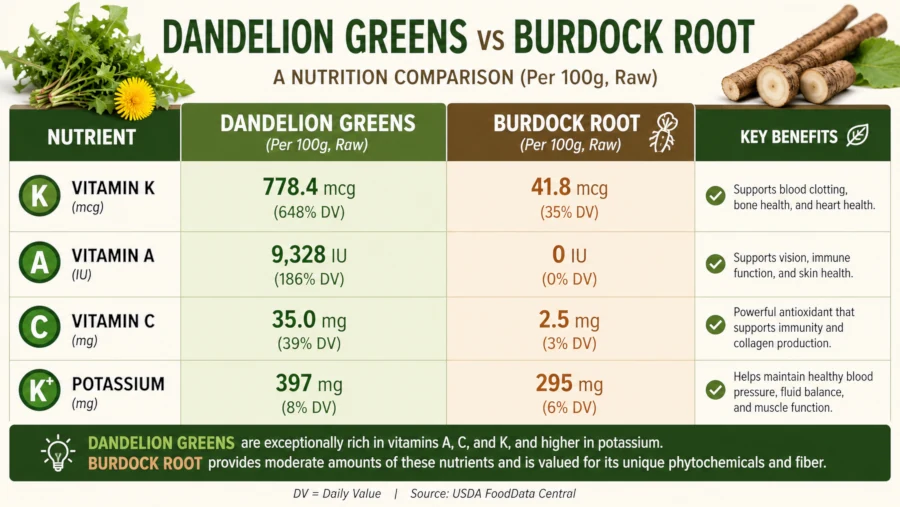
One cup of chopped raw dandelion greens (about 55 g) provides roughly 25 calories, 428 mcg of vitamin K (357% of the Daily Value), 279 mcg of vitamin A as RAE (31% DV), 19 mg of vitamin C (21% DV), and smaller amounts of calcium, iron, and potassium [USDA FoodData Central via MyFoodData, 2024]. The vitamin K figure is high enough to matter if you’re on warfarin or another vitamin K–sensitive blood thinner.
One cup of raw burdock root, cut into pieces (about 118 g), provides roughly 85 calories, 3.9 g of fiber (14% DV), 0.28 mg of vitamin B6 (17% DV), 363 mg of potassium (8% DV), and smaller amounts of folate, vitamin C, and manganese [USDA FoodData Central via MyFoodData, 2024]. Eaten as a root vegetable, it behaves nutritionally more like a starchy, fibrous vegetable than a “superfood” in the marketing sense.
Dandelion: What It’s Used For and What’s Proven
Traditional use of dandelion centers on its diuretic, digestive, and mild anti-inflammatory properties, documented for its diuretic, cholagogic, antirheumatic and appetite-stimulating uses, and in Chinese medicine to promote lactation [MSKCC, 2023]. Of these, the diuretic effect has actual human data behind it: a human study found dandelion leaf extract had a measurable diuretic effect over a single day, an effect researchers link to the plant’s naturally high potassium content. That’s a real, if narrow, finding — a single small study, not a green light to substitute dandelion for a prescribed diuretic.
Beyond that, the evidence gets thinner. Laboratory and animal research suggests dandelion may have lipid-lowering, liver-protective, antiviral, blood-thinning, and antioxidant activity, and a preliminary case series has reported possible benefit in a small number of blood cancer patients, though it’s unclear whether dandelion was actually responsible. None of that amounts to proof that dandelion treats liver disease, cancer, or high cholesterol in people.
Burdock: What It’s Used For and What’s Proven
Burdock has an even longer list of traditional uses and an even shorter list of confirmed ones. Memorial Sloan Kettering’s clinical summary states plainly that there is no evidence to support using burdock to treat cancer, infections, diabetes, or other medical conditions [MSKCC, 2023] — worth knowing before you see it marketed as a “blood purifier” or detox ingredient, since that framing comes from traditional Chinese medicine, not clinical testing.
What does have some support: a small clinical study found that a cream containing burdock extract improved the visible appearance of wrinkled skin, though more research is needed to confirm the effect, and a small trial in people with diabetic nephropathy found that a burdock-containing formulation improved post-meal blood glucose and lipid levels. That’s a reasonable case for burdock as a topical skin ingredient worth further study — not a case for it as a cancer or infection treatment.
Side Effects, Interactions, and Who Should Avoid Them
Dandelion Safety
Eaten as food or brewed as tea in ordinary amounts, dandelion is likely safe for most people, though it can cause allergic reactions, stomach discomfort, diarrhea, or heartburn in some people [WebMD, 2026]. Documented case reports include hemorrhagic cystitis linked to a slimming product containing dandelion, toxic blood levels of immunosuppressant drugs in a kidney transplant recipient who drank a dandelion-containing tea, and digital necrosis in a man with chronic kidney disease after drinking ten to fifteen cups of dandelion tea daily for six months [MSKCC, 2023] — an extreme intake, but a real illustration that “herbal” doesn’t mean “unlimited.”
Who should be cautious or avoid dandelion:
- Pregnant or breastfeeding people — there isn’t enough reliable information to know if dandelion is safe, and clinical references advise avoiding use.
- People with ragweed, daisy, chrysanthemum, or marigold allergies, particularly those with eczema.
- Anyone on blood thinners, lithium, or diabetes medication.
- People on potassium-sparing diuretics.
- Anyone scheduled for surgery — stop at least two weeks beforehand.
- People with kidney problems, due to dandelion’s effect on oxalate clearance.
Burdock Safety
Burdock’s biggest real-world risk isn’t the plant itself — it’s contamination. Some commercial burdock tea products have been found contaminated with atropine, an alkaloid from belladonna (deadly nightshade), because the two roots can be confused during harvesting [MSKCC, 2023]. Buy burdock products from reputable, quality-tested sources for this reason alone.
Reported adverse effects include allergic contact dermatitis, a documented case of anaphylaxis in a man an hour after eating boiled burdock, and a case of acute liver injury in a woman who drank an herbal “liver detox” tea containing burdock.
Who should be cautious or avoid burdock:
- Pregnant people — burdock may stimulate the uterus and increase the risk of premature delivery.
- People allergic to chrysanthemums.
- Anyone on diabetes medication or blood thinners.
- Anyone scheduled for surgery — stop at least two weeks beforehand.
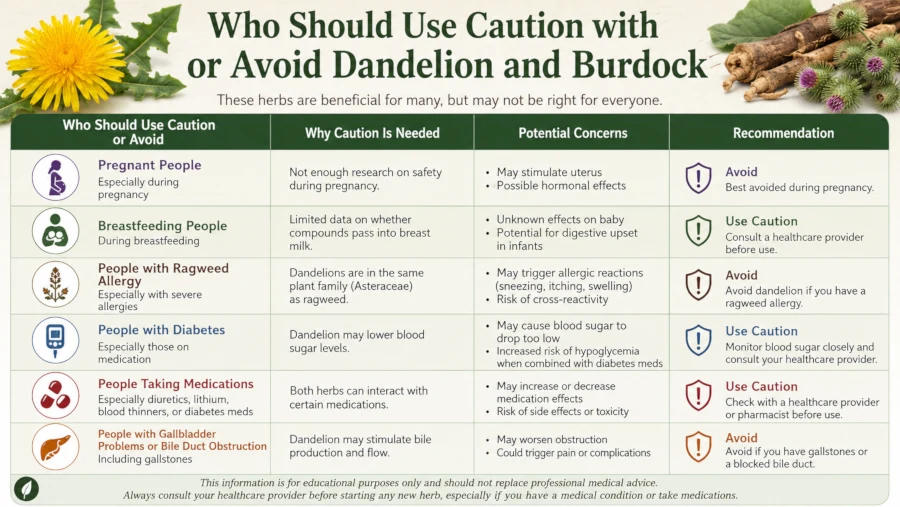
| Health Disclaimer: This article is for general information only and isn’t a substitute for advice from a licensed healthcare provider. Dandelion and burdock have real but limited evidence behind them, and neither is proven to treat, cure, or prevent any disease. If you’re pregnant, breastfeeding, managing a chronic condition, or taking prescription medication — especially blood thinners, diabetes drugs, lithium, or diuretics — talk to a healthcare provider before adding either plant to your routine as a tea, supplement, or extract. If you experience a rash, swelling, difficulty breathing, or any other sign of an allergic reaction after eating or drinking either plant, stop use and seek medical care. |
Frequently Asked Questions
Is it safe to eat dandelion greens and burdock root as food?
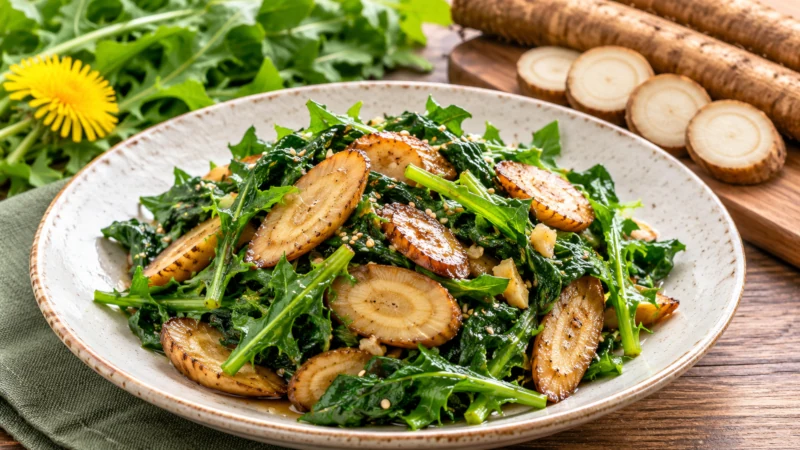
Yes, for most people. Both are consumed as ordinary food — dandelion greens in salads and cooked dishes, burdock root (gobo) as a vegetable in Japanese cooking. The safety concerns above apply mainly to concentrated teas, extracts, and supplements.
Can I drink dandelion or burdock tea every day?
Occasional use is generally low-risk for a healthy adult, but the case reports above involved people drinking large amounts over long stretches, not an occasional cup. If you want to drink either regularly, check with a healthcare provider first, especially if you take any regular medication.
Does dandelion or burdock actually “detox” the liver or blood?
Not in the sense the phrase usually implies. Dandelion has shown liver-protective effects in animal and lab studies, and burdock is traditionally described as a “blood purifier,” but neither claim has been confirmed in human clinical trials. Your liver and kidneys already filter your blood; no food or herb is required to do that job for them.
Can I take dandelion or burdock if I’m on blood thinners or diabetes medication?
Talk to your prescriber first. Both plants can affect blood clotting and blood sugar, and combining them with anticoagulants, antiplatelet drugs, or antidiabetic medication can push those effects further than intended.
Who should avoid dandelion and burdock entirely?
Pregnant people, anyone with a known allergy to ragweed, daisies, chrysanthemums, or marigolds, and anyone about to have surgery should avoid both plants unless a healthcare provider says otherwise.
What’s the difference between the “dandelion and burdock” soft drink and the herbal remedies?
The commercial soft drink uses the plants mainly for flavor, in small amounts, alongside sugar and other ingredients — it isn’t formulated as a health product and shouldn’t be treated as one.
References
- Memorial Sloan Kettering Cancer Center. “Dandelion.” About Herbs database. Last updated Feb 8, 2023. View source
- Memorial Sloan Kettering Cancer Center. “Burdock.” About Herbs database. Last updated Mar 13, 2023. View source
- WebMD. “Dandelion.” Licensed from Therapeutic Research Center, LLC. View source
- RxList. “Burdock.” Licensed from Therapeutic Research Center, LLC. View source
- USDA FoodData Central via MyFoodData. “Raw Dandelion Greens” (FDC ID 169226). View source
- USDA FoodData Central via MyFoodData. “Burdock root, raw” (FDC ID 169974). View source
- Smithsonian’s Lemelson Center for the Study of Invention and Innovation. “George de Mestral: Velcro® Inventor.” View source
- Wikipedia. “Dandelion and burdock.” View source
- University of New Hampshire Extension. “Does leaving the dandelions in my lawn benefit pollinators?” Apr 16, 2024. View source
