
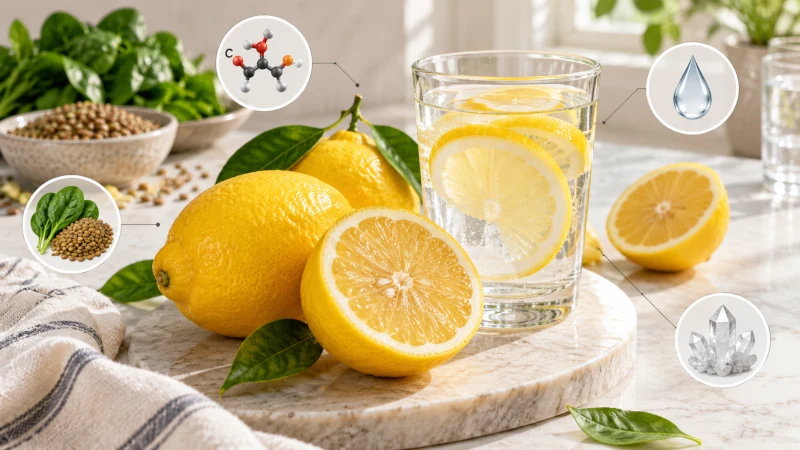
A lemon is a genuinely useful little fruit — but not for most of the reasons it gets famous. It won’t detox you, “alkalize” your blood, cleanse your arteries, or burn fat. What it actually offers is smaller and far more dependable: a solid hit of vitamin C, a squeeze that helps you absorb more iron from plant foods, a dose of citrate that may help certain people avoid kidney stones, and a bright, near-zero-calorie way to drink more water. Those are the real health benefits of lemons, and they’re worth getting right — along with two ways a lemon can quietly cause harm if you use it the way older advice suggested.
Here’s the honest map of what holds up, what’s promising, and what to ignore.
What’s actually in a lemon
A lemon is mostly water — about 88–89% — wrapped around a short list of useful compounds. The standouts are vitamin C and citric acid; the rest is a little fiber, a little potassium, and small amounts of plant compounds called flavonoids.
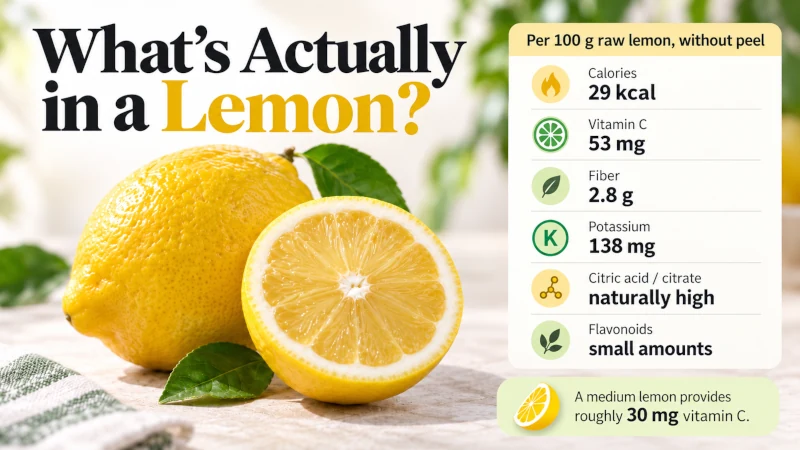
| Component (per 100 g, raw lemon, no peel) | Roughly | Why it matters |
| Calories | ~29 kcal | Very low; a medium lemon is only about 20 kcal |
| Vitamin C | ~53 mg (~59% DV) | Prevents scurvy; supports collagen, immunity, iron absorption |
| Citric acid / citrate | High | Citrate can inhibit calcium kidney-stone formation |
| Fiber | ~2.8 g | Mostly pectin, concentrated in pulp and peel |
| Potassium | ~138 mg | A minor contribution to daily needs |
| Flavonoids (e.g., hesperidin) | Small amounts | Studied for blood-vessel effects; not proven to treat disease |
Nutrition figures: USDA FoodData Central; a medium lemon (without peel) supplies roughly 30 mg of vitamin C — about a third of an adult’s daily target [USDA FoodData Central]. One practical detail: vitamin C breaks down with heat, light, and time, so freshly squeezed juice delivers more than bottled [NIH ODS, 2021]. The juice of half a lemon in water adds only about 10 mg of vitamin C — pleasant, but not a megadose.
The health benefits of lemons, graded by evidence
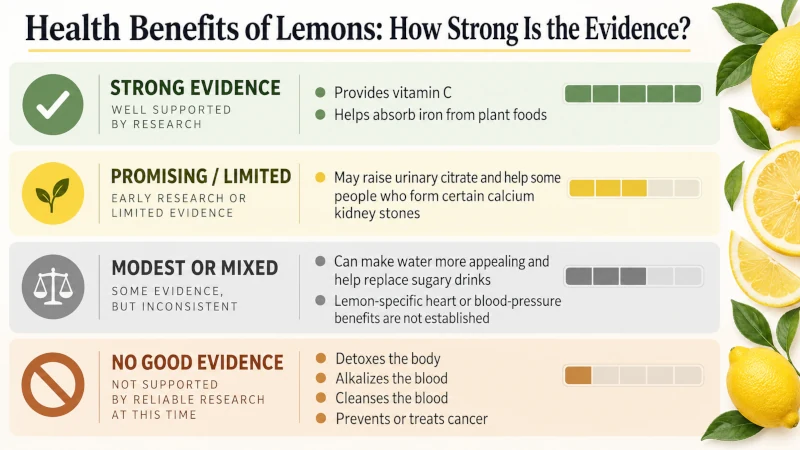
Not every claim deserves equal weight. Here’s the same information a careful clinician would give you, sorted by how strong the evidence actually is.
| Claim | What the evidence says | Strength |
| Supplies vitamin C / prevents scurvy | Established fact | Strong |
| Helps absorb iron from plant foods | Well established for vitamin C | Strong |
| Raises urinary citrate (may help prevent some stones) | Small clinical studies, mixed; helps some people | Promising / limited |
| Helps you drink more water / cut sugary drinks | Real, if modest | Modest |
| Protects the heart / lowers cholesterol or BP | Diet-level association; lemon-specific proof lacking | Weak / mixed |
| Detoxes, “alkalizes,” or cleanses the blood | Not supported by physiology | No evidence |
| Prevents or treats cancer | Not supported; lab/animal only | No evidence |
Vitamin C and scurvy: the part beyond dispute
Your body can’t make vitamin C, so it has to come from food. Go without long enough and you get scurvy — fatigue, swollen and bleeding gums, easy bruising, poor wound healing — which is fatal if untreated [NIH ODS, 2021]. That’s the bedrock: lemons carry vitamin C, and vitamin C keeps you well. A lemon a day is a real contributor, though not your main source — a red bell pepper, some broccoli, a kiwi, or an orange each delivers more, and if you want the biggest hitters, our roundup of vitamin C–rich foods lays them out.
Vitamin C also supports normal immune function, which is where the “lemon fights colds” idea comes from. The accurate version: getting enough keeps your immune system working normally, but supplements don’t stop the average person catching colds — at most they slightly shorten one [Mayo Clinic, 2025]. A hot lemon-and-honey drink is a comfort for a sore throat, not a cure.
Better iron absorption from plant foods
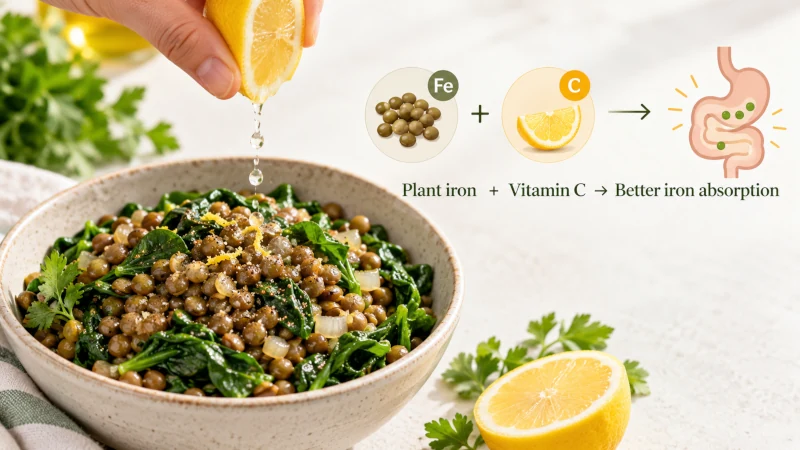
This is the quiet, genuinely useful one. Vitamin C improves your absorption of non-heme iron — the kind in lentils, beans, tofu, and leafy greens [NIH ODS, 2021]. So squeezing lemon over a bowl of lentils or a spinach salad helps your body pull more iron out of that meal. It’s a small, evidence-backed habit that matters most for vegetarians and anyone prone to iron-deficiency anemia. Two honest limits: lemon boosts absorption rather than adding much iron itself, and it is not a treatment for diagnosed anemia. If that’s your concern, pair it with the right foods (see foods for healthy blood) and get a blood test rather than self-treating.
Kidney stones: the most promising claim, with real caveats
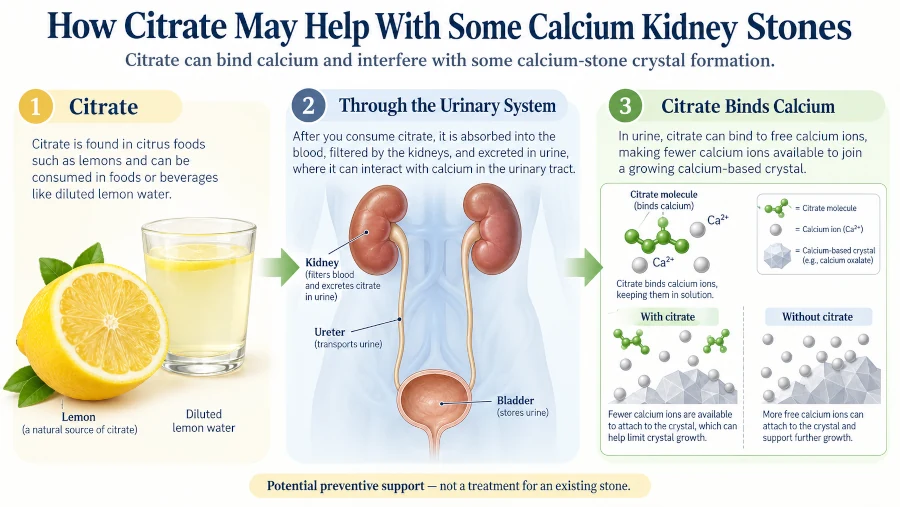
Here is where lemon moves from “nice flavor” to something actually studied. Citrate is one of the body’s natural inhibitors of calcium stone formation — it binds calcium in the urine and interferes with crystals forming — and lemon juice is one of the richest dietary sources of it. In small studies, “lemonade therapy” (on the order of 4 ounces of lemon juice a day, diluted) raised urinary citrate and urine volume in people who form calcium oxalate stones [Penniston et al., 2007].
But the picture is genuinely mixed, and it’s worth stating plainly. A 2021 systematic review found that lemon juice reliably raises urinary citrate, yet — unlike orange or grapefruit juice — it does not significantly make urine more alkaline, and at least one trial found lemonade didn’t raise citrate at all [Barghouthy & Somani, 2021]. The same review is blunt that lemon had a smaller protective effect than orange juice and that larger, better studies are still needed.
The takeaway a urologist would give you: lemon may help as an add-on, especially if your urine citrate is low, but it is not a substitute for prescribed potassium citrate, and it should be tailored to your stone type and a 24-hour urine test. Skip sugary lemonade — the sugar can work against you.
Hydration and cutting sugary drinks
No magic, but a real effect. Lemon makes plain water more appealing, so people tend to drink more of it, and swapping soda or sweetened coffee for lemon water cuts sugar. Drinking more fluid is, by itself, one of the simplest ways to lower kidney-stone risk. Modest — but it adds up.
Heart, blood vessels, and flavonoids: interesting, not proven
Lemons contain flavonoids such as hesperidin, and diets rich in fruit and vitamin C are associated with lower heart-disease risk [NIH ODS, 2021]. That’s a long way from proof that lemons protect your heart. Most flavonoid research is on concentrated supplements or on orange juice, not lemons, and the human trials conflict. The old claim that lemon “reinforces capillary walls,” thins the blood, or dissolves calcium deposits in arteries isn’t supported by human evidence. Enjoy lemon as part of a plant-rich diet for your heart; don’t treat it as medicine. For a close comparison, the evidence on oranges tracks the same chemistry.
The claims to retire: detox, “alkalizing,” and blood cleansing
This is the big one, because it’s where lemon’s reputation runs furthest ahead of the facts. The popular story says lemon is acidic in the glass but “alkalizing” once metabolized, shifting your body’s pH and flushing out toxins. The physiology simply doesn’t work that way. Your blood pH is held in a narrow band of about 7.35–7.45 by your lungs, kidneys, and chemical buffers, and even a small deviation is a medical emergency, not a wellness goal — food does not move it [Merck Manual, 2025].
Diet can nudge the pH of your urine, but that’s your kidneys doing their job, not your bloodstream changing. And notably, lemon barely alkalizes even urine [Barghouthy & Somani, 2021]. As for “detox” and “cleansing the blood,” your liver and kidneys handle that continuously; a squeeze of lemon adds nothing to it.
A few older folk claims deserve the same skepticism: that lemon dissolves arterial plaque, “purifies” or “regenerates” the blood, cures infections, or prevents cancer. On cancer specifically, diets high in fruit and vegetables are linked to lower risk of some cancers, but vitamin C supplements don’t appear to prevent cancer, and the anticancer activity of lemon compounds like d-limonene has been seen mainly in lab dishes and animals — not shown to prevent or treat cancer in people [NIH ODS, 2021]; [Mayo Clinic, 2025]. Using lemon in place of medical care for a real infection or disease is not just ineffective; it’s dangerous.
Lemon water is still fine. It’s pleasant, hydrating, and a nice little source of vitamin C. It just isn’t doing the dramatic things the internet promises. If lemon water specifically is your interest, our companion guide to lemon water, day to day covers the practical side.
How to use lemon (and get the benefit)
You don’t need a regimen. The simplest habits capture nearly all of it:
- Add the juice of half to a whole lemon to a glass of water, hot or cold — fresh beats bottled for vitamin C.
- Squeeze it over food — fish, vegetables, lentils, salads — for flavor and to help you absorb plant iron.
- A little honey makes warm lemon water more soothing for a scratchy throat (comforting, not curative).
- If kidney-stone prevention is the goal, the amount studied is roughly 4 ounces of juice a day — but do that with a clinician, not on your own.
Safety, side effects, and who should be careful
Lemon is safe for most people in normal amounts. The cautions below are the ones that actually matter — including two that older articles got dangerously wrong.
Protect your teeth first

Lemon juice has a pH of roughly 2–3, and the American Dental Association lists acidic fruit juice among the drinks that erode tooth enamel — a loss that is permanent [ADA, 2025]. Sipping lemon water all day is the worst pattern, because your enamel never gets to recover. You don’t have to give it up: dilute it, drink it in one sitting rather than nursing it, use a straw, rinse with plain water afterward, and wait 30–60 minutes before brushing so softened enamel can re-harden [ADA, 2025].
Don’t put lemon on your skin before sun — or in your eyes
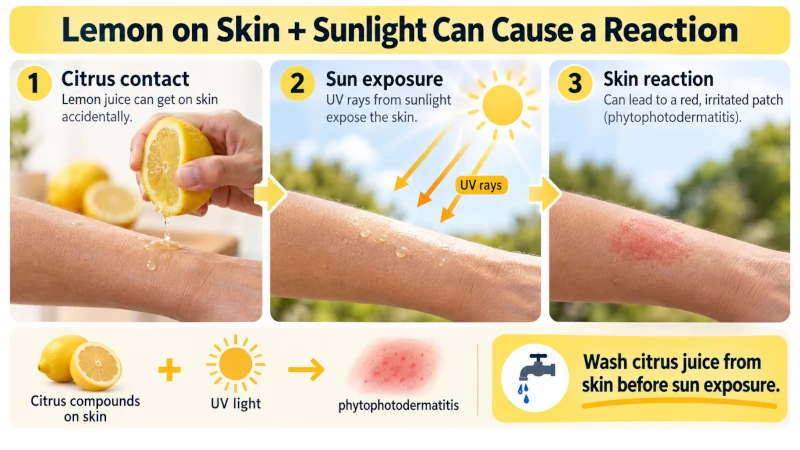
This corrects a genuinely harmful piece of old advice. Lemons contain compounds called furocoumarins; get the juice on your skin, then go into sunlight, and you can develop phytophotodermatitis — the “margarita burn” — with redness, blistering, and dark patches that can linger for weeks or months [Poison Control]. Skip DIY lemon skin treatments, face masks, and hair lighteners, and wash any splashes off promptly. And to be unambiguous about another old claim: never put lemon juice in your eyes. It is acidic enough to injure the eye and does nothing to treat conjunctivitis or any infection. Lemon is a food, not an antiseptic for skin, nostrils, throat, or eyes.
Reflux, mouth sores, and sensitive stomachs
Acidity that’s fine for most people is a problem for some. Lemon can aggravate heartburn or acid reflux, sting canker sores, and, in large amounts, upset a sensitive stomach. Older advice that lemon juice is good for diarrhea or colitis isn’t supported — if lemon reliably triggers symptoms for you, that’s your cue to cut back.
Medications and iron overload
Good news for most people on medication: the common lemon is not grapefruit. The serious grapefruit drug interactions come from furanocoumarins that block the CYP3A4 enzyme, an effect strong in grapefruit (and Seville oranges, pomelos, and limes) but not a recognized concern for ordinary lemons.
Two real cautions do apply, and both are about vitamin C in supplement doses, not lemons as food: high-dose vitamin C can blunt the blood thinner warfarin and can interfere with chemotherapy and certain cholesterol drug combinations, so check with your clinician before taking supplements [Mayo Clinic, 2025]. And because vitamin C increases iron absorption, people with an iron-overload condition such as hemochromatosis should be cautious [NIH ODS, 2021]; [Mayo Clinic, 2025]. If you take medication and have questions, a pharmacist is the right person to ask.
Pregnancy and breastfeeding
Lemon used as a food or flavoring in normal culinary amounts is considered safe during pregnancy and breastfeeding. What isn’t supported is any concentrated “lemon cure” or multi-week lemon protocol — there’s no good evidence behind those, so skip them and ask your provider before starting any supplement.
| Health disclaimer: This article is for general education and is not a substitute for professional medical advice, diagnosis, or treatment. Nutritional needs and medication interactions vary from person to person. If you are pregnant or breastfeeding, take medication (such as warfarin), or have a condition like kidney disease, recurrent kidney stones, reflux, or an iron-overload disorder, talk with a qualified healthcare professional — your doctor, a registered dietitian, or a pharmacist — before making significant changes to your diet or starting a supplement. If you have severe symptoms — such as intense flank pain, blood in your urine, eye injury, or a spreading blistering rash — seek medical care promptly. |
When to see a doctor
Lemon is a food, not a treatment. Some symptoms need real care:
- Seek urgent care for severe one-sided flank or back pain, blood in your urine, or pain with fever — possible signs of a kidney stone or infection; and for any chemical injury to the eye.
- See a clinician for bleeding gums, easy bruising, poor wound healing, or unexplained fatigue, which have many causes and deserve a diagnosis.
- Get medical care for a spreading or severe blistering rash after citrus and sun exposure.
Frequently Asked Questions
Is lemon water actually good for you?
In a modest way, yes. It hydrates you, adds a little vitamin C, and helps some people drink more water or cut sugary drinks. It won’t detox you, change your body’s pH, or cause weight loss on its own.
Does lemon detox your body or cleanse your blood?
No. Your liver and kidneys handle that continuously, and no food meaningfully changes your blood pH or “flushes toxins.” Blood pH is held near 7.35–7.45 no matter what you eat [Merck Manual, 2025].
Can lemon prevent or dissolve kidney stones?
It may help prevent certain calcium stones by raising urinary citrate, and the studied amount is about 4 ounces of lemon juice a day — but the evidence is mixed and it’s an add-on, not a replacement for prescribed potassium citrate [Barghouthy & Somani, 2021]. It does not dissolve existing stones.
Does lemon help with iron and anemia?
The vitamin C in lemon increases how much plant (non-heme) iron you absorb from the same meal, so a squeeze over lentils or greens is a smart habit [NIH ODS, 2021]. But it boosts absorption rather than adding iron, and it’s not a treatment for diagnosed anemia — get a blood test if you’re concerned.
Will lemon water damage my teeth?
It can, because it’s acidic enough to erode enamel over time [ADA, 2025]. Reduce the risk: dilute it, drink it in one sitting, use a straw, rinse with water afterward, and wait 30–60 minutes before brushing.
How much lemon is safe per day?
For most people, the juice of one to three lemons a day in water or on food is fine. The main limit is dental — frequent, all-day acid exposure is harder on enamel than the same amount in one sitting.
References
- National Institutes of Health, Office of Dietary Supplements. Vitamin C — Fact Sheet for Consumers. Updated 2021. View source
- Mayo Clinic. Vitamin C (drugs & supplements). Updated Aug 14, 2025. View source
- Barghouthy Y, Somani BK. Role of Citrus Fruit Juices in Prevention of Kidney Stone Disease (KSD): A Narrative Review. Nutrients. 2021;13(11):4117. DOI 10.3390/nu13114117. View source
- Penniston KL, Steele TH, Nakada SY. Lemonade Therapy Increases Urinary Citrate and Urine Volumes in Patients with Recurrent Calcium Oxalate Stone Formation. Urology. 2007;70(5):856–860. PMID 17919696. View source
- American Dental Association. Dental Erosion. Updated Oct 22, 2025. View source
- Poison Control (National Capital Poison Center). Lime juice and sun can cause skin rashes. View source
- Merck Manual, Consumer Version. Overview of Acid-Base Balance. Updated Jul 2025. View source
- U.S. Department of Agriculture, FoodData Central (Lemons, raw, FDC #167746; Lemon juice, #167747). View source
