
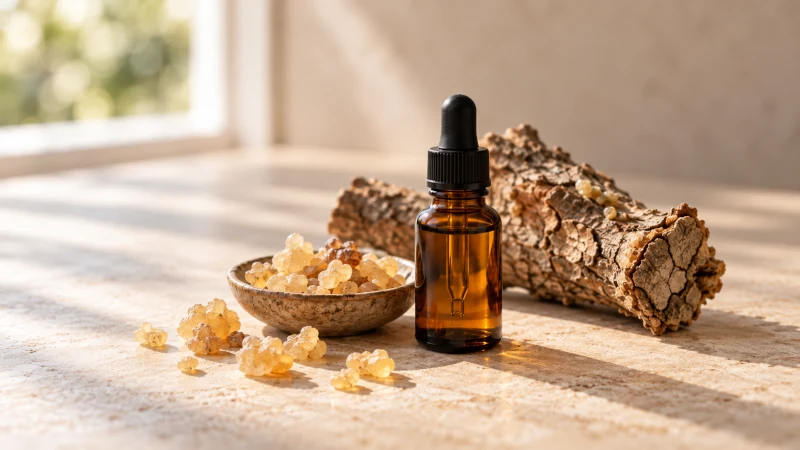
Frankincense essential oil is the steam-distilled, aromatic oil pressed out of the resin of Boswellia trees — the same fragrant resin burned as incense for thousands of years. People reach for it today mostly to unwind, to scent a room, and as an ingredient in diluted skincare. Those are reasonable uses. The trouble starts when frankincense essential oil gets sold as a fix for arthritis, inflammatory bowel disease, or cancer, because almost all of that research was done on something else: an oral Boswellia extract that contains active compounds the distilled oil barely has.
That distinction is the single most useful thing to understand before you buy a bottle, so let’s start there.
What frankincense essential oil actually is
Frankincense comes from the milky resin that seeps out when the bark of a Boswellia tree is scored. That resin — also called olibanum — can be turned into very different products. Steam-distill it and you get the essential oil: a light, volatile liquid dominated by aromatic monoterpenes such as alpha-pinene, along with smaller amounts of larger molecules [Ojha et al., 2022]. Extract the same resin with solvents or press it into capsules, and you get a Boswellia supplement concentrated in boswellic acids — the anti-inflammatory compounds most of the headlines are about.
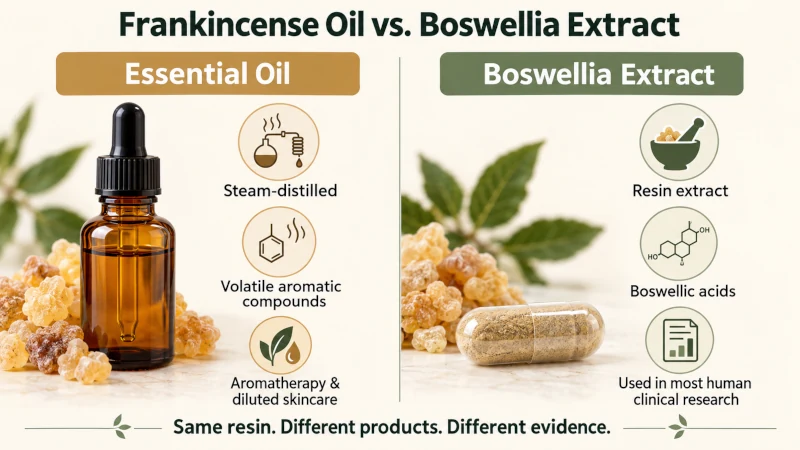
Here’s the catch that most articles miss: boswellic acids are large, heavy molecules that mostly don’t evaporate, so they largely stay behind in the resin during steam distillation. A typical steam-distilled frankincense essential oil contains little to none of them. So when you read that “frankincense reduces arthritis pain,” that finding almost always comes from an oral extract standardized for boswellic acid — not from the oil in a diffuser or a face serum [MSKCC, 2026].
Neither form is “better.” They’re different products for different jobs. The table below is the quick version.
Frankincense essential oil vs. Boswellia supplement
| Frankincense essential oil | Boswellia extract / supplement | |
| How it’s made | Steam-distilled from resin | Solvent-extracted resin, usually in capsules |
| Main active compounds | Volatile monoterpenes (e.g., alpha-pinene), incensole acetate | Boswellic acids (e.g., AKBA) |
| Typical use | Aromatherapy, diffusing, diluted skincare | Taken by mouth for joint or inflammatory conditions |
| Where the research is | Mostly lab, animal, and small mood/skin studies | Most human trials (arthritis, gut, etc.) |
| Boswellic acid content | Little to none | The whole point |
Keep that split in mind and the evidence below sorts itself out neatly.
What the evidence actually shows
Calm, mood, and sleep — the oil’s most plausible use
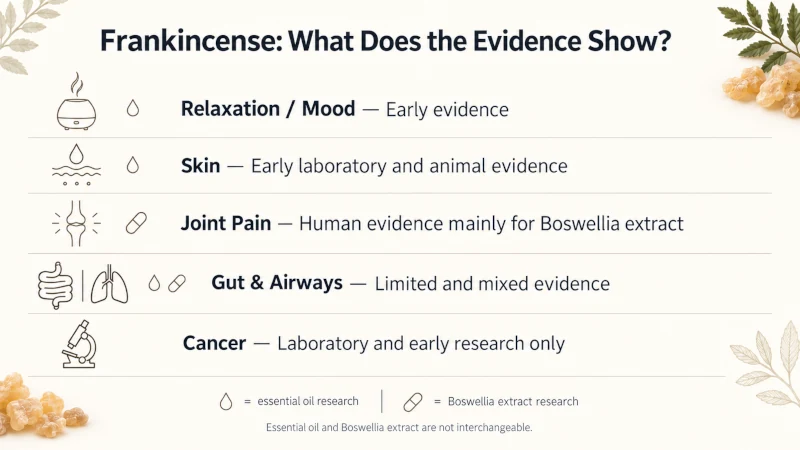
If frankincense essential oil has a “best” use, it’s here — though the evidence is early, not settled. One of its volatile constituents, incensole acetate, was shown to activate a brain ion channel called TRPV3 and to produce anxiety-reducing and antidepressant-like effects in mice [Moussaieff et al., 2008]. That’s a genuinely interesting finding, and unlike the boswellic-acid research, it involves a compound the oil actually carries. But it’s an animal study using an isolated compound, not proof that diffusing frankincense treats anxiety or depression in people.
What’s fair to say: many people find the warm, woody aroma grounding, and aromatherapy used for relaxation is low-risk. As a wind-down ritual — a few drops in a diffuser before bed — it’s a reasonable thing to try. As a treatment for a diagnosed anxiety, mood, or sleep disorder, it isn’t a substitute for care that works.
Skin and anti-aging
The volatile fraction that steam distillation captures does have measurable biological activity in the lab — antioxidant and antimicrobial effects among them [MSKCC, 2026]. In one animal study, a frankincense essential oil showed anti-collagenase and anti-elastase activity and protected against UV-induced skin damage in rats [PMC10735031]. That’s a plausible mechanism for the “anti-aging” reputation, but rat skin and lab dishes aren’t human faces, and there’s no strong clinical trial showing a frankincense serum erases wrinkles or fades scars. Treat those specific promises as unproven.
For everyday use, a properly diluted frankincense oil can be a pleasant addition to a routine for its scent and possible soothing feel. It is not a treatment for eczema, psoriasis, or wounds — and, importantly, frankincense oil is itself a documented (if uncommon) cause of allergic contact dermatitis, so a patch test matters here [MSKCC, 2026]. If you want oils with more evidence behind their skin claims, the site’s guide to jojoba oil benefits is a more grounded starting point — and it also makes a good carrier oil for dilution.
Joint pain and arthritis — mostly the supplement, not the oil
This is the strongest area of evidence, and it belongs almost entirely to the oral extract. A 2020 systematic review and meta-analysis pooled seven randomized trials (545 people with osteoarthritis) and found that Boswellia and its extract improved pain, stiffness, and joint function compared with control, with benefits typically appearing after about four weeks at doses around 100–250 mg [Yu et al., 2020]. The authors were careful, though: the trials were mostly medium-to-low quality, small, and inconsistent, so the results are promising rather than conclusive. Other reviews describe the osteoarthritis data as genuinely mixed [MSKCC, 2026].
The practical takeaway: rubbing diluted frankincense essential oil on a sore knee may feel soothing, but the joint-pain research is about swallowing a standardized Boswellia extract, which is a different product and a decision worth discussing with a clinician. If you’re managing arthritis, broader, better-supported approaches — an anti-inflammatory eating pattern (see the rheumatoid arthritis diet guide) and supplements with stronger evidence like omega-3s and curcumin (see anti-inflammatory supplements) — deserve first consideration.
Gut, airways, and cancer — where claims outrun the evidence
You’ll see frankincense credited with treating inflammatory bowel disease, asthma, and even cancer. Sort these carefully. Small, older clinical studies of oral Boswellia resin suggested benefit in ulcerative colitis and bronchial asthma, but a randomized trial found it did not help maintain remission in Crohn’s disease, and evidence for related gut conditions is unclear or negative [MSKCC, 2026]. Again — these are extract studies, not the essential oil.
The cancer claims deserve the most caution. Boswellic acids kill certain cancer cells and shrink tumors in laboratory and animal models, and a few early human studies exist — for example, a small trial found Boswellia extract reduced brain swelling in patients receiving radiation for brain tumors, and an early “window of opportunity” trial explored anti-proliferative effects in breast cancer [MSKCC, 2026]. That is a long way from “frankincense treats cancer.” No form of frankincense is a cancer treatment, and it should never replace oncology care. If you have cancer and are considering any supplement, tell your oncology team first — some frankincense preparations can affect bleeding and drug transport (more on that below).
How to use frankincense essential oil safely
Dilution and carrier oils
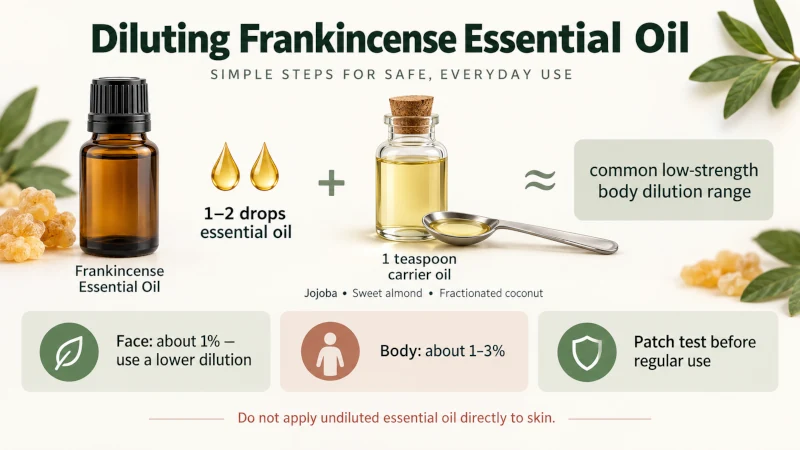
Essential oils are concentrated, and frankincense should never go on skin undiluted — doing so raises the risk of irritation and sensitization [MSKCC, 2026]. Blend it into a carrier oil (jojoba, sweet almond, or fractionated coconut all work) before applying. A common, sensible range is about 1–3% for body use — roughly one to two drops of essential oil per teaspoon of carrier — and lower, around 1%, on the more delicate skin of the face. Children need gentler dilutions still, generally in the 0.5–2.5% range depending on age [NAHA].
Whatever the dilution, patch-test any new blend first: apply a small amount to the inner forearm and wait 24 hours (ideally longer) to check for redness or itching. The site’s patch testing guide walks through how to do this properly. Frankincense oil naturally contains fragrance allergens such as linalool, limonene, and geraniol, which is exactly why testing first is worth the wait.
One correction worth making, since many articles get it wrong: frankincense is not among the essential oils that make skin more sensitive to sunlight. Phototoxicity is a property of certain expressed citrus oils (bergamot, lemon, lime) that contain furanocoumarins — frankincense isn’t on that list [Tisserand Institute, 2025]. You don’t need to avoid the sun after using it, though general sun protection is always wise.
Diffusing and inhalation
For aromatherapy, a few drops in a diffuser is the lowest-risk way to enjoy frankincense. Use it in a ventilated room, keep sessions intermittent rather than all-day, and keep diffusers and undiluted oil away from children and pets. Don’t take frankincense essential oil by mouth as a home remedy — the oral research is on Boswellia extract products, not on swallowing the distilled oil, and one case report describes a stomach mass (bezoar) after excessive frankincense intake [MSKCC, 2026].
Side effects, interactions, and who should avoid it
Used sensibly, frankincense is generally well tolerated [MSKCC, 2026]. The most common problem is a skin reaction — irritation or allergic contact dermatitis — which is why dilution and patch testing matter.
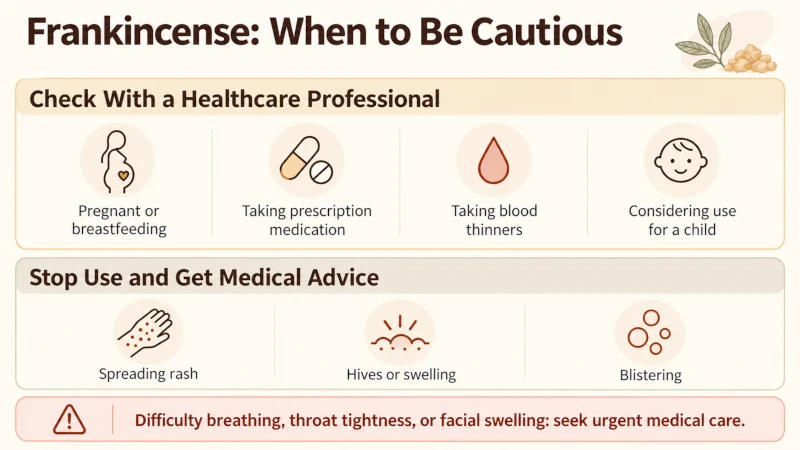
The interaction worth flagging applies mainly to Boswellia taken orally: it can inhibit platelet aggregation and may increase bleeding risk alongside anticoagulant or antiplatelet drugs such as warfarin, so talk to your doctor before combining them [MSKCC, 2026]. Laboratory studies also suggest boswellic acids can affect drug-transport proteins (P-glycoprotein, OATP1B3, MRP2), though the real-world significance of that isn’t yet established. If you take prescription medication, mention any frankincense or Boswellia product to your pharmacist.
Pregnancy, breastfeeding, and children
Here the guidance genuinely disagrees, and it’s worth being honest about that. Some aromatherapy references list frankincense among the oils considered acceptable when properly diluted during pregnancy [NAHA]. Others, including product-safety labeling, advise consulting a healthcare professional before using any essential oil while pregnant or nursing. Because rigorous human safety data in pregnancy is thin, the cautious, practical course is to check with your obstetric provider before using frankincense during pregnancy or breastfeeding rather than assuming it’s fine. For young children, keep undiluted oil out of reach, use only well-diluted blends, and avoid it in infants and toddlers unless a knowledgeable professional advises otherwise.
Red flags — when to stop and see a professional
Stop using frankincense and get medical advice if you develop a spreading rash, hives, swelling, or blistering after applying it. Seek urgent care for any sign of a severe allergic reaction, such as difficulty breathing, throat tightness, or facial swelling. And don’t let any essential oil delay real care: joint pain that’s hot and swollen with fever, digestive symptoms with bleeding or weight loss, a persistent cough or breathing trouble, or any new lump or symptom that concerns you all warrant a clinician’s evaluation rather than a home remedy.
| Health Disclaimer: This article is for general education only and is not a substitute for professional medical advice, diagnosis, or treatment. Frankincense essential oil and Boswellia supplements are not proven to cure, treat, or prevent any disease. Always talk with a qualified healthcare provider before using essential oils or herbal supplements — especially if you are pregnant or breastfeeding, give them to a child, take prescription medication (particularly blood thinners), or are managing a medical condition such as arthritis, inflammatory bowel disease, or cancer. If you think you’re having a severe allergic reaction, seek emergency care. |
Frequently Asked Questions
Is frankincense essential oil the same as Boswellia supplements?
No — and it’s the most important thing to know. The essential oil is steam-distilled and made of volatile aromatic compounds; Boswellia supplements are extracts concentrated in boswellic acids, which the distilled oil barely contains. Most “frankincense” health research is on the oral extract, not the oil you diffuse.
Does frankincense oil help with anxiety or sleep?
It may help you feel calmer as part of a relaxation routine, and one of its compounds (incensole acetate) had anxiety-reducing effects in mice, but that’s early animal research — not proof it treats anxiety or a sleep disorder in people. It’s low-risk to try for relaxation, but not a replacement for treatment.
Can I put frankincense oil directly on my skin?
No. Dilute it in a carrier oil first (about 1–3% for the body, lower for the face) and patch-test before regular use. Undiluted essential oil can irritate skin, and frankincense oil is a documented cause of allergic contact dermatitis in some people.
Does frankincense make my skin more sensitive to the sun?
No. Phototoxicity comes from certain citrus oils that contain furanocoumarins; frankincense isn’t among them.
Is frankincense oil safe during pregnancy?
The guidance is mixed. Some references consider properly diluted frankincense acceptable in pregnancy; others advise caution because human safety data is limited. The safest approach is to ask your obstetric provider first.
Can frankincense treat arthritis or cancer?
Oral Boswellia extract shows modest, mixed benefit for osteoarthritis pain in trials, but the quality is limited. Cancer claims rest mainly on lab and animal studies plus a few early human trials — frankincense is not a cancer treatment and shouldn’t replace medical care.
References
- Yu G, Xiang W, Zhang T, Zeng L, Yang K, Li J. “Effectiveness of Boswellia and Boswellia extract for osteoarthritis patients: a systematic review and meta-analysis.” BMC Complementary Medicine and Therapies. 2020;20:225. DOI: 10.1186/s12906-020-02985-6. View source
- Memorial Sloan Kettering Cancer Center. “Boswellia.” Integrative Medicine / About Herbs. Last updated September 3, 2026. View source
- Ojha PK, Poudel DK, Rokaya A, Satyal R, Setzer WN, Satyal P. “Comparison of Volatile Constituents Present in Commercial and Lab-Distilled Frankincense (Boswellia carteri) Essential Oils for Authentication.” Plants. 2022;11(16):2134. DOI: 10.3390/plants11162134. View source
- Moussaieff A, Rimmerman N, Bregman T, et al. “Incensole acetate, an incense component, elicits psychoactivity by activating TRPV3 channels in the brain.” FASEB Journal. 2008;22(8):3024–3034. DOI: 10.1096/fj.07-101865. PMID: 18492727. View source
- Tisserand Institute. “Phototoxicity: essential oils, sun and safety.” View source
- National Association for Holistic Aromatherapy (NAHA). “Safety.” View source
- Frankincense essential oil anti-photoaging study (Boswellia papyrifera, in vivo rat model). PMC10735031. View source


