
Jojoba oil benefits are most believable when the claims stay simple: this plant-derived liquid wax can help reduce moisture loss from dry skin, soften rough patches, remove oil-based makeup, and smooth dry or frizzy hair.
It shows up in so many cosmetic products because its wax esters are stable and work well as emollients — ingredients that soften and condition the skin. What jojoba oil is not: a sunscreen, a proven acne treatment, or a hair-regrowth remedy [Gad et al., 2021] [Blaak & Staib, 2022].
That distinction matters, because online articles routinely turn a useful cosmetic oil into a cure-all. A more realistic approach is to use jojoba oil as a small part of a basic skin or hair routine, then get medical care when symptoms are persistent, painful, infected, or severe.
What is jojoba oil?
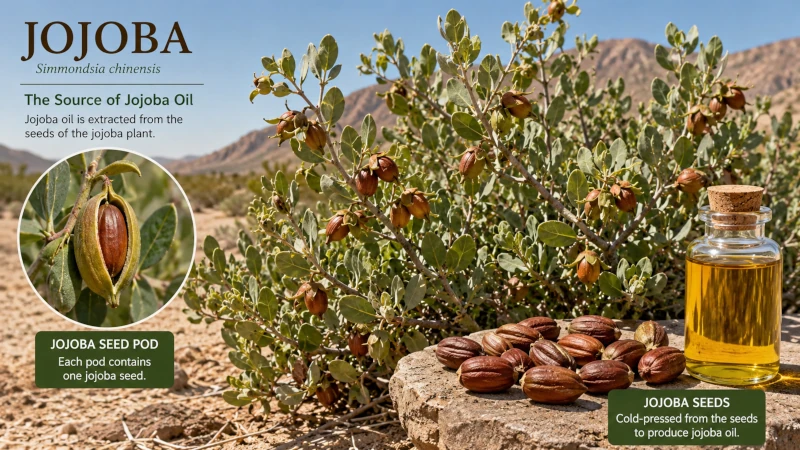
Jojoba oil comes from the seeds of Simmondsia chinensis, a shrub adapted to dry regions. Despite the name, it’s technically a liquid wax rather than a typical vegetable oil — a 2021 review found jojoba wax is roughly 98% wax material, mostly wax esters, with smaller amounts of other compounds [Gad et al., 2021].
That waxy composition explains why jojoba turns up in moisturizers, lip products, cleansers, shampoos, and conditioners. It can form a light conditioning layer that slows water loss and improves the feel of dry skin or hair [Blaak & Staib, 2022].
Jojoba Oil Benefits at a Glance
| Use | What the evidence supports | How to think about it |
| Dry or rough skin | Reasonable cosmetic use as an emollient and moisture-supporting ingredient (Blaak & Staib, 2022) | Useful for softness and comfort, especially in a fragrance-free product |
| Acne-prone skin | One observational pilot study found improvement with a clay–jojoba facial mask, but it had no control group (Meier et al., 2012) | Possible add-on for some people, not a replacement for proven acne care |
| Fine lines and redness | Ex-vivo research suggests anti-inflammatory and skin-conditioning effects (Tietel et al., 2024) | Hydration may reduce the look of fine lines temporarily. Anti-aging claims are not clinically established |
| Dry, frizzy, or brittle hair | Reasonable use as a conditioning oil (Cleveland Clinic, 2023) | Helpful for appearance and manageability; not proven to regrow hair |
| Eczema or psoriasis | May feel soothing as a moisturizer, not a treatment (Pazyar et al., 2013) | Use only if tolerated; keep prescribed care in place |
| Sun protection | No established sunscreen protection (AAD, 2025) | Use broad-spectrum, water-resistant SPF 30+ |
Jojoba Oil Benefits for Skin
Dry skin and moisture support
The clearest reason to reach for jojoba oil is dryness. Emollients soften rough skin and help the surface feel smoother, and plant oils and waxes can also reduce water loss by leaving a thin layer behind — useful on dry hands, elbows, cuticles, lips, or small flaky patches [Blaak & Staib, 2022].
Apply a small amount after washing, while skin is still slightly damp. For the face, start with one or two drops; for hands or cuticles, rub in a drop as needed. More isn’t automatically better — too much can feel heavy or trigger breakouts in some people.
Acne-prone skin: promising but limited evidence
Jojoba oil gets marketed for acne partly because it shows up in products labeled non-comedogenic, meaning unlikely to clog pores. But acne is a genuinely layered problem — clogged pores, inflammation, excess oil, bacteria, and sometimes hormones — and a cosmetic oil can’t address all of it.
The most-cited human study is a prospective observational pilot involving 133 people with acne-prone or lesioned skin, who used a clay–jojoba oil mask two to three times a week for six weeks. Lesion counts improved, but there was no control group, so the study can’t say whether the effect came from the jojoba oil, the clay, the routine itself, or some combination [Meier et al., 2012].
For mild breakouts, a finished product labeled non-comedogenic, introduced slowly, is the safer bet. The American Academy of Dermatology recommends non-comedogenic moisturizers for acne-prone skin specifically because they’re less likely to trigger breakouts [AAD]. For a wider look at plant-based options and their limits, see the site’s herbs for acne guide.
Skip jojoba oil as self-treatment for deep, painful pimples, cysts, nodules, scarring, or breakouts that aren’t improving with careful over-the-counter care — those patterns deserve a dermatologist’s input.
Fine lines, redness, eczema, and psoriasis
Jojoba oil can make dry skin feel more comfortable, and better hydration can temporarily soften the look of fine lines. A 2024 study using an ex-vivo human skin model — living tissue studied outside the body — found that topical jojoba wax reduced several inflammation-related signals by about 30%, and increased markers tied to hyaluronic acid and pro-collagen III. That’s useful for generating hypotheses, but it doesn’t prove a bottle of jojoba oil will reverse wrinkles or treat a skin disease in everyday use [Tietel et al., 2024].
People with eczema, psoriasis, or rosacea may tolerate jojoba oil, especially in a simple fragrance-free formula — others may flare. Use it as a moisturizer only if it feels comfortable, and don’t let it replace a prescription plan or a dermatologist’s guidance [Pazyar et al., 2013].
What jojoba oil does not do
Jojoba oil isn’t sunscreen. It has no established SPF and shouldn’t be described as protection against skin cancer. The American Academy of Dermatology recommends a broad-spectrum, water-resistant sunscreen with SPF 30 or higher, plus shade and protective clothing when practical [AAD, 2025].
It also shouldn’t go on open wounds, infected skin, or fresh burns as a home treatment. Lab studies have explored wound-healing mechanisms at the cellular level, but that’s not the same as clinical evidence that plain jojoba oil safely treats wounds in people [Ranzato et al., 2011].
Jojoba Oil Benefits for Hair
Jojoba oil can help when hair feels dry, rough, or frizzy. A few drops on the lengths and ends can add slip and cut down on a brittle feel, and it may make curls or textured hair easier to style. Cleveland Clinic describes jojoba oil as a leave-in conditioning option for dry or brittle hair [Cleveland Clinic, 2023].
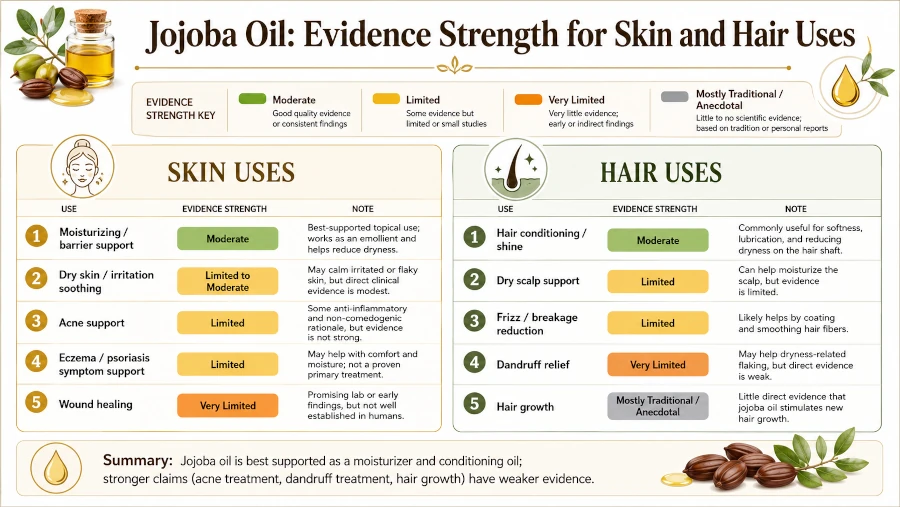
What the evidence doesn’t show: that jojoba oil regrows thinning hair, reverses a receding hairline, or treats a medical cause of shedding. Hair loss can stem from genetics, hormonal shifts, illness, stress, nutritional deficiencies, medications, or scalp conditions — an oil may improve how strands look and feel without touching the underlying cause.
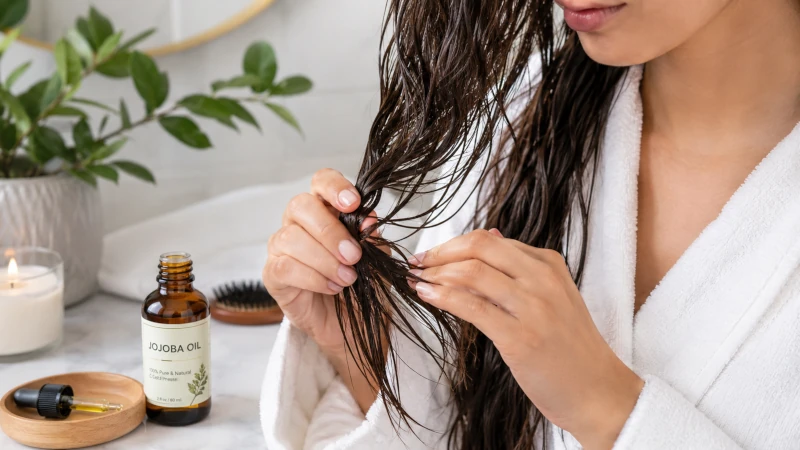
For practical application details, see the site’s jojoba oil for hair guide. A simple approach works well: warm one to three drops between your palms, smooth them over damp ends, and add more only if hair still feels dry. Fine hair may need less; thick, curly, or very dry hair may tolerate more.
Avoid heavy scalp oiling if it makes itching, flaking, or bumps worse. Persistent dandruff, scalp pain, patchy hair loss, or sudden shedding needs a clinician’s evaluation.
How to Use Jojoba Oil Safely
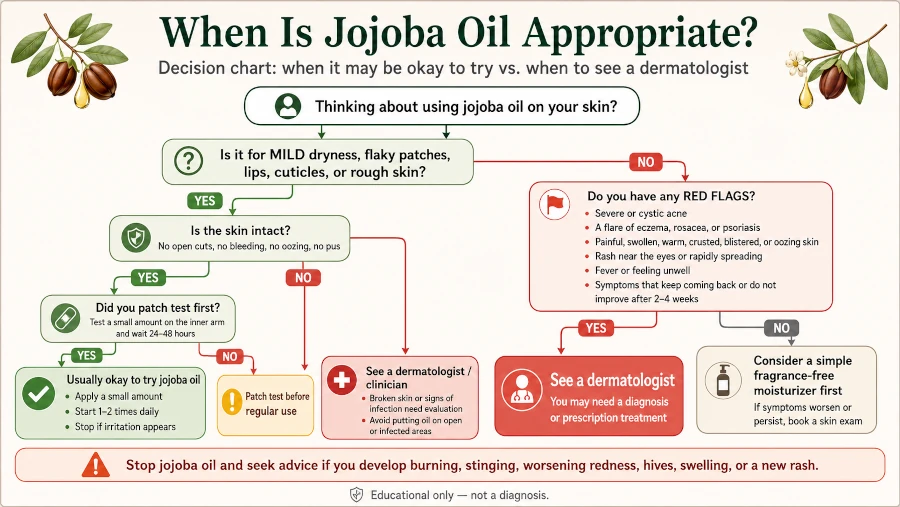
Patch-test first
Plant-derived doesn’t mean automatically gentle. The American Academy of Dermatology recommends testing a new skin care product on a quarter-sized spot twice daily for seven to ten days — the underside of your arm or the bend of your elbow works well. If redness, itching, or swelling shows up, wash it off and stop [AAD, 2021].
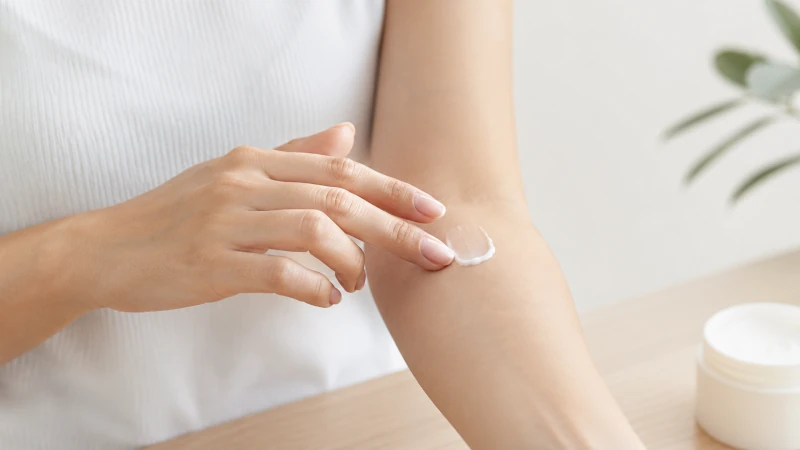
The site’s patch testing guide explains the difference between this kind of home trial and formal medical patch testing done by a dermatologist.
Who should avoid it or ask a clinician first
- Anyone who has reacted to jojoba oil, botanical oils, or a product containing jojoba esters.
- People with an active rash, infected skin, open wounds, blistering, or fresh burns.
- Anyone using prescription creams or ointments on the same area — jojoba may affect how topical ingredients spread or absorb, so ask your prescriber how to layer products [Pazyar et al., 2013].
- People with severe acne, eczema, psoriasis, rosacea, or a flaring seborrheic dermatitis.
- Anyone pregnant or breastfeeding who’s considering a blended product containing essential oils, retinoids, or other active ingredients — plain jojoba oil is different from a multi-ingredient blend, and the full ingredient list matters.
Don’t swallow cosmetic jojoba oil. Use it externally, and follow the product label.
How to Choose a Jojoba Oil Product
For a first trial, a simple formula is easier to evaluate than a scented blend. Check the ingredient list for Simmondsia Chinensis (Jojoba) Seed Oil or jojoba esters. Fragrance-free is a sensible default for sensitive skin, since fragrance can trigger irritation or allergic contact dermatitis in some people [AAD, 2021].
“Organic,” “cold-pressed,” and “unrefined” describe sourcing or processing — not a guarantee the product will work better for your skin. In the United States, cosmetics generally don’t need FDA premarket approval, aside from color additives; the company that markets a cosmetic is responsible for its safety and labeling [FDA, 2025].
Realistic Expectations
A good result is a modest one: softer skin, less tightness after washing, smoother cuticles, easier makeup removal, or hair that feels less dry. You’ll likely notice the cosmetic effect fairly quickly, since the oil coats and conditions the surface. Medical problems work differently — acne, eczema, psoriasis, hair loss, and persistent scalp symptoms need evidence-based care when they’re moderate, severe, or stubborn.
Stop using the product if skin becomes red, itchy, swollen, blistered, or more inflamed. The FDA advises stopping use and contacting a healthcare provider after a reaction, and unexpected reactions can also be reported directly to the FDA [FDA, 2026].
When to Talk to a Healthcare Professional
- Your rash, dryness, or itching is painful, widespread, cracked, bleeding, or not improving.
- You have deep or scarring acne, or breakouts that persist despite a careful routine.
- You notice sudden shedding, bald patches, scalp pain, or a rapidly changing hairline.
- You develop facial swelling, trouble breathing, hives, blistering, or rapidly spreading redness after using a product. Seek urgent medical care for trouble breathing or significant facial swelling.
| Health Disclaimer This article is for educational purposes only and isn’t a substitute for medical advice, diagnosis, or treatment. Jojoba oil is a cosmetic ingredient, not a cure for acne, eczema, psoriasis, hair loss, wounds, or sun damage. Stop using a product if it causes a reaction, and seek medical care for severe symptoms, infection, significant swelling, or breathing trouble. |
Frequently Asked Questions
Can I use jojoba oil on my face every day?
Many people can use a small amount daily, but start slowly — patch-test first, use one or two drops, and stop if you notice clogged pores, itching, redness, or swelling [AAD, 2021].
Is jojoba oil good for acne?
It may suit some acne-prone skin, but the evidence is limited. The best-known human study tested a clay–jojoba mask without a control group, so it doesn’t prove jojoba oil alone treats acne [Meier et al., 2012].
Can jojoba oil replace moisturizer?
It can reduce a dry feel, especially as the last step of a routine. Very dry or eczema-prone skin may do better with a fragrance-free cream or ointment designed for barrier support.
Does jojoba oil grow hair?
There’s no good human evidence that it regrows hair. It can smooth dry strands and improve manageability, but sudden shedding, thinning, or bald patches need medical evaluation.
Can I use jojoba oil instead of sunscreen?
No. Jojoba oil has no established SPF — use broad-spectrum, water-resistant sunscreen with SPF 30 or higher [AAD, 2025].
Should jojoba oil be diluted?
Plain jojoba oil is commonly used directly on skin or hair in small amounts. A blended product may contain other ingredients that change its safety profile, so read the label and patch-test the finished product.
References
- American Academy of Dermatology. How to test skin care products. Updated August 10, 2021. View source
- American Academy of Dermatology. Moisturizer: Why you may need it if you have acne. View source
- American Academy of Dermatology. Sunscreen FAQs. Last updated February 11, 2025. View source
- Blaak J, Staib P. An updated review on efficacy and benefits of sweet almond, evening primrose and jojoba oils in skin care applications. Int J Cosmet Sci. 2022;44(1):1–9. View source
- Cleveland Clinic. How Jojoba Oil Benefits Your Hair and Skin. July 26, 2023. View source
- FDA. FDA Authority Over Cosmetics. Content current as of November 18, 2025. View source
- FDA. How to Report a Cosmetic Product Related Complaint. Content current as of May 12, 2026. View source
- Gad HA, Roberts A, Hamzi SH, et al. Jojoba Oil: An Updated Comprehensive Review on Chemistry, Pharmaceutical Uses, and Toxicity. Polymers. 2021;13(11):1711. View source
- Meier L, Stange R, Michalsen A, Uehleke B. Clay jojoba oil facial mask for lesioned skin and mild acne. Forschende Komplementärmedizin. 2012;19(2):75–79. View source
- Pazyar N, Yaghoobi R, Ghassemi MR, et al. Jojoba in dermatology: a succinct review. G Ital Dermatol Venereol. 2013;148(6):687–691. View source
- Ranzato E, Martinotti S, Burlando B. Wound healing properties of jojoba liquid wax: an in vitro study. J Ethnopharmacol. 2011;134(2):443–449. View source
- Tietel Z, Melamed S, Ogen-Shtern N, et al. Topical application of jojoba wax enhances pro-collagen III and hyaluronic acid synthesis. Front Pharmacol. 2024;15:1333085. View source
