
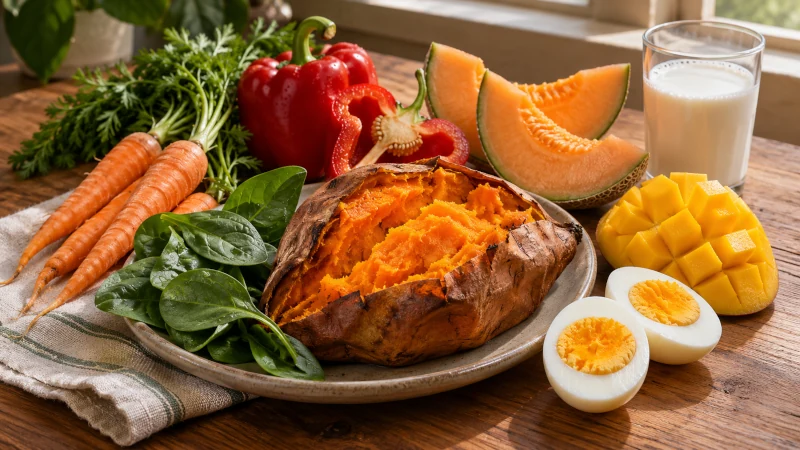
The single richest food is beef liver: one 3-ounce serving has more than seven times the Daily Value. For everyday eating, though, the best sources of vitamin A are orange and dark green plants (one baked sweet potato covers more than a full day), plus fortified milk, eggs, and oily fish [NIH ODS, 2022].
Most people in the United States already get enough. Outright deficiency is rare here, and fewer than 1% of people have low blood levels [NIH ODS, 2022]. So the useful questions are which foods give you the most, how to absorb more from vegetables, and where the real risk of overdoing it lies. That risk comes almost entirely from liver and supplements, not carrots. For the bigger picture on what this vitamin does in the body, see our guide to vitamin A benefits and safe intake.
The best sources of vitamin A, ranked
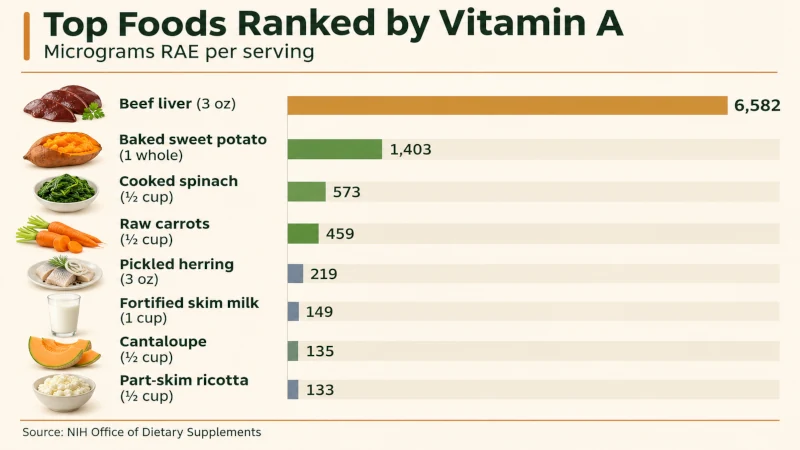
The figures below come from USDA data compiled by the NIH Office of Dietary Supplements. They’re listed in micrograms of retinol activity equivalents (mcg RAE), and the % Daily Value is based on 900 mcg [NIH ODS, 2022].
| Food | Serving | mcg RAE | % DV | Main form |
| Beef liver, pan-fried | 3 oz | 6,582 | 731% | Retinol (animal) |
| Sweet potato, baked in skin | 1 whole | 1,403 | 156% | Beta-carotene (plant) |
| Spinach, frozen, boiled | ½ cup | 573 | 64% | Beta-carotene (plant) |
| Carrots, raw | ½ cup | 459 | 51% | Beta-carotene (plant) |
| Herring, Atlantic, pickled | 3 oz | 219 | 24% | Retinol (animal) |
| Milk, skim, vitamin A added | 1 cup | 149 | 17% | Added retinol |
| Cantaloupe, raw | ½ cup | 135 | 15% | Beta-carotene (plant) |
| Ricotta, part skim | ½ cup | 133 | 15% | Retinol (animal) |
| Red sweet pepper, raw | ½ cup | 117 | 13% | Beta-carotene (plant) |
| Mango, raw | 1 whole | 112 | 12% | Beta-carotene (plant) |
| Breakfast cereal, fortified (10% DV) | 1 serving | 90 | 10% | Added |
| Egg, hard-boiled | 1 large | 75 | 8% | Retinol (animal) |
| Black-eyed peas, boiled | 1 cup | 66 | 7% | Beta-carotene (plant) |
| Apricots, dried, sulfured | 5 apricots | 63 | 7% | Beta-carotene (plant) |
| Broccoli, boiled | ½ cup | 60 | 7% | Beta-carotene (plant) |
| Salmon, sockeye, cooked | 3 oz | 59 | 7% | Retinol (animal) |
Source: NIH Office of Dietary Supplements, Vitamin A and Carotenoids fact sheet. Foods of animal origin also contain small amounts of carotenoids, and vice versa; “main form” is a simplification.
Two things stand out. Liver is in a category of its own. Below it, the top tier is almost all orange or dark green produce. Fish, eggs, and dairy add steady, modest amounts.
Retinol vs. beta-carotene: why the source matters
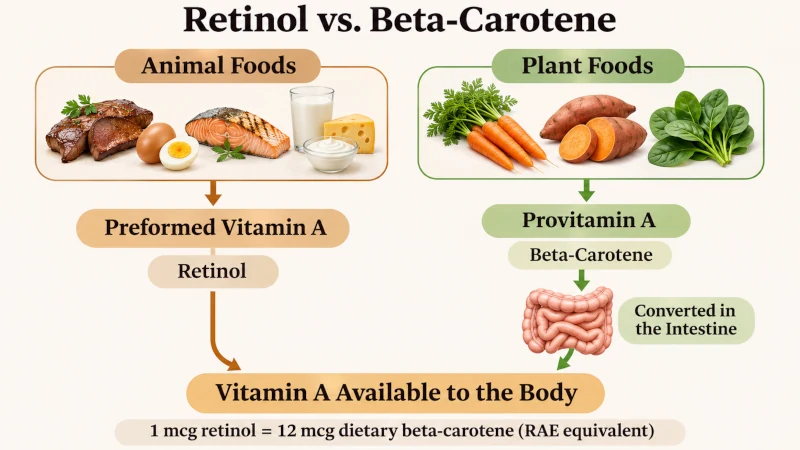
Food gives you vitamin A in two forms. Preformed vitamin A (retinol and retinyl esters) comes from animal foods and most supplements, and your body absorbs roughly 75% to 100% of it. Provitamin A carotenoids (mainly beta-carotene, plus alpha-carotene and beta-cryptoxanthin) are plant pigments your intestine converts into vitamin A. In most cases you absorb only 10% to 30% of the beta-carotene in food [NIH ODS, 2022].
That gap is why nutrition labels now use RAE. One mcg RAE equals 1 mcg of retinol, 12 mcg of beta-carotene from food, or 24 mcg of alpha-carotene or beta-cryptoxanthin. Beta-carotene in supplements converts more efficiently, at 2 mcg per mcg RAE [NIH ODS, 2022]. Some older charts still use a 6-to-1 ratio for beta-carotene, which makes plant foods look about twice as rich as the current U.S. standard says they are.
International units (IU), still common on supplement bottles, are trickier. One IU of retinol equals 0.3 mcg RAE, but one IU of beta-carotene from food equals only 0.05 mcg RAE. You can’t convert IU to RAE accurately unless you know which form is in the product [NIH ODS, 2022].
The good news is that the RAE figures in the table above already account for conversion. When a sweet potato is listed at 1,403 mcg RAE, that’s what your body is expected to get from it, not the raw beta-carotene content.
Animal sources: liver first, then fish, dairy, and eggs
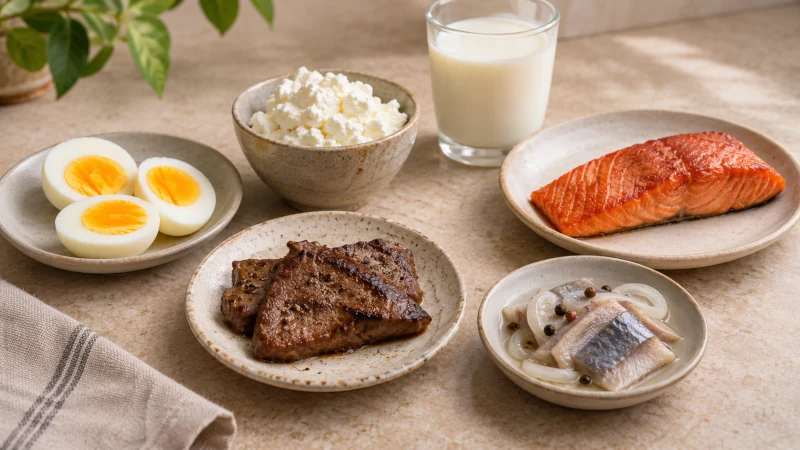
A 3-ounce serving of beef liver has 6,582 mcg RAE. That’s more than twice the 3,000 mcg upper limit for preformed vitamin A in adults, in a single meal [NIH ODS, 2022]. An occasional serving isn’t a problem for most healthy adults, but liver isn’t a food to eat every day. The UK’s NHS advises having liver or liver pâté no more than once a week, and avoiding it entirely during pregnancy [NHS, 2020]. If you do eat it, you’re also getting one of the top foods for vitamin B12.
Everything else on the animal side is gentler. Pickled herring gives about a quarter of the Daily Value per 3 ounces, and salmon, eggs, and ricotta each add 7% to 15%. In the U.S., vitamin A is added to skim milk and many breakfast cereals, which makes them easy everyday contributors [NIH ODS, 2022].
Plant sources: orange, red, and dark green
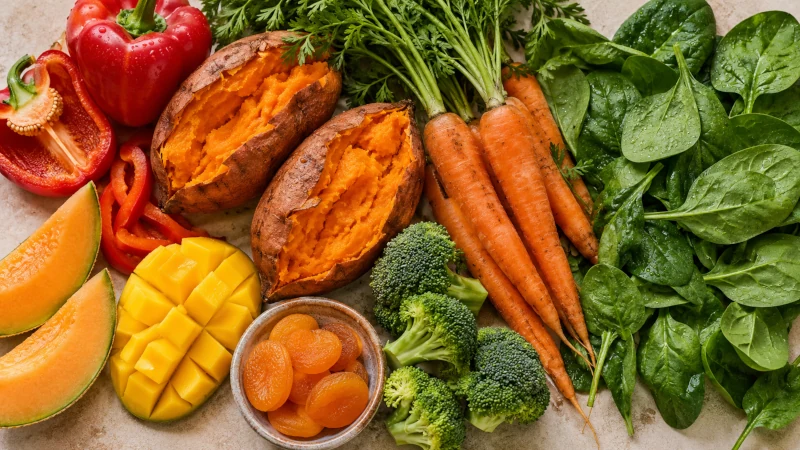
The baked sweet potato is the standout plant food. One whole potato provides 156% of the Daily Value. Half a cup of cooked frozen spinach gives 64%, and half a cup of raw carrots gives 51% [NIH ODS, 2022]. Any of the three, eaten a few times a week, does most of the work.
A second tier of fruits and vegetables supplies 12% to 15% per serving: cantaloupe, mango, and red sweet peppers [NIH ODS, 2022]. Red is the most beta-carotene-rich color of bell pepper. Dried apricots, broccoli, and black-eyed peas each add about 7%.
As a rule of thumb, deep orange flesh and dark green leaves tend to mean more carotenoids. It’s a shortcut, not a guarantee. Leafy greens like spinach also do double duty as one of the best food sources of folate.
Can you get enough on a vegan or vegetarian diet? Yes, if orange and green vegetables show up regularly. Because the RAE values already reflect conversion, one baked sweet potato (1,403 mcg RAE) covers the adult Daily Value of 900 mcg by itself.
How to get more vitamin A out of vegetables
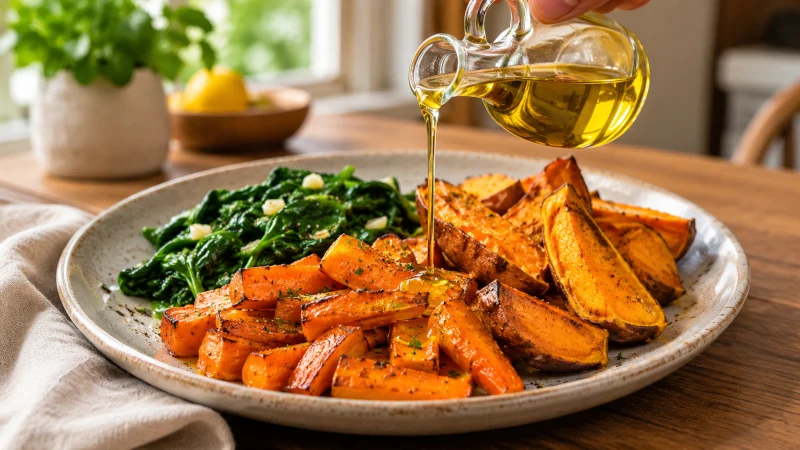
Cook some of them. Cooking and heat treatment can make the beta-carotene in foods more available to your body [NIH ODS, 2022]. Raw carrots are still a good source. Cooked carrots, spinach, and sweet potatoes simply give up their carotenoids more easily.
Eat them with a little fat. Carotenoids are fat-soluble. In one small trial, seven adults ate the same salad of spinach, romaine, carrots, and cherry tomatoes with dressings containing 0, 6, or 28 grams of canola oil. With fat-free dressing, carotenoid absorption was negligible. It rose with the reduced-fat dressing and rose again with the full-fat version [Brown et al., 2004]. The study is tiny, but the practical point is simple: a drizzle of oil, some cheese, or a handful of nuts with your vegetables helps.
How much vitamin A do you need?
These are the U.S. Recommended Dietary Allowances, in mcg RAE per day [NIH ODS, 2022]:
| Age | Male | Female | Pregnancy | Breastfeeding |
| Birth–6 months* | 400 | 400 | – | – |
| 7–12 months* | 500 | 500 | – | – |
| 1–3 years | 300 | 300 | – | – |
| 4–8 years | 400 | 400 | – | – |
| 9–13 years | 600 | 600 | – | – |
| 14–18 years | 900 | 700 | 750 | 1,200 |
| 19–50 years | 900 | 700 | 770 | 1,300 |
| 51+ years | 900 | 700 | – | – |
*Adequate Intake, based on healthy breastfed infants. Source: NIH ODS.
The 900 mcg Daily Value on U.S. food labels is set for adults and children 4 and older [NIH ODS, 2022]. If you read UK sources, you’ll see lower targets: 700 mcg for men and 600 mcg for women aged 19 to 64 [NHS, 2020]. Different expert bodies set slightly different numbers. Either way, a varied diet covers it for most people.
Who is at risk of not getting enough
In the U.S., the groups most likely to run short are preterm infants, people with cystic fibrosis, and people with digestive conditions that interfere with fat absorption, including Crohn’s disease, ulcerative colitis, and newly diagnosed celiac disease [NIH ODS, 2022].
Globally the picture is very different. The World Health Organization counts vitamin A deficiency as a public health problem in more than half of all countries, especially in Africa and South-East Asia. It’s the leading preventable cause of childhood blindness, and an estimated 250,000 to 500,000 deficient children lose their sight each year [WHO, n.d.].
The first sign of deficiency is usually night blindness: trouble seeing in dim light. Without treatment it can progress to xerophthalmia, a drying of the eye’s surface that can cause permanent blindness. Deficiency also makes infections such as measles and diarrhea more severe [NIH ODS, 2022]. Vitamin A is only one of several possible causes of night blindness, so don’t assume it’s the reason.
Can you get too much vitamin A?
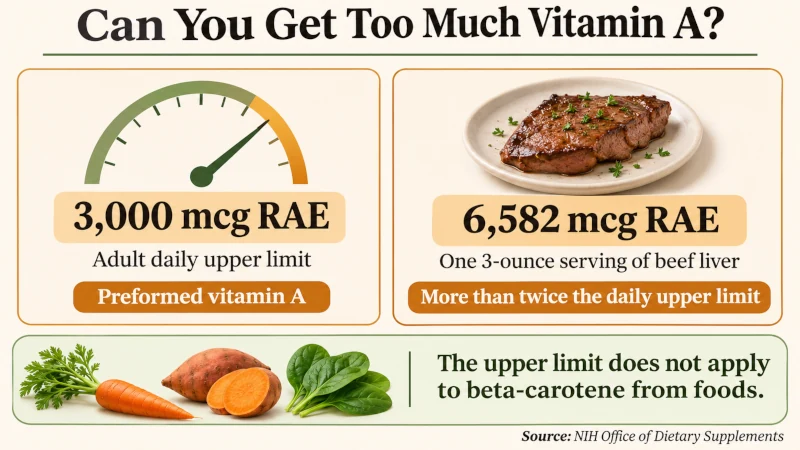
Yes, but almost always from preformed vitamin A, meaning liver, fish liver oils, and supplements. The adult upper limit is 3,000 mcg a day of preformed vitamin A from food and supplements combined. That limit doesn’t apply to beta-carotene and other carotenoids [NIH ODS, 2022].
Regularly taking too much can cause dry skin, painful muscles and joints, fatigue, depression, and abnormal liver tests. Very large single doses, typically more than 100 times the RDA, can cause severe headache, blurred vision, nausea, dizziness, muscle aches, and poor coordination [NIH ODS, 2022].
Bone health is less settled. The NHS notes that some research suggests averaging more than 1,500 mcg a day over many years may affect your bones, particularly in older women already at higher risk of osteoporosis, and it advises keeping your total from food and supplements at or below that level [NHS, 2020]. Treat this as a reasonable precaution based on limited evidence, not a proven threshold.
Beta-carotene from food is a different matter. It isn’t known to cause toxicity or birth defects. Eating a lot of it can turn your skin yellow-orange, a harmless condition called carotenodermia that fades when intake drops [NIH ODS, 2022].
Beta-carotene supplements are a different story
Food and pills don’t behave the same way. In the ATBC study, male smokers who took 20 mg of beta-carotene daily had an 18% higher risk of lung cancer. In the CARET trial, smokers and asbestos-exposed workers who took 30 mg of beta-carotene plus retinyl palmitate had a 28% higher lung cancer risk and 17% higher overall mortality [NIH ODS, 2022]. If you smoke or have been exposed to asbestos, avoid beta-carotene supplements unless a doctor recommends them. The pattern is familiar: large trials of vitamin E supplements also failed to deliver the benefits early studies hinted at.
One supervised use holds up. For people at high risk of advanced age-related macular degeneration (AMD), the original AREDS supplement, which contained beta-carotene along with vitamins C and E, zinc, and copper, lowered the risk of advanced AMD by 25%. The follow-up AREDS2 study found the formula worked just as well without beta-carotene [NIH ODS, 2022]. If you have AMD, talk to your eye doctor before choosing a formula.
Pregnancy and breastfeeding
Your needs go up slightly: 770 mcg a day in pregnancy and 1,300 mcg while breastfeeding for adults. But high doses of preformed vitamin A, and some retinoid medicines, can cause birth defects affecting the eyes, skull, lungs, and heart. Experts advise anyone who is pregnant, might be pregnant, or is breastfeeding not to take more than 3,000 mcg RAE (10,000 IU) a day of preformed vitamin A [NIH ODS, 2022]. The NHS also advises avoiding liver and liver products during pregnancy [NHS, 2020]. Food sources of beta-carotene are fine. Check with your prenatal care provider before adding any supplement that contains vitamin A.
Medication interactions
- Orlistat (Alli, Xenical), a weight-loss drug, reduces absorption of vitamin A, beta-carotene, and other fat-soluble vitamins. The manufacturers recommend a multivitamin [NIH ODS, 2022].
- Oral retinoids such as acitretin and bexarotene raise the risk of vitamin A toxicity if you also take vitamin A supplements [NIH ODS, 2022].
If you take either, ask your pharmacist or prescriber before using a supplement with vitamin A.
When to talk to a healthcare professional
Food is the right first step for most people. Get advice from a doctor, dietitian, or pharmacist if:
- you have trouble seeing in dim light or at night, or your eyes stay dry and irritated
- you have cystic fibrosis, Crohn’s disease, ulcerative colitis, or celiac disease and are wondering about your vitamin A status
- you’re pregnant, planning a pregnancy, or breastfeeding and considering any supplement
- you take orlistat or a retinoid medicine
- you smoke or have had asbestos exposure and are thinking about beta-carotene pills
Get urgent care if someone develops a severe headache, blurred vision, vomiting, dizziness, unusual drowsiness, or confusion after taking a high-dose vitamin A supplement, or if a child swallows adult vitamins. Call Poison Control or emergency services right away.
| HEALTH DISCLAIMER: This article is for general education and isn’t a substitute for advice, diagnosis, or treatment from a qualified healthcare professional. Nutrient needs vary with age, pregnancy, health conditions, and medications. If you’re pregnant, breastfeeding, managing a medical condition, or taking prescription medicine, talk with your doctor or pharmacist before starting a vitamin A or beta-carotene supplement. |
Frequently Asked Questions
What food has the most vitamin A?
Beef liver, by a wide margin: about 6,582 mcg RAE in 3 ounces, or 731% of the Daily Value. Among plant foods, a baked sweet potato leads at 1,403 mcg RAE [NIH ODS, 2022].
Are carrots or sweet potatoes better for vitamin A?
Both are excellent. A whole baked sweet potato provides 156% of the Daily Value; half a cup of raw carrots provides 51% [NIH ODS, 2022]. Cooking either and eating it with a little fat helps you absorb more.
Can vegans get enough vitamin A?
Yes. Plant foods supply beta-carotene, which your body converts as needed. Regular servings of sweet potato, carrots, pumpkin or squash, and cooked leafy greens can cover the daily target on their own.
Does cooking destroy vitamin A in vegetables?
Not in a way that should put you off cooking. Heat can actually make beta-carotene more available to your body [NIH ODS, 2022], so a mix of raw and cooked vegetables works well.
Should I take a vitamin A supplement?
Most people in the U.S. don’t need one, because deficiency is rare [NIH ODS, 2022]. Supplements make sense only for specific medical reasons, and preformed vitamin A above 3,000 mcg a day carries real risks, especially in pregnancy.
References
- National Institutes of Health, Office of Dietary Supplements. Vitamin A and Carotenoids: Fact Sheet for Health Professionals. View source
- NHS. Vitamins and minerals: Vitamin A. View source
- World Health Organization. Vitamin A deficiency. Nutrition Landscape Information System. View source
- Brown MJ, Ferruzzi MG, Nguyen ML, Cooper DA, Eldridge AL, Schwartz SJ, White WS. Carotenoid bioavailability is higher from salads ingested with full-fat than with fat-reduced salad dressings as measured with electrochemical detection. View source
- Background (not cited in body): WHO/UNICEF. Global prevalence of vitamin A deficiency. View source


