
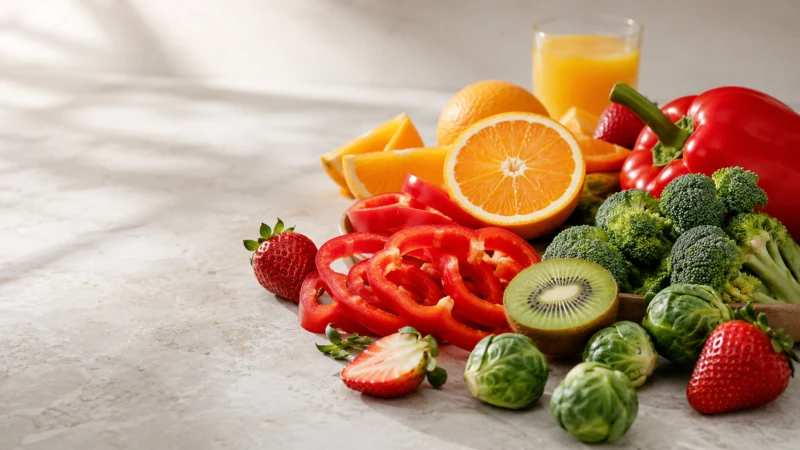
Vitamin C does a handful of essential jobs — it builds collagen, helps your immune cells work, protects cells as an antioxidant, and pulls more iron out of plant foods — and most people in the US get enough of it from food without much effort [NIH Office of Dietary Supplements, 2025]. It also can’t do many of the dramatic things it’s often credited with. It won’t cure disease, it won’t stop a cold once one starts, and taking huge amounts doesn’t buy you extra health. Here’s what vitamin C is actually good for, how much you need, where to get it, and where the popular claims run ahead of the science.
What vitamin C does in your body
Vitamin C (ascorbic acid) is water-soluble, which means your body doesn’t store much of it and you need a steady supply. Unlike most animals, humans can’t make their own, so it has to come from food or supplements [NIH, 2025].
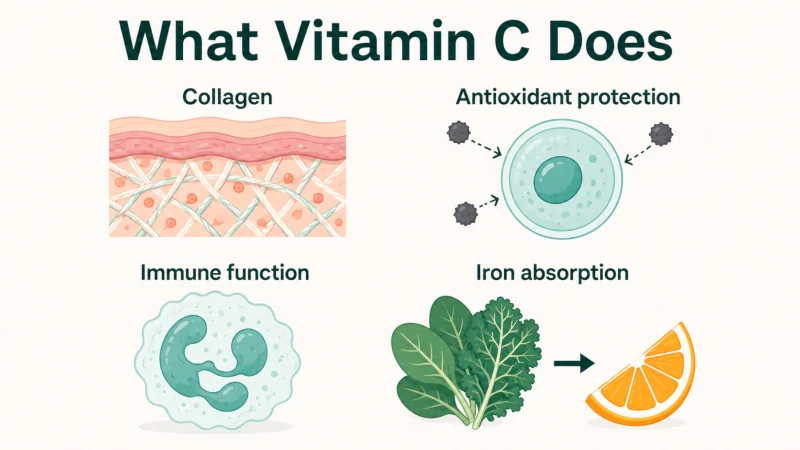
Its best-established roles are specific and worth knowing:
- Collagen production. Vitamin C is required to build collagen, the protein that holds skin, blood vessels, tendons, and other connective tissue together and lets wounds heal. This is the job whose absence causes scurvy.
- Antioxidant protection. It neutralizes free radicals and even helps regenerate another antioxidant, vitamin E, back into its active form.
- Immune function. Your white blood cells concentrate vitamin C well above blood levels and rely on it to work normally.
- Iron absorption. It markedly improves how much non-heme iron (the kind in plants) you absorb — a squeeze of lemon on spinach genuinely helps.
It’s also involved in making L-carnitine and certain neurotransmitters [NIH, 2025]. These are real, physiological functions — which is different from saying more vitamin C makes an already-healthy body function above its baseline.
How much vitamin C you actually need
For most adults the target is modest, and it’s easy to hit through diet.
| Group | Recommended amount (per day) |
| Men, 19+ | 90 mg |
| Women, 19+ | 75 mg |
| Pregnancy | 85 mg |
| Breastfeeding | 120 mg |
| Teens 14–18 (M / F) | 75 mg / 65 mg |
| Children 9–13 | 45 mg |
| Children 4–8 | 25 mg |
| Children 1–3 | 15 mg |
| Upper limit, adults | 2,000 mg |
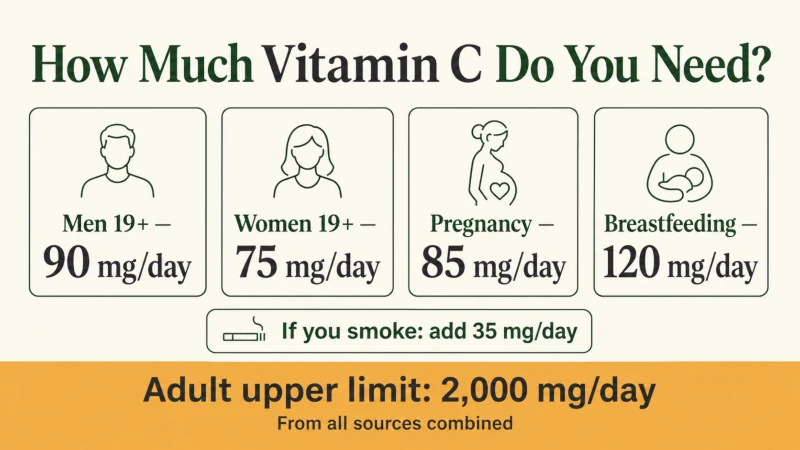
Source: NIH Office of Dietary Supplements, 2025.
Two numbers matter most here. The first is how little you need: 75–90 mg is roughly one orange plus half a cup of red pepper. The second is the ceiling. The tolerable upper intake level for adults is 2,000 mg a day, and going past it mainly buys you diarrhea and stomach upset rather than benefit [NIH, 2025]. Your body also actively limits what it keeps: above about 1 gram a day, absorption drops below 50% and the excess is simply flushed out in urine. That’s the honest answer to the old “you can never take too much” idea — you can, and your kidneys spend the difference.
Do you need more if you smoke, or are pregnant?
If you smoke, yes — add 35 mg a day, because smoking depletes vitamin C through oxidative stress. Regular exposure to secondhand smoke lowers levels too, so those individuals should at least meet the standard amount [NIH, 2025]. Pregnancy and breastfeeding raise the target modestly (85 mg and 120 mg), and that’s easily met with food.
The best food sources of vitamin C
You don’t need exotic foods. Common produce covers it, and several everyday options beat an orange.
| Food | Vitamin C per serving |
| Red bell pepper, raw, ½ cup | 95 mg |
| Orange juice, ¾ cup | 93 mg |
| Orange, 1 medium | 70 mg |
| Kiwifruit, 1 medium | 64 mg |
| Green bell pepper, raw, ½ cup | 60 mg |
| Broccoli, cooked, ½ cup | 51 mg |
| Strawberries, sliced, ½ cup | 49 mg |
| Brussels sprouts, cooked, ½ cup | 48 mg |
| Tomato juice, ¾ cup | 33 mg |
| Cantaloupe, ½ cup | 29 mg |
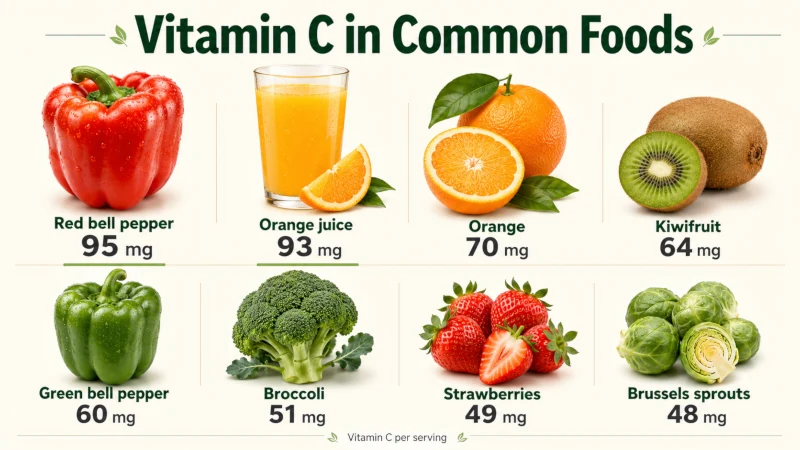
Source: NIH Office of Dietary Supplements, 2025.
Five varied servings of fruits and vegetables a day supply well over 200 mg — more than most people need [NIH, 2025]. A few tropical fruits go much further: a single guava carries more than twice the daily target, and acerola cherries are higher still. For a wider list of options, see our guide to vitamin C–rich foods.
One practical caveat: vitamin C is fragile. Heat, water, and long storage break it down, so ascorbic acid leaches into cooking water and degrades over time [NIH, 2025]. Eating some produce raw, steaming or microwaving instead of boiling, and not letting cut fruit sit for days all help preserve it.
Vitamin C and colds: what the strongest research shows
This is the question most people actually came for, and the answer is nuanced rather than magical. The best evidence is a Cochrane review that pooled placebo-controlled trials in more than 11,000 people [Cochrane review, Hemilä & Chalker, 2013].
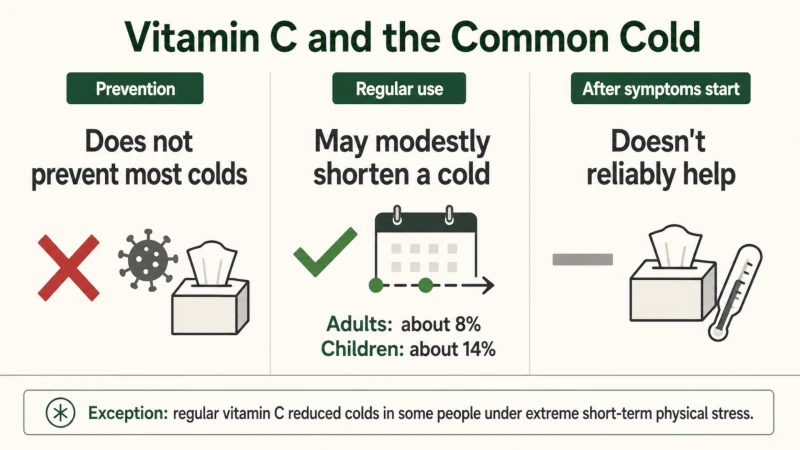
Three findings stand out:
- It doesn’t prevent colds for most people. Taking vitamin C every day did not reduce how often ordinary people caught colds.
- It slightly shortens colds — but only if you were already taking it. Regular supplementation of at least 200 mg a day trimmed cold duration by about 8% in adults and 14% in children. On a week-long cold, that’s roughly half a day for an adult.
- Starting it once you’re sick doesn’t help. When people began vitamin C after symptoms appeared, it didn’t reliably shorten the cold or ease symptoms.
There’s one genuine exception. In people under intense short-term physical stress — marathon runners, skiers, and soldiers training in extreme cold — regular vitamin C cut the incidence of colds roughly in half [Cochrane, 2013]. For everyday life, that doesn’t apply.
So the reactive “megadose at the first sniffle” habit isn’t supported. If you want the modest duration benefit, it comes from steady, ongoing intake — which is one more reason a food-first approach makes sense. Our deeper look at what vitamin C really does for immunity walks through the immune-cell biology in more detail.
Vitamin C and disease: separating the strong evidence from the hype
Vitamin C has been studied for a long list of conditions. For most of them, the honest verdict is “associated with, but not proven to prevent or treat.”
Cancer
People who eat more vitamin C–rich fruits and vegetables tend to have lower rates of several cancers — but that may reflect the whole diet, not vitamin C specifically. Most randomized trials of vitamin C supplements, alone or with other antioxidants, have not reduced cancer risk [NIH, 2025]. Separately, high-dose intravenous vitamin C reaches blood concentrations that oral pills can’t and is being investigated as an experimental cancer therapy, but that’s a clinical, physician-administered setting — not a case for swallowing large doses at home. If you’re in cancer treatment, don’t add high-dose vitamin C or other antioxidant supplements without talking to your oncologist, because of a possible interaction with chemotherapy and radiation.
Heart disease
Diets rich in fruits and vegetables track with lower cardiovascular risk, but studies isolating vitamin C are conflicting, and most supplement trials have not shown a protective effect against heart disease [NIH, 2025]. Vitamin C is a reasonable part of a heart-healthy diet; it isn’t a substitute for the things that clearly help.
Eye health (cataracts and AMD)
The current evidence doesn’t show that vitamin C, taken alone or with other antioxidants, prevents cataracts or age-related macular degeneration (AMD) [NIH, 2025]. There’s one specific, real exception: in people who already have intermediate or advanced AMD, a particular high-dose antioxidant combination (the AREDS formula, which includes vitamin C along with vitamin E, zinc, copper, and others) slowed progression to advanced disease. That’s a benefit of a specific formula for a specific group under medical guidance, not a reason for the general public to megadose vitamin C for their eyes.
Choosing a vitamin C supplement (if you need one)
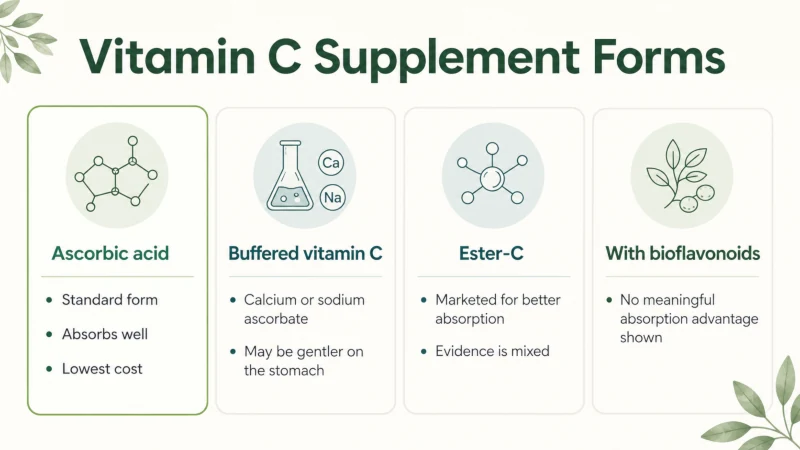
Most people who eat produce don’t need a supplement. If you do take one, the science here is refreshingly simple.
Plain ascorbic acid is the most common form, and its absorption is equivalent to the vitamin C in food [NIH, 2025]. It’s also the cheapest. Buffered forms (mineral ascorbates such as sodium or calcium ascorbate) are gentler on the stomach for some people. Ester-C is marketed as better absorbed; the small human studies are mixed — one found higher levels inside white blood cells, another found no meaningful difference — and researchers concluded that ordinary ascorbic acid is the sensible default given its low cost.
What about bioflavonoids? They’re plant compounds that naturally travel with vitamin C in fruit, and supplements often pair them together. When researchers compared ascorbic acid with and without added bioflavonoids, they didn’t find a meaningful absorption advantage at the levels typically used [NIH, 2025]. They’re not harmful, but you don’t need to pay extra for them. And whatever the label promises, a supplement can’t replicate the full mix of fiber, potassium, and other compounds you get from eating the actual fruit.
Vitamin C deficiency and scurvy
True deficiency is uncommon in the US but not extinct. Scurvy can begin within about a month of getting less than roughly 10 mg a day [NIH, 2025].
Early signs are easy to miss — fatigue, general malaise, and irritated gums. As it progresses, impaired collagen shows up as easy bruising, tiny skin hemorrhages (petechiae), swollen and bleeding gums, loose teeth, poor wound healing, joint pain, and a distinctive “corkscrew” body hair. Depression and iron-deficiency anemia can follow, and untreated scurvy is ultimately fatal [NIH, 2025].
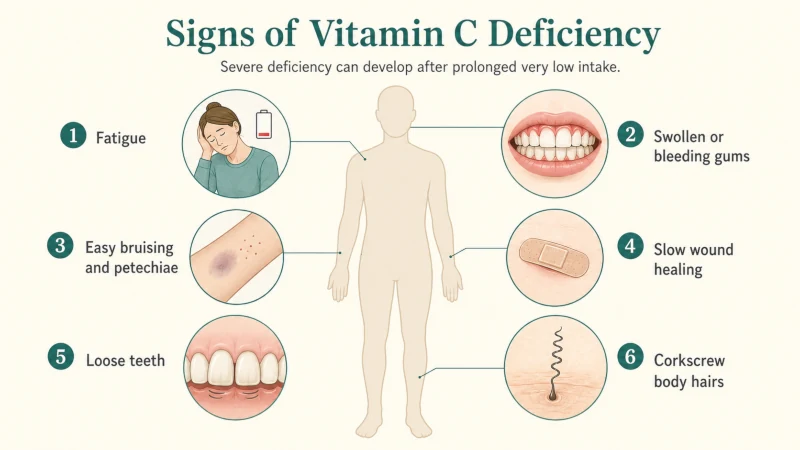
Some people are at higher risk and worth flagging: people who smoke, anyone eating a very limited diet (including some older adults, people struggling with alcohol or drug use, and people with serious mental illness), those with intestinal malabsorption, and people on long-term dialysis [NIH, 2025]. The historical lesson still holds — a British naval surgeon, James Lind, showed in the mid-1700s that citrus cured scurvy long before anyone had isolated the vitamin.
Safety, side effects, and who should be careful
Vitamin C is genuinely low in toxicity, which is why the old “harmless in any amount” framing caught on. But low toxicity isn’t zero, and a few groups need real caution.
- Common side effects. The usual complaints come from large doses: diarrhea, nausea, and stomach cramps, caused by unabsorbed vitamin C drawing water into the gut. Staying under the 2,000 mg/day upper limit — counting supplements, multivitamins, and fortified foods together — avoids most of this.
- Kidney stones. Vitamin C from food isn’t linked to stones, but the evidence on supplements is mixed and the clearest risk is in people who already form stones. Large cohort studies have linked high-dose supplements (around 1,000 mg a day or more) to a higher risk of stones in men — not from diet, and not clearly in women. If you’ve had calcium-oxalate stones, keep supplemental vitamin C modest and talk to your doctor.
- Iron-overload conditions. Because vitamin C boosts iron absorption, people with hereditary hemochromatosis can worsen iron overload with high doses.
- G6PD deficiency. In this inherited condition, very high doses — especially intravenous or gram-level amounts — have triggered red-blood-cell breakdown (hemolysis) in case reports. People with G6PD deficiency should avoid high-dose vitamin C unless a doctor is directing it.
- Medication interactions. Beyond chemotherapy and radiation, vitamin C combined with other antioxidants may blunt the HDL-cholesterol benefit of certain niacin-plus-statin regimens. If you take blood thinners or any regular medication, run high-dose vitamin C past your pharmacist or doctor first.
- Pregnancy and breastfeeding. Meeting the recommended amounts (85 mg in pregnancy, 120 mg while breastfeeding) is appropriate and easily done with food. High-dose supplements haven’t been well studied in pregnancy or breastfeeding — stick to recommended intakes unless your obstetric provider advises otherwise.
For the kidney-stone and G6PD points, see [NIH, 2025], [Am J Kidney Dis, 2016], and [Vitamin C–induced hemolysis review, 2022].
When to see a doctor
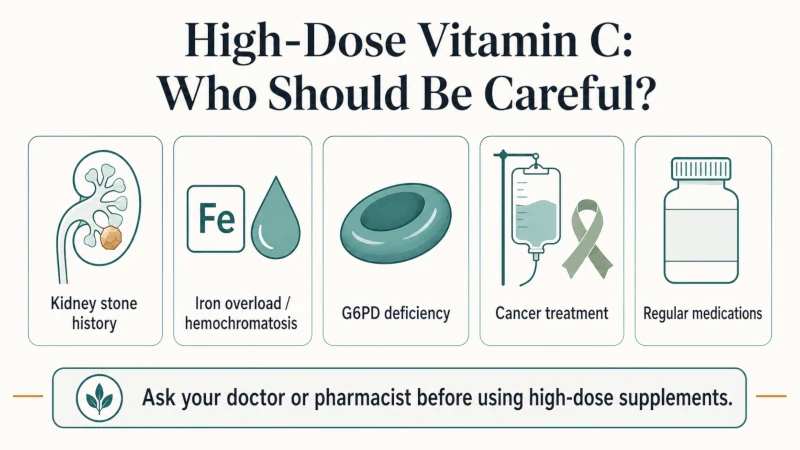
Vitamin C is nutrition, not treatment. Reach out to a professional rather than relying on a supplement if you have symptoms that could signal deficiency (unexplained easy bruising, bleeding gums, poor wound healing, persistent fatigue), or if you’re weighing high-dose vitamin C while managing kidney stones, hemochromatosis, G6PD deficiency, cancer treatment, or any chronic condition. And treat a cold like a cold: get medical care for a fever above 103°F (39.4°C), symptoms lasting beyond about 10 days or clearly worsening after starting to improve, trouble breathing, or chest pain — those aren’t jobs for vitamin C.
| HEALTH DISCLAIMER: This article is for general education only and is not medical advice. It is not intended to diagnose, treat, cure, or prevent any disease. Vitamin C can interact with certain health conditions and medications, and individual needs vary. Talk with a qualified healthcare professional — such as your doctor, a registered dietitian, or a pharmacist — before starting, stopping, or changing any supplement, especially if you are pregnant or breastfeeding, taking medication, or managing a health condition. If you think you may have a medical emergency, call 911 or go to the nearest emergency room. |
Frequently Asked Questions
How much vitamin C should I take per day?
For adults, 90 mg a day for men and 75 mg for women covers your needs, rising to 85 mg in pregnancy and 120 mg while breastfeeding; people who smoke should add 35 mg. Most people reach this through food. The upper limit for adults is 2,000 mg a day from all sources combined [NIH, 2025].
Does vitamin C prevent or cure colds?
It doesn’t prevent colds in the general population, and starting it after symptoms begin doesn’t reliably help. Taking at least 200 mg a day regularly, before you get sick, modestly shortens colds — about 8% in adults and 14% in children [Cochrane, 2013].
Can you take too much vitamin C?
Yes. Above roughly 1 gram a day your body absorbs a smaller fraction and excretes the rest, and doses near or above the 2,000 mg upper limit commonly cause diarrhea and stomach upset [NIH, 2025].
Is Ester-C or buffered vitamin C better than regular ascorbic acid?
For most people, no. Plain ascorbic acid absorbs as well as the vitamin C in food and costs the least. Buffered forms may be gentler on the stomach, and the evidence that Ester-C is meaningfully better is mixed [NIH, 2025].
Does vitamin C cause kidney stones?
Vitamin C from food isn’t linked to stones. The evidence on supplements is mixed, but high doses (about 1,000 mg a day or more) have been associated with a higher risk of stones in men and are a particular concern for people who already form stones [NIH, 2025]; [Am J Kidney Dis, 2016].
Who should avoid high-dose vitamin C?
People with a history of calcium-oxalate kidney stones, hereditary hemochromatosis, or G6PD deficiency, and anyone undergoing chemotherapy or radiation, should avoid high doses unless a doctor is directing it [NIH, 2025]; [hemolysis review, 2022].
References
- National Institutes of Health, Office of Dietary Supplements. Vitamin C: Fact Sheet for Health Professionals. Updated July 31, 2025. View source
- NIH Office of Dietary Supplements. Vitamin C: Fact Sheet for Consumers. View source
- Hemilä H, Chalker E. Vitamin C for preventing and treating the common cold. Cochrane Database of Systematic Reviews, 2013, Issue 1. Art. No.: CD000980. DOI: 10.1002/14651858.CD000980.pub4. View source
- Total, Dietary, and Supplemental Vitamin C Intake and Risk of Incident Kidney Stones. American Journal of Kidney Diseases, 2016. View source
- Vitamin C–induced Hemolysis: Meta-summary and Review of Literature. Indian Journal of Critical Care Medicine, 2022. View source
