
If you want more folate from food, build your plate around four things: legumes (lentils, chickpeas, black-eyed peas), dark leafy greens like spinach, a handful of specific vegetables such as asparagus and Brussels sprouts, and fortified grains. That short list covers most of the best foods high in folate, and a varied diet built around them is enough for most people to hit their daily target without thinking too hard about it [NIH ODS, 2022].
Before the food chart, one piece of vocabulary clears up most of the confusion online — including the mix-up in a lot of folate articles.
Folate vs. folic acid vs. vitamin B9 — what the words actually mean
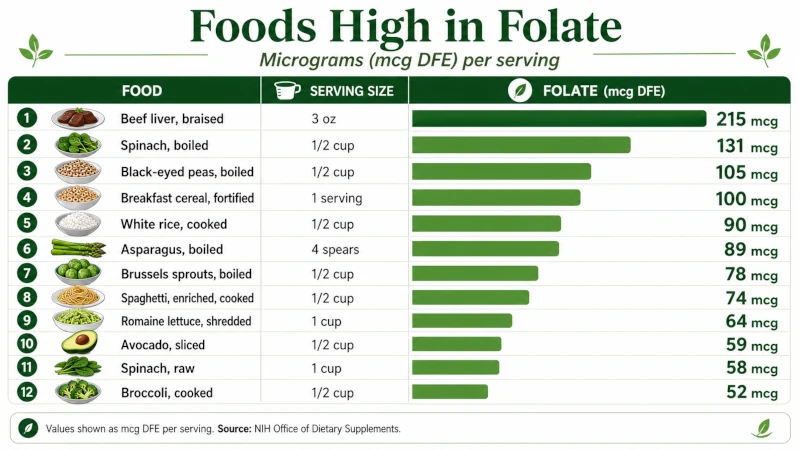
These get used interchangeably, but they aren’t quite the same thing.
Folate is the umbrella term for this B vitamin in all its natural forms — the kind found in beans, greens, and other whole foods. Folic acid is the synthetic form, the one added to fortified foods and used in most supplements. Vitamin B9 is an informal name for the same vitamin; “folacin” is an older one you’ll still see in print [NIH ODS, 2022].
The distinction matters for one practical reason: your body absorbs folic acid more efficiently than the folate in food. Because of that gap, intake is measured in dietary folate equivalents (DFE) rather than raw micrograms. Roughly, 240 mcg of folic acid delivers the same usable amount as 400 mcg of food folate — both count as 400 mcg DFE [NIH ODS, 2022]. You don’t need to do this math at the dinner table, but it’s why supplement labels and food values don’t line up one-to-one.
The best foods high in folate
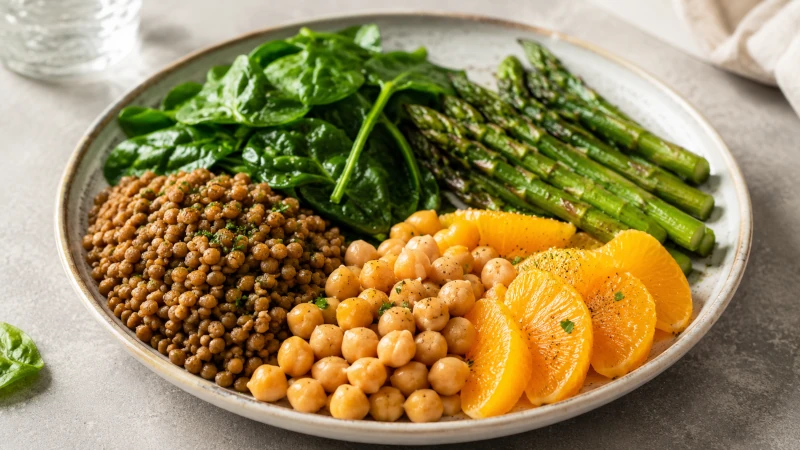
Here are strong sources with approximate amounts per serving, drawn from NIH and USDA reference data. Treat the numbers as ballpark — actual content varies with growing conditions, storage, and cooking.
| Food | Serving | Approx. folate (mcg DFE) |
| Beef liver, braised | 3 oz | 215 |
| Lentils, cooked | ½ cup | ~180 |
| Chickpeas, cooked | ½ cup | ~140 |
| Spinach, boiled | ½ cup | 130 |
| Black-eyed peas, boiled | ½ cup | 105 |
| Fortified breakfast cereal | 1 serving | 100–400* |
| Asparagus, boiled | 4 spears | 90 |
| Rice, white, enriched, cooked | ½ cup | 90 |
| Spaghetti, enriched, cooked | ½ cup | 85 |
| Brussels sprouts, boiled | ½ cup | 80 |
| Romaine lettuce, shredded | 1 cup | 65 |
| Avocado | ½ cup | 60 |
| Broccoli, cooked | ½ cup | 50 |
| Orange | 1 small | 30 |
*Fortified cereals vary widely; check the Nutrition Facts label, where folic acid is listed by name [NIH ODS, 2022].
Plant sources you’ll actually eat
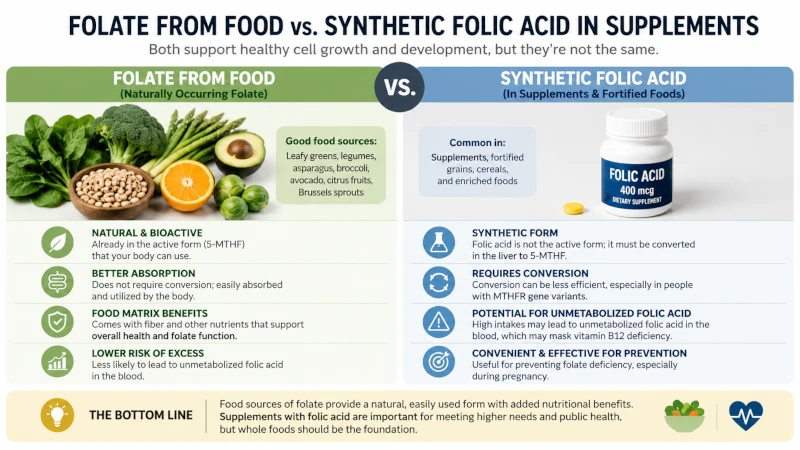
Legumes do the heaviest lifting. Lentils, chickpeas, black beans, and black-eyed peas are among the densest plant sources, and they bring fiber and plant protein along with the folate — which is part of why lentils as an iron- and fiber-rich staple. Dark leafy greens come next: spinach is a standout for folate and other nutrients, along with romaine, mustard greens, and collards. Then a cluster of specific vegetables — asparagus, Brussels sprouts, broccoli — and a few fruits, with oranges and orange juice leading the fruit category. chickpeas are another easy, versatile way to add folate to soups, salads, and grain bowls.
Beef liver tops the list by a wide margin, but most people aren’t eating it regularly, so the plant sources and fortified foods carry the day for the majority of diets.
Fortified foods (where folic acid hides)
Since 1998, the U.S. has required folic acid to be added to enriched bread, flour, cornmeal, pasta, and rice, and in 2016 the FDA allowed it in corn masa flour used for tortillas and tamales [NIH ODS, 2022]. If you eat standard grain products, you’re already getting folic acid whether you think about it or not. That fortification program is the main reason folate deficiency is now rare in the U.S. [NIH ODS, 2022].
What folate does in your body
Folate is a workhorse, not a specialist. Your body uses it to build and repair DNA, and to let cells divide — which is why demand climbs during any period of rapid growth, including infancy and pregnancy [NIH ODS, 2022]. It’s also needed to form healthy red blood cells, and it helps convert homocysteine, an amino acid, into methionine [NIH ODS, 2022].
When folate runs short, the clearest consequence is a specific kind of anemia, covered below.
How much folate do you need?
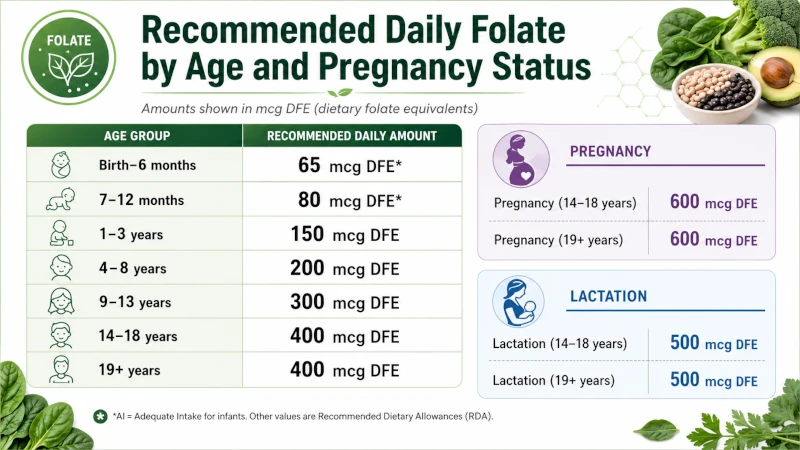
The amounts below are the recommended daily intakes, in mcg DFE [NIH ODS, 2022].
| Life stage | Recommended amount (mcg DFE) |
| Birth–6 months | 65 |
| 7–12 months | 80 |
| 1–3 years | 150 |
| 4–8 years | 200 |
| 9–13 years | 300 |
| 14–18 years | 400 |
| Adults 19+ | 400 |
| Pregnant | 600 |
| Breastfeeding | 500 |
Most adults in the U.S. meet the 400 mcg target through everyday food and fortified grains [NIH ODS, 2022]. Pregnancy is the stage where the number jumps and the source matters, which is its own section below.
Cooking and storage: how much folate survives
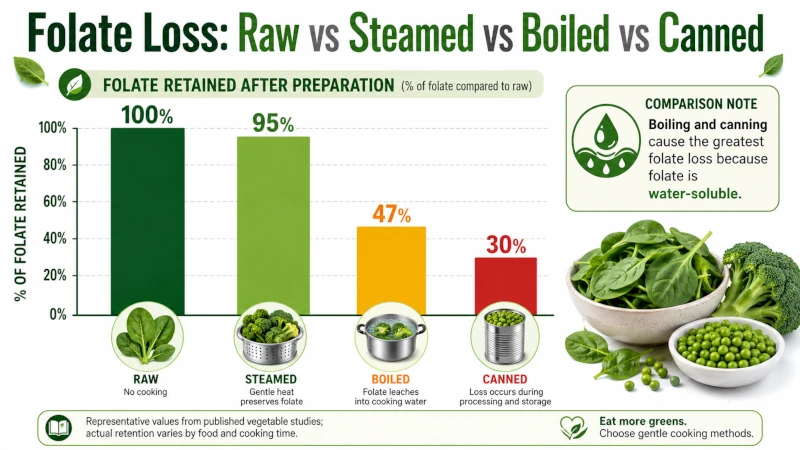
Folate is fragile. It breaks down with heat, light, and time, so how you store and cook food affects how much actually reaches your plate. Prolonged boiling and canning cause the largest losses, and folate leaches into cooking water. Refrigeration slows the decline; steaming, microwaving, or eating some sources raw preserves more than long boiling does. The practical takeaway: don’t drown your greens, and don’t let folate-rich produce sit at room temperature for days.
Who’s most likely to run low
Deficiency is uncommon, but some groups are more exposed [NIH ODS, 2022]:
- People with alcohol use disorder — alcohol interferes with folate absorption and use.
- People with conditions that impair absorption, such as celiac disease or inflammatory bowel disease.
- People taking certain medications, including some antiseizure drugs and the chemotherapy/immune drug methotrexate, which acts against folate.
- Teen girls and women of reproductive age, and non-Hispanic Black women, who are statistically more likely to fall short.
- People with an MTHFR gene variant, whose bodies process folate slightly differently.
Signs of folate deficiency — and when to see a doctor
Too little folate over time can cause megaloblastic anemia, where red blood cells are larger and fewer than normal. It tends to show up as fatigue, weakness, trouble concentrating, irritability, headache, heart palpitations, and shortness of breath. Mouth and tongue soreness or open sores, and changes in skin, hair, or nail color, can also appear [NIH ODS, 2022].
See a healthcare professional rather than self-treating if you have persistent fatigue, shortness of breath, or palpitations — these have many possible causes, and anemia needs to be diagnosed with a blood test, not guessed at. Seek prompt care for severe shortness of breath, chest pain, fainting, or a racing heartbeat. And before starting a folic acid supplement, it’s worth a conversation with your clinician, for a reason explained in the supplements section.
Folate and pregnancy: the one place the dose really matters
This is where folate goes from “eat your vegetables” to a specific medical recommendation. Adequate folic acid before and during early pregnancy substantially lowers the risk of neural tube defects — serious birth defects of the brain (anencephaly) and spine (spina bifida) [CDC, 2025].
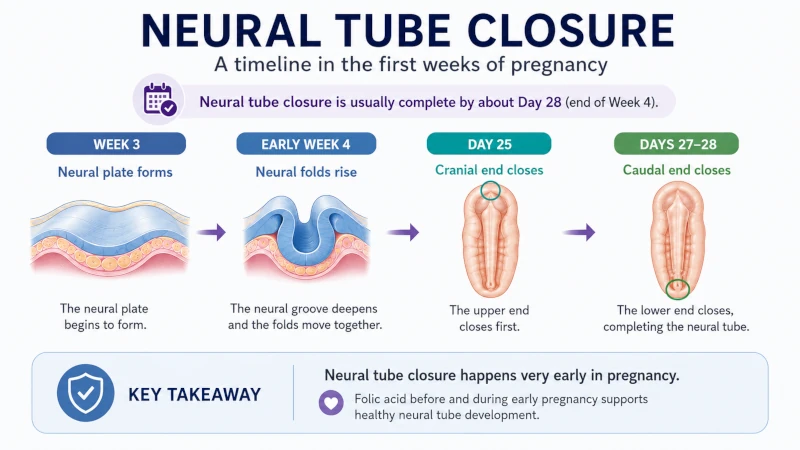
The recommendation from the CDC, the U.S. Preventive Services Task Force, and other expert bodies is consistent: anyone capable of becoming pregnant should get 400 mcg of folic acid daily from supplements, fortified foods, or both, on top of the folate they eat [CDC, 2025]; [USPSTF, 2023]. The timing is the catch — the neural tube closes in the first weeks of pregnancy, often before someone knows they’re pregnant, which is why the advice applies to all women who could become pregnant, not only those actively trying [CDC, 2025].
Two specifics worth knowing. First, food folate alone is hard to rely on here, and folic acid is the form with the actual evidence behind neural-tube-defect prevention — so this is the one situation where a supplement or fortified food is recommended rather than optional, even for people with an MTHFR variant [NIH ODS, 2022]. Second, anyone who has had a previous pregnancy affected by a neural tube defect may be advised to take a much higher dose (around 4,000 mcg), but only under a doctor’s supervision — this is not a do-it-yourself decision [CDC, 2025].
What folate does and doesn’t do for heart disease and cancer
Here the honest answer is more useful than the optimistic one.
Heart disease. Folic acid reliably lowers homocysteine, and high homocysteine is associated with cardiovascular disease. It’s tempting to connect those dots — but large randomized trials have not shown that folic acid supplements directly reduce heart-disease risk [NIH ODS, 2022]. A meta-analysis of 30 trials with more than 82,000 participants found no significant effect on coronary heart disease, and only a modest reduction in stroke risk, concentrated in people without prior cardiovascular disease and in places without folic-acid food fortification [JAHA, 2016]. So: helpful for homocysteine, promising for stroke in specific groups, not an established heart-disease preventive. Don’t take folic acid as a heart drug.
Cancer. The relationship runs in two directions, which is why blanket claims mislead. Folate naturally present in food is associated with lower risk of several cancers. But high-dose folic acid supplements taken after precancerous changes have already started — particularly in the colon — may speed progression rather than prevent it [NIH ODS, 2022]. This is a strong reason not to megadose folic acid on your own, especially with any history of colorectal polyps.
The throughline: getting folate from a varied diet is well supported and low-risk. Treating high-dose folic acid as a cure-all is neither.
Folate supplements: forms, the upper limit, and the B12 trap
Most people who eat a reasonably varied diet don’t need a folate supplement. The clear exceptions are pregnancy (and planning for it), a diagnosed deficiency, or a malabsorption condition — situations where a clinician guides the decision.
If you do supplement, three things matter:
The upper limit. For adults, the ceiling for folic acid from supplements and fortified foods is 1,000 mcg per day (lower for children) [NIH ODS, 2022]. Food folate has no upper limit — you can’t overdo it from beans and greens.
The vitamin B12 trap. This is the most important safety point. High doses of folic acid can correct the anemia caused by a vitamin B12 deficiency while the underlying nerve damage keeps progressing silently — and that nerve damage can become permanent [NIH ODS, 2022]. The risk concentrates in older adults, who are more prone to low B12. (At the standard recommended 400 mcg, the CDC notes this masking isn’t a practical concern — the issue is high-dose supplementation [CDC, 2025].) If you’re considering folic acid and might be low in B12, that’s a conversation to have with a clinician, and it’s worth knowing which foods supply vitamin B12.
Drug interactions. Folate can interact with methotrexate, several antiseizure medications (phenytoin, carbamazepine, valproate), and sulfasalazine — in both directions, sometimes lowering the drug’s level and sometimes the folate’s [NIH ODS, 2022]. Tell your prescriber about any supplement you’re taking.
For most readers, the better move than a pill is simply eating more of the foods at the top of this page — ideally as part of an overall heart-healthy eating pattern that’s rich in vegetables and legumes anyway.
Daily upper limits for folic acid (supplements + fortified foods)
| Age | Upper limit |
| Birth–12 months | Not established |
| 1–3 years | 300 mcg |
| 4–8 years | 400 mcg |
| 9–13 years | 600 mcg |
| 14–18 years | 800 mcg |
| Adults 19+ | 1,000 mcg |
A note on safety
| Health disclaimer This article is for general education and is not a substitute for personalized medical advice, diagnosis, or treatment. Folate needs, supplement decisions, and drug interactions vary from person to person. If you are pregnant, nursing, planning a pregnancy, taking medication, or managing a health condition, talk with a qualified healthcare professional before changing your diet or starting any supplement. Seek prompt medical care for symptoms such as severe shortness of breath, chest pain, fainting, or a rapid heartbeat. |
Frequently Asked Questions
What food has the most folate?
By amount per serving, beef liver is highest (around 215 mcg in 3 ounces). Among foods people eat more often, lentils, spinach, chickpeas, black-eyed peas, asparagus, and fortified grains are the strongest sources [NIH ODS, 2022].
Is folate the same as folic acid?
Not exactly. Folate is the natural form in food; folic acid is the synthetic form in supplements and fortified foods. Folic acid is absorbed more efficiently, which is why intake is measured in dietary folate equivalents [NIH ODS, 2022].
How much folate do I need during pregnancy?
The recommended intake in pregnancy is 600 mcg DFE per day, and anyone who could become pregnant is advised to get 400 mcg of folic acid daily from supplements or fortified foods before and during early pregnancy to help prevent neural tube defects [CDC, 2025]; [NIH ODS, 2022].
Can you get too much folate?
Not from food. From supplements and fortified foods, the adult upper limit is 1,000 mcg per day. Going higher can mask a vitamin B12 deficiency and may carry other risks, so stay under the limit unless a clinician advises otherwise [NIH ODS, 2022].
Does cooking destroy folate?
A lot of it, yes. Folate is sensitive to heat, light, and water, and long boiling and canning cause the biggest losses. Steaming, microwaving, eating some sources raw, and refrigerating produce help preserve more.
Does folate prevent heart disease?
It lowers homocysteine, but trials haven’t shown that folic acid supplements directly reduce heart-disease risk. There’s a modest stroke benefit in some groups. Eating folate-rich foods is worthwhile; taking folic acid specifically to protect your heart isn’t supported [NIH ODS, 2022]; [JAHA, 2016].
References
- National Institutes of Health, Office of Dietary Supplements. Folate — Fact Sheet for Consumers (updated 2022) and Health Professional Fact Sheet. View source
- Centers for Disease Control and Prevention. Folic Acid (About; Safety, Interactions, and Health Outcomes; Recommendations). View source
- U.S. Preventive Services Task Force. Folic Acid Supplementation to Prevent Neural Tube Defects (2023). View source
- Folic Acid Supplementation and the Risk of Cardiovascular Diseases: A Meta-Analysis of Randomized Controlled Trials. Journal of the American Heart Association, 2016. DOI: 10.1161/JAHA.116.003768. View source
- U.S. Department of Agriculture. FoodData Central. View source
- Harvard T.H. Chan School of Public Health, The Nutrition Source. Folate (Folic Acid). View source
