
Some supplements can lower LDL cholesterol or triglycerides on a lab report. That does not make them a substitute for proven cholesterol treatment. The 2026 ACC/AHA dyslipidemia guideline says dietary supplements are not recommended as a strategy to lower LDL-C or triglycerides because the benefits are limited or inconsistent and there is little evidence that they reduce cardiovascular events. The American Heart Association’s cholesterol guidance gives the same practical message.
If you still want to know which supplements help lower cholesterol, there is a useful evidence hierarchy. Psyllium and plant sterols have the most consistent data for modest LDL reductions. Red yeast rice can lower LDL more substantially when it contains enough monacolin K, but that compound is chemically identical to lovastatin and commercial products are unpredictable. Omega-3s mainly lower triglycerides, not LDL. Berberine, garlic, bergamot, and niacin each come with important limitations.
Before choosing anything, make sure you know which number is actually high. A cholesterol test separates LDL, HDL, triglycerides, and total cholesterol; those results do not call for the same strategy.
Supplements That Help Lower Cholesterol: Quick Comparison
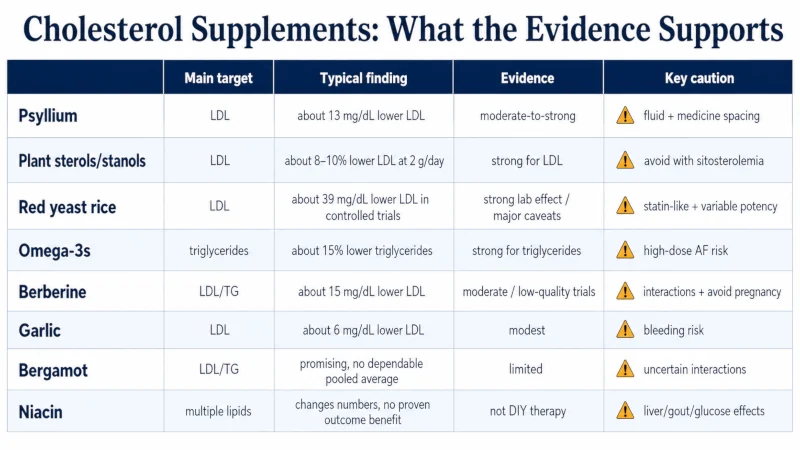
| Supplement | Main target | What the evidence found | Evidence grade | Main caution |
| Psyllium | LDL | About 13 mg/dL lower LDL in a 28-trial meta-analysis | Moderate-to-strong for a modest lab effect | Gas/bloating; must take with enough fluid; can affect medicine absorption |
| Plant sterols/stanols | LDL | About 8–10% lower LDL at 2 g/day | Strong for LDL lowering; no hard-outcome RCT proof | Avoid in sitosterolemia; take with meals |
| Red yeast rice | LDL | About 39 mg/dL lower LDL in trials using known monacolin K | Strong lab effect, major product/safety caveats | Statin-like side effects/interactions; potency varies; citrinin risk; avoid pregnancy/breastfeeding |
| Omega-3s | Triglycerides | About 15% lower triglycerides across a large Cochrane review summarized by NIH | Strong for triglycerides, not an LDL treatment | High-dose therapy can raise atrial-fibrillation risk; drug interactions need review |
| Berberine | LDL / triglycerides | About 15 mg/dL lower LDL in a meta-analysis | Moderate signal; trial quality is a major limitation | GI effects; medicine interactions; avoid pregnancy/breastfeeding |
| Garlic | LDL | About 6 mg/dL lower LDL in a 2026 meta-analysis | Modest average effect | Bleeding risk; interaction concerns; supplement-dose pregnancy data limited |
| Bergamot | LDL / triglycerides | Direction of effect promising; no reliable pooled estimate to use clinically | Limited | No standardized dose; interaction and pregnancy data are insufficient |
| Niacin | LDL / HDL / triglycerides | Changes lipid numbers, but outcome benefit is lacking | Not recommended as a DIY supplement strategy | Flushing, liver injury, gout, glucose effects, interactions |
The table describes changes in lipid measurements, not proof that a supplement prevents heart attack or stroke. Individual response varies, and commercial products may differ from products used in trials.
Start With the Right Target: LDL vs. Triglycerides
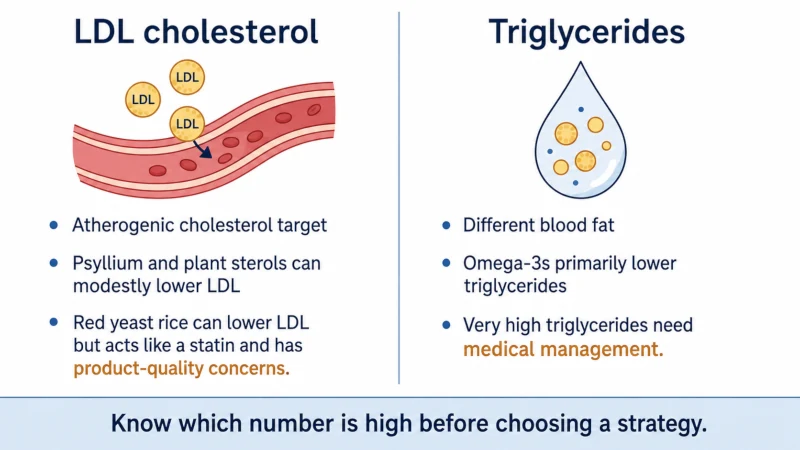
LDL cholesterol is a major treatment target because LDL-containing particles contribute to atherosclerotic plaque. Triglycerides are a different blood fat, and the treatment priorities can change when they are elevated. The latest guideline uses overall cardiovascular risk, LDL-C, non-HDL-C, triglycerides, and selected markers to guide therapy rather than treating “total cholesterol” as one problem [ACC/AHA dyslipidemia guideline, 2026].
That distinction is why fish oil can be useful in one person and disappointing in another. If triglycerides are the main issue, see the site’s guide to lowering triglycerides naturally. If LDL is the problem, food patterns rich in oats, beans, nuts, vegetables, and unsaturated fats deserve more attention than most supplement bottles; the companion guide to foods good for the heart gives practical examples.
1. Psyllium: The Clearest Fiber-Supplement Evidence
Psyllium is a viscous soluble fiber. It traps bile acids in the intestine, so the liver pulls more cholesterol from the blood to replace them. In a meta-analysis of 28 randomized trials involving 1,924 participants, a median dose of about 10.2 grams per day lowered LDL-C by 0.33 mmol/L — roughly 13 mg/dL — compared with control. The authors graded the LDL evidence as moderate quality [Jovanovski et al., 2018].
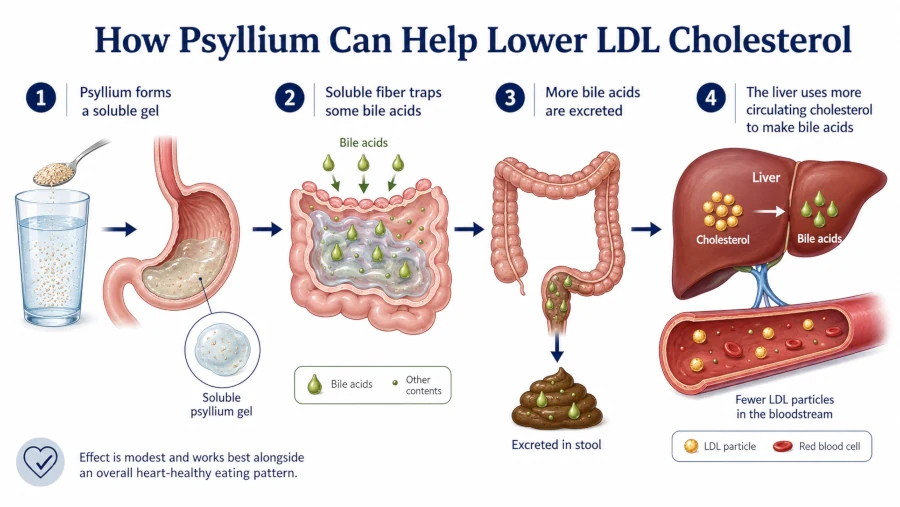
That is a meaningful but modest change. It is also one of the easier options to test objectively: use a consistent product and dose, keep the rest of your routine stable, then recheck the lipid panel with your doctor rather than assuming it worked.
Safety matters. Psyllium must be taken with enough fluid. MedlinePlus advises at least 8 ounces with a dose and warns about swallowing problems and intestinal blockage; it can also affect the absorption of some medicines [MedlinePlus, 2024]. Gas, bloating, and changes in bowel habits are common when fiber intake rises quickly.
2. Plant Sterols and Stanols: Consistent, Modest LDL Lowering
Plant sterols and stanols resemble cholesterol chemically and compete with it for absorption in the intestine. An European Atherosclerosis Society consensus review found that about 2 grams per day lowered LDL-C by 8–10% [Gylling et al., 2014]. The same review also made an important limitation clear: randomized trials have not shown that plant sterols themselves reduce heart attacks or other hard cardiovascular outcomes.
NCCIH notes that foods containing added sterols or stanols have a longer evidence base than supplements, although supplement forms taken with meals can lower cholesterol. They are generally well tolerated, but people with the rare inherited condition sitosterolemia should avoid high plant-sterol exposure [NCCIH natural-products review, 2024].
3. Red Yeast Rice: Effective Chemistry, Unpredictable Supplement
Red yeast rice is the clearest example of why “natural” does not mean pharmacologically mild. Its active compound monacolin K is structurally identical to lovastatin, a prescription statin [NCCIH, 2022].
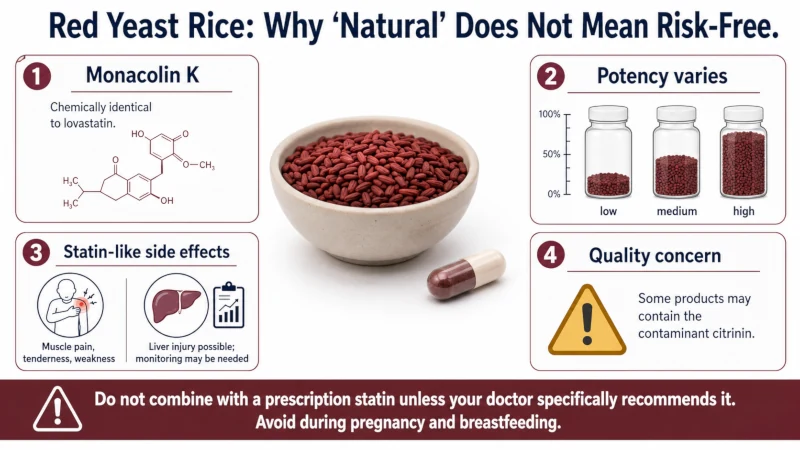
In a systematic review of 20 trials using red yeast rice with known monacolin K content, LDL-C fell by 1.02 mmol/L versus placebo — about 39 mg/dL. The LDL effect was substantial, but safety reporting was weak in many trials [Gerards et al., 2015].
The commercial-product problem is harder to ignore. NCCIH reports that 26 U.S. products containing detectable monacolin K varied more than 60-fold in the amount per 1,200 mg of red yeast rice, and labels generally did not disclose that amount. Products with enhanced or added lovastatin cannot legally be marketed as dietary supplements in the United States. Red yeast rice can also cause statin-like muscle, liver, and kidney problems, interact with the same kinds of medicines, and may contain the kidney toxin citrinin. It is not recommended during pregnancy or breastfeeding [NCCIH, 2022].
Practical takeaway: red yeast rice can lower LDL, but that is precisely because it can behave like a drug. It is a poor choice for self-treating around a prescribed statin or for trying to avoid medical follow-up.
4. Omega-3s: Useful for Triglycerides, Not an LDL Fix
Fish-oil supplements are often marketed under the broad label of “cholesterol support,” but their strongest lipid effect is on triglycerides. NIH’s Office of Dietary Supplements summarizes a 2020 Cochrane review of 86 trials in 162,796 participants: long-chain omega-3s reduced triglycerides by about 15%, while effects on many cardiovascular outcomes were small or absent [NIH ODS omega-3 fact sheet].
For people with high triglycerides, the AHA guidance summarized by NIH supports 4 grams per day of prescription omega-3 under medical care — not simply four grams of any over-the-counter fish-oil capsule. High-dose omega-3 trials have also found a small increase in atrial fibrillation in people with cardiovascular disease or high cardiovascular risk. Most routine side effects are mild gastrointestinal symptoms or an unpleasant taste [NIH ODS].
If LDL is your main target, omega-3 is usually not the supplement to choose for that purpose.
5. Berberine: A Real Signal, but Lower-Quality Evidence
Berberine has enough human data to take seriously, but not enough high-quality evidence to put it beside established LDL-lowering therapies. A meta-analysis of 16 randomized trials with 2,147 participants found an average LDL-C reduction of 0.38 mmol/L, or about 15 mg/dL. The same authors described high clinical heterogeneity and generally low methodological quality across the trials [Ju et al., 2018].
NCCIH lists nausea, diarrhea, bloating, and constipation among common side effects and warns that berberine can interact with medicines. It should not be used during pregnancy or breastfeeding, and it should not be given to infants because of bilirubin-related safety concerns [NCCIH, 2023].
Berberine is best viewed as a “discuss it first” option, especially if you already take prescriptions.
6. Garlic: Small Average LDL Effect
Garlic is a good example of a supplement with a statistically real effect that may be smaller than the marketing implies. A 2026 meta-analysis of 108 randomized trials involving 7,137 adults found an average LDL-C reduction of 5.9 mg/dL. The review also reported modest changes in several other cardiovascular risk markers, but called for larger and longer studies [Behrouz et al., 2026].
NCCIH likewise describes garlic’s cholesterol effect as small. Garlic supplements may increase bleeding risk, which matters before surgery and for people taking anticoagulants or aspirin. Supplement-level amounts may also be unsafe during pregnancy or breastfeeding because the safety evidence is limited [NCCIH Garlic, 2025].
7. Bergamot: Promising, Still Limited
Bergamot extract has promising lipid data, but this is where restraint matters. A systematic review found 12 human studies; 9 reported significant improvements in total cholesterol, triglycerides, and LDL-C. The studies used different bergamot preparations, populations, and designs, and the reviewers described the overall scientific quality as quite limited [Lamiquiz-Moneo et al., 2020].
NCCIH currently classifies the cholesterol-lowering evidence for bergamot as limited [NCCIH, 2026]. There is not enough consistency to give one reliable LDL effect size or a single evidence-based dose. Because supplement-specific interaction and pregnancy data are incomplete, anyone taking prescription medicine or who is pregnant or breastfeeding should treat bergamot as an “ask first” product rather than a harmless citrus extract.
8. Niacin: Not a Do-It-Yourself Cholesterol Strategy
High-dose niacin can change LDL, HDL, and triglyceride levels, but improving those numbers did not translate into lower rates of death, heart attack, or stroke in modern outcome studies. Mayo Clinic therefore frames prescription niacin as an option for selected patients — for example, some people who cannot take statins — rather than a routine supplement strategy [Mayo Clinic, 2025].
At cholesterol-lowering doses, niacin can cause flushing, itching, stomach problems, gout, liver damage, and blood-sugar problems. It can interact with anticoagulants, blood-pressure medicines, and diabetes medicines. Prescription niacin for high cholesterol should not be used during pregnancy [Mayo Clinic, 2025].
Why “Natural” Does Not Guarantee Quality or Safety
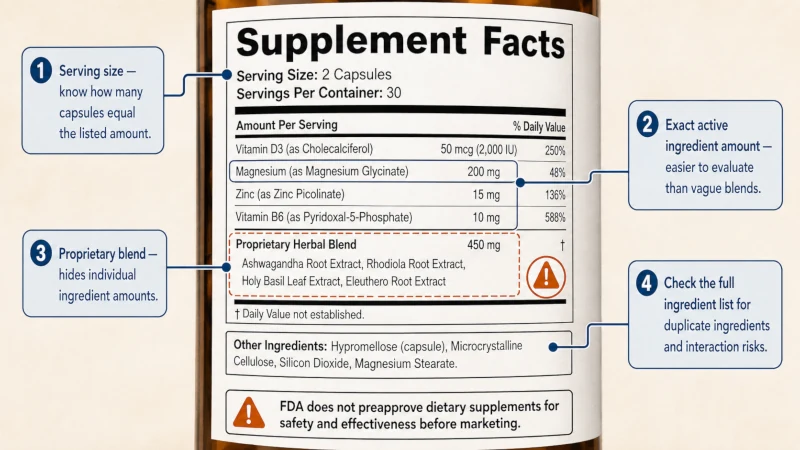
Dietary supplements in the United States do not go through the same premarket approval process as prescription drugs. FDA is not authorized to approve dietary supplements for safety and effectiveness before they are marketed [FDA consumer guidance]. That matters when the active amount drives both benefit and risk — red yeast rice is the clearest example.
- Prefer a product that lists the exact amount of each active ingredient. Avoid proprietary blends when you are trying to evaluate a specific dose.
- Run the ingredient list past a pharmacist if you take prescriptions. This is especially important for anticoagulants, statins, blood-pressure medicines, diabetes medicines, transplant drugs, and drugs with narrow therapeutic ranges.
- Change one variable at a time. Stacking several supplements makes side effects harder to trace and makes it impossible to know what moved the lipid panel.
- Do not use a supplement to “cover” a high-risk lipid pattern. A large LDL reduction is not the only goal; proven treatment is chosen to reduce the chance of heart attack and stroke.
A Safer Way to Decide Whether to Try a Supplement
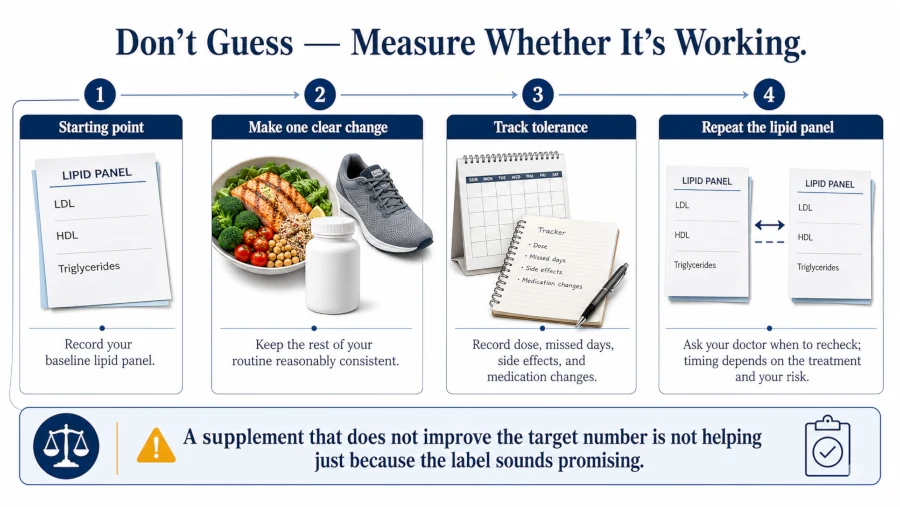
- Start with the actual lipid panel. Know whether LDL, non-HDL cholesterol, triglycerides, or several markers are elevated.
- Put the highest-value changes first. Food pattern, physical activity, smoking cessation, weight management when relevant, sleep, and prescribed medicine have broader cardiovascular evidence than supplement stacking.
- Choose one measurable goal. For example: “I want to see whether psyllium lowers my LDL,” not “I want better heart health.”
- Agree on follow-up. The 2026 guideline recommends a lipid profile 4–12 weeks after starting or adjusting lipid-lowering therapy. A doctor can choose an appropriate interval for a supplement trial based on the ingredient and your risk.
- Stop if the trade-off is poor. If the lipid change is trivial, side effects appear, or the product complicates your medication plan, there is little reason to keep paying for it.
Who Should Talk With a Doctor Before Using Cholesterol Supplements
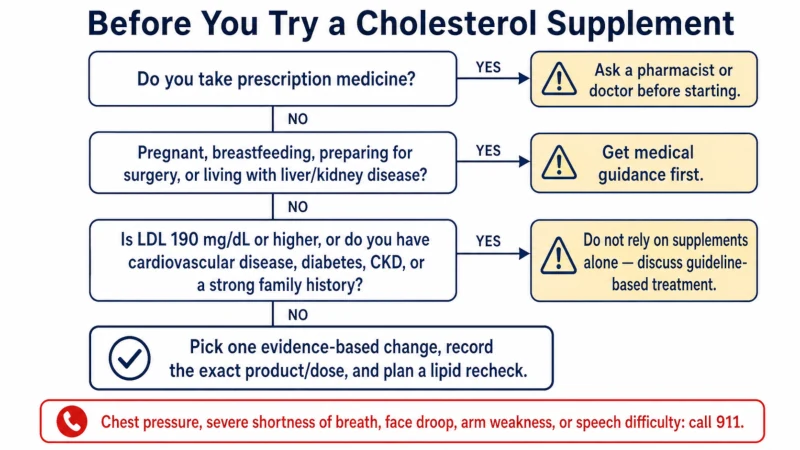
Get individualized advice before adding a cholesterol supplement if any of these apply:
- You already take a statin or another cholesterol-lowering medicine.
- You take anticoagulants, antiplatelet drugs, blood-pressure medicine, diabetes medicine, transplant medicine, or several prescriptions.
- You are pregnant, trying to become pregnant, or breastfeeding.
- You have liver disease, kidney disease, gout, a bleeding disorder, difficulty swallowing, or a history of bowel obstruction.
- Your LDL-C is 190 mg/dL or higher. The 2026 guideline classifies this as severe hypercholesterolemia and recommends evidence-based lipid-lowering drug therapy rather than supplement-only management.
- You have known cardiovascular disease, diabetes, chronic kidney disease, or a strong family history of early cardiovascular disease.
- You are preparing for surgery or a procedure and use herbal or high-dose supplements.
For the broader connection between cholesterol and atherosclerotic disease, see the site’s cardiovascular disease overview.
High cholesterol itself usually does not cause sudden warning symptoms. But chest pressure or pain, severe shortness of breath, sudden facial drooping, arm weakness, speech difficulty, or other heart-attack or stroke warning signs are emergencies. Call 911 [American Heart Association emergency signs].
| HEALTH DISCLAIMER: This article is for general educational purposes and is not a substitute for medical advice, diagnosis, or treatment. High cholesterol should be evaluated in the context of your overall cardiovascular risk. Do not stop, replace, or change a prescription medicine because of information here. Before using a supplement, talk with your doctor or pharmacist if you take medication, have a chronic condition, are pregnant or breastfeeding, or are preparing for surgery. Call 911 for symptoms of a heart attack or stroke. |
Frequently Asked Questions
Which supplement lowers LDL cholesterol the most?
Red yeast rice produced the largest average LDL drop among the ingredients reviewed here in trials using known monacolin K content. That is not a reason to self-treat with it: monacolin K is lovastatin-like, U.S. products vary widely in potency, and the same muscle, liver, kidney, and drug-interaction concerns can apply. For a more predictable modest effect, psyllium and plant sterols have cleaner evidence.
Can supplements replace a statin?
No. The 2026 ACC/AHA guideline does not recommend dietary supplements to lower LDL-C or triglycerides, and supplements do not have the same body of cardiovascular-outcome evidence as guideline-directed medications. If a statin causes side effects, there are other prescription options to discuss rather than substituting an unmonitored supplement.
Is fish oil good for high cholesterol?
It depends on which lipid is high. Omega-3s lower triglycerides, but they are not a reliable LDL-lowering strategy. Prescription omega-3 treatment can be useful for selected people with high triglycerides under medical care.
How long should I try a cholesterol supplement before checking whether it works?
Use a planned follow-up rather than an open-ended trial. Lipid-lowering medicines are commonly assessed with a repeat lipid profile 4–12 weeks after a treatment change under the 2026 guideline. A doctor can choose an appropriate interval for a supplement based on the ingredient, your baseline values, and your cardiovascular risk.
Can I combine several cholesterol-lowering supplements?
Combining products can increase interaction and side-effect risk, and it makes the result hard to interpret. A cleaner approach is to discuss one evidence-based change at a time, keep prescription treatment stable unless your doctor changes it, and measure the response.
References
- American College of Cardiology / American Heart Association. 2026 ACC/AHA/AACVPR/ABC/ACPM/ADA/AGS/APhA/ASPC/NLA/PCNA Guideline on the Management of Dyslipidemia. 2026. View source
- American Heart Association. Prevention and Treatment of High Cholesterol (Hyperlipidemia). 2026. View source
- National Center for Complementary and Integrative Health. 8 Tips: High Cholesterol and Dietary Supplements. 2026. View source
- National Center for Complementary and Integrative Health. High Cholesterol and Natural Products: What the Science Says. 2024. View source
- Jovanovski E, et al. American Journal of Clinical Nutrition. Effect of psyllium (Plantago ovata) fiber on LDL cholesterol and alternative lipid targets: systematic review and meta-analysis. 2018. View source
- MedlinePlus / U.S. National Library of Medicine. Psyllium: Drug Information. 2024. View source
- Gylling H, et al. Atherosclerosis. Plant sterols and plant stanols in the management of dyslipidaemia and prevention of cardiovascular disease. 2014. View source
- National Center for Complementary and Integrative Health. Red Yeast Rice: What You Need To Know. 2022. View source
- Gerards MC, et al. Atherosclerosis. Traditional Chinese lipid-lowering agent red yeast rice results in significant LDL reduction but safety is uncertain. 2015. View source
- NIH Office of Dietary Supplements. Omega-3 Fatty Acids: Fact Sheet for Health Professionals. current online fact sheet. View source
- Ju J, et al. Phytomedicine. Efficacy and safety of berberine for dyslipidaemias: systematic review and meta-analysis. 2018. View source
- National Center for Complementary and Integrative Health. Berberine and Weight Loss: What You Need To Know. 2023. View source
- Behrouz V, et al. Nutrition Reviews. Effects of Garlic Supplementation on Cardiovascular Risk Factors in Adults: Updated Systematic Review and Meta-Analysis. 2026. View source
- National Center for Complementary and Integrative Health. Garlic: Usefulness and Safety. 2025. View source
- Lamiquiz-Moneo I, et al. Critical Reviews in Food Science and Nutrition. Effect of bergamot on lipid profile in humans: A systematic review. 2020. View source
- Mayo Clinic. Niacin. 2025. View source
- U.S. Food and Drug Administration. Information for Consumers on Using Dietary Supplements. 2024. View source
- American Heart Association. Heart Attack, Stroke and Cardiac Arrest Symptoms. current online guidance. View source
