
These almond cookies are a whole-grain, dairy-free, egg-free batch sweetened with molasses rather than refined sugar — closer to a sturdy digestive biscuit than a soft bakery cookie. The almonds, sesame and wheat do bring real nutrition with them. An ounce of almonds on its own carries 6.8 mg of vitamin E, nearly half a day’s worth, and 80 mg of magnesium [NIH ODS, 2021]; [NIH ODS, 2026]. They are also still cookies, built on half a cup of molasses and most of a cup of oil. Both of those things are true at once, and the older version of this page only told you the first one.
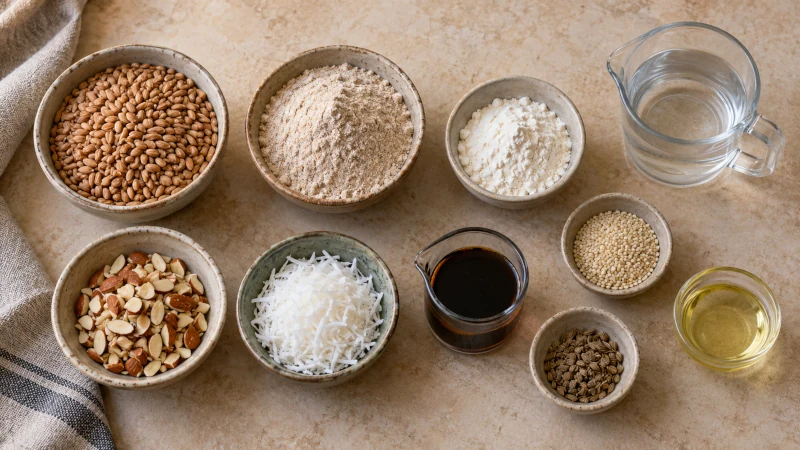
| Ingredient | What it is doing |
| 10.6 oz (300 g) wheat grains, ground — see the note below | The structural flour. Ground at home from whole berries, so it keeps the bran and germ. |
| 2⅓ cups whole wheat flour | Almost certainly the same 300 g expressed by volume rather than a second addition. See the note below. |
| ¾ cup white flour | Softens the crumb. Whole-grain flour alone gives a denser, more crumbly cookie. |
| ¾ cup raw shredded almonds | The flavour, and most of the vitamin E and magnesium. |
| 1 cup shredded coconut | Texture and sweetness; also most of the saturated fat in the recipe. |
| ½ cup molasses | The only sweetener. It also supplies the dark colour and a faint bitterness. |
| 1 tablespoon sesame seeds | Flavour and a light toasted crunch across the whole batch. |
| 1 tablespoon green anise seeds | Steeped in the water first, which is what gives the dough its liquorice note. |
| 14 tablespoons (about ⅞ cup) seed oil | The fat. A neutral, linoleic-acid-rich oil such as sunflower or safflower fits the original intent. |
| ⅘ cup water | Boiled with the anise, then cooled to lukewarm before it meets the rest. |
A note on the flour
The source recipe lists both “10.6 oz of wheat grains” and “2⅓ cups of whole flour”, then opens the method with “grind the wheat grains”. Read literally that is two separate quantities of whole-wheat flour, which would give you a dough far too dry for the liquid listed. 300 g of wheat berries grinds down to roughly 2⅓ cups of flour, so the two lines are almost certainly the same ingredient written twice — once by weight, once by the volume it yields.
Use one or the other, not both: either grind 300 g of wheat berries, or measure out 2⅓ cups of shop-bought whole wheat flour. That reading is my editorial judgement, not something the original text states.
How to make them
- Grind the wheat grains into flour, or skip this step if you are using ready-milled whole wheat flour.
- Boil the water with the anise seeds for five minutes, then take the pan off the heat. Once the water has cooled to lukewarm, add the remaining ingredients and knead until the dough is smooth.
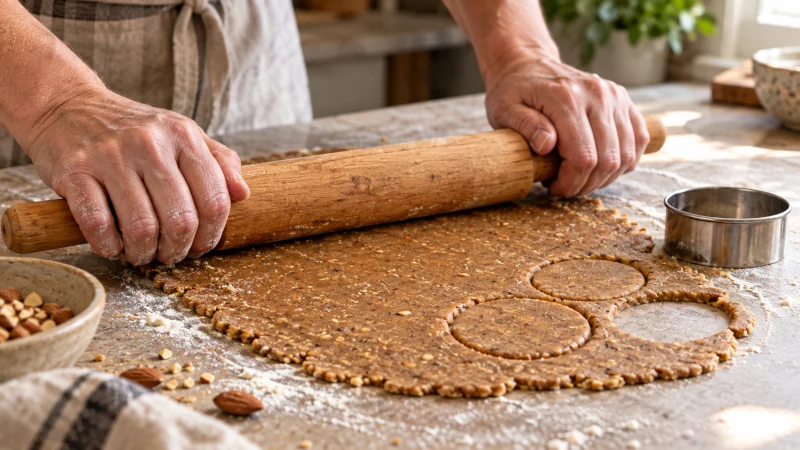
- Roll the dough out to about 5 mm thick with a rolling pin on a floured surface.
- Cut out shapes with cookie cutters or the rim of a glass. Lay them on a greased baking sheet and bake in a medium oven until browned on both sides.
- Cool completely, then store in an airtight container.
Preparation: 20 minutes · Baking: 45 minutes

Two practical gaps worth knowing about before you start. The source gives no oven temperature — “a medium oven” conventionally means around 350°F (180°C), which is the right range for a rolled cookie of this thickness. And it gives no yield, so how many cookies you get depends entirely on your cutter. At 5 mm thick with a 2-inch cutter, a batch this size will run to several dozen; weigh the dough before you cut if you want a reliable per-cookie figure.
What the ingredients actually contribute
It is worth separating what is solidly established about these foods from what gets claimed about them, because the two have drifted a long way apart on recipe pages like this one.
Almonds: vitamin E and magnesium, in real numbers
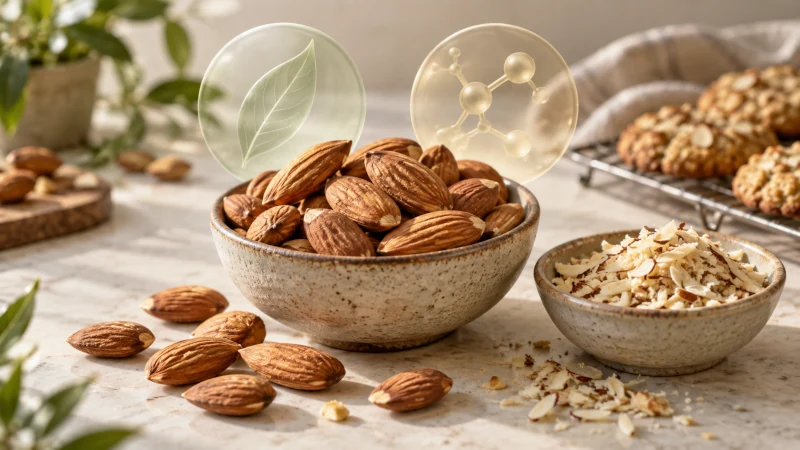
This is the part of the recipe with genuine nutritional weight. An ounce of dry-roasted almonds supplies 6.8 mg of vitamin E — 45% of the 15 mg Daily Value, and behind only wheat germ oil and sunflower seeds among everyday foods [NIH ODS, 2021]. The same ounce carries 80 mg of magnesium, about 19% of the Daily Value [NIH ODS, 2026]. That second number matters more than it sounds: analysis of national survey data found roughly 48% of people in the US take in less magnesium than they need from food and drink [NIH ODS, 2026]. Almonds are one of the easier ways to close that gap. Our guides to vitamin E-rich foods and magnesium-rich foods go through the full source lists.
The honest caveat is arithmetic. Three-quarters of a cup of shredded almonds is roughly three ounces spread across the entire batch. Divided among several dozen cookies, the per-cookie contribution is small — real, but small. Eating a handful of almonds on their own is a far more efficient way to get those nutrients than eating the cookies they are baked into.
Whole grain versus the white flour
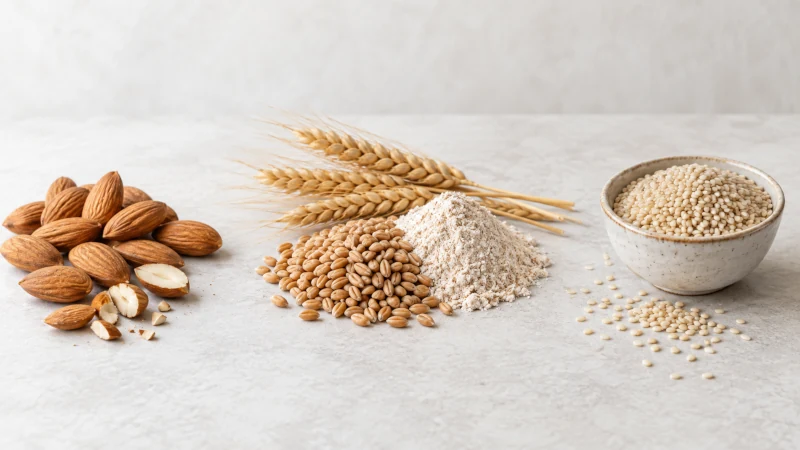
Grinding your own wheat keeps the bran and the germ, and that is where nearly all the nutrition sits. Refining strips away more than half of wheat’s B vitamins, 90% of its vitamin E and virtually all of its fibre [Harvard T.H. Chan, 2025]. Fortification puts some of that back; the phytochemicals it cannot replace.
Whole-grain eating patterns are associated with better long-term outcomes — a meta-analysis of seven studies found cardiovascular disease was 21% less likely among people eating 2.5 or more servings of whole grains a day compared with fewer than two a week, and a separate analysis linked two extra daily servings to a 21% lower risk of type 2 diabetes [Harvard T.H. Chan, 2025]. Read that carefully, though: those are observational findings about whole dietary patterns sustained over years, not about any single food. A cookie containing whole wheat is not a serving of the eating pattern those studies measured, and the ¾ cup of white flour in this recipe dilutes even the whole-grain content.
The seed oil and linoleic acid
The original page pointed at linoleic acid here, and the underlying research is sound — but it is about substitution, not addition. Replacing saturated fat or refined carbohydrate with linoleic-acid-rich vegetable oils lowers coronary heart disease risk, and Harvard researchers found that the effect holds whichever of the two you replace, suggesting linoleic acid is doing something itself rather than simply displacing something worse [Farvid et al., 2014]. Their data support 5–10% of energy intake from linoleic acid, in line with American Heart Association guidance [Farvid et al., 2014].
Nothing about that makes a cookie heart-healthy. The benefit comes from the oil taking the place of butter or lard in your cooking overall. Adding ⅞ cup of seed oil to a batch of biscuits adds calories; it does not perform a substitution. If the distinction is new to you, our explainer on essential fatty acids and “vitamin F” unpacks it.
Sesame and molasses: the part the old version oversold
The previous version of this page described sesame and molasses as “an excellent source of minerals and trace minerals”. One tablespoon of sesame seeds across an entire batch of cookies is not an excellent source of anything — it is a flavour decision, and a good one. Treat it as such.
Molasses deserves a straighter answer too. It does carry minerals that white sugar does not, which is why it turns up in mineral-rich food lists. It is also sugar, and the American Heart Association names it directly among the other words for sugar on an ingredient label [AHA, 2024]. The AHA suggests capping added sugars at about 6% of daily calories — roughly 6 teaspoons (100 calories) for most women and 9 teaspoons (150 calories) for men [AHA, 2024]. Half a cup of molasses is about 24 teaspoons of sugar distributed through the batch. Spread across three or four dozen cookies that is a modest amount per cookie, and it is not nothing.
The version of this page that ran from 2020 recommended these cookies for intellectual strain during exams, physical strain, pregnancy and lactation, and “thinness and malnutrition”, on the grounds that they supply the nutrients the nervous system needs. Those recommendations have been removed. Here is the honest grading.
| Claim | Evidence | What is actually true |
| Almonds are rich in vitamin E and magnesium | Well established | Confirmed by federal nutrient data: 6.8 mg vitamin E and 80 mg magnesium per ounce [NIH ODS]. |
| Whole grains carry nutrients that refining removes | Well established | Refining removes the bran and germ, taking most of the fibre, vitamin E and B vitamins with them [Harvard T.H. Chan]. |
| Whole-grain diets are linked to lower heart disease and diabetes risk | Moderate — observational | Consistent across large cohorts, but it describes long-term eating patterns, not individual baked goods [Harvard T.H. Chan]. |
| Linoleic acid lowers coronary heart disease risk | Supported — as a replacement | The benefit comes from swapping it in for saturated fat or refined carbohydrate, not from adding oil to a recipe [Farvid et al., 2014]. |
| These cookies support nervous system function | Not supported | No study has tested this recipe or anything like it. Individual ingredients contain nutrients nerves use; that is not the same claim. |
| These cookies help students under exam strain | Not supported | No evidence exists for this recipe or for cookies generally as a cognitive aid. |
| These cookies are recommended for pregnancy and lactation | Not supported — removed | Nutritional needs do rise in pregnancy and breastfeeding (the vitamin E recommendation goes from 15 mg to 19 mg during lactation [NIH ODS]), but that is a reason to talk to a clinician about your whole diet, not to eat a particular cookie. |
| These cookies are recommended for thinness and malnutrition | Not supported — removed | Unintentional weight loss and clinically significant undernutrition need medical assessment. A recipe page is the wrong tool, and suggesting otherwise can delay real care. |
Nutrition information
The figures below come from the print source this recipe was taken from. I could not open that book to verify them, and they carry two problems you should know about before relying on them.
| Per 100 g | Amount |
| Energy | 444 kcal (1,857 kJ) |
| Protein | 8.29 g |
| Carbohydrates | 45.0 g |
| Fibre | 7.57 g |
| Total fat | 24.4 g |
| Saturated fat | 4.86 g |
| Cholesterol | — |
| Sodium | 8.62 mg |
First, the table reports per 100 g, and 100 g of cookie is not a serving — it is several cookies for most people. Without a stated yield or cookie weight there is no way to convert it to a per-cookie figure. Second, the original table carried a “% Daily Value (based on a 2000 calorie diet)” footer above a column that contains absolute amounts, not percentages. That footer was wrong and has been removed rather than corrected, because correcting it would require data the source does not provide. Treat these numbers as indicative. Source: Pamplona-Roger, Encyclopedia of Foods and Their Healing Power, Vol. 3 (Editorial Safeliz, 2005), p. 155 — unverified.
Allergens: this recipe contains three of the nine
The United States recognises nine major food allergens: milk, eggs, fish, crustacean shellfish, tree nuts, peanuts, wheat, soybeans and sesame [FDA, 2026]. This recipe contains three of them, which is unusual for a single batch of cookies and worth stating plainly if you are baking for anyone but yourself.
- Tree nuts. Almonds. Named on the label of any packaged food that contains them, and one of the more common tree-nut allergies.
- Wheat. Both the whole and white flour. Also relevant to anyone with coeliac disease or non-coeliac gluten sensitivity — this recipe is not gluten-free and cannot easily be made so.
- Sesame. Sesame became the ninth US major food allergen under the FASTER Act, signed on 23 April 2021 and effective from 1 January 2023 [FDA, 2026]. One tablespoon is enough to matter to someone who is allergic.
Coconut is a special case. The FDA removed it from its tree nut list in the fifth edition of its allergen guidance, published 6 January 2025, so it is no longer treated as a major food allergen and should not appear in a “Contains” statement — though it must still be listed by name in a product’s ingredient list [FDA, 2025]. Coconut allergy is rare, but it exists. If you are baking for a crowd, say what is in the cookies.
Signs of an allergic reaction
Symptoms usually appear within minutes to a couple of hours of eating. They can include hives, flushed skin or a rash, a tingling or itchy mouth, swelling of the face, tongue or lips, vomiting or diarrhoea, abdominal cramps, coughing or wheezing, dizziness, swelling of the throat, difficulty breathing, or loss of consciousness [FDA, 2026]. A severe, life-threatening reaction is called anaphylaxis.
| Seek emergency care immediately: If someone has difficulty breathing, throat or tongue swelling, sudden dizziness or collapse after eating, use an epinephrine auto-injector if one is prescribed and call emergency services. Do not wait to see whether it settles [FDA, 2026]. |
Who should be careful
- Anyone managing blood sugar. Molasses is sugar. The whole-grain flour slows digestion somewhat, but it does not cancel the sweetener, and there is no evidence that molasses behaves differently from other added sugars in this respect.
- Anyone tracking added sugars. The AHA guidance of roughly 6 teaspoons a day for women and 9 for men [AHA, 2024] is easy to reach without noticing when a batch contains half a cup of molasses.
- People with a tree nut, sesame or wheat allergy, or coeliac disease. This recipe is not for you, and substituting around three separate allergens rarely produces a cookie worth the effort.
- Pregnancy and breastfeeding. These cookies are food, not a prenatal strategy. Requirements for several nutrients rise — vitamin E goes from 15 mg to 19 mg a day during lactation [NIH ODS, 2021] — and the sensible route is a conversation with your midwife, obstetrician or a registered dietitian about your whole diet.
- Anyone losing weight without meaning to. That needs medical assessment, not a calorie-dense snack. See a clinician.
- Anyone considering supplements instead. Vitamin E from food carries no known risk — federal reviewers report no adverse effects from vitamin E consumed in food — whereas the tolerable upper limit for supplemental vitamin E is 1,000 mg a day for adults [NIH ODS, 2021], and for supplemental magnesium it is 350 mg [NIH ODS, 2026]. Food first is the easy call here.
When to talk to a professional: if you have had any reaction to nuts, seeds or wheat before; if you have diabetes or prediabetes and want to know how a recipe like this fits your day; if you are pregnant, breastfeeding, or feeding a young child with a family history of food allergy; or if you are eating less than you should and losing weight. A GP, allergist or registered dietitian can answer those in a way a recipe page cannot.
| Health disclaimer: This article is for general education and is not medical advice, diagnosis or treatment. Nutritional needs, allergy risk and medication interactions vary from person to person. Talk to a qualified healthcare professional before making significant changes to your diet or starting a supplement — particularly if you are pregnant or breastfeeding, manage diabetes or another chronic condition, take prescription medication, or have any history of food allergy. If you have symptoms that worry you, seek care promptly. If you have signs of a severe allergic reaction, treat it as an emergency. Nutrition figures in this article are reproduced from the cited print source and have not been independently laboratory-verified. |
Frequently Asked Questions
Healthier than a standard butter-and-white-sugar cookie, and still a cookie. The almonds bring vitamin E and magnesium, and grinding your own wheat keeps the bran and germ that refining removes [NIH ODS, 2021]; [Harvard T.H. Chan, 2025]. But the batch also contains half a cup of molasses and most a cup of oil. They are a reasonable occasional snack, not a health food.
Can I make these gluten-free or nut-free?
Not easily. Wheat provides the entire structure here, so swapping in a gluten-free blend changes the hydration and the handling, and this recipe has not been tested that way. A nut-free version is not really the same thing — almonds are the point. If you need one or the other, start from a recipe developed for that constraint rather than adapting this one.
Is molasses actually better than white sugar?
It carries minerals that refined sugar does not, so it is a marginal improvement. It is still an added sugar, and the American Heart Association lists it as one of the other names sugar appears under on a label [AHA, 2024]. Choose it for the flavour, which is genuinely different, rather than because you expect a health benefit.
What temperature is “a medium oven”?
The source recipe does not give one. “Medium oven” conventionally means around 350°F (180°C), which suits a 5 mm rolled cookie. Watch them rather than the clock — the instruction is to bake until browned on both sides, and thin cookies go from golden to burnt quickly.
Will these help with concentration during exams?
No. The earlier version of this page suggested they would, and that claim has been removed because no evidence supports it. Almonds contain nutrients your nervous system uses, which is a statement about almonds, not a demonstrated effect of eating these cookies before a test.
How long do they keep?
Cool them completely first — trapping steam is what turns a crisp cookie soft — then keep them in an airtight container. With no eggs or dairy and a low moisture content once baked, they hold up well for a week or more at room temperature.
References
- National Institutes of Health, Office of Dietary Supplements. Vitamin E: Fact Sheet for Health Professionals. Updated 26 March 2021. View source
- National Institutes of Health, Office of Dietary Supplements. Magnesium: Fact Sheet for Health Professionals. Updated 6 January 2026. View source
- Harvard T.H. Chan School of Public Health, The Nutrition Source. Whole Grains. Last modified 14 January 2025. View source
- Farvid MS, Ding M, Pan A, Sun Q, Chiuve SE, Steffen LM, Willett WC, Hu FB. Dietary Linoleic Acid and Risk of Coronary Heart Disease: A Systematic Review and Meta-Analysis of Prospective Cohort Studies. Circulation, 2014. Author Q&A published by Harvard T.H. Chan School of Public Health, 5 November 2014. View source
- U.S. Food and Drug Administration. Food Allergies. Content current as of 11 March 2026. View source
- U.S. Food and Drug Administration. Frequently Asked Questions: Food Allergen Labeling Guidance for Industry. Content current as of 26 March 2025. View source
- American Heart Association. Added Sugars. Last reviewed 2 August 2024. View source
- Pamplona-Roger GD. Encyclopedia of Foods and Their Healing Power. Trans. Annette Melgosa. Vol. 3. Editorial Safeliz, 2005, p. 155. Print.


