
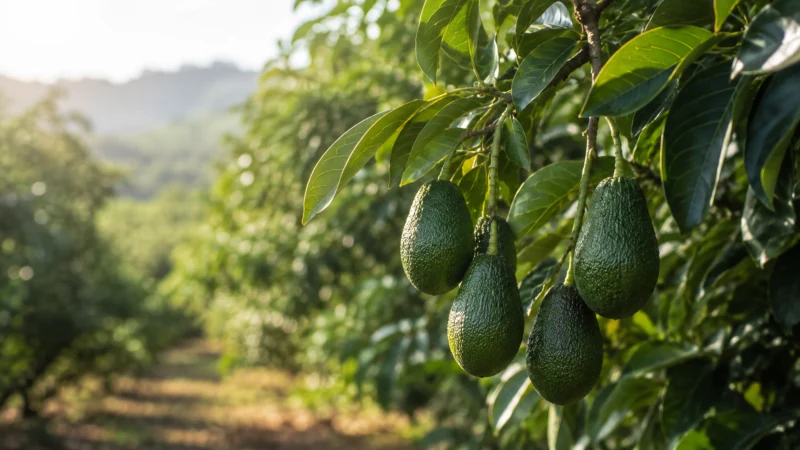
The avocado tree is a tall subtropical evergreen grown for one thing above all: its buttery fruit. The flesh is the only part with a long, settled record as everyday food. The leaves have a narrow role as a cooking herb and a folk remedy, the big seed and the skin are not foods, and the avocado oil on store shelves is pressed from the flesh, not the pit.
What Is the Avocado Tree?
The avocado tree, Persea americana, is a broadleaf evergreen in the laurel family, Lauraceae [Missouri Botanical Garden]. The genus name comes from an old Greek name for an Egyptian tree, and americana simply means “of the Americas” [Missouri Botanical Garden].
You may have read that “avocado” means “testicle” in the Aztec language. There’s a thread of truth to it: the word comes from the Nahuatl ahuacatl. But a Nahuatl scholar quoted in a fact-check found that written sources use the word for the fruit, and that the anatomical sense was a euphemism based on shape, the way English speakers say “nuts” [IFLScience, 2022]. Good etymology, shaky biology.
Botanically, the fruit is a berry: a single large seed wrapped in buttery pulp [UF/IFAS Extension].
Where Avocado Trees Grow
Avocados are native to tropical America and have been cultivated there since before Columbus [UF/IFAS Extension]. An engineering review of avocado oil production puts the start of cultivation in southern Mexico possibly some 6,000 years ago, based on archaeological evidence [Costagli & Betti, 2015].
Today it’s grown commercially from Mexico and Chile to Israel, Spain and Indonesia, and in the U.S. in California, Florida, Puerto Rico, Hawaii and Texas. The first recorded imports reached Florida in 1833 and California in 1856 [UF/IFAS Extension]. Southern California supplies about 95% of the U.S. commercial crop, and Hass makes up roughly 80% of that [Missouri Botanical Garden].
Outdoors, think frost-free. Missouri Botanical Garden rates the tree hardy only in USDA Zones 10 to 12 and intolerant of frost [Missouri Botanical Garden], though some Mexican-type varieties handle brief cold far better than others (see the variety table below).
Avocado Tree Characteristics and Fruit Production
A mature avocado is a medium-to-large tree, about 30 to 65 feet tall in Florida [UF/IFAS Extension], with a spread of 20 to 30 feet [Missouri Botanical Garden]. Grafted trees usually stay shorter, and the limbs break easily under wind or a heavy crop [UF/IFAS Extension].
Leaves, flowers, and the A/B flowering puzzle
Leaves run 3 to 16 inches long. New growth is often reddish and slightly hairy, then turns smooth, leathery and dark green. The flowers are small (about half an inch), yellowish-green and borne in many-flowered clusters [UF/IFAS Extension].
A mature tree produces around a million flowers, yet a good crop keeps only about 200 of them through to harvest [UC Cooperative Extension, Bender].
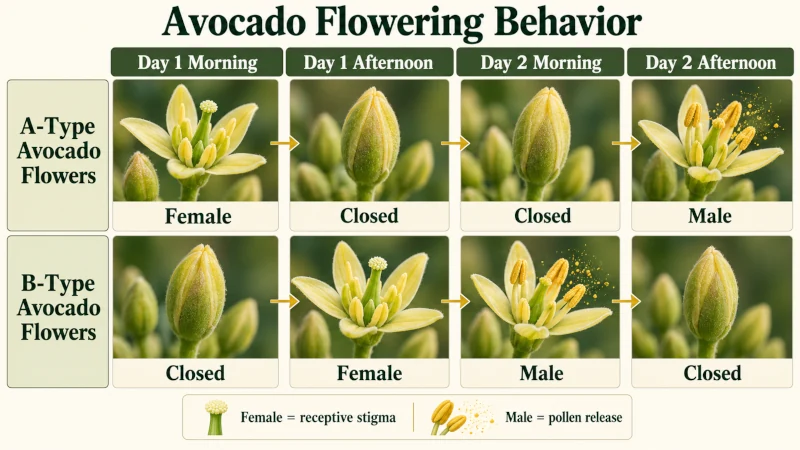
Part of the reason is timing. Each flower is bisexual but opens twice: once as a female, ready to receive pollen, and again the next day as a male, shedding pollen. “A” varieties are female in the morning of the first day and male in the afternoon of the second. “B” varieties run the opposite schedule [UC Cooperative Extension, Bender]. The rhythm holds when average temperatures stay above about 70°F; below an average of about 60°F, fruit set may fail [UC Cooperative Extension, Bender].
What to do with that: if neighbors already grow avocados, one tree will usually be pollinated well enough. If yours would be the only one around, UF suggests planting one A-type and one B-type. Some varieties, such as ‘Lula’, fruit well alone [UF/IFAS Extension].
Why avocados ripen only after picking
Avocados don’t ripen on the tree. A mature fruit softens 3 to 8 days after it’s picked, so you can leave fruit on the branch and pick as needed, though it eventually drops. To test readiness, pick one large fruit and see whether it ripens on the counter or shrivels [UF/IFAS Extension].
How long until a tree bears fruit
Grafted trees usually start producing in 3 to 4 years [UF/IFAS Extension]. Ungrafted seedlings have a long juvenile phase and may not fruit for 10 years [UC Cooperative Extension, Bender], and most varieties don’t come true from seed, so a pit won’t give you the fruit it came from [UF/IFAS Extension].
The Hass avocado shows how much luck is involved. It began as a chance seedling bought by postman Rudolph Hass; his children preferred its fruit, he patented it in 1935, and nobody knows which variety’s seed produced it [California Avocado Society].
Mexican, Guatemalan, and West Indian Avocado Varieties
Extension horticulturists group avocado varieties into three ecological “races.” West Indian types come from the tropical lowlands of southern Mexico and Central America. Guatemalan and Mexican types come from mid-altitude highlands [UF/IFAS Extension].
| Trait | West Indian | Guatemalan | Mexican |
| Origin | Tropical lowlands | Tropical highlands | Tropical highlands |
| Leaf scent | None | None | Anise-scented |
| Fruit size | 1–5 lb | ½–5 lb | Up to 1 lb |
| Skin | Leathery, smooth | Woody, rough | Papery, smooth |
| Oil content | Low | Medium to high | Medium to high |
| Fruit set to maturity | 5–8 months | 10–15 months | 6–8 months |
| Mature-tree cold tolerance | 25–30°F | 24–28°F | 18–26°F |
Source: UF/IFAS Extension, Avocado Growing in the Florida Home Landscape, Table 1. Cold tolerance varies with tree health and growth stage.
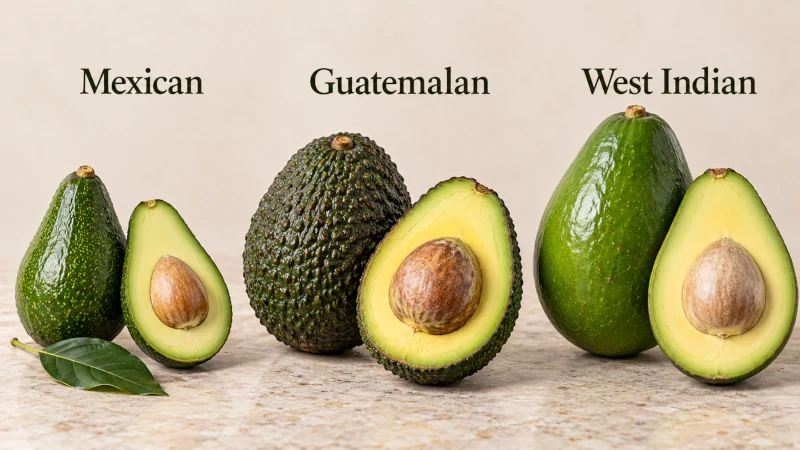
Most named varieties are hybrids. Typical California varieties, including Hass, Gwen, Pinkerton, Fuerte and Reed, are mostly Guatemalan types with thick, pebbly skins. Florida grows West Indian varieties such as Donnie and Simmonds and Guatemalan–West Indian hybrids such as Booth 8, Choquette and Monroe [Missouri Botanical Garden]. If you garden where frosts happen, Mexican and Mexican-hybrid varieties such as ‘Brogdon’, ‘Mexicola’ and ‘Winter Mexican’ may withstand the low 20s°F [UF/IFAS Extension].
Race matters for more than flavor. The anise-scented leaves used in Mexican cooking belong to the Mexican race [UF/IFAS Extension], while Guatemalan varieties are the ones most often linked to poisoning in animals [Merck Veterinary Manual]. Hass, being largely Guatemalan, is not the tree to pick cooking leaves from.
Parts of the Avocado Tree and Their Uses
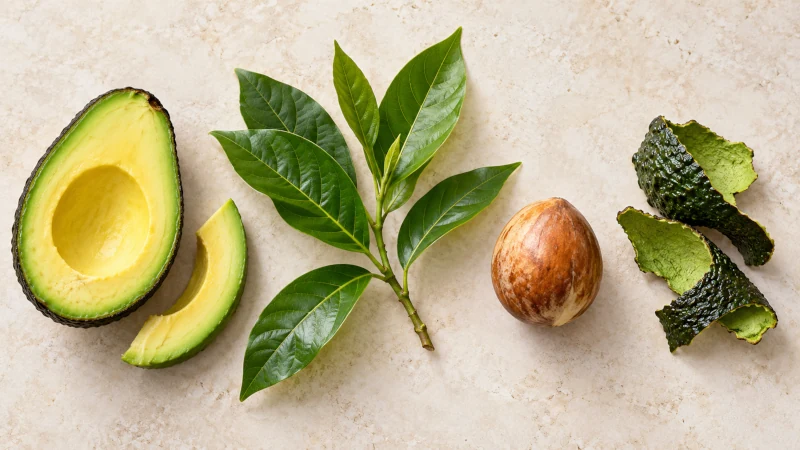
Fruit
The flesh is the reason the tree is grown. Depending on variety, ripe fruit can be green, black, purple or reddish, and Florida varieties range from 3% to 15% oil [UF/IFAS Extension]. That fat is mostly monounsaturated oleic acid [Costagli & Betti, 2015]. For calories, fiber, potassium and vitamins per serving, see our avocado nutrition facts. For what research shows about heart health, cholesterol and blood sugar, see our guide to the health benefits of eating avocado.
Leaves
In Mexican cooking, dried leaves from Mexican-type trees are toasted and used like bay leaves in beans and stews. In folk medicine they’re brewed as a tea for digestion, coughs and more (see the traditional-uses section). The leaves are also the most toxic part of the tree for animals [Merck Veterinary Manual]. For the lab and animal research, the variety question, and how to use them in the kitchen, see avocado leaves and their traditional uses.
Seed and skin
The seed is mostly starch: carbohydrates make up about 65% of it, with only about 1% to 1.5% fat [California Avocado Commission]. Seed extracts have shown antioxidant, anti-inflammatory and blood-sugar effects in cell and animal studies, and a 2022 review in Food Chemistry: X concluded that more clinical testing is needed [Bangar et al., 2022]. The California Avocado Commission points out that there are no direct human feeding studies on the seed’s safety or benefits, and it does not recommend eating it [California Avocado Commission].
The skin has no tradition as a food and no human safety data behind eating it. Treat it the way you treat the pit: compost, kept away from pets.
Oil derived from the fruit
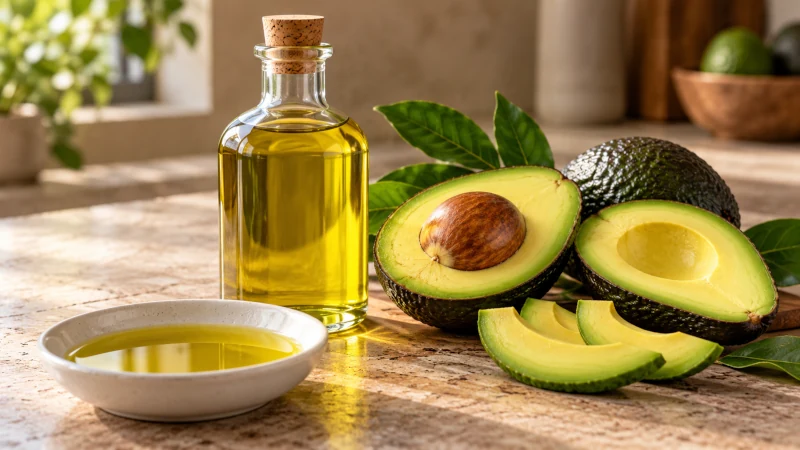
Avocado oil, like olive oil, is extracted from the fruit pulp; the kernel holds only about 1% oil. The traditional method was to mash the pulp in water, heat it and skim off the oil. Refined oil has long been used in cosmetics for its vitamin E and emollient feel; cold-pressed cooking oil dates only to the late 1990s in New Zealand [Costagli & Betti, 2015].
On skin, avocado oil is a reasonable moisturizer. The wound-healing research is early: in rats, avocado oil applied to wounds increased collagen and reduced inflammatory cells compared with petroleum jelly [de Oliveira et al., 2013]. That’s animal evidence, not proof in people. Claims that it prevents stretch marks or stops hair loss rest on tradition, not trials.
Basic Avocado Tree Growing Conditions
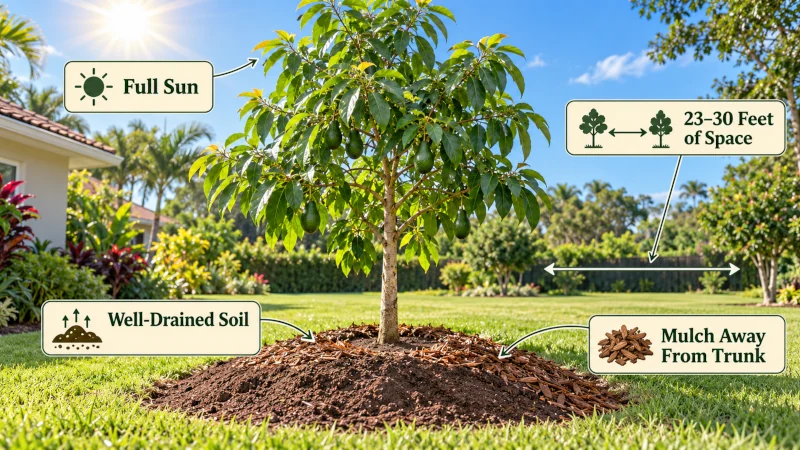
Avocado tree care comes down to warmth, sun and, above all, drainage. Most of this comes from UF/IFAS Extension’s home-landscape guide [UF/IFAS Extension]:
- Sun and warmth. Plant in full sun in the warmest spot you have. Choose a Mexican-type variety if you get occasional frost.
- Drainage. Avocados don’t tolerate flooding. Wet roots invite Phytophthora root rot, the most serious avocado disease worldwide. If water stands after summer storms, plant on a mound of native soil 2 to 3 feet high.
- Space. Keep the tree 23 to 30 feet or more from buildings and other trees.
- Water. Water a new tree every other day for the first week or so, then once or twice a week for the first couple of months. Avoid frequent lawn-sprinkler watering, which invites root rot.
- Feeding. Fertilize young trees every 1 to 2 months in the first year, starting with about ¼ pound per tree and working up to 1 pound.
- Pruning. After a few years of production, cut the tops back to 10 to 15 feet for easier harvest and less storm damage.
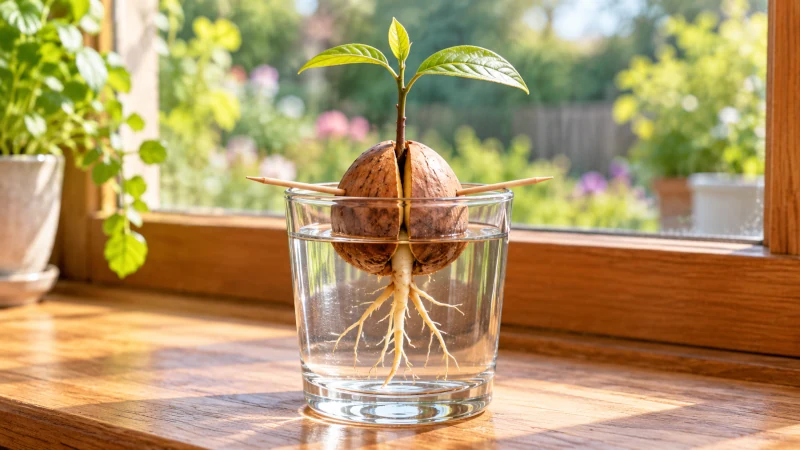
One threat to watch for: laurel wilt, a fungal disease spread by ambrosia beetles, can kill an infected tree within 4 to 8 weeks [Missouri Botanical Garden]. If you just want a houseplant, a pit suspended on toothpicks in a glass of water usually roots in 2 to 6 weeks, but indoor trees normally won’t fruit [Missouri Botanical Garden].
Traditional Uses of Different Avocado Tree Parts
Avocado is one of the most widely used medicinal plants in Mesoamerica. A review of 28 ethnobotanical surveys found it cited in 21 of them, mostly for digestive, respiratory, skin, musculoskeletal and pregnancy-related complaints. Leaves, bark and seeds were all used: usually taken by mouth for gut and breathing problems, and as baths or applied to the skin for the rest [Geck et al., 2020]. Elsewhere, the leaf has been used for high blood pressure, cough, ulcers and diarrhea, and the bark for asthma, cough and diabetes [Ehikioya et al., 2023].
The research behind those uses is early. Leaf extracts reduced experimentally induced diarrhea in rats and showed antimicrobial activity in lab tests, and the reviewers rated avocado “safe but limited evidence for efficacy” for external uses [Geck et al., 2020]. In diabetic rats, leaf, bark and root extracts lowered blood glucose, but the authors themselves say their findings are not sufficient for clinical use [Ehikioya et al., 2023].
| Part | Main traditional uses | Best available evidence | Evidence grade |
| Fruit flesh | Everyday food | Extensive human dietary research | Established food |
| Leaves | Cooking herb; tea for digestion, cough | Lab and animal studies | Traditional; early-stage |
| Seed | Decoctions and poultices for digestive and skin complaints | Cell and animal extract studies; no human feeding studies | Insufficient — avoid eating |
| Bark and root | Various internal and topical uses | Animal studies | Insufficient |
| Oil (on skin) | Moisturizer; skin and hair care | Cosmetic use; rat wound study | Reasonable as cosmetic; medical claims unproven |
Some herbal sources still recommend several cups of leaf tea a day, or a seed decoction three times daily. No human study has tested either for safety.
Which Parts of the Avocado Tree Are Safe to Consume?
Fruit flesh: yes. It’s an ordinary food. A few people need care with it, including those with latex allergy and those taking warfarin; those cautions are covered in our avocado nutrition facts.
Leaves: only as an occasional cooking herb. Use leaves sold for culinary use, ideally from Mexican-type trees, rather than picking them from a backyard Hass or unknown tree, since Guatemalan varieties are the ones linked to toxicity in animals [Merck Veterinary Manual]. Medicinal amounts have no established safe dose.
Seed: no. There’s no human evidence that it’s safe or beneficial [California Avocado Commission].
Skin: no. It isn’t a food and hasn’t been studied as one.
Oil: yes, as a cooking oil. Cold-pressed avocado oil is a culinary oil much like extra-virgin olive oil [Costagli & Betti, 2015]. On skin, patch-test first.
Who should skip leaf and seed preparations
- Pregnant or breastfeeding people. There’s no human safety data for medicinal leaf or seed use, and in lactating animals avocado causes mammary-gland damage and a steep drop in milk [Merck Veterinary Manual].
- People on diabetes or blood pressure medicine. Because leaf and bark extracts lowered blood glucose in diabetic rats [Ehikioya et al., 2023], regular use could in theory add to your medication’s effect. Ask your prescriber or pharmacist first.
Call 911 for throat swelling or trouble breathing after any avocado product. See a doctor for persistent digestive symptoms, or for blood pressure or blood sugar concerns, rather than treating them with leaf tea.
Avocado Trees and Animal Toxicity
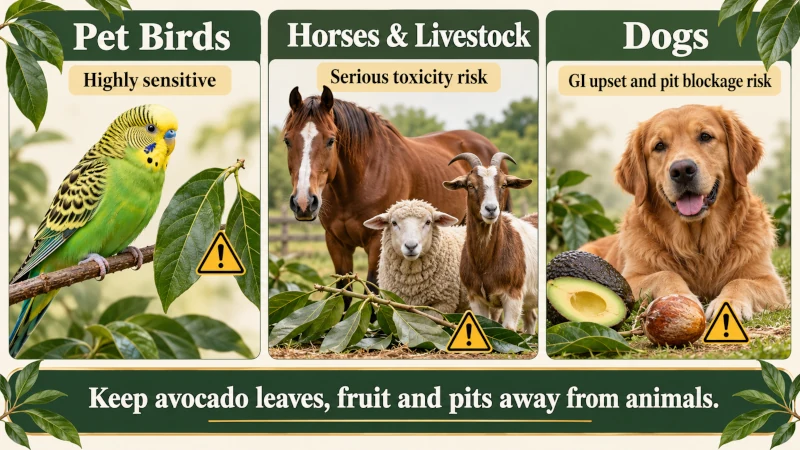
This is where the tree is genuinely dangerous. Eating avocado fruit, leaves, stems or seeds can poison animals, and the leaves are the most toxic part. The toxic compound, persin, damages heart muscle in mammals and birds and inflames the udder in lactating animals [Merck Veterinary Manual].
Affected species include cattle, goats, horses, sheep, rabbits, rodents, fish and many birds. Caged birds are the most sensitive. Budgerigars have died within 48 hours of eating 8.7 grams of mashed fruit. Lactating animals can lose about 75% of their milk within a day [Merck Veterinary Manual]. Horses, donkeys, sheep and goats often develop swollen heads and necks [ASPCA].
Dogs are relatively resistant but can get vomiting and diarrhea [ASPCA], and a swallowed pit can block the intestines [Merck Veterinary Manual].
Don’t plant avocado trees where goats, sheep, horses or cattle graze, and rake up fallen leaves if animals share the yard. Keep pet birds and their cages well away from avocado. Compost pits and skins where dogs can’t reach them. If an animal eats any part of an avocado, note roughly how much and call your veterinarian or the ASPCA Animal Poison Control Center at (888) 426-4435 [ASPCA].
| HEALTH DISCLAIMER: This article is for general education and is not medical, veterinary, or horticultural advice for your specific situation. It does not diagnose, treat, cure, or prevent any disease. Talk to your doctor, pharmacist, or a registered dietitian before using any part of the avocado tree as a remedy — especially if you are pregnant or breastfeeding, give it to a child, take prescription medication, or have a chronic condition. Keep all parts of the tree away from birds, livestock and pets. If you think you are having a medical emergency, call 911. |
Frequently Asked Questions
How long does an avocado tree take to produce fruit?
A grafted tree usually starts bearing in 3 to 4 years [UF/IFAS Extension]. A tree grown from a pit can take up to 10 years [UC Cooperative Extension, Bender] and won’t produce the same fruit as its parent.
Do you need two avocado trees to get fruit?
Not always. If other avocado trees grow nearby, one tree is usually enough. If yours is the only one around, planting an A-type and a B-type improves pollination [UF/IFAS Extension].
Can you grow an avocado tree from a pit?
Yes. Suspend a washed pit on toothpicks with the bottom third in water, and roots typically appear in 2 to 6 weeks. It makes an attractive houseplant, but indoor trees normally won’t fruit [Missouri Botanical Garden].
Are avocado tree leaves poisonous?
To animals, yes — the leaves are the most toxic part of the tree, especially from Guatemalan-type varieties [Merck Veterinary Manual]. People use dried Mexican-type leaves as a cooking herb, but medicinal amounts haven’t been shown to be safe. More in our guide to avocado leaves and their traditional uses.
Why won’t my avocados ripen on the tree?
They never do. Avocados ripen only after they’re picked or fall, usually 3 to 8 days later on the counter [UF/IFAS Extension].
Is it safe to eat the avocado seed?
There are no human feeding studies showing it’s safe or beneficial, and the California Avocado Commission recommends sticking to the flesh [California Avocado Commission].
References
- ASPCA. The Scoop on Avocado and Your Pets. View source
- Bangar SP, Dunno K, Dhull SB, Siroha AK, Changan S, Maqsood S, Rusu AV. Avocado seed discoveries: Chemical composition, biological properties, and industrial food applications. View source
- California Avocado Commission. Is It Safe to Eat the Avocado Seed? View source
- California Avocado Society. Mother Hass Tree. View source
- Costagli G, Betti M. Avocado oil extraction processes: method for cold-pressed high-quality edible oil production versus traditional production. View source
- Crane JH, Balerdi CF, Maguire I. Avocado Growing in the Florida Home Landscape. View source
- de Oliveira AP, et al. Effect of semisolid formulation of Persea americana Mill (avocado) oil on wound healing in rats. View source
- Ehikioya CO, Osagie AM, Omage SO, et al. Carbohydrate digestive enzyme inhibition, hepatoprotective, antioxidant and antidiabetic benefits of Persea americana. View source
- Funnell R. Fact Check: Are Avocados Really Named After Testicles? IFLScience. View source
- Geck MS, Cristians S, Berger-González M, Casu L, Heinrich M, Leonti M. Traditional Herbal Medicine in Mesoamerica: Toward Its Evidence Base for Improving Universal Health Coverage. View source
- Hayes C (peer reviewed by Brutlag A). Avocado (Persea spp) Toxicosis in Animals. Merck Veterinary Manual. View source
- Bender GS. Chapter 3 – Avocado Flowering and Pollination. University of California Cooperative Extension. View source
- Missouri Botanical Garden. Persea americana. Plant Finder. View source


