
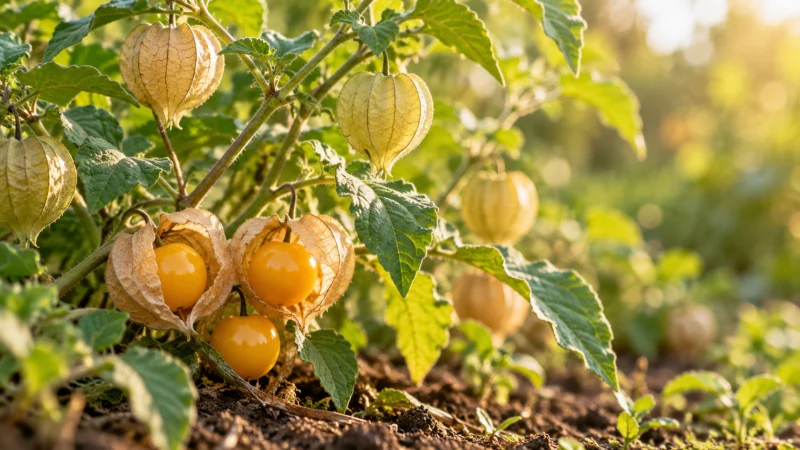
Ground cherries are one of the small rewards of a late-summer garden: a sweet-tart berry, about half an inch across, sealed in a papery husk [Penn State Extension, 2026]. The catch is that the fruit is the only part of the ground cherry plant you should eat. Leaves, stems, flowers and unripe green berries contain solanine and related alkaloids, and plant guides from three land-grant universities list them as poisonous [NC State Extension, n.d.] [Ohio State Weed Guide, n.d.] [Penn State Extension, 2026].
That matters because some older herbal references recommend drinking a tea boiled from the leaves and stems for coughs, and dabbing it on rashes and psoriasis. No human studies support those uses, and the tea is made from the toxic parts. The short version: eat the ripe fruit, leave the rest of the plant alone, and treat claims about joint pain, wounds and psoriasis as unproven.
What is the ground cherry plant?
Ground cherries belong to Physalis, a genus of roughly 94 species in the nightshade family — the same family as tomatoes, peppers and potatoes [NC State Extension, n.d.] [Penn State Extension, 2026]. The name comes from the Greek word for bladder, a nod to the inflated husk around each fruit [Penn State Extension, 2026]. The plants are native to the Americas and grow both as garden crops and as weeds of fields, roadsides and disturbed ground [NC State Extension, n.d.] [Ohio State Weed Guide, n.d.].
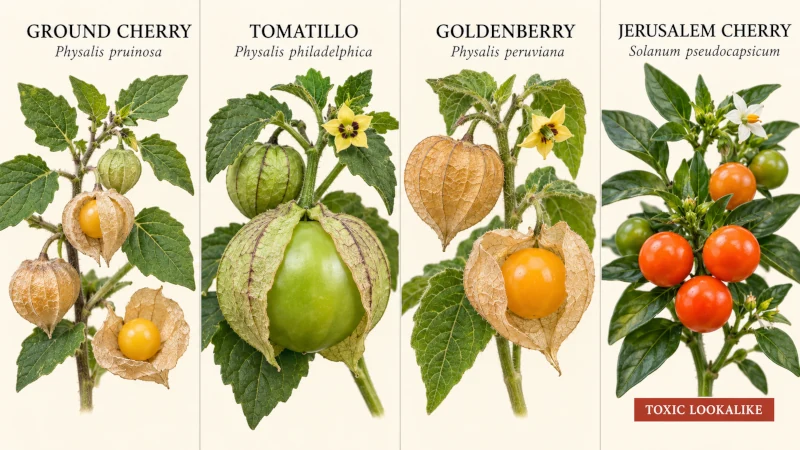
“Ground cherry” is a loose name that covers several species. In eastern North America, gardeners usually grow Physalis pruinosa or the native Virginia ground cherry, P. virginiana [Penn State Extension, 2026]. Clammy ground cherry (P. heterophylla) and smooth ground cherry grow wild across Ohio and much of the Midwest [Ohio State Weed Guide, n.d.]. Cape gooseberry, also sold as goldenberry, is P. peruviana, and the tomatillo is a close cousin, P. philadelphica, native to Mexico and Central America [Penn State Extension, 2026] [NC State Extension – tomatillo, n.d.].
| Easy to mix up. The “green tomato” of Mexican and Central American cooking is the tomatillo, P. philadelphica — not P. angulata [NC State Extension – tomatillo, n.d.]. P. angulata, the cutleaf ground cherry, matters for a different reason: it’s the species behind much of the laboratory research described below [Meira et al., 2022]. |
How to recognize it (and what it isn’t)
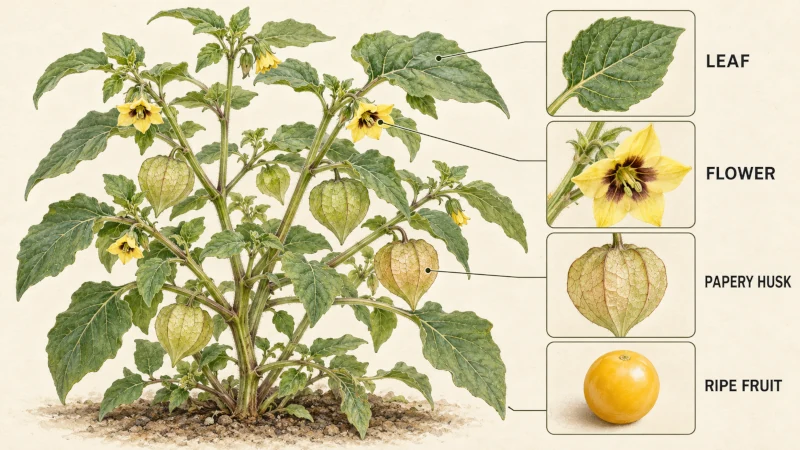
Look for yellow, bell-shaped flowers with a darker purplish center, hanging one at a time where the leaf stalk meets the stem [Ohio State Weed Guide, n.d.] [Penn State Extension, 2026]. Each flower becomes a berry sealed inside a five-sided, lantern-like husk [Ohio State Weed Guide, n.d.]. Most plants reach 1 to 3 feet and sprawl [Ohio State Weed Guide, n.d.] [Penn State Extension, 2026].
Other nightshades can look similar at a glance. Ohio State’s weed guide notes that Solanum nightshades resemble ground cherries but carry white or purple flowers in clusters rather than single yellow ones [Ohio State Weed Guide, n.d.]. Common names won’t protect you either: Jerusalem cherry (Solanum pseudocapsicum), also sold as winter cherry, is a different plant that the ASPCA lists as toxic to dogs, cats and horses [ASPCA, n.d.]. If you can’t identify a wild plant with certainty, don’t eat it.
Which parts are safe to eat
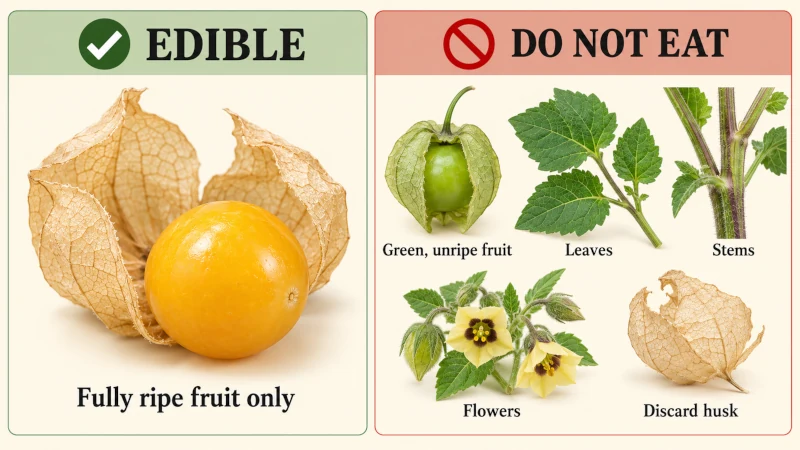
Every extension source we checked agrees on the rule: only the ripe fruit is food [NC State Extension, n.d.] [Ohio State Weed Guide, n.d.] [Penn State Extension, 2026].
| Plant part | Safe to eat? | Why |
| Ripe fruit (golden-yellow berry, tan papery husk) | Yes | Ripe fruit carries negligible amounts of the plant’s solanine alkaloids [Knight, 2008]. Eaten fresh or in jam, salsa and pies [Penn State Extension, 2026]. |
| Unripe (green) fruit | No | Contains solanine and is listed as poisonous [NC State Extension, n.d.] [Ohio State Weed Guide, n.d.]. |
| Leaves | No | Listed as poisonous [NC State Extension, n.d.] [Ohio State Weed Guide, n.d.] — and the main ingredient in traditional ground cherry tea. |
| Stems | No | Contain toxins, like other nightshade stems [Penn State Extension, 2026]. |
| Flowers | No | Listed among the poisonous parts [NC State Extension, n.d.]. |
| Husk | Discard | Extension guidance says to harvest only the fruit [NC State Extension, n.d.]. |
How to tell when ground cherries are ripe
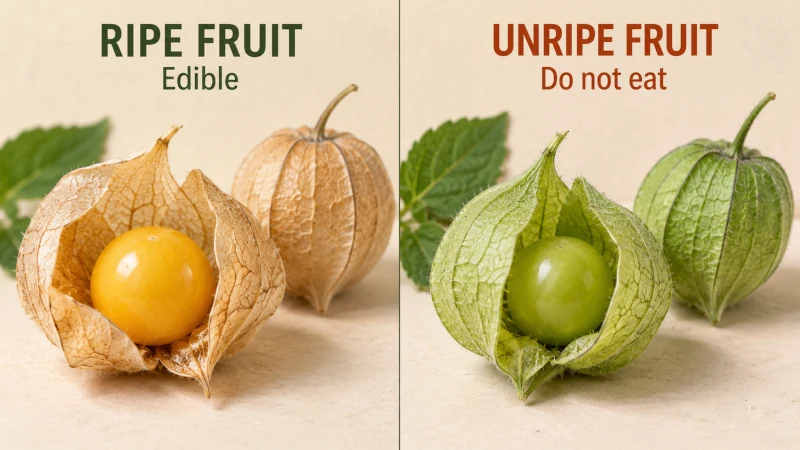
Ripe ground cherries mostly announce themselves. The berry ripens inside the husk, the husk turns beige to tan and papery, and the whole package drops to the ground [Penn State Extension, 2026]. Peel the husk back and look: a ripe berry is golden-yellow [Penn State Extension, 2026]. If it’s still green, it isn’t ready — and green fruit is the part that carries the toxins [NC State Extension, n.d.].
None of the extension guidance we reviewed says cooking makes unripe fruit or leaves safe to eat, so don’t count on it.
Fresh ground cherries keep in a cool spot inside their husks for up to three months, in the refrigerator for two to three weeks, and frozen for about six months [Penn State Extension, 2026].
Ground cherry nutrition
Ripe ground cherries are a low-calorie fruit with some vitamin C, niacin and iron. The figures below are USDA values for “groundcherries (cape-gooseberries or poha), raw” — one entry that doesn’t separate species, so treat them as approximate for whichever ground cherry you grow [USDA data via University Hospitals, n.d.].
| Nutrient | Per 1 cup (140 g), raw |
| Energy | 74 kcal |
| Carbohydrate | 15.7 g |
| Protein | 2.7 g |
| Fat | 1.0 g |
| Vitamin C | 15.4 mg |
| Niacin | 3.9 mg |
| Iron | 1.4 mg |
| Vitamin A | 1,008 IU |
| Thiamin | 0.15 mg |
| Phosphorus | 56 mg |
Source: USDA nutrient data as published by University Hospitals’ health library [USDA data via University Hospitals, n.d.].
A 2020 review by researchers at the Boyce Thompson Institute, Cornell University and Cold Spring Harbor Laboratory notes that edible Physalis fruits supply potassium and vitamin C, along with plant steroids called withanolides that are being studied in the lab. The authors describe the nutrition studies so far as preliminary [Shenstone et al., 2020].
Eat ground cherries because you like them. Penn State Extension describes the flavor as a burst of pineapple with hints of vanilla, mango or tomato, and suggests eating them fresh, cooking them into jam, salsa or pie, or drying them like raisins [Penn State Extension, 2026].
Traditional uses vs. what the evidence shows
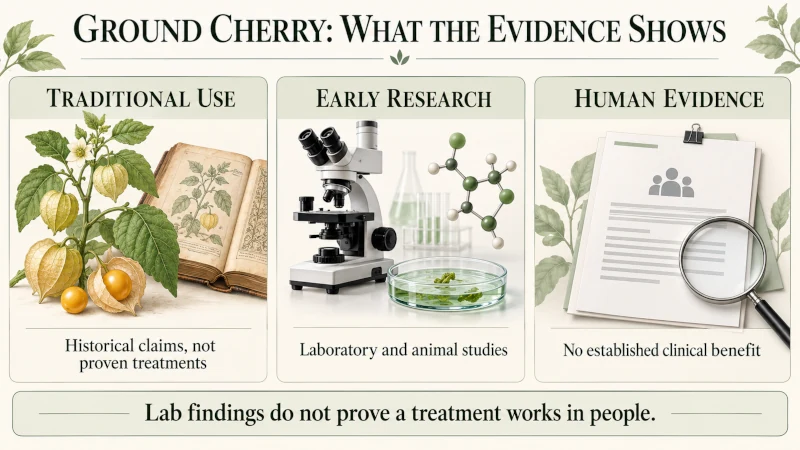
Folk medicine has used ground cherry for wounds, rashes, psoriasis, coughs and joint pain, and the fruit as a mild diuretic and laxative. These claims still circulate in older herbal encyclopedias. Here’s how each one holds up.
| Traditional claim | What research exists | Evidence grade |
| Rashes, wounds and psoriasis (decoction applied to skin) | No human studies found. An isolated compound, physalin E, reduced experimentally triggered skin inflammation when applied to the ears of mice [Meira et al., 2022]. | Insufficient — animal data only |
| Cough (drinking the leaf-and-stem decoction) | No human studies found. The recipe uses parts listed as poisonous [NC State Extension, n.d.]. | Insufficient — and not safe to try |
| Arthritis, joint pain and swelling | Physalin F, given by mouth, reduced paw swelling and joint inflammation in a mouse model of arthritis [Meira et al., 2022]. No human trials. | Insufficient — animal data only |
| Diuretic and mild laxative (fruit) | Traditional use of related goldenberry fruit as a diuretic is described, without controlled human studies [Perk et al., 2013]. | Traditional use only |
| Cancer prevention and “antioxidant” protection | Physalins kill cancer cells in lab dishes and slowed tumors in some mouse studies [Meira et al., 2022]; withanolide extracts were toxic to cancer cells in the lab [Shenstone et al., 2020]. | Early laboratory research |
| “Liver congestion” (attributed to P. angulata) | Nothing found in the sources reviewed. | Insufficient |
Most of the lab work centers on physalins, steroid-like compounds found mainly in Physalis species. More than 75 have been described; physalins B and F are the most potent studied so far [Meira et al., 2022]. In cell and animal experiments they dampen inflammatory signaling, and some suppress immune cells strongly enough to prevent transplant rejection in mice [Meira et al., 2022]. That cuts both ways. A compound that quiets the immune system isn’t automatically a gentle home remedy.
The 2022 review that gathered this research says plainly that mechanisms, toxicology and animal results still need better characterization before physalins can move into clinical studies [Meira et al., 2022]. None of it used a homemade tea, and none of it tells you a safe amount of leaves or stems.
If you came here looking for a skin remedy, our guide to herbs for skin issues sorts the options by how strong the human evidence is. For a cough, honey and a few other options have better support — see herbs for colds and flu and the best foods for cold and flu.
Why the leaf-and-stem tea isn’t safe
Some traditional recipes call for boiling ground cherry leaves and stems in water and drinking several cups a day. Skip it.
NC State Extension lists every part of the plant except the ripe fruit as toxic, names solanine and related alkaloids as the cause, and describes effects ranging from headache, stomach pain and diarrhea to depressed breathing and circulation. It rates the poison severity as high and notes poisoning may be fatal [NC State Extension, n.d.]. Ohio State’s weed guide likewise calls the leaves and unripe fruit poisonous and potentially fatal, while adding that toxicity takes large amounts and poisonings are rare [Ohio State Weed Guide, n.d.]. A veterinary toxicology reference agrees that Physalis poisonings are rarely reported [Knight, 2008].
Rare poisoning isn’t the same thing as a safe dose, and nobody has established one. Set that against benefits that have never been shown in people, and the tea has nothing to offer. Comfrey went through the same reversal — once brewed as a tea, now known to injure the liver when swallowed, as our comfrey root guide explains.
The compress and lotion versions don’t fare better. There are no human studies, and these preparations put plant extract on broken, inflamed skin. Whatever new topical product you try, patch testing it on a small area first is a sensible habit.
Side effects, interactions, and who should avoid it
Eating the ripe fruit
Ripe ground cherries are a garden and farmers’-market food [Penn State Extension, 2026]. Concentrated products are a different matter. In a 2013 rat study of freeze-dried goldenberry (P. peruviana) juice, a single 5,000 mg/kg dose killed no animals, but 90 days of daily high doses raised markers of heart-muscle damage in male rats, and half the males on the top dose died [Perk et al., 2013]. The authors also cite reports from Turkey — mostly conference presentations — of high blood pressure and a dangerous heart rhythm in people using goldenberry products for weight loss [Perk et al., 2013]. A bowl of fresh fruit isn’t the same exposure, but this is a good reason to skip ground cherry or goldenberry extract pills.
Medication interactions
No human interaction studies exist for ground cherry. Two theoretical concerns come from the lab. Physalins suppressed immune responses in animal studies [Meira et al., 2022], which matters if you take immunosuppressants after a transplant or for an autoimmune condition. And screening tests on goldenberry juice came back positive for cardiac glycoside–type compounds [Perk et al., 2013], which matters if you take digoxin or another heart-rhythm medicine. Neither has been shown to apply to a handful of fresh fruit. Both are reasons to avoid extracts and teas, and to ask your pharmacist before using any Physalis product as medicine.
Pregnancy and breastfeeding
There’s no safety research on ground cherry leaf, stem or extract preparations in pregnancy or breastfeeding, so don’t use them. Ripe fruit as an occasional food is a separate question; if you’re unsure, ask your obstetric provider.
Who should avoid ground cherry preparations
- Anyone pregnant or breastfeeding (leaf, stem and extract preparations).
- People taking immunosuppressants, digoxin or other heart-rhythm medicines, unless a clinician has approved it.
- Young children around wild plants — keep them away from unripe fruit and foliage.
- Anyone who can’t identify the plant with certainty.
Pets and livestock
Sheep and other grazing animals have been poisoned by ground cherry foliage and unripe berries, though animals usually avoid the plant [Ohio State Weed Guide, n.d.]; in one report, sheep died after eating cutleaf ground cherry [Knight, 2008]. We found no veterinary source saying ripe ground cherries are safe for dogs, so don’t feed them to pets, and keep dogs out of patches with green fruit. If your pet eats part of the plant, call your veterinarian or the ASPCA Animal Poison Control Center at (888) 426-4435; a consultation fee may apply [ASPCA, n.d.].
Signs of poisoning and when to get help
Solanine poisoning mostly hits the gut, and symptoms are often delayed 8 to 10 hours after eating [MedlinePlus, 2025]. MedlinePlus’s guidance is written for green potatoes, which carry the same toxin; NC State lists a very similar picture for Physalis [MedlinePlus, 2025] [NC State Extension, n.d.]. Watch for:
- Nausea, vomiting, stomach pain or diarrhea
- Headache, fever, or an unusually low body temperature
- Dilated pupils or vision changes
- Confusion, agitation or hallucinations
- In large ingestions: slow pulse, slowed breathing, loss of sensation or paralysis [MedlinePlus, 2025]
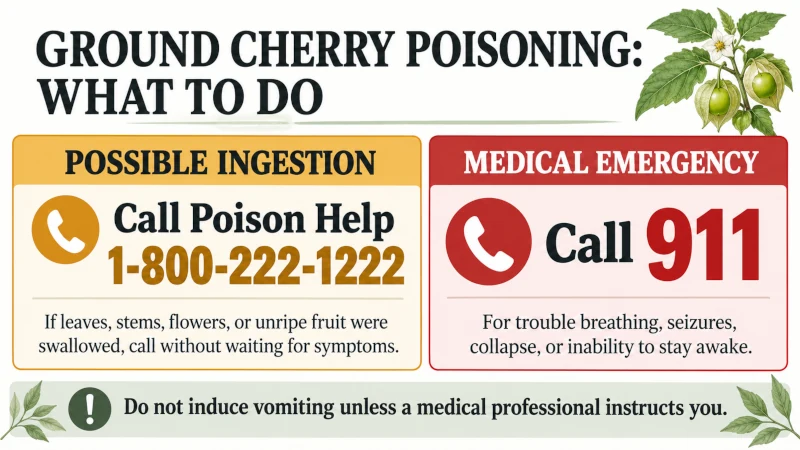
| If someone has eaten leaves, stems, flowers or unripe fruit, call Poison Help at 1-800-222-1222. It connects you to your local poison center, it’s free and confidential, and you don’t need to wait for symptoms [HRSA Poison Help, 2025] [MedlinePlus, 2025]. Call 911 for trouble breathing, a seizure, collapse, or someone who can’t stay awake. |
Don’t make the person vomit unless poison control or a clinician tells you to. When you call, have the plant part, the amount and the time it was eaten ready [MedlinePlus, 2025]. Most people recover within one to three days, though some need hospital care [MedlinePlus, 2025].
| HEALTH DISCLAIMER: This article is for general education and is not medical advice. Ground cherry leaves, stems, flowers and unripe fruit are toxic and should not be eaten or used to make teas, compresses or lotions. Talk with your doctor or pharmacist before using any herbal product, especially if you are pregnant or breastfeeding, caring for a child, taking prescription medicines, or managing a chronic condition. In a poisoning emergency, call Poison Help at 1-800-222-1222; for a medical emergency, call 911. |
Frequently Asked Questions
Are ground cherries poisonous?
The ripe fruit isn’t; it’s eaten fresh and cooked [Penn State Extension, 2026]. Everything else — leaves, stems, flowers and unripe green fruit — contains solanine and is considered poisonous [NC State Extension, n.d.] [Ohio State Weed Guide, n.d.]. Serious poisonings are rare [Knight, 2008], but there’s no reason to risk one.
Can you eat ground cherries raw?
Yes, once they’re ripe. Pull them from the husk and eat them like grapes, or use them in jam, salsa or pie, or dry them like raisins [Penn State Extension, 2026].
Are ground cherries the same as tomatillos or goldenberries?
Same genus, different species. Tomatillo is P. philadelphica; goldenberry or Cape gooseberry is P. peruviana; garden ground cherries are usually P. pruinosa or P. virginiana [Penn State Extension, 2026] [NC State Extension – tomatillo, n.d.]. The same rule applies to all of them: only the ripe fruit is edible [NC State Extension – tomatillo, n.d.].
Can dogs eat ground cherries?
Skip it. Foliage and unripe fruit have poisoned animals [Ohio State Weed Guide, n.d.] [Knight, 2008], and we found no veterinary source saying the ripe fruit is safe for dogs. If your dog eats any part of the plant, call your vet or ASPCA Animal Poison Control at (888) 426-4435 [ASPCA, n.d.].
Does ground cherry help arthritis or psoriasis?
Not in any way shown in people. Compounds isolated from Physalis reduced inflammation in mouse models of arthritis and skin inflammation, but no human trials exist [Meira et al., 2022]. Stick with treatments your doctor or dermatologist recommends.
How long do ground cherries keep?
Up to three months in their husks in a cool spot, two to three weeks in the refrigerator, and about six months frozen [Penn State Extension, 2026].
References
- NC State Extension. “Physalis (Strawberry Tomato, Ground Cherry).” North Carolina Extension Gardener Plant Toolbox. n.d. View source
- NC State Extension. “Physalis philadelphica (Tomatillo).” North Carolina Extension Gardener Plant Toolbox. n.d. View source
- Gibson MJR. “Growing Ground Cherries.” Penn State Extension. View source
- The Ohio State University. “Groundcherries (Physalis spp.).” Ohio Perennial and Biennial Weed Guide. n.d. View source
- Knight A. “Physalis species: Chinese lantern plant.” In: Guide to Poisonous House and Garden Plants. View source
- MedlinePlus Medical Encyclopedia. “Potato plant poisoning – green tubers and sprouts.” U.S. National Library of Medicine. View source
- Health Resources and Services Administration. “About Us.” Poison Help. View source
- ASPCA Animal Poison Control. “Jerusalem Cherry (Solanum pseudocapsicum).” Toxic and Non-Toxic Plants. n.d. View source
- University Hospitals Health & Wellness Library. “Groundcherries, (cape-gooseberries or poha), raw, 1 cup” (USDA nutrient data). n.d. View source
- Shenstone E, Lippman Z, Van Eck J. “A review of nutritional properties and health benefits of Physalis species.” Plant Foods Hum Nutr. View source
- Meira CS, Soares JWC, dos Reis BPZC, et al. “Therapeutic Applications of Physalins: Powerful Natural Weapons.” Front Pharmacol. View source
- Perk BO, Ilgin S, Atli O, Duymus HG, Sirmagul B. “Acute and Subchronic Toxic Effects of the Fruits of Physalis peruviana L.” Evid Based Complement Alternat Med. View source


