
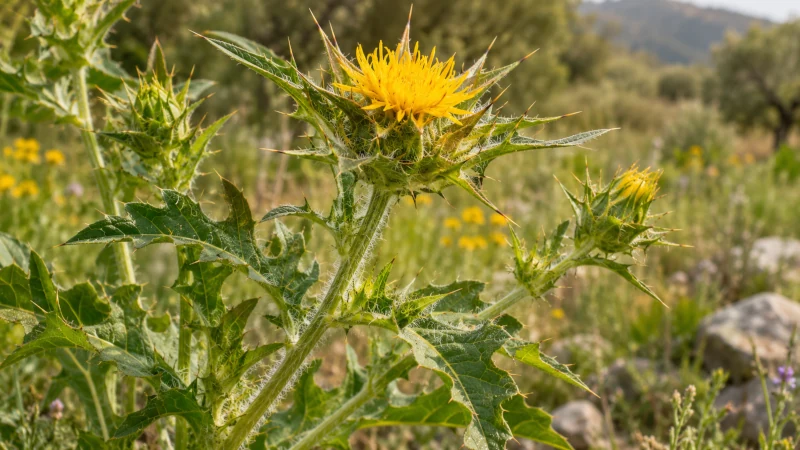
Blessed thistle (Cnicus benedictus) is a bitter herb with one use that holds up reasonably well: taking the edge off a poor appetite or mild indigestion. European regulators accept blessed thistle for exactly that, and even there the support comes from long traditional use rather than clinical trials [EMA, 2023]. Most of the other benefits you’ll see promised, such as more breast milk, lower blood sugar or a “cleansed” liver, have not been shown in people.
That doesn’t make it worthless. It means you should know which claims hold up, and whether you’re someone who should skip it, before you buy a bottle.
What blessed thistle is
Blessed thistle is a spiny member of the daisy family (Asteraceae), the same plant family as ragweed [LactMed, 2022]. Herbal products use the dried above-ground parts: leaves, stems and flower heads [EMA, 2026]. You may also see it sold as holy thistle, St. Benedict’s thistle or spotted thistle.
Its bitter taste comes mostly from cnicin, one of a group of compounds called sesquiterpene lactones [Drugs.com, 2025]. Bitter herbs have traditionally been taken before meals to get saliva and stomach juices flowing, which is the whole idea behind blessed thistle as an appetite aid.
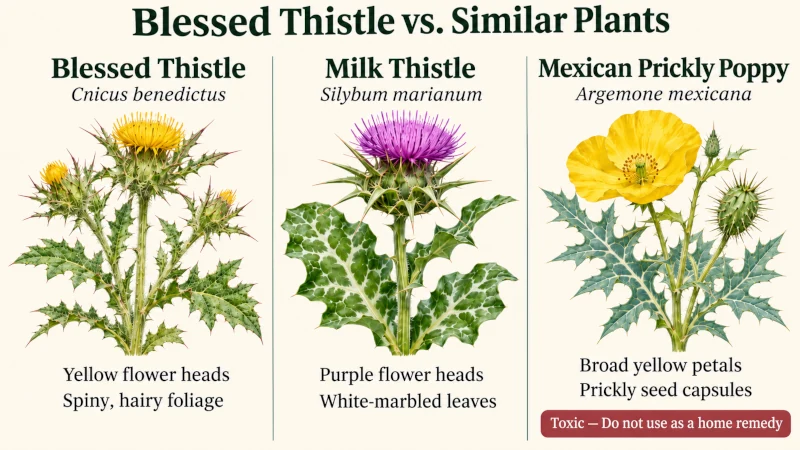
Don’t confuse it with milk thistle
“Holy thistle” is also a common name for milk thistle (Silybum marianum), a different plant with different chemistry and a different research record [NCCIH, 2025]. Check the Latin name on any label. You want Cnicus benedictus, sometimes listed under its synonym Centaurea benedicta [Drugs.com, 2025].
Never substitute Mexican prickly poppy
Some older herbal guides describe a “Mexican holy thistle” with sedative uses. That plant is Argemone mexicana, the Mexican prickly poppy, and it is not a thistle at all. Oil from its seeds contains the toxic alkaloids sanguinarine and dehydrosanguinarine. When that oil contaminates cooking oil it causes a poisoning called epidemic dropsy: swelling, skin changes, breathing trouble that can progress to heart failure, and glaucoma [Sharma et al., 1999]. The seeds are the documented danger, but with a plant this toxic there is no good reason to use any part of it as a home remedy.
Blessed thistle benefits: what the evidence says
Appetite and indigestion: accepted traditional use
This is the one use with official standing. The European Medicines Agency’s herbal committee lists blessed thistle as a traditional herbal medicine for temporary loss of appetite, indigestion (dyspepsia) and mild cramping of the digestive tract [EMA, 2023]. “Traditional” has a specific meaning there: the herb has been used safely for at least 30 years, including 15 in the EU, and its effect is plausible [EMA, 2026]. It does not mean trials have proven it. The committee’s review found no clinical studies of blessed thistle for any disease [EMA Assessment Report, 2023].
In practice, a cup before meals is a reasonable thing to try for occasional fullness or a flagging appetite. Frequent indigestion is a different matter, and so is appetite loss you can’t explain. Both deserve a doctor’s look before an herb (see the warning signs below). To compare blessed thistle with other options, see our guide to herbs for stomach issues that actually help.
Breast milk supply: popular, not proven
Blessed thistle is a fixture in lactation teas and capsules. The evidence hasn’t kept up with the marketing. LactMed, the National Library of Medicine’s database on medicines and breastfeeding, says no scientifically valid clinical trials support using it to increase milk supply [LactMed, 2022]. In an Australian survey of 98 mothers taking it, the average rating landed between “slightly” and “moderately” effective, and 8% reported side effects, most often nausea, stomach cramps, dry mouth and fatigue. LactMed also records raised liver enzymes in a woman drinking a blended lactation tea that contained blessed thistle [LactMed, 2022].
Expert bodies differ on how cautious to be. The Academy of Breastfeeding Medicine names blessed thistle among commonly mentioned herbs but recommends no specific galactagogue, herbal or prescription [Brodribb & ABM, 2018]. The EMA goes further and advises against using it while breastfeeding because its safety hasn’t been established [EMA, 2023]. Where they agree: if your supply seems low, start with a lactation consultant. Frequent, effective milk removal is the core fix, and no supplement should replace that assessment [Brodribb & ABM, 2018; LactMed, 2022].

Blood sugar: animal data only
Claims that blessed thistle helps type 2 diabetes trace back to animal work. In a university thesis, a leaf extract injected into the abdomens of rats lowered their blood glucose [UWC thesis, n.d.]. Injected doses in rats say little about a cup of tea in a person. No clinical studies exist, and the EMA’s full review contains no blood-sugar data at all [EMA Assessment Report, 2023]. Blessed thistle is not a diabetes treatment, complementary or otherwise. If you’re working on glucose control, start with what your blood sugar levels mean and the foods that help control blood sugar.
Infections and wounds: test-tube results
Older lab studies found cnicin and the plant’s extracts active against some bacteria [EMA Assessment Report, 2023]. The EMA describes those studies as very old, with incomplete information, and blessed thistle compresses and sitz baths have not been tested in people. Contact dermatitis has been reported in people sensitive to the daisy family, so a homemade decoction on broken skin carries real downside for an unproven benefit. If hemorrhoids are why you’re looking, these herbs for hemorrhoids, ranked by the evidence are a better place to start.
Liver, heart and the rest of the folk list
Traditional herbals credit blessed thistle with a long list of jobs: stimulating bile, strengthening the heart, “purifying” the blood, helping the kidneys and lungs, sharpening memory, and easing headaches, gout and colds. No clinical trials support any of these [Drugs.com, 2025]. Its liver reputation also overlaps with milk thistle, a separate plant promoted for liver disorders [NCCIH, 2025]. If liver health is your goal, the foods with the best evidence for your liver are a sounder starting point.
The evidence at a glance
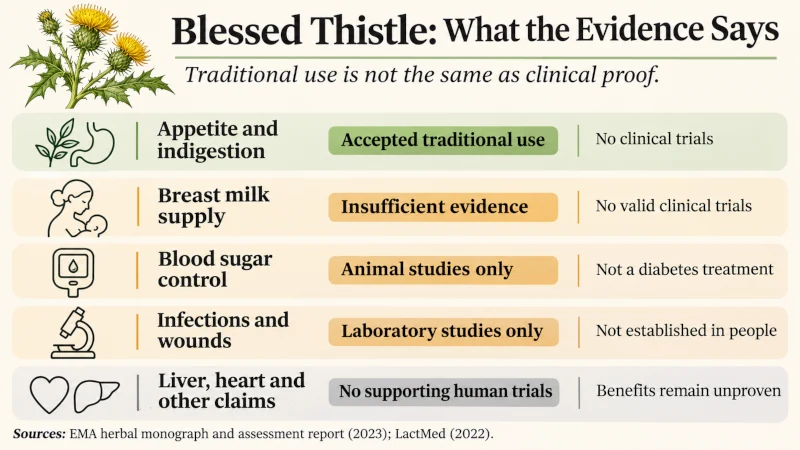
| Claimed use | What’s behind it | Verdict |
| Loss of appetite, mild indigestion | Long traditional use accepted by the EMA; no clinical trials | Traditional use only. Reasonable for short-term, mild symptoms |
| Increasing breast milk | Surveys and popularity; no valid trials | Insufficient evidence; EMA advises against while breastfeeding |
| Lowering blood sugar | Rat studies with injected extract | Animal data only. Not a diabetes treatment |
| Infections, wounds, hemorrhoids | Old test-tube studies | Lab data only |
| Heart, liver, kidneys, lungs, memory, “blood cleansing” | Folk tradition | No evidence in people |
How to take blessed thistle
No clinical studies have established a dose [Drugs.com, 2025]. The EMA monograph lists these traditional doses for adults [EMA, 2023]:
| Form | Amount | How often |
| Tea (dried herb, steeped) | 1.5–3 g in 150 mL (about 5 oz) of water | 3 times a day |
| Liquid extract (1:1, 25% alcohol) | 1.5–2 mL | 3 times a day |
| Tincture (1:5, 25% alcohol) | 3–6 mL | 3 times a day |
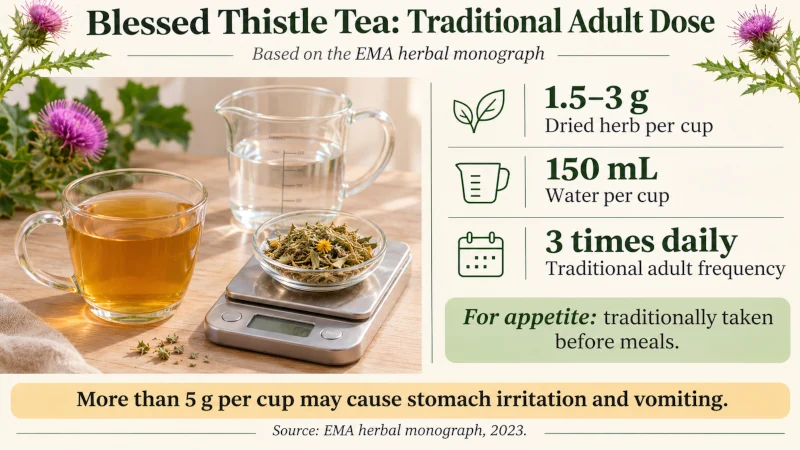
For appetite, take it before meals. A few cautions matter more than the exact numbers. More is not better: over 5 g of herb in a single cup can irritate the stomach and cause vomiting [EMA, 2023], and the generous “handful per liter” recipes in some herbal guides can push past that. Tinctures and extracts contain alcohol. If your symptoms last more than two weeks, stop and see a doctor or pharmacist [EMA, 2023]. Blessed thistle is not recommended for anyone under 18, because safety data are lacking [EMA, 2023].
Supplements also aren’t checked for safety or effectiveness before they’re sold, and what’s in the bottle can differ from the label [LactMed, 2022]. A product with a third-party quality seal confirms ingredients, not that the herb works.
Side effects and who should avoid blessed thistle
Reported side effects are mostly digestive: nausea, stomach cramps and, at high doses, vomiting [LactMed, 2022; EMA, 2023]. Allergic reactions can occur, though how often isn’t known [EMA, 2026].
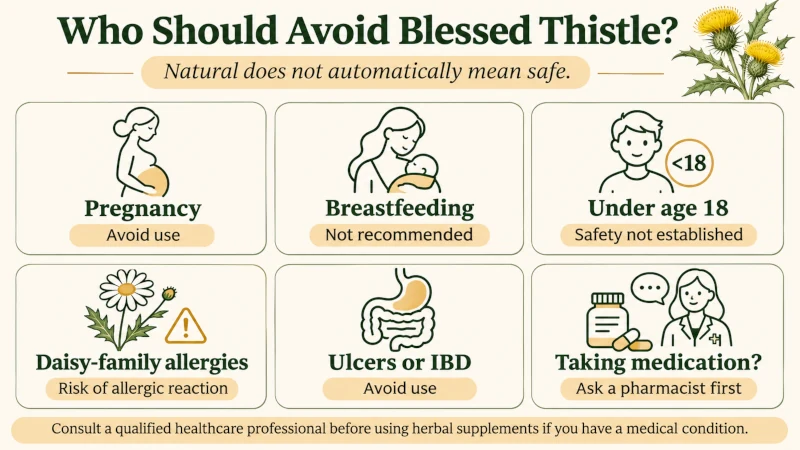
Skip it if you…
- Are pregnant. It was traditionally used to bring on menstruation or end a pregnancy, and the EMA says it should be avoided [EMA Assessment Report, 2023].
- Are breastfeeding, unless your doctor or lactation consultant agrees after looking at your situation.
- Are under 18.
- Are allergic to ragweed or other daisy-family plants. Cross-reactions are possible [EMA Assessment Report, 2023].
- Have a stomach ulcer, Crohn’s disease or another inflammatory bowel condition. Drugs.com lists these as reasons not to use it because the herb may raise stomach acid; the EMA calls use “inadvisable” with peptic ulcers [Drugs.com, 2025; EMA Assessment Report, 2023].
Medication interactions
No interactions are well documented [Drugs.com, 2025]. The EMA notes two theoretical ones. Because blessed thistle may raise stomach acid, it could work against antacids, H2 blockers and proton pump inhibitors. A lab finding also raises a theoretical bleeding concern that hasn’t been seen in people [EMA Assessment Report, 2023]. Herbal supplements in general can interact with blood thinners and blood-sugar-lowering drugs [Brodribb & ABM, 2018]. If you take any of these, ask your pharmacist first.
When indigestion needs a doctor, not an herb
Get medical care right away if indigestion comes with any of these [NIDDK, 2025]:
- Chest, jaw, neck or arm pain, or shortness of breath (call 911)
- Trouble swallowing or painful swallowing
- Frequent vomiting, or blood in your vomit
- Black, tar-like stools
- Severe, constant belly pain, or bloating that won’t go away
- Yellowing of the eyes or skin
- Weight loss or appetite loss you can’t explain
See a doctor, too, if indigestion keeps coming back or doesn’t improve [NIDDK, 2025].
| HEALTH DISCLAIMER: This article is general information, not a substitute for advice from your doctor, pharmacist or another qualified health professional. Herbal products are not held to the same standards as medicines. Talk to a professional before using blessed thistle if you are pregnant, breastfeeding, under 18, taking any medication or managing a health condition, and stop using it if you notice a reaction. |
Frequently Asked Questions
Is blessed thistle the same as milk thistle?
No. Blessed thistle is Cnicus benedictus; milk thistle is Silybum marianum. Both are sometimes called “holy thistle,” so check the Latin name on the label [NCCIH, 2025; Drugs.com, 2025].
Does blessed thistle increase breast milk?
There is no good evidence that it does. LactMed reports no valid clinical trials, and the EMA advises against using it while breastfeeding [LactMed, 2022; EMA, 2023]. A lactation consultant is the best first step for low supply.
How much blessed thistle tea is safe?
The EMA’s traditional adult dose is 1.5–3 g of dried herb in 150 mL of water, three times a day. More than 5 g in one cup can cause stomach irritation and vomiting [EMA, 2023].
Can blessed thistle lower blood sugar?
It has only been shown in rats given injected extracts [UWC thesis, n.d.]. It has not been studied in people with diabetes and should not replace diabetes treatment.
Is blessed thistle safe during pregnancy?
No. It was traditionally used to bring on menstruation, and the EMA advises avoiding it in pregnancy [EMA Assessment Report, 2023].
How long can I take blessed thistle?
If appetite loss or indigestion lasts more than two weeks while you’re using it, stop and see a doctor or pharmacist [EMA, 2023].
References
- European Medicines Agency, Committee on Herbal Medicinal Products. European Union herbal monograph on Cnicus benedictus L., View source
- European Medicines Agency, HMPC. Assessment report on Cnicus benedictus L., View source
- European Medicines Agency. Cnici benedicti herba – herbal medicinal product View source
- Drugs and Lactation Database (LactMed). Blessed Thistle. View source
- Drugs.com. Blessed Thistle (Natural Products monograph). View source
- Brodribb W; Academy of Breastfeeding Medicine. ABM Clinical Protocol #9: Use of Galactogogues in Initiating or Augmenting Maternal Milk Production, View source
- Sharma BD, Malhotra S, Bhatia V, Rathee M. Epidemic dropsy in India. Postgraduate Medical Journal. View source
- National Center for Complementary and Integrative Health. Milk Thistle. View source
- National Institute of Diabetes and Digestive and Kidney Diseases. Symptoms & Causes of Indigestion. View source
- University of the Western Cape electronic theses repository. “Investigation of the antidiabetic activity of Cnicus benedictus L. in rats.” View source


