
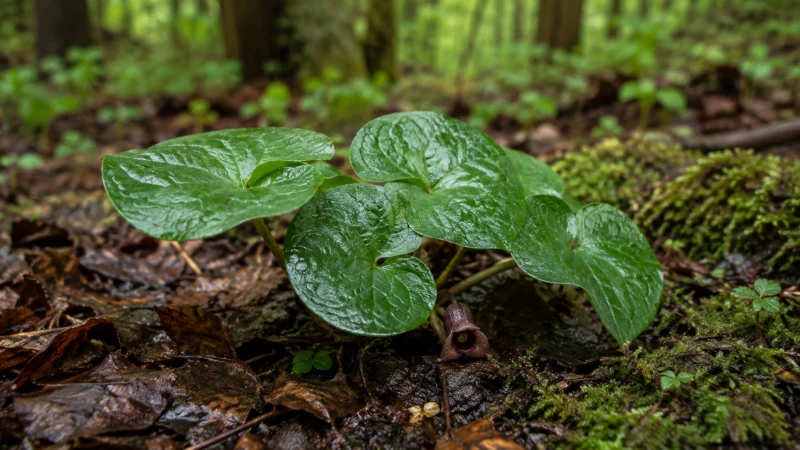
If you’re reading up on asarum plant benefits, here’s the honest answer first: this woodland plant has a long history in European and North American folk medicine, but it belongs to a plant family that produces aristolochic acid — a substance that U.S. and international health agencies classify as a known human carcinogen and a cause of permanent, often irreversible kidney failure U.S. National Toxicology Program, 2021. That one fact outweighs every traditional use on the list.
So the modern guidance isn’t “use it carefully.” It’s “don’t take it.” Below is what asarum actually is, what people once used it for, why medicine walked away from it, and — if you’ve already taken it — exactly what to do next.
What the asarum plant is
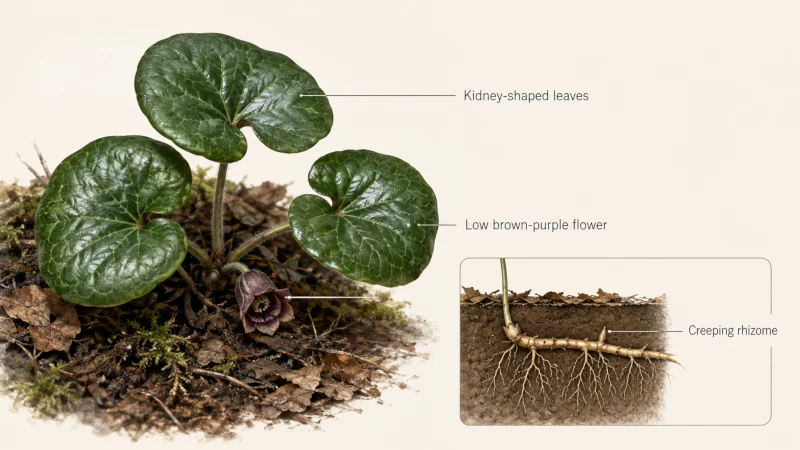
Asarum is a low, creeping plant of the birthwort family (Aristolochiaceae). It grows only about 10–15 cm high, spreads across the floor of shady forests, and has glossy, kidney-shaped leaves with small purplish-brown flowers hidden near the ground. You’ll see it under several folk names: asarabacca, hazelwort, wild nard, and European snakeroot. Two species show up most in herbal writing — Asarum europaeum in Europe, and Asarum canadense, the North American plant usually called wild ginger Han et al., 2019.
One point worth clearing up before anything else: asarum “wild ginger” is not the ginger you cook with. Culinary ginger is Zingiber officinale, a completely different, food-safe plant. Asarum shares a common name and a spicy smell, and nothing else. Confusing the two is a genuine safety risk.
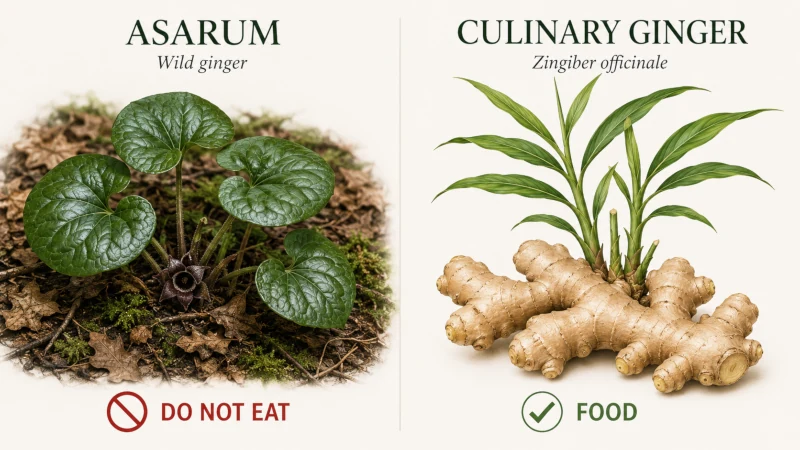
Historically, the root and leaves were the parts used. Chemically, asarum carries a pungent aromatic oil and, importantly for this article, aristolochic acids — the compounds that define its whole family and drive the safety problem covered below Han et al., 2019.
What asarum was traditionally used for
Old herbals leaned on asarum mainly for its violence on the gut. Understanding those uses helps explain why it fell out of favor — none of them is a reason to take it today.
- As an emetic — to force vomiting, including after poisoning or heavy drinking. The effect comes from harsh irritation of the stomach lining, not from any gentle medicinal action.
- As a purgative — to provoke strong diarrhea, on the old and now-discarded theory that “purging” cured illness.
- As an errhine (sneezing powder) — inhaled to trigger sneezing and clear the nose during congestion.
- In folk practice, to bring on menstruation or end a pregnancy — a use that is both ineffective and dangerous, and one no one should ever attempt.
Traditional use tells you a plant was available and strong, not that it was safe or that it worked. On the modern evidence, asarum’s traditional benefits are best graded as historical claims with no credible clinical support — and its dramatic effects are simply the signs of a plant irritating and poisoning the body.
The real problem: aristolochic acid
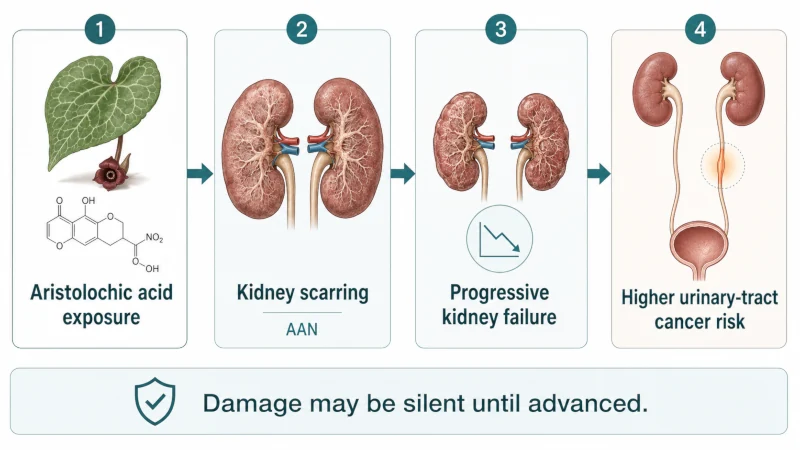
Every plant in the Aristolochiaceae family — including the Aristolochia and Asarum genera — can contain aristolochic acids Han et al., 2019. This is where asarum stops being a quaint folk remedy and becomes a documented hazard.
Aristolochic acids I and II are classified by the International Agency for Research on Cancer as Group 1 — carcinogenic to humans, the same category as asbestos and tobacco IARC / WHO. The U.S. National Toxicology Program independently lists aristolochic acids as known human carcinogens, and the American Cancer Society carries the same listing U.S. National Toxicology Program, 2021, American Cancer Society.
The harm takes two main forms. The first is aristolochic acid nephropathy (AAN) — progressive scarring of the kidneys that can advance to complete kidney failure requiring dialysis or a transplant. The second is cancer of the upper urinary tract, which develops in a large share of people affected by AAN. Two features make this especially frightening: the kidney damage is often silent until it is advanced, and it is largely irreversible, with no specific antidote U.S. National Toxicology Program, 2021, Han et al., 2019.
Regulators have acted on exactly this. The U.S. Food and Drug Administration advises consumers to stop using any product that may contain aristolochic acid, names “Asarum” specifically among the ingredients of concern, and treats any botanical containing the acid as unsafe and adulterated U.S. FDA import alert on aristolochic acid. Health Canada issued a parallel warning naming asarum (wild ginger) as an aristolochic-acid-containing plant to avoid Health Canada, 2004 (Canada).
An honest note on the scientific debate
The picture isn’t identical for every species. Some researchers report that certain asarum plants — such as the traditional Chinese herb xixin — contain relatively lower levels of aristolochic acids I and II than Aristolochia does, and a few studies argue that carefully limited asarum root preparations may carry lower risk Xie et al., 2021. That is a real debate, but it is not a green light. The amount varies by species, plant part, and preparation; aristolochic acids are genotoxic with no established safe threshold; and Western regulators still class asarum as an aristolochic-acid botanical to avoid. When the possible downside is irreversible kidney failure or cancer, “probably lower risk” is not a basis for taking it at home.
What the evidence actually supports
It helps to separate what’s well established from what’s merely claimed:
- Well established: asarum is a strong gastrointestinal irritant. That’s the real mechanism behind its old use as an emetic and purgative.
- Well established (harm): asarum contains aristolochic acids, which are nephrotoxic and carcinogenic to humans.
- Not supported: there is no strong human evidence that asarum safely treats or prevents any condition at doses that don’t also expose you to aristolochic acid.
Put plainly, there is no asarum benefit that outweighs the risk for home use. The plant’s effects that once looked medicinal are the same effects that make it dangerous.
Safety: side effects, interactions, and who should avoid it
Short-term effects. Even a modest amount can cause intense nausea, forceful vomiting, stomach cramping, and diarrhea. Larger amounts can bring on severe gastroenteritis, with a risk of bleeding in the stomach or intestines.
The bigger danger. The kidney damage and urinary-tract cancer risk tied to aristolochic acid can build quietly over time, long after any short-term effects fade U.S. National Toxicology Program, 2021. This is what makes asarum different from a herb that just gives you an upset stomach.
Medication interactions. Because asarum is nephrotoxic, taking it alongside other things that stress the kidneys — such as NSAID pain relievers (ibuprofen, naproxen), certain antibiotics, or imaging contrast dye — is especially risky, as is using it if you take medicines your kidneys clear. These interactions aren’t neatly mapped out, for the simple reason that the plant shouldn’t be used at all.
Pregnancy and breastfeeding. Avoid completely. Asarum was historically used in attempts to end pregnancy, and aristolochic acid is genotoxic. It is not safe during pregnancy or while breastfeeding.
Who should avoid it. As something you swallow, everyone. The danger is greatest for people with existing kidney disease, anyone pregnant or breastfeeding, children, and older adults — but there is no group for whom taking asarum at home is a reasonable idea. If you want to talk through what herbs do and don’t have evidence for the kidneys and bladder, this careful overview of urinary conditions and when to see a doctor is a better starting point.
If you’ve already taken asarum
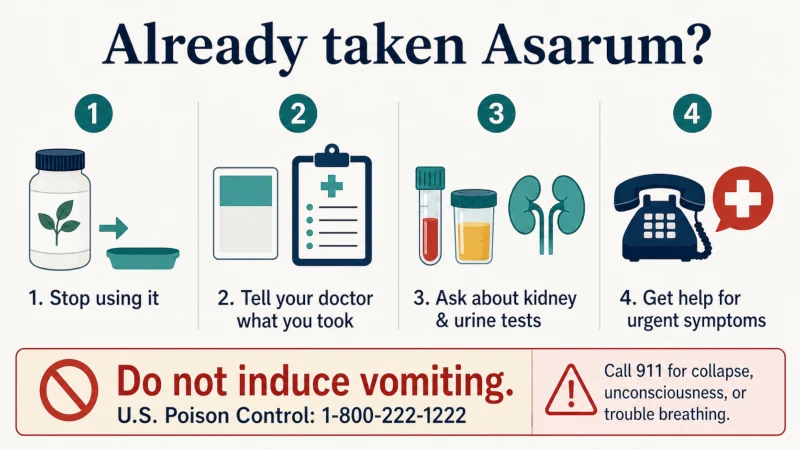
Try not to panic — but do act. Stop taking it, and stop any product that lists asarum, aristolochia, bragantia, wild ginger, mu tong, or fangji on the label, since these are all linked to aristolochic acid U.S. FDA import alert on aristolochic acid.
Tell your doctor what you took, roughly how much, and for how long, and ask whether a kidney-function blood test (creatinine and eGFR) and a urine test make sense for you. Because aristolochic acid damage can be silent, this is worth doing even if you feel fine.
See a doctor promptly if you notice any of these:
- Blood in your urine — pink, red, or found on a test — even once. This always deserves evaluation.
- A drop in how much you’re urinating, or unexplained swelling in your legs, ankles, or face.
- Persistent fatigue, nausea, or loss of appetite that isn’t explained by something else.
If you think someone has just swallowed a harmful amount of asarum or any herbal product, do not try to make them vomit. In the United States, call Poison Control at 1-800-222-1222 (free and available 24 hours a day), or call 911 if the person is collapsing, unconscious, or struggling to breathe. There’s more on why inducing vomiting is no longer advised in this guide to the ipecac plant and why it’s no longer recommended.
What to reach for instead
Whatever asarum was once used for, there’s a safer route. For ongoing nausea or digestive trouble, a doctor can look for the cause rather than mask it with a harsh irritant. For nasal congestion, plain saline sprays or rinses do the decongesting job without any of the risk. The general rule with a plant like this is not to swap it for another strong herb, but to step out of self-dosing entirely for anything that isn’t minor and short-lived. For symptoms involving the kidneys or bladder, start with the urinary health guides and a conversation with your doctor or pharmacist.
| Health Disclaimer: This article is for general education and is not medical advice, diagnosis, or treatment, and it does not tell you how to prepare or dose asarum. Do not use asarum as a home remedy. If you are pregnant or breastfeeding, have kidney disease, or take prescription medicines, talk with your doctor or pharmacist before using any herbal or natural product. If you have taken asarum, tell your doctor and ask about kidney and urine testing. Poisoning emergency (U.S.): do not induce vomiting — call Poison Control at 1-800-222-1222, or call 911 if the person is unconscious or struggling to breathe. |
Frequently Asked Questions
Is asarum (wild ginger) safe to take?
No. As something you swallow, asarum isn’t considered safe, because it contains aristolochic acid — a known human carcinogen linked to irreversible kidney failure and urinary-tract cancer U.S. National Toxicology Program, 2021. U.S. and Canadian regulators advise against using products that contain it U.S. FDA import alert on aristolochic acid.
Is asarum the same as the ginger I cook with?
No. Kitchen ginger is Zingiber officinale and is food-safe. Asarum is called “wild ginger” only because of its smell; botanically it’s unrelated, and it is toxic. Don’t treat them as interchangeable.
What is aristolochic acid, and why does it matter so much?
It’s a natural compound found across the birthwort family, including asarum. It damages the kidneys (aristolochic acid nephropathy) and is strongly linked to cancer of the upper urinary tract. The damage is often silent until it’s advanced and is largely irreversible Han et al., 2019, IARC / WHO.
I took an herbal product that may contain asarum — what should I do?
Stop using it and anything listing asarum, aristolochia, bragantia, wild ginger, mu tong, or fangji. Tell your doctor what you took and for how long, and ask about a kidney-function blood test and a urine test. Get medical care promptly if you see blood in your urine or develop swelling or reduced urination.
Isn’t “natural” safer than a drug?
Not automatically. Asarum is a clear example of a natural plant that is genuinely dangerous. “Natural” describes where something comes from, not whether it’s safe to put in your body.
References
- International Agency for Research on Cancer (IARC/WHO). Aristolochic acids I and II — Group 1, carcinogenic to humans; present in Aristolochia and Asarum species. → View source
- U.S. National Toxicology Program. “Aristolochic Acids,” 15th Report on Carcinogens (2021), NCBI Bookshelf NBK590841 — listed as known human carcinogens. → View source
- American Cancer Society. “Known and Probable Human Carcinogens” — lists aristolochic acid and plants containing it. → View source
- U.S. Food and Drug Administration. Import Alert 54-10, botanicals containing aristolochic acid; consumer advisory naming “Asarum.” → View source
- Han J, Xian Z, Zhang Y, Liu J, Liang A. “Systematic Overview of Aristolochic Acids: Nephrotoxicity, Carcinogenicity, and Underlying Mechanisms.” Front Pharmacol. 2019;10:648. DOI 10.3389/fphar.2019.00648 (PMID 31244661; PMC6580798). → View source
- Xie J, et al. “Quantitative Determination and Toxicity Evaluation of Aristolochic Acid Analogues in Asarum heterotropoides (Xixin) …” PMC8662950 — notes relatively lower AA I/II levels in asarum and the ongoing safety debate. → View source
- Health Canada. “Health Canada advises consumers not to use products containing aristolochic acid,” 2004 — names Asarum (wild ginger). Canadian advisory, cited as corroborating evidence. → View source
