
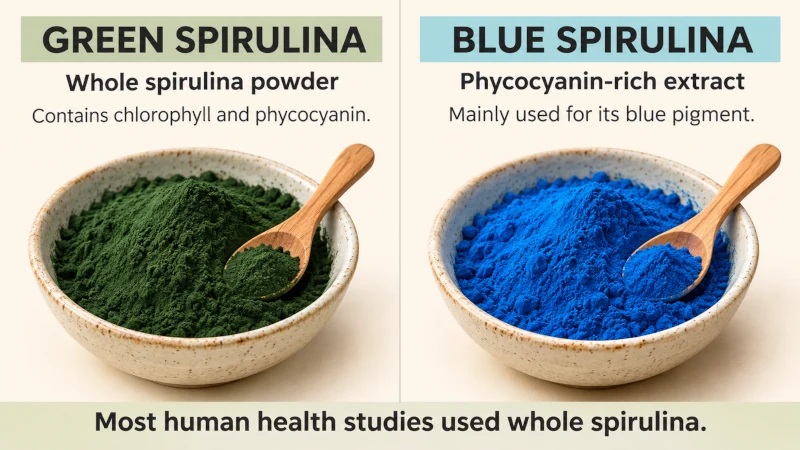
Blue spirulina isn’t a separate kind of algae. It’s an extract: the blue pigment phycocyanin, washed out of ordinary green spirulina and filtered [FDA, 2026]. That one fact changes how you should read most blue spirulina benefits claims, because nearly all the human research behind them was done on the whole green powder.
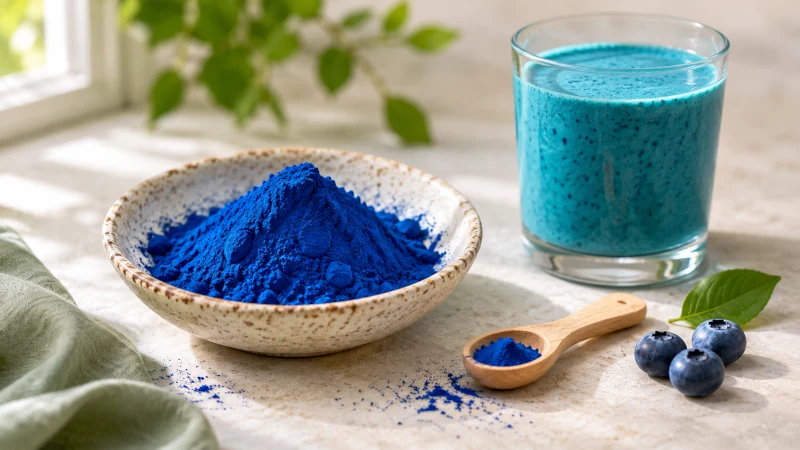
Here’s the short answer. Whole spirulina has fairly consistent evidence for nudging cholesterol and triglycerides in a better direction, and smaller, weaker evidence for weight and blood sugar. Blue spirulina extract is mainly a natural food color with promising lab research. It isn’t a usable vitamin B12 source, it hasn’t been shown to treat anemia, and some people, including anyone with an autoimmune condition or phenylketonuria, should skip it or talk to a clinician first.
What blue spirulina actually is
Spirulina is the dried biomass of Arthrospira platensis, a cyanobacterium usually called blue-green algae [LiverTox, 2019]. Its color comes from chlorophyll plus phycocyanin, a blue protein-pigment complex that can make up as much as 20% of its dry weight [LiverTox, 2019].
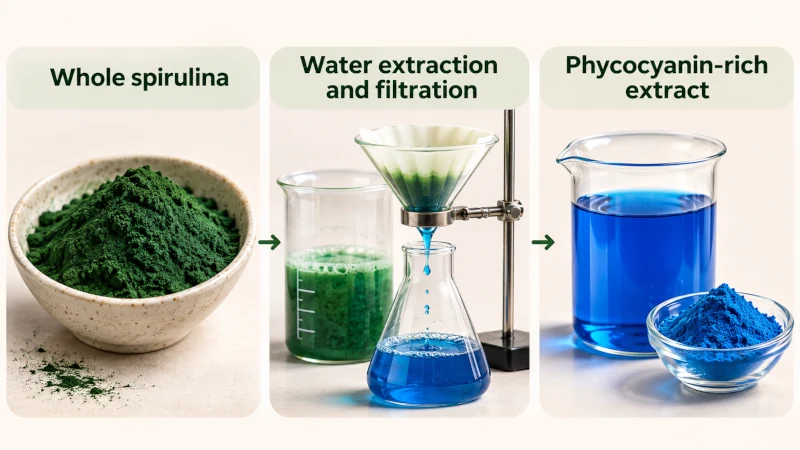
To make the blue version, producers extract dried spirulina with water and filter it. The FDA describes the result as a color additive whose main coloring components are phycocyanins, with oils, oil-soluble substances and fiber removed. In early 2026 the agency approved it for coloring foods in general, effective March 23, 2026 [FDA, 2026]. That’s why it shows up in bright blue lattes, smoothie bowls and candy.
People ate spirulina long before anyone could explain it. The Aztecs skimmed a blue-green paste they called tecuitlatl from Lake Texcoco and dried it in the sun [Pérez-Romero & Arredondo-Vega, 2023], and the Kanembu people near Lake Chad still harvest and dry a similar food called dihé [Furmaniak et al., 2017]. Both traditions used the whole green organism, not a blue extract.
Blue vs. green spirulina at a glance
| Green spirulina | Blue spirulina | |
| What it is | Whole dried cyanobacterium | Water extract rich in phycocyanin |
| Color comes from | Chlorophyll plus phycocyanin | Phycocyanin |
| Oils and fiber | Present | Largely removed during extraction |
| Human trials | Many randomized trials and several meta-analyses | Little pooled human data; mostly cell and animal studies |
| Typical use | Supplement, food ingredient | Food color, smoothie add-in, supplement |
Spirulina nutrition: impressive per 100 grams, modest per serving
USDA’s reference entry for dried spirulina lists about 57 grams of protein and about 28 milligrams of iron per 100 grams [USDA FoodData Central, n.d. — UNVERIFIED]. Those numbers get repeated on product pages, but nobody eats 100 grams. At a 3-gram serving, the same figures work out to roughly 1.7 grams of protein and under 1 milligram of iron. That’s a small bonus, not a meal.
Blue extract is a different product again. Because it’s filtered for color, don’t assume it carries the full nutrient profile of green spirulina. Check the Supplement Facts panel for what a serving actually contains.
The vitamin B12 problem
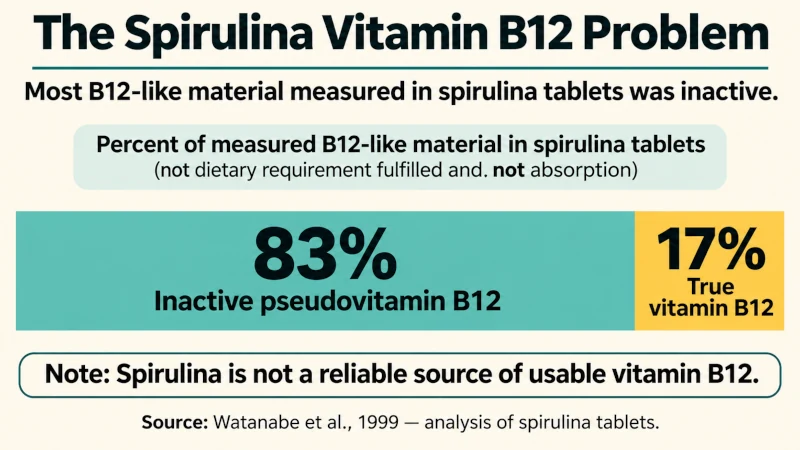
You’ll still see spirulina sold as a vegan B12 source. The tests behind that claim pick up compounds the body can’t use. When researchers analyzed spirulina tablets, 83% of the B12-like material was pseudovitamin B12, an inactive form, and only 17% was true B12 [Watanabe et al., 1999]. The NIH says plant foods contain no vitamin B12 unless they’re fortified [NIH ODS, n.d.].
If you’re vegan, get B12 from fortified foods or a supplement. If you eat eggs or dairy, those provide the active form [NIH ODS, n.d.].
What the research says about blue spirulina benefits
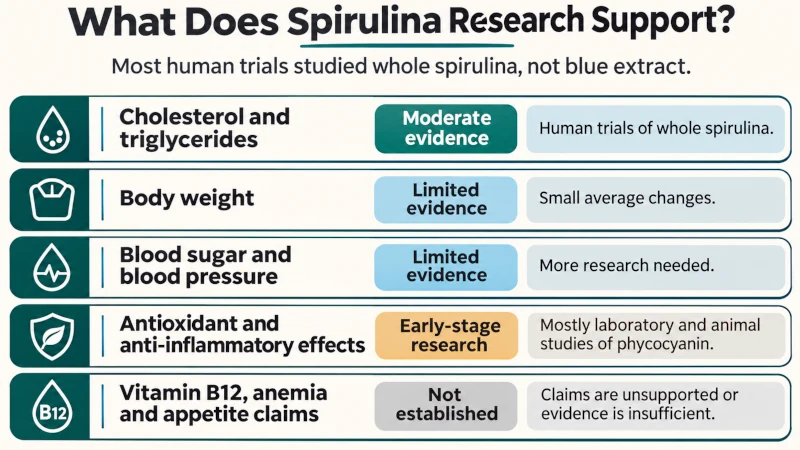
One caveat applies to everything in this section: the trials tested spirulina supplements, not the isolated blue extract. Research on phycocyanin itself is still mostly cell and animal work [Citi et al., 2024].
Cholesterol and triglycerides: the strongest case
This is where the evidence is most consistent. A meta-analysis of seven randomized trials found spirulina lowered total cholesterol, LDL cholesterol and triglycerides and raised HDL [Serban et al., 2016]. A larger 2023 analysis of 20 studies with 1,076 participants pointed the same way [Rahnama et al., 2023].
Treat that as supportive, not decisive. Individual trials have produced conflicting results, and they differed widely in dose (1 to 19 grams a day) and length (2 to 48 weeks) [Huang et al., 2018]. If your LDL is high, spirulina doesn’t replace the treatment your clinician recommends. A heart-healthy eating pattern will do more.
Body weight: real, but small
Pooled trials show weight loss, but not much of it. One meta-analysis of five trials (278 people) found an average loss of about 1.6 kg, slightly more in people with obesity [Moradi et al., 2019]. A 2025 analysis of 17 trials put the average at about 1 kg, with small drops in BMI and body-fat percentage [Lak et al., 2025]. A broader 2025 review of algae supplements rated the certainty of the weight evidence as low [Kazeminejad et al., 2025].
What about appetite? Some sellers say spirulina curbs hunger. Memorial Sloan Kettering’s review finds no scientific evidence for that [MSK, 2023]. A kilogram over a few months won’t replace eating and activity changes, and quick fixes like juicing for weight loss come with their own trade-offs.
Blood sugar and blood pressure: promising, thin
A 2018 meta-analysis of 12 trials concluded that spirulina improved lipids, blood glucose and diastolic blood pressure, with diastolic pressure about 7 mmHg lower on average [Huang et al., 2018]. That’s one analysis of a modest number of trials, so it’s a lead worth following, not a treatment.
If you take diabetes medication, mention spirulina to your prescriber before adding it [WebMD, 2026]. Food still does the heavy lifting, and these diabetes-friendly foods are a better place to start.
Anemia, energy and appetite: not supported
Spirulina contains iron, but pooled human trials showing it treats iron-deficiency anemia are lacking, and MSK notes that evidence for fatigue is lacking too [MSK, 2023]. Anemia has many causes, including blood loss, B12 or folate deficiency and chronic disease, so it needs a diagnosis rather than a supplement guess. If you’re working on iron through diet, start with these foods for anemia.
Antioxidant, anti-inflammatory and immune claims: mostly lab work
Phycocyanin shows antioxidant and anti-inflammatory activity in cell and animal studies [Citi et al., 2024]. In people, the picture is thinner. One study in healthy adults found more natural killer cells, but nothing showing that helps fight infection, and blue-green algae have not been shown to treat or prevent cancer or other serious diseases [MSK, 2023]. That immune-stimulating effect also matters for safety, as you’ll see below.
Evidence at a glance
| Claim | What the evidence shows | Strength |
| Lower LDL, total cholesterol, triglycerides; higher HDL | Two meta-analyses of randomized trials (whole spirulina) | Moderate; trials vary widely |
| Weight loss | Meta-analyses; average 1–2 kg | Limited; small effect |
| Blood sugar, diastolic blood pressure | One meta-analysis of 12 trials | Limited |
| Vegan vitamin B12 source | Mostly inactive pseudovitamin B12 | Not supported |
| Anemia, fatigue | No pooled human trials | Insufficient |
| Appetite suppression | No scientific evidence | Not supported |
| Antioxidant / anti-inflammatory (blue extract) | Cell and animal studies | Early-stage |
| Cancer, viral infections | Lab studies only | Not shown in humans |
How to use blue spirulina
There’s no established dose. Follow the label, and keep in mind that the trials above used 1 to 19 grams a day of whole spirulina [Huang et al., 2018], while blue extract products are concentrated pigment sold in smaller servings.
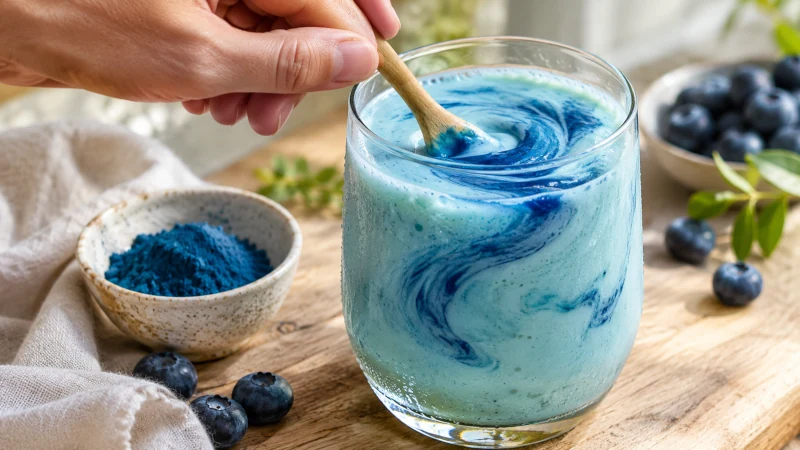
- Add it cold. Phycocyanin is heat-sensitive and most stable between pH 5 and 8 [Cyano-phycocyanin review, 2022], so hot drinks or very acidic ones such as citrus-heavy smoothies can dull the color.
- Buy tested products. As a food color, spirulina extract must test negative for microcystin toxins [FDA, 2026]. Supplements are a different story: the FDA hasn’t reviewed blue-green algae supplements for safety or effectiveness [WebMD, 2026]. Look for an independent third-party testing seal and a stated source species (Arthrospira platensis).
- Start small. A partial serving for the first few days lets you see how your stomach handles it.
Blue spirulina side effects and safety
Most healthy adults tolerate spirulina well. Human studies report few problems, and liver injury appears very rare [LiverTox, 2019]. The most common complaints are nausea, diarrhea, stomach pain, skin rash and trouble sleeping [WebMD, 2026].
Contamination
Spirulina grows in open alkaline water and can be contaminated with other blue-green algae that make toxins called microcystins [LiverTox, 2019]. At significant levels these can damage the liver and kidneys, and you can’t see, smell or taste them in a product [FDA, n.d.]. Product quality varies, and heavy metals may also be present [WebMD, 2026]. Testing matters more than price.
Allergic reactions
Spirulina allergy is uncommon, but most reported cases have been anaphylaxis, and phycocyanin itself has been identified as the trigger in at least one case [Gromek et al., 2024]. A 17-year-old developed anaphylaxis the first time he took a single tablet [Le et al., 2014]. Since blue spirulina is concentrated phycocyanin, anyone who has reacted to spirulina should avoid it.
Who should avoid it or ask first
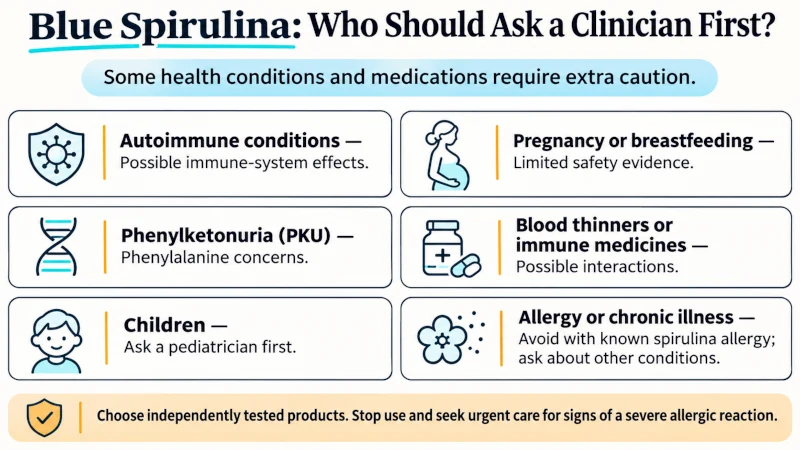
- Autoimmune conditions (lupus, rheumatoid arthritis, multiple sclerosis, dermatomyositis, pemphigus): spirulina may stimulate the immune system, and case reports link immune-stimulating supplements to new autoimmune disease or flares [Lee & Werth, 2004] [Chakka et al., 2021] [WebMD, 2026].
- Phenylketonuria (PKU): spirulina contains phenylalanine [WebMD, 2026].
- Pregnancy and breastfeeding: effects are unknown and contaminants could cause harm [WebMD, 2026]. MSK describes a newborn hospitalized with seizures and high blood calcium, linked to the mother’s long-term spirulina use [MSK, 2023]. Some herbal sources recommend spirulina during pregnancy; the safety data don’t support that.
- Children: check with a pediatrician first, since adult amounts may not be safe [FDA, n.d.].
- Bleeding disorders, and thyroid, kidney or liver disease: talk with your clinician before using it [WebMD, 2026].
- Known allergy to spirulina or other algae.
Medication interactions
- Immunosuppressants, such as drugs taken after a transplant or for autoimmune disease [WebMD, 2026].
- Blood thinners (anticoagulants and antiplatelets) [WebMD, 2026].
- Diabetes medications [WebMD, 2026].
- Drugs processed by the liver enzymes CYP1A2 and CYP2E1: spirulina may inhibit these enzymes, though how much that matters in people is unknown [MSK, 2023].
Interaction research is incomplete [WebMD, 2026], so tell your pharmacist about spirulina the same way you would about any prescription.
When to stop and get medical help
- Trouble breathing, swelling of the face or throat, or throat tightness: get emergency care [WebMD, 2026].
- Yellow skin or eyes, dark urine or pale stools, which can signal liver problems [WebMD, 2026].
- Severe muscle pain or weakness. MSK reports a man who developed this after a month of spirulina; it resolved when he stopped [MSK, 2023].
- Vomiting, diarrhea or abdominal pain after starting a new product [FDA, n.d.].
- New rashes, joint pain, or a flare of an existing autoimmune condition.
| HEALTH DISCLAIMER: This article is for general education and isn’t a substitute for advice, diagnosis or treatment from a qualified healthcare professional. Spirulina and blue spirulina are not approved to treat or prevent any disease. Talk to your doctor or pharmacist before using them if you’re pregnant or breastfeeding, giving them to a child, have an autoimmune condition, phenylketonuria, a bleeding disorder or a chronic illness, or take prescription medication. If you have symptoms of a severe allergic reaction, call emergency services. |
Frequently Asked Questions
Is blue spirulina better than green spirulina?
Not in any proven way. Blue spirulina is a concentrated phycocyanin extract, while green spirulina is the whole organism [FDA, 2026]. Most human trials used whole spirulina, so if you want the effects studied in people, green has more evidence behind it.
Does blue spirulina contain vitamin B12?
Not in a form you can rely on. Most of the B12-like compound in spirulina is inactive pseudovitamin B12 [Watanabe et al., 1999]. Vegans should use fortified foods or a B12 supplement.
Can blue spirulina help you lose weight?
Trials of whole spirulina show an average loss of about 1 to 2 kg [Moradi et al., 2019] [Lak et al., 2025], and the certainty of that evidence is low [Kazeminejad et al., 2025]. There’s no good evidence that it suppresses appetite [MSK, 2023].
Is it safe to take blue spirulina every day?
For most healthy adults, tested products at label doses appear well tolerated [LiverTox, 2019]. The exceptions are people with autoimmune disease, PKU, pregnancy, a spirulina allergy, or medications that may interact (see the safety section).
Why did my blue smoothie lose its color?
Phycocyanin breaks down with heat and is most stable between pH 5 and 8 [Cyano-phycocyanin review, 2022]. Add it to cold drinks and go light on lemon or other acidic ingredients.
References
- Chakka S, Concha JSS, Bax CE, Zeidi M, Werth VP. The effects of immunostimulatory herbal supplements on autoimmune skin diseases. View source
- Citi V, Torre S, Flori L, et al. Nutraceutical features of the phycobiliprotein C-phycocyanin: evidence from Arthrospira platensis (Spirulina). View source
- Cyano-phycocyanin: mechanisms of action on human skin and future perspectives in medicine. View source
- FDA. Blue-green algae products and microcystins. View source
- FDA. Listing of color additives exempt from certification; spirulina extract. View source
- Furmaniak MA, Misztak AE, Franczuk MD, Wilmotte A, Waleron M, Waleron KF. Edible cyanobacterial genus Arthrospira. View source
- Gromek W, Kołdej N, Kurowski M, Majsiak E. Spirulina (Arthrospira platensis): antiallergic agent or hidden allergen? A literature review. View source
- Huang H, Liao D, Pu R, Cui Y. Quantifying the effects of spirulina supplementation on plasma lipid and glucose concentrations, body weight, and blood pressure. View source
- Kazeminejad S, Arzhang P, Moradi Baniasadi M, Hatami A, Azadbakht L. The effect of algae supplementation on anthropometric indices in adults. View source
- Lak M, Karimi M, Akhgarjand C, et al. Effects of spirulina supplementation on body composition in adults. View source
- Le TM, Knulst AC, Röckmann H. Anaphylaxis to Spirulina confirmed by skin prick test with ingredients of Spirulina tablets. View source
- Lee AN, Werth VP. Activation of autoimmunity following use of immunostimulatory herbal supplements. View source
- LiverTox: Clinical and Research Information on Drug-Induced Liver Injury. Spirulina. View source
- Memorial Sloan Kettering Cancer Center. About Herbs: Blue-green algae. View source
- Moradi S, et al. Effects of Spirulina supplementation on obesity: a systematic review and meta-analysis of randomized clinical trials. View source
- NIH Office of Dietary Supplements. Vitamin B12: Fact Sheet for Consumers. View source
- Pérez-Romero, Arredondo-Vega. Del tecuitlatl azteca a la Spirulina: un recurso biotecnológico. Recursos Naturales y Sociedad. View source
- Rahnama I, Arabi SM, Chambari M, et al. The effect of Spirulina supplementation on lipid profile. View source
- Serban MC, Sahebkar A, Dragan S, et al. A systematic review and meta-analysis of the impact of Spirulina supplementation on plasma lipid concentrations. View source
- USDA FoodData Central. Seaweed, spirulina, dried (FDC 170495), SR Legacy. View source
- Watanabe F, Katsura H, Takenaka S, et al. Pseudovitamin B12 is the predominant cobamide of an algal health food, spirulina tablets. View source
- WebMD. Blue-green algae: uses, side effects, and more. View source


