Onions are worth eating. They cost almost nothing, they make plain food taste like cooking, and they carry a real load of fibre, vitamin C and plant compounds — quercetin above all. What they are not is medicine. The honest benefits of eating onions are modest, mostly indirect, and easy to oversell — and a lot of what circulates online comes from petri dishes, rats, or concentrated supplement capsules rather than from an onion on a plate.
So here is the useful version: what holds up, what is still thin, what to ignore, and who should genuinely be careful.
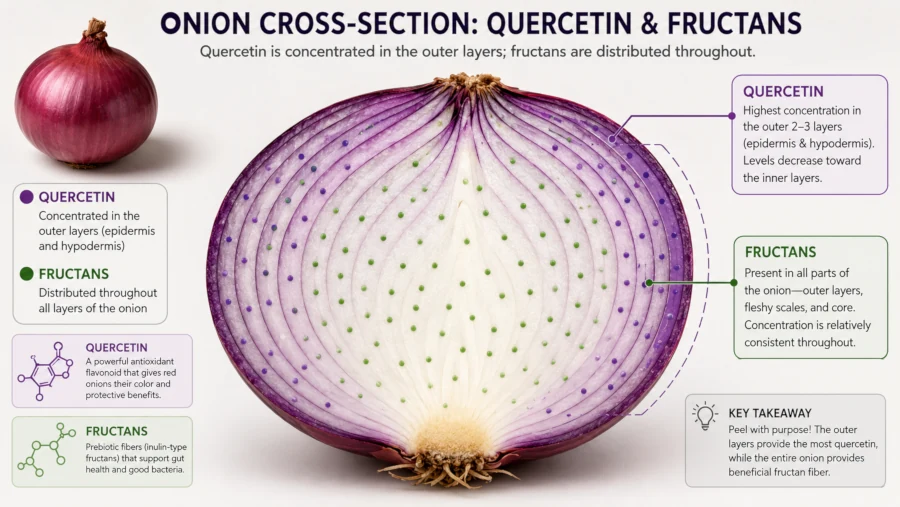
| Claim | Strength of evidence | What that means in practice |
| Onions as part of a vegetable-rich diet | Strong (for the pattern, not the onion) | Eating more vegetables is well supported. Onions count. No single vegetable earns the credit. |
| Lower blood pressure | Limited and mixed | One trial found a small drop — using a concentrated onion-skin extract, only in people who were already hypertensive. |
| Lower stomach cancer risk | Observational, geographically inconsistent | A real association in pooled case-control data, strong in Asian studies, absent in European ones. |
| Feeds gut bacteria | Reasonable (mechanism well established) | Onion fructans are prebiotic. For some people that is exactly the problem. |
| Onion juice for patchy hair loss | One small, unblinded 2002 trial | Interesting, never replicated at scale, and irritating to the scalp. |
| Treats infections, diabetes, worms, asthma | Insufficient in humans | Traditional use. Not a substitute for treatment. |
What’s actually in an onion
An onion is mostly water. Beyond that, a 100 g serving (roughly half a medium onion) supplies around 40 calories, a little under 2 g of fibre, and modest amounts of vitamin C, vitamin B6 and potassium — useful, but not remarkable. Figures here are approximate values drawn from USDA FoodData Central [USDA FoodData Central]; treat them as ballpark rather than precise.
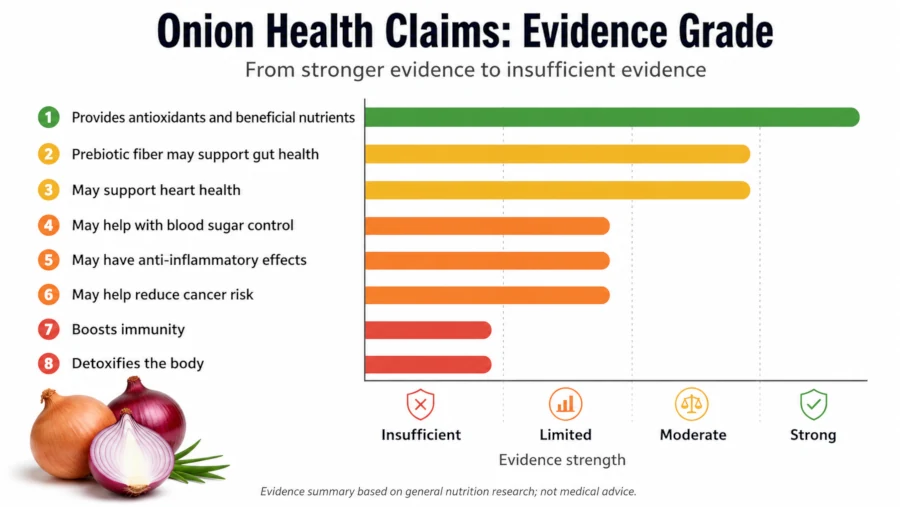
The interesting part is not the vitamins. It is the sulphur compounds and flavonoids. Quercetin — the flavonol that most onion research is really about — is concentrated in the outer layers and papery skin, and red onions carry more of it than white. Onions also store their carbohydrate as fructans rather than starch, which is why they behave as a prebiotic fibre in the gut, and why they cause trouble for a particular group of people. More on both below.
Benefits of eating onions: Where the evidence is strongest
Onions earn their place in a vegetable-rich diet
This is the least exciting claim and the best supported one. Diets built around vegetables, fruit, whole grains and legumes are consistently linked to lower rates of several cancers and of cardiovascular disease. Onions are a cheap, keeps-for-weeks way to get more vegetables into meals you would cook anyway. If you want the full pattern rather than a single food, our guide to a cancer-preventing diet lays out what the World Cancer Research Fund actually recommends.
Blood pressure: promising, with the fine print intact
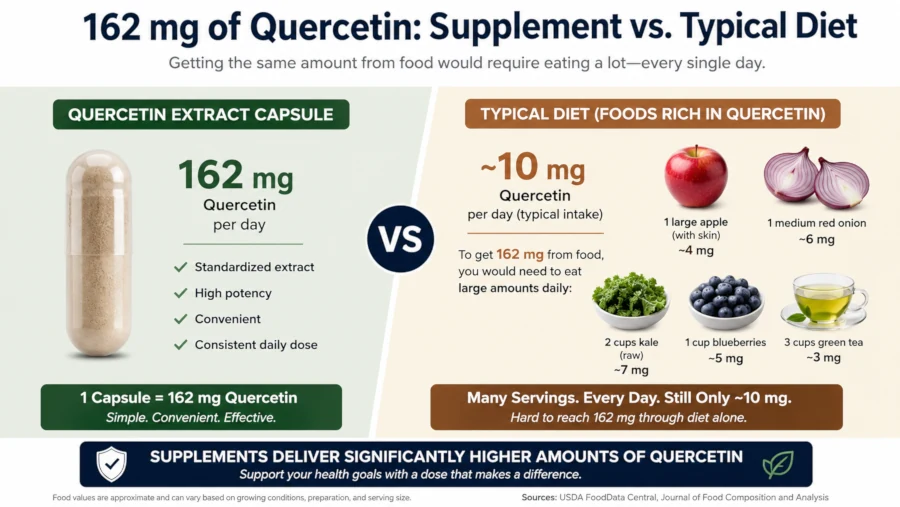
This is where most onion-and-heart-health claims come from, so it is worth reading closely. In a randomised, double-blind, placebo-controlled crossover trial, 68 overweight-to-obese adults with pre-hypertension or stage 1 hypertension took 162 mg/day of quercetin from an onion-skin extract for six weeks [Brüll et al., British Journal of Nutrition, 2015].
Across the whole group, quercetin did not significantly change 24-hour ambulatory blood pressure or office blood pressure at all. In the subgroup who were already hypertensive, 24-hour systolic pressure fell by 3.6 mmHg from baseline, with a treatment difference of 3.9 mmHg versus placebo. None of the mechanistic markers the researchers measured — endothelial function, ACE activity, inflammation, oxidised LDL — moved.
Three things follow from that, and they matter more than the headline:
- It was an extract, not food. Onion skins were extracted with ethanol and packed into capsules. The authors said plainly that their conclusion applies to quercetin-rich onion-skin extract, not to pure quercetin — and certainly not to onions on a plate.
- It was a subgroup finding. The pre-specified whole-group result was null, and the authors acknowledged they could not rule out that the hypertensive subgroup result was a chance finding from multiple testing.
- The dose was 10 to 15 times typical dietary quercetin intake. Participants were eating roughly 9–12 mg a day from food. You would not reach 162 mg by eating onions.
So: interesting signal, honest researchers, weak grounds for telling anyone that onions lower blood pressure. If blood pressure is your reason for reading this, the levers with real evidence behind them are sodium, weight, alcohol, activity and overall dietary pattern — and knowing which foods push blood pressure up is more useful than adding a single vegetable.
Stomach cancer: a real association, and a real caveat
The Stomach cancer Pooling (StoP) Project analysed individual data from 17 studies — 6,097 gastric cancer cases and 13,017 controls. People in the highest tertile of allium vegetable intake had lower odds of gastric cancer than those in the lowest (OR 0.71, 95% CI 0.56–0.90), and for onions specifically the pooled odds ratio for high versus low intake was 0.69 (95% CI 0.55–0.86) [Dalmartello et al., British Journal of Cancer, 2022].
The caveat is the interesting part. The association was clear in Asian studies (OR 0.50) but essentially absent in European studies (OR 0.96) and not statistically significant in American ones. Heterogeneity between studies was substantial, and these were mostly case-control studies, where people are asked to recall what they ate — a design prone to recall bias. The authors themselves urged caution in interpretation.
Read that as: eating onions is associated with lower gastric cancer rates in some populations, the finding is not consistent worldwide, and nobody has shown that onions cause the reduction. Helicobacter pylori infection, smoking and salt intake remain the risk factors with the strongest evidence, and H. pylori is treatable.
Fiber and fructans: good for most guts
Onions store fructans, which human enzymes cannot break down. They reach the colon intact and get fermented by gut bacteria — the textbook definition of a prebiotic. For most people that is a small plus, part of the general case for eating more plants and more fibre. For people with irritable bowel syndrome, it is the single most common reason onions cause trouble, which is covered in the safety section below.
Claims that don’t survive a close look
Onions have a long folk-medicine record, and some of the claims attached to them are repeated with a confidence the evidence does not support. Being straight about this matters more than being encouraging.
- “Onions are an antibiotic.” Onion extracts inhibit bacteria in laboratory dishes. That is a long way from treating an infection in a person. There are no human trials showing that onion poultices, juice or compresses heal wounds, boils or abscesses, and treating a spreading skin infection with onion instead of antibiotics is genuinely dangerous.
- “Onions lower blood sugar enough to reduce diabetes medication.” Human evidence is insufficient. In the trial above, six weeks of a supra-nutritional quercetin dose did not change fasting glucose, insulin, HOMA-IR or HbA1c. Never adjust insulin or an antidiabetic drug based on food.
- “Onions expel intestinal worms.” Traditional use, no reliable human trials. Pinworm and other helminth infections have safe, effective drug treatments that actually work; ask a pharmacist or GP.
- “Onion syrup treats asthma or bronchitis.” Honey has modest evidence for soothing a cough; the onion component does not. Asthma is a condition where undertreatment kills people. A home syrup is not a substitute for an inhaler or a controller medication.
- “Onions prevent intestinal cancer.” Overstated. The colorectal evidence is weaker than the gastric evidence, and even the gastric evidence is observational and geographically inconsistent.
Onion juice and hair: one small study, endlessly recycled
Nearly every “onion juice for hair growth” article traces back to a single 2002 trial. Iraqi dermatologists asked 23 people with patchy alopecia areata to rub crude onion juice into the bare patches twice daily; 15 controls used tap water. At six weeks, 86.9% of the onion group had regrowth versus 13% of controls [Sharquie & Al-Obaidi, The Journal of Dermatology, 2002].
The result is real and peer-reviewed. It is also much narrower than the way it gets quoted. The trial was small, unblinded, and has not been replicated at scale in more than twenty years. It tested alopecia areata — a patchy autoimmune hair loss — not male or female pattern thinning, which has a completely different mechanism. The authors themselves could not explain how it worked, and suggested the effect might come from irritation: mild scalp redness was common. If your hair loss is sudden, patchy, spreading or scarring, that is a reason to see a doctor, not to reach for the chopping board — alopecia areata has treatments with far better evidence behind them.
Raw or cooked, and how much
There is no therapeutic dose of onion, and anyone quoting one — two onions a day, a teaspoon of juice four times daily — is quoting tradition, not evidence. Eat them the way you enjoy them.
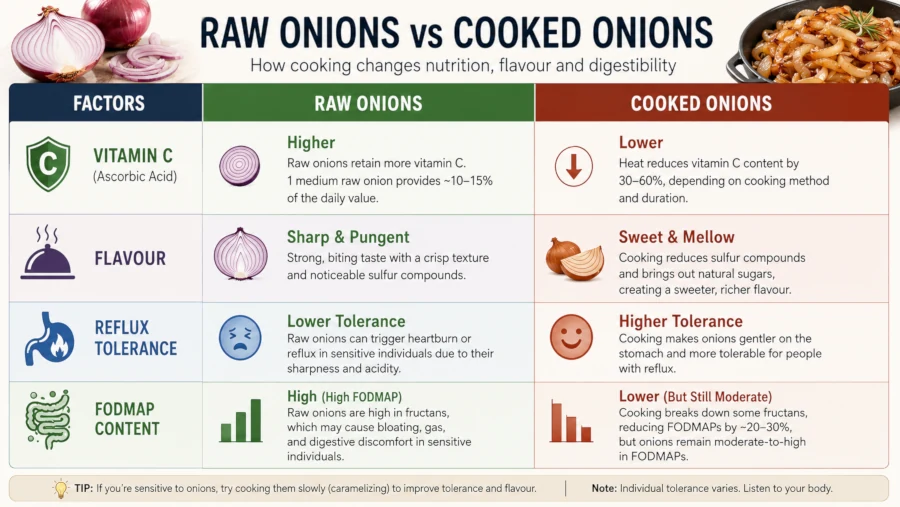
A few practical points that are true regardless. Raw onion retains more vitamin C, which is heat-sensitive, and hits harder on flavour and on reflux. Cooking softens both the taste and the sulphur compounds, which is why caramelised onions sit more comfortably with people who cannot manage them raw. Quercetin is concentrated in the outer layers, so peeling aggressively throws away the most interesting part. And since fructans are water-soluble, they leach into any liquid the onion is cooked in — so a soup made with onion carries them even if you fish the pieces out. Sliced thin with lemon juice and olive oil is still the simplest way to eat one raw without it dominating the plate.
Side effects, and who should be careful
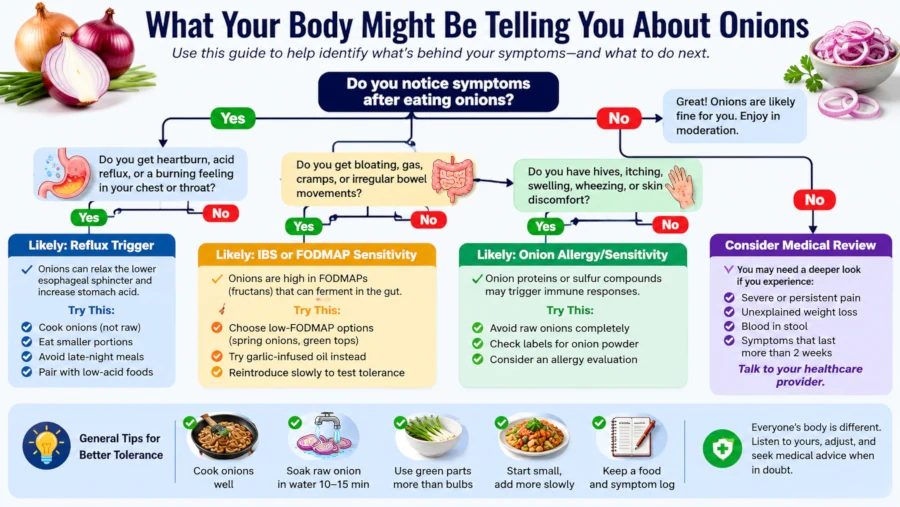
Reflux and heartburn
Onions are one of the commonly listed dietary triggers for gastro-oesophageal reflux, alongside fatty and fried food, chocolate, caffeine, peppermint, carbonated drinks and alcohol [Harvard Health Publishing, GERD diet]. Triggers are individual — plenty of people with reflux tolerate cooked onion and not raw. A short food-and-symptom diary will tell you more than any list.
IBS and the low-FODMAP diet
Onion is rated high FODMAP by Monash University, the group that developed the diet, because of its fructan content — and it appears on their high-FODMAP list alongside garlic, leek and spring onion [Monash University FODMAP, high and low FODMAP foods]. In people with IBS this can mean bloating, cramping, wind or diarrhoea at portions most people never notice.
Two practical notes from Monash that get misreported constantly. Removing onion pieces from a soup does not help, because the fructans have already leached into the liquid. Infusing onion into oil does work, because fructans are water-soluble but not fat-soluble. And the low-FODMAP diet is meant to be a three-step process with reintroduction, ideally with a dietitian — not a permanent ban on onions.
Allergy and skin reactions
True onion allergy is rare, but it exists. In sensitised people, handling onions can cause rhinoconjunctivitis, asthma and contact dermatitis, and anaphylaxis after eating onion — including cooked onion — has been reported in case reports [Thermo Fisher Phadia Allergen Encyclopedia, Onion f48]. Occupational contact dermatitis of the fingertips is a recognised problem for cooks and greengrocers; the usual culprit is diallyl disulfide, which is shared with garlic and penetrates most ordinary glove materials [Moyle et al., Australasian Journal of Dermatology, 2004].
The eye-watering when you chop is a different thing entirely — a volatile irritant released when the cells are cut. It is unpleasant, not allergic, and not a sign of anything wrong with you.
Medicines, supplements and pregnancy
This is where the distinction between onions and quercetin capsules stops being academic. Eating onions is not a recognised drug-interaction risk. Concentrated quercetin supplements are a different question, and the sources genuinely disagree.
Drug-interaction databases flag quercetin with warfarin as a moderate interaction, on the basis that various flavonoids inhibit CYP2C9 in vitro — while noting in the same monograph that there have been no specific reports of the interaction actually occurring in people [Drugs.com, quercetin–warfarin professional monograph]. A review of clinically evidenced herb–warfarin interactions places most herbs in the “possible” or “doubtful” evidence tiers rather than the well-documented ones [Ge et al., Evidence-Based Complementary and Alternative Medicine, 2014]. In other words: a plausible theoretical interaction with thin clinical evidence — not established, not dismissible.
The sensible reading: if you take warfarin or another anticoagulant and you are considering a quercetin supplement, raise it with the clinician who manages your INR. If you are simply eating onions, this does not apply to you.
Onions eaten as food are considered safe in pregnancy and breastfeeding. Quercetin supplements are not — they have not been studied adequately in pregnancy or lactation, and the usual advice is to avoid them. That gap is a lack of evidence rather than evidence of harm, but with a supplement offering modest benefits at best, there is no good reason to take the risk.
Who should limit or avoid onions
- Anyone with a diagnosed onion or allium allergy — including cooked onion, since some onion allergens survive heat.
- People with IBS during the elimination phase of a low-FODMAP diet, with reintroduction later.
- People whose reflux reliably flares after onion, particularly raw.
- Anyone with an active peptic ulcer or a flare of a gastrointestinal condition who finds raw onion aggravates symptoms.
- People considering quercetin supplements while on warfarin, ciclosporin or other narrow-therapeutic-index drugs — speak to a clinician first.
The food-safety part nobody mentions
Raw onions have caused some of the largest produce-linked Salmonella outbreaks on record. A 2021 outbreak of Salmonella Oranienburg linked to whole fresh onions imported from Chihuahua, Mexico, infected 1,040 people across 39 states, the District of Columbia and Puerto Rico, and hospitalised 33% of those with information available. Of people interviewed, 72% reported eating raw onions or dishes likely containing them [CDC, Salmonella outbreak linked to onions, 2022].
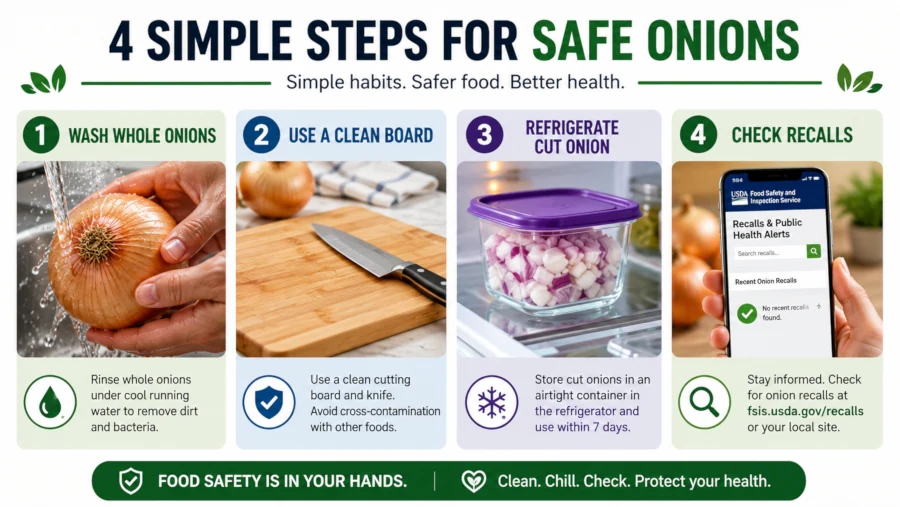
Nothing about that argues against eating onions. It argues for treating them like any raw produce: wash and dry whole onions before peeling, keep cut onion refrigerated rather than sitting on the counter, use a clean board, and pay attention to recall notices. Cooking destroys Salmonella; raw preparations are where the risk sits.
Never for dogs and cats
Onions, garlic, chives and leeks cause Heinz-body haemolytic anaemia in dogs and cats, and cats are the most susceptible species. All forms count — raw, cooked, dehydrated, powdered — and concentrated forms such as onion powder or dry soup mix are the most common cause of poisoning [Merck Veterinary Manual, Allium spp. toxicosis in animals]. Signs can be delayed by several days: weakness, pale gums, jaundice, dark urine, collapse. If a pet has eaten onion in any form, call a vet rather than waiting for symptoms.
When food is not the answer
Onions are food. Some things need a doctor, not a kitchen remedy.
Seek urgent care for:
- Difficulty breathing, throat tightness, facial or tongue swelling, widespread hives, or faintness after eating — possible anaphylaxis. Call emergency services.
- A skin infection that is spreading, streaking, hot, or accompanied by fever.
- Chest pain, or pain radiating to the jaw or arm — never assume it is heartburn.
- Vomiting that will not stop, bloody or black stools, or signs of dehydration after a suspected foodborne illness.
Book an appointment for:
- Heartburn several times a week, heartburn needing regular over-the-counter medication, or new difficulty swallowing.
- Persistent bloating, a change in bowel habit lasting more than a few weeks, unexplained weight loss, or blood in the stool — these need assessment, not a FODMAP app.
- Patchy, sudden or scarring hair loss.
- Blood pressure or blood glucose you are trying to manage. Do not change medication doses based on diet without medical advice.
| Health Disclaimer: This article is for general education and information only. It is not medical advice and does not replace diagnosis or treatment from a qualified health professional. No food, including onions, treats or cures disease. If you are pregnant or breastfeeding, take prescription medication such as warfarin or a diabetes drug, or live with a condition such as IBS, reflux, kidney disease or a food allergy, talk to your doctor, pharmacist or a registered dietitian before making significant dietary changes or starting any supplement. Seek prompt medical care for severe or worsening symptoms. |
Frequently Asked Questions
Is it better to eat onions raw or cooked?
Both are fine. Raw keeps more vitamin C and a sharper flavour; cooking mellows the sulphur compounds and is usually easier on reflux and on sensitive stomachs. There is no evidence that one form delivers meaningfully better health outcomes, so eat whichever you will actually eat regularly.
How many onions a day should I eat?
There is no established therapeutic amount. Older sources quote a medium onion a day, or two to three boiled onions, but those figures come from tradition rather than trials. Treat onions as a normal vegetable and let taste and tolerance decide.
Do onions really lower blood pressure?
Not in any way you can rely on. The main human trial used a concentrated onion-skin extract at roughly ten to fifteen times dietary quercetin intake, found no effect in the group as a whole, and saw a small drop only in participants who were already hypertensive. That is a reason for further research, not a reason to expect a result from your dinner.
Are red onions healthier than white or yellow?
Red onions carry more quercetin and anthocyanins, so on paper they have the richer polyphenol profile. Whether that translates into any difference you would notice is unknown. Buy the one that suits the dish.
Why do onions make me bloated?
Almost always the fructans. They pass undigested to the colon, where gut bacteria ferment them and produce gas. That is normal physiology, and it is only a problem if the symptoms are disproportionate — which is the pattern seen in IBS. Garlic-and-onion-infused oil is the standard workaround, because fructans do not dissolve into fat.
Does onion juice regrow hair?
The only supporting human evidence is a single small 2002 trial in patchy alopecia areata, unblinded and never replicated at scale. It says nothing about hereditary thinning, and scalp irritation was common. If hair loss is bothering you, get a diagnosis first — the treatment depends entirely on the cause.
References
- Brüll V, Burak C, Stoffel-Wagner B, et al. (2015). Effects of a quercetin-rich onion skin extract on 24 h ambulatory blood pressure and endothelial function in overweight-to-obese patients with (pre-)hypertension: a randomised double-blinded placebo-controlled cross-over trial. British Journal of Nutrition, 114(8), 1263–1277. DOI 10.1017/S0007114515002950; PMID 26328470; PMC4594049. → View source
- Dalmartello M, Turati F, Zhang Z-F, et al. (2022). Allium vegetables intake and the risk of gastric cancer in the Stomach cancer Pooling (StoP) Project. British Journal of Cancer, 126(12), 1755–1764. DOI 10.1038/s41416-022-01750-5. → View source
- Sharquie KE, Al-Obaidi HK (2002). Onion juice (Allium cepa L.), a new topical treatment for alopecia areata. The Journal of Dermatology, 29(6), 343–346. DOI 10.1111/j.1346-8138.2002.tb00277.x; PMID 12126069. → View source
- Monash University FODMAP. High and low FODMAP foods. → View source
- Centers for Disease Control and Prevention (2022). 2021 Salmonella outbreak linked to onions — investigation details. → View source
- Harvard Health Publishing. GERD diet: foods to avoid to reduce acid reflux. Reviewed by Lawrence S. Friedman, MD. → View source
- Merck Veterinary Manual. Garlic and onion (Allium spp.) toxicosis in animals. → View source
- Thermo Fisher Scientific, Phadia Allergen Encyclopedia. f48 Onion. → View source
- Moyle M, Frowen K, Nixon R (2004). Use of gloves in protection from diallyl disulphide allergy. Australasian Journal of Dermatology, 45(4), 223–225. PMID 15527433. → View source
- Drugs.com. Quercetin and warfarin drug interactions (professional monograph). → View source
- Ge B, Zhang Z, Zuo Z (2014). Updates on the clinical evidenced herb–warfarin interactions. Evidence-Based Complementary and Alternative Medicine, 2014, 957362. PMC3976951. → View source
- U.S. Department of Agriculture, Agricultural Research Service. FoodData Central. → View source
