
Bee balm is the common name for Monarda, a group of North American wildflowers in the mint family with shaggy red, pink, or lavender flower heads and a strong minty smell. That smell comes from oils rich in thymol and carvacrol, two antiseptic compounds that kill bacteria in lab tests [Lawson et al., 2021].
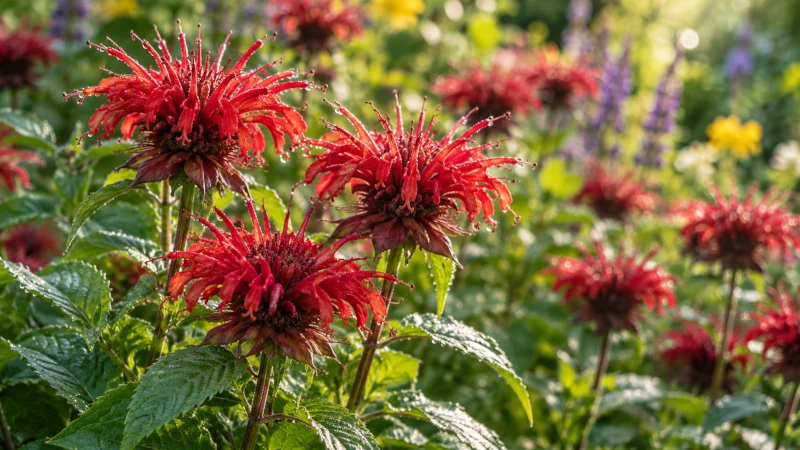
The bee balm plant has a long history as a Native American medicine and a colonial stand-in for tea. But we couldn’t find a single published clinical trial of it in people, and its safety in medicinal amounts has never been established [RxList, Natural Medicines]. Enjoy it as a garden plant, a hummingbird magnet, and an occasional cup of tea. Don’t count on it as a remedy, and don’t take it medicinally if you’re pregnant.
| Bee balm at a glance What it is: Monarda species, native to North America, in the mint family.Not the same as: lemon balm (Melissa officinalis), which is sometimes also called bee balm.Best evidence: lab studies showing the essential oil kills bacteria.Evidence in people: none found for any health use.Avoid: medicinal amounts in pregnancy and while breastfeeding. Never swallow the essential oil. |
Which plant is “bee balm”?
Most of the time, “bee balm” means one of three Monarda species. Scarlet bee balm (Monarda didyma), also sold as Oswego tea or bergamot, is the red-flowered garden classic. It’s native to eastern North America, grows 2 to 5 feet tall, and blooms from June through September [USDA NRCS, 2015]. Wild bergamot (Monarda fistulosa) has lavender flowers, grows 2 to 4 feet tall, and grows wild from Canada to Mexico in dry prairies, fields and roadsides [Missouri Botanical Garden]. Horsemint (Monarda punctata) is less common in gardens but turns up often in the medicinal literature. The genus has 22 species in all, 18 of them found in the United States [Lawson et al., 2021].
Then there’s the name problem. Lemon balm (Melissa officinalis), a lemon-scented herb, has also been called bee balm. The U.S. National Library of Medicine’s medical vocabulary notes that “beebalm” and “lemonbalm” are used for both Melissa and Monarda [NLM MeSH], and supplement references warn readers not to mix them up [RxList]. They are different plants with different chemistry and very different research behind them, so check the Latin name before you trust a label, a recipe, or a study. A third plant, wild balm, is a European woodland herb unrelated to either.
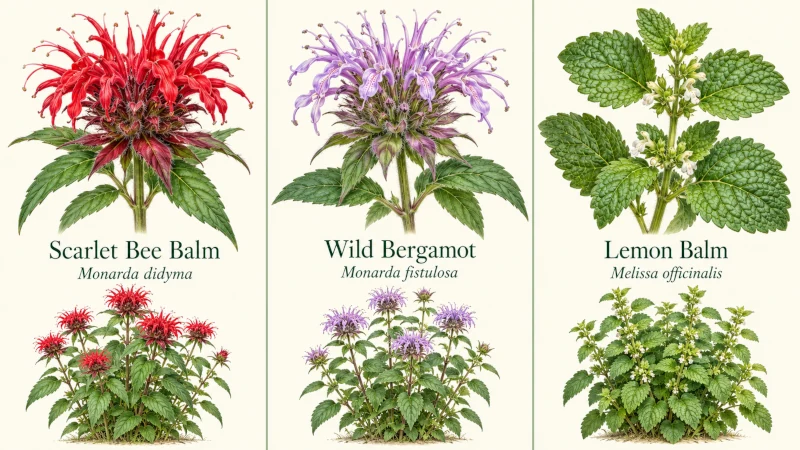
| Scarlet bee balm | Wild bergamot | Lemon balm | |
| Latin name | Monarda didyma | Monarda fistulosa | Melissa officinalis |
| Flowers | Scarlet red, June–Sept [NRCS] | Lavender [MBG] | Not showy |
| Key aroma compounds | Carvacrol or thymol, depending on the plant [Côté]; [Chen] | Carvacrol-, thymol- or geraniol-rich types [Lawson] | Citral, geranial, citronellal [see our guide] |
| Human clinical trials | None found | None found | Small trials for anxiety and mood [Ghazizadeh] |
How bee balm was traditionally used
Bee balm’s medicinal reputation comes from Native American practice. According to the USDA plant guide, the Blackfeet used scarlet bee balm as an antiseptic for skin and mouth infections, poultices went on minor wounds, and leaf tea was used for mouth and throat infections. The Cherokee and Teton Dakota used it for stomach complaints, and the Winnebago made a tea they took as a general stimulant [USDA NRCS, 2015].
Wild bergamot was used even more widely: by the Blackfoot, Navajo, Lakota and Winnebago for boils, cuts and wounds; by the Cherokee, Chippewa, Flathead, Ojibwa and Tewa for colds, fever and flu; and by the Crow, Lakota, Menominee and Ojibwa for coughs. Horsemint served several nations, including the Delaware and Navajo, for colds, fevers and coughs [Lawson et al., 2021].
The name Oswego tea traces to the Oswego people of upstate New York, who showed early settlers how to brew it. Colonists drank it when black tea was scarce, including after the British tea taxes and the Boston Tea Party. The name bee balm comes from rubbing the crushed leaves on bee stings [USDA NRCS, 2015].
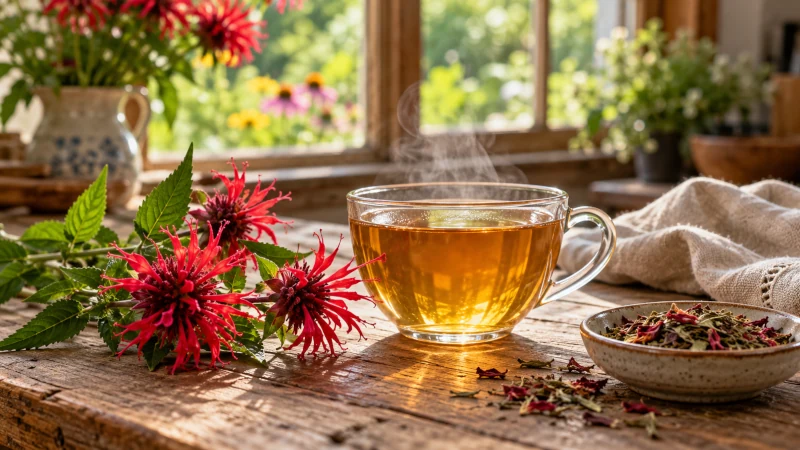
Other recorded uses include easing gas, expelling intestinal worms, and treating headaches, fevers, colds, sore throats, insomnia, nausea and vomiting [USDA NRCS, 2015]. If gas is your problem, our guide to foods that cause flatulence covers approaches with better evidence. A long list of traditional uses shows the plant mattered to people. It doesn’t tell you which uses work, or at what dose.
What’s in the bee balm plant: thymol, carvacrol, and a lot of variation
Bee balm’s leaves and flowers carry an essential oil dominated by two phenolic compounds, thymol and carvacrol, along with p-cymene [Lawson et al., 2021]. The USDA plant guide describes bee balm as a natural source of thymol, the antiseptic used in many mouthwashes [USDA NRCS, 2015]. If you’re curious how plant-based rinses compare with standard ones, see our evidence review of herbs for teeth and gums.
The catch is consistency. The mix of compounds changes with the species, the individual plant, and where it grows. Wild bergamot comes in at least three chemical types, rich in carvacrol, thymol, or geraniol [Lawson et al., 2021]. Scarlet bee balm oil from Quebec was about 49% carvacrol [Côté et al., 2021], while the oil from the same species used in a Chinese study was about 64% thymol [Chen et al., 2023]. In practice, a tea brewed from your garden has no standard strength, and two patches of bee balm can be chemically quite different.
What the research on bee balm actually shows
Nearly all of it is chemistry or lab work. That matters, because lab results are where most herbal hype starts.
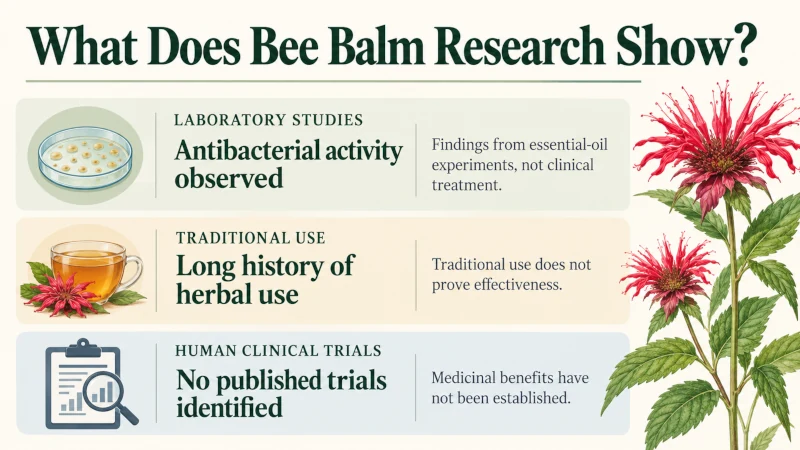
Antibacterial activity in the lab
This is the most consistent finding. Scarlet bee balm oil stopped the growth of E. coli, Staphylococcus aureus and Clostridium perfringens in lab cultures, with carvacrol doing much of the work [Côté et al., 2021]. A second team tested oil from the same species against 20 clinical strains of carbapenem-resistant Klebsiella pneumoniae, a drug-resistant hospital bacterium. The oil killed the bacteria at 1.25 mg/mL and cut biofilm formation by about half at that concentration [Chen et al., 2023]. Horsemint flower oil, about 75% thymol, was active against several respiratory bacteria, including Streptococcus pyogenes and Streptococcus pneumoniae. MRSA was the hardest strain to kill [Li et al., 2014].
None of this shows that bee balm tea treats an infection. Killing bacteria in a dish at a fixed concentration tells you little about what a diluted tea does inside your body. A throat or skin infection that might be bacterial needs a clinician, not a home remedy.
Anti-inflammatory and antioxidant effects
In the same Canadian study, the oil lowered an inflammation marker in mouse immune cells and showed antioxidant activity in a cell-based test [Côté et al., 2021]. Again, these are cells, not people.
Animal studies
Researchers have added bee balm oil to the feed of mice and broiler chickens as a possible replacement for growth-promoting antibiotics in livestock. Chickens fed the oil gained about 2.6% more weight than birds given standard antibiotics [Côté et al., 2021]. That’s a farming finding, not a human health one.
Studies in people
We found no published clinical trials of bee balm in humans. Natural Medicines, the database behind the RxList monograph, rates the evidence for every traditional use it lists, including digestive problems, gas, PMS, spasms, fluid retention and fever, as insufficient to judge [RxList].
| Claim | What it rests on | Strength |
| Kills bacteria | Lab studies of the essential oil [Côté]; [Chen]; [Li] | Lab only |
| Calms inflammation | One cell study [Côté] | Lab only |
| Soothes bee stings | Traditional use; origin of the name [NRCS] | Traditional only |
| Eases gas, nausea, colds, fever, headache | Traditional use [NRCS]; [Lawson] | Traditional only; rated insufficient [RxList] |
| Treats any disease in people | No human trials found | Not supported |
How to use bee balm sensibly
Think of bee balm as a kitchen and tea herb. Dried leaves and flower heads make an aromatic tea, and fresh leaves and shoot tips can flavor salads. The flowers also work in fresh or dried arrangements and in potpourri [USDA NRCS, 2015].
There’s no established medicinal dose [RxList], so don’t treat bee balm like a supplement with a target amount. If you drink it, drink it the way you would any herbal tea: an occasional cup, brewed from a plant you’ve identified with certainty, not daily mugs aimed at a symptom.
Skip the concentrated forms. Bee balm essential oil should never be swallowed, and essential oils in general are a growing cause of accidental poisoning in young children [UT Southwestern, 2016].
Growing the bee balm plant
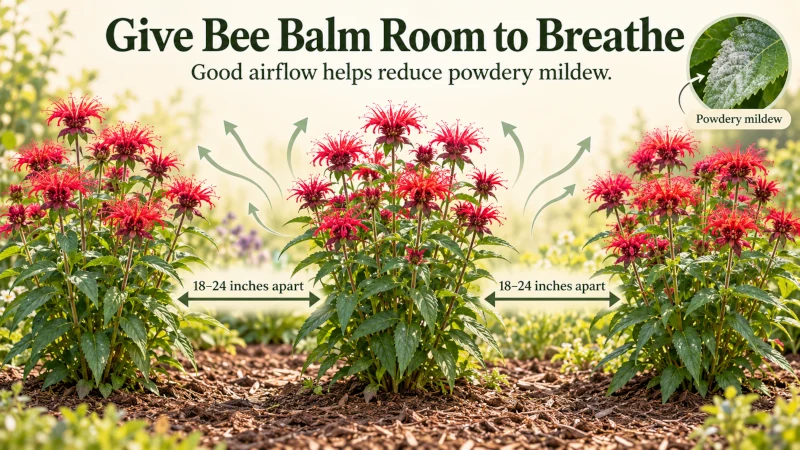
This is where bee balm earns its place. The tubular flowers draw hummingbirds and butterflies. Despite the name, bees visit less often, because reaching the nectar takes a long tongue [USDA NRCS, 2015]. Scarlet bee balm is hardy in USDA zones 4 to 9 and does best in moist, rich, well-drained soil with a pH of 6.0 to 7.0, in full sun or partial shade [USDA NRCS, 2015].
| Scarlet bee balm (M. didyma) | Wild bergamot (M. fistulosa) | |
| Height | 2–5 ft [NRCS] | 2–4 ft [MBG] |
| Soil | Moist, rich, well-drained | Dry soils of prairies, fields and roadsides |
| Powdery mildew | The most common problem | Less susceptible than scarlet bee balm |
| Spread | Forms clumps 24–36 in wide | Spreads by rhizomes and self-seeding |
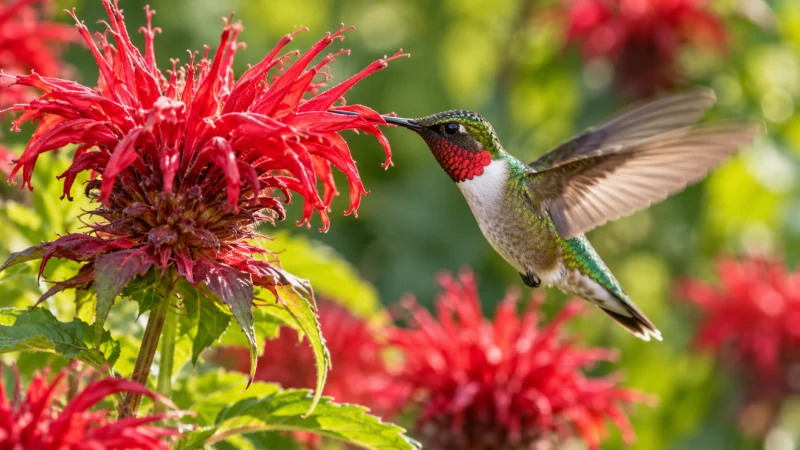
- Space plants 18 to 24 inches apart. Better air flow lowers the risk of powdery mildew [USDA NRCS, 2015].
- Thin crowded stems early in the season, and cut mildewed stems off at the base [USDA NRCS, 2015].
- Deadhead spent flowers to stretch out the bloom [USDA NRCS, 2015]. On wild bergamot, deadheading also cuts down on self-seeding [Missouri Botanical Garden].
- Divide clumps every 2 to 3 years in early spring, while the plants are dormant [USDA NRCS, 2015].
- Scarlet bee balm has moderate deer resistance and can become weedy in some regions [USDA NRCS, 2015].
Lemon balm: the other “bee balm”
If you came here looking for the lemon-scented herb, you want Melissa officinalis. Unlike Monarda, lemon balm has been tested in people. A 2021 meta-analysis of randomized trials found it improved anxiety and depression scores compared with placebo, without serious side effects. But the trials were few and varied widely, and the authors said the results should be read with caution [Ghazizadeh et al., 2021].
Lemon balm has its own doses, side effects and drug cautions. Our guides to supplements for anxiety and stress and lemon balm essential oil cover them. For more on Monarda didyma in particular, see our profile of the Oswego tea plant.
Bee balm safety: who should avoid it
Using bee balm in food amounts is a different question from taking it as medicine. For medicinal amounts, there isn’t enough reliable information to know whether bee balm is safe or what its side effects are [RxList].
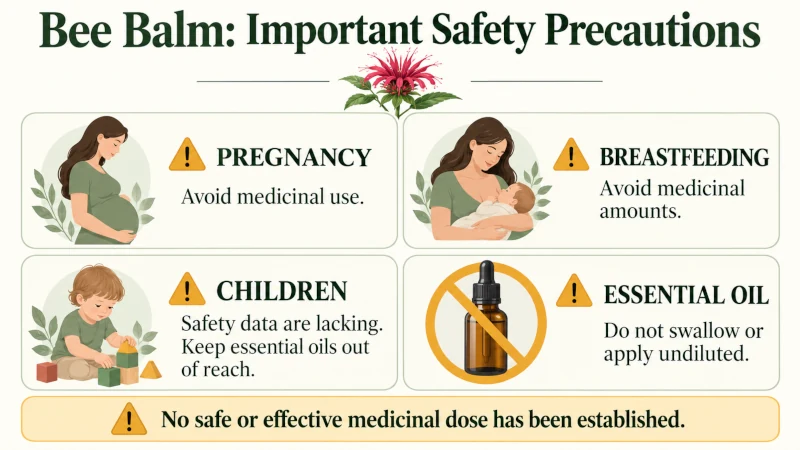
- Pregnancy: Natural Medicines rates Oswego tea as unsafe in pregnancy because it might bring on a period, which could cause a miscarriage [RxList]. Avoid medicinal use.
- Breastfeeding: Too little is known about effects on a nursing infant. Avoid medicinal amounts [RxList].
- Children: There’s no safety data for children. Keep essential oils locked away. Children who swallow them can choke, inhale the oil into their lungs, and develop pneumonia [UT Southwestern, 2016].
- Essential oil, any age: Don’t swallow it, and don’t put undiluted oil on your skin [Connecticut Poison Control Center].
- Medications: We found no published data on interactions between bee balm and medicines. Missing data means the risk is unknown, not that bee balm is safe. If you take prescription medication, ask a pharmacist before using bee balm as a remedy.
When to get medical help
If you rub bee balm leaves on a sting the old-fashioned way, know when a sting is more than a local reaction. Call 911 for trouble breathing or wheezing, swelling of the face or mouth, throat tightness or trouble swallowing, weakness, or skin turning blue [MedlinePlus, 2025]. For an ordinary sting, scrape the stinger out with a straight edge such as a credit card, wash the area with soap and water, apply ice wrapped in a cloth, and watch for signs of infection over the next several days [MedlinePlus, 2025].
If anyone swallows bee balm essential oil, call Poison Control at 1-800-222-1222 [Connecticut Poison Control Center]. If a symptom you hoped bee balm would help is severe, getting worse, or not settling after a few days, see a clinician rather than trying a stronger brew.
| HEALTH DISCLAIMER: This article is for general education only. It is not medical advice, diagnosis, or treatment. Bee balm has not been tested in human clinical trials, and no safe or effective medicinal dose has been established. Talk to a doctor or pharmacist before using any herb medicinally, especially if you are pregnant, breastfeeding, giving it to a child, taking prescription medication, or managing a health condition. In an emergency, call 911. |
Frequently Asked Questions
Is bee balm the same as lemon balm?
No. Bee balm usually means a Monarda species, a North American wildflower. Lemon balm is Melissa officinalis. Both have been called bee balm, which is why the Latin name matters [NLM MeSH].
Can you eat bee balm?
Yes, in food amounts. The dried leaves and flower heads make tea, and fresh leaves and shoot tips can flavor salads [USDA NRCS, 2015]. There’s no reliable safety data for medicinal amounts [RxList].
Does bee balm really help bee stings?
It’s where the name comes from [USDA NRCS, 2015], but no study has tested it. Use basic first aid instead: scrape out the stinger, wash, and ice. Call 911 for any sign of a severe allergic reaction [MedlinePlus, 2025].
Is bee balm tea safe during pregnancy?
Does bee balm attract bees?
Some, but hummingbirds and butterflies are the main visitors. The long, narrow flower tubes favor pollinators with long tongues [USDA NRCS, 2015].
References
- Lester RK, Vandevender J. Plant Guide for scarlet beebalm (Monarda didyma). View source
- Lawson SK, Satyal P, Setzer WN. The volatile phytochemistry of Monarda species growing in South Alabama. View source
- Côté H, Pichette A, St-Gelais A, Legault J. The biological activity of Monarda didyma L. essential oil and its effect as a diet supplement in mice and broiler chicken. Molecules. View source
- Chen Y, Zhao J, Liu C, Wu D, Wang X. In-vitro antibacterial activity and mechanism of Monarda didyma essential oils against carbapenem-resistant Klebsiella pneumoniae. View source
- Li H, Yang T, Li FY, Yao Y, Sun ZM. Antibacterial activity and mechanism of action of Monarda punctata essential oil and its main components against common bacterial pathogens in respiratory tract. View source
- Ghazizadeh J, Sadigh-Eteghad S, Marx W, et al. The effects of lemon balm (Melissa officinalis L.) on depression and anxiety in clinical trials: a systematic review and meta-analysis. View source
- RxList. Oswego Tea: health benefits, side effects, uses, dose and precautions. View source
- U.S. National Library of Medicine. View source
- Missouri Botanical Garden, Butterfly House. Monarda fistulosa (wild bergamot). View source
- UT Southwestern Medical Center. Essential oils a poisoning danger for young children. View source
- Connecticut Poison Control Center (UConn Health). Essential oils tipsheet. View source
- MedlinePlus Medical Encyclopedia. Insect bites and stings. View source


