Lemon balm essential oil is a concentrated aromatic product made from Melissa officinalis, a lemon-scented herb in the mint family. It may be useful as a pleasant aromatherapy scent, and small human studies suggest possible benefits for anxiety or sleep in specific groups. But the evidence is limited. The oil should not be swallowed, applied undiluted, or treated as a remedy for high blood pressure, high cholesterol, liver disease, dementia, or cancer. [NCCIH, n.d.] [OPSS, 2020] [Cîmpeanu et al., 2026]
A major source of confusion is the phrase “lemon balm.” Research on leaf tea, oral extracts, standardized creams, and essential oil is often discussed as if every product works the same way. It does not. The form matters because each preparation contains a different mix of plant compounds and has a different safety profile. [EMA, 2013] [Cîmpeanu et al., 2026]
| At a glance: The safest starting point is simple: use lemon balm essential oil only for the route listed on the product label, keep it away from children, and do not ingest it. For anxiety or sleep, aromatherapy may be a small comfort measure. It is not a replacement for care when symptoms persist, disrupt daily life, or become severe. For cold sores, the better human evidence is for a standardized lemon balm leaf-extract cream — not a homemade essential-oil application. |
What lemon balm essential oil is
Essential oils are concentrated mixtures of volatile compounds: the aromatic molecules that evaporate readily and create a plant’s scent. Lemon balm oil commonly contains compounds such as citral, geranial, and citronellal, although the exact profile varies with the plant material and production method. [Pasyar et al., 2025]
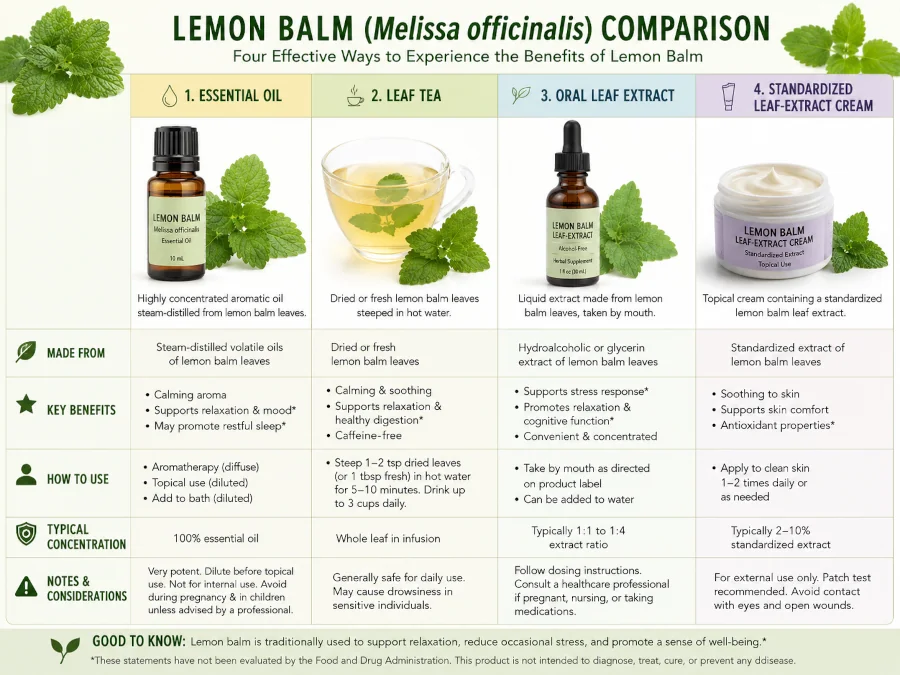
That is different from a cup of lemon balm tea, a capsule containing a leaf extract, or a cream made with a standardized leaf extract. The European Medicines Agency assessment concerns lemon balm leaf preparations, including tea and oral extracts. It does not establish that the essential oil has the same effects. [EMA, 2013] [EMA, 2013 monograph]
| Product form | What it is | What you can reasonably infer |
| Lemon balm leaf tea or oral leaf preparation | Dried leaf or an extract of the leaf used by mouth. | EMA recognizes traditional use of lemon balm leaf for mild mental stress, sleep support, and mild digestive complaints. This is not proof for the essential oil. |
| Standardized lemon balm leaf-extract cream | A topical product formulated with a measured leaf extract. | A small clinical trial studied a 1% dried-leaf-extract cream for cold sores. A commercial extract cream is not the same as DIY essential oil. |
| Lemon balm essential oil | A concentrated aromatic fraction used mainly by inhalation or, when labeled for skin use, in diluted topical products. | Small trials suggest possible aromatherapy benefits in narrow groups. Evidence is early and does not support broad disease-treatment claims. |
What the evidence says about lemon balm essential oil uses
Stress and anxiety
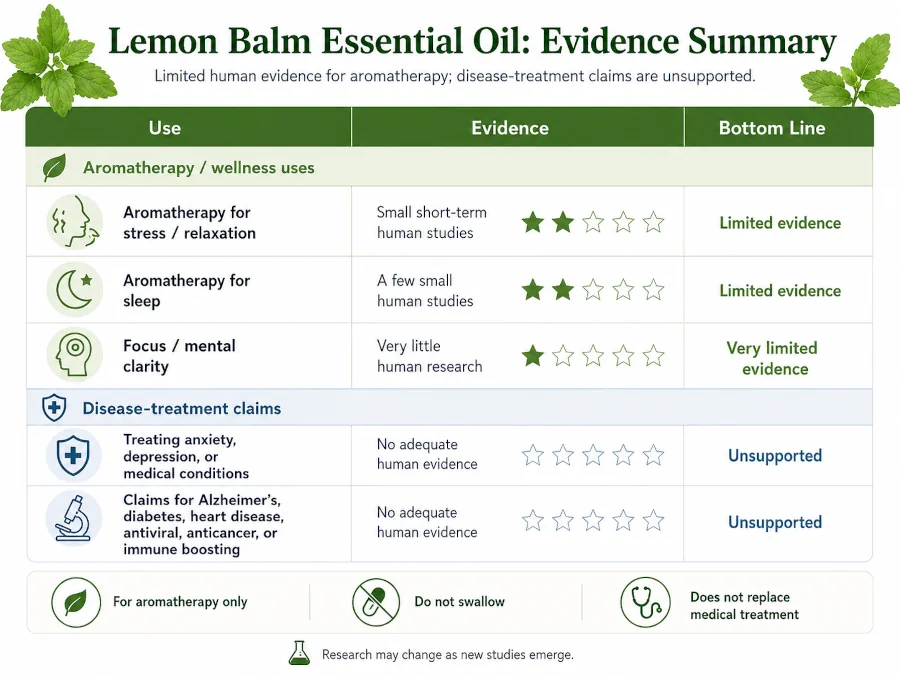
Lemon balm aromatherapy has some early human evidence, but the studies do not justify calling it an anxiety treatment. In a 2025 randomized trial, 68 adults receiving hemodialysis inhaled lemon balm essential oil or refined sweet almond oil three times a week for one month. The lemon balm group had lower anxiety scores after the intervention. The population was specific, the study was small, and scent differences made full blinding difficult. [Pasyar et al., 2025]
A diffuser or another label-directed inhalation method may be reasonable if you enjoy the scent and it does not trigger irritation. Treat it as a comfort measure. If stress is persistent, consider proven approaches and talk with a healthcare professional. Readers comparing herbal options can review ashwagandha benefits and safety before choosing a supplement. [NCCIH, n.d.]
Sleep
A 2024 randomized trial included 50 mothers of preterm infants in a neonatal intensive care unit. Participants assigned to lemon balm essential-oil inhalation had improved sleep-quality scores after two weeks. That result is encouraging, but it does not show that the oil treats chronic insomnia in the general population. [Sinaei et al., 2024]
The National Center for Complementary and Integrative Health states that rigorous aromatherapy research for insomnia is limited. A calming scent can fit into a bedtime routine, but ongoing insomnia deserves medical attention because it can have many causes. [NCCIH, n.d.]
Cold sores
Lemon balm is often promoted for cold sores, but the product form is easy to misstate. A randomized, double-blind, placebo-controlled trial of 66 people studied a cream containing 1% dried lemon balm leaf extract. Participants applied it four times daily for five days, and the treatment group showed an improvement in symptom scores. That trial did not test essential oil. [Koytchev et al., 1999]
A separate laboratory study found antiviral activity when lemon balm essential oil was tested against herpes simplex virus in cells. A laboratory result is useful for research, but it is not proof that applying the oil to your lip is safe or effective. Do not put undiluted essential oil on a cold sore, your lips, or the inside of your mouth. Ask a pharmacist or clinician about an appropriate commercial product. [Schnitzler et al., 2008] [Poison Control, n.d.]
Claims that are not established
Lemon balm essential oil has been studied in laboratory and animal research, but those findings should not be turned into treatment claims for people. There is not enough clinical evidence to recommend the essential oil for lowering blood pressure, lowering triglycerides, protecting the liver, preventing cognitive decline, or treating cancer. Studies of oral lemon balm preparations also cannot be used as proof for an inhaled or topical oil. [Cîmpeanu et al., 2026]
If your goal is heart health, use strategies with stronger evidence. For a practical starting point, see evidence-based ways to lower triglycerides and discuss your numbers with a healthcare professional.
How to use lemon balm essential oil more safely
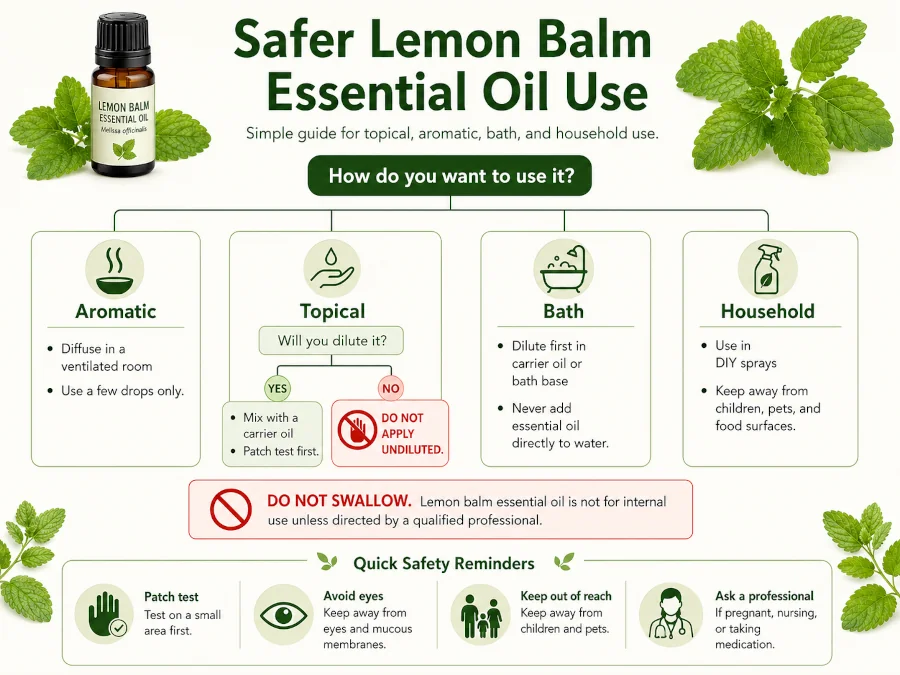
There is no medically established universal drop count for home use of lemon balm essential oil. Concentration, diffuser size, exposure time, and product instructions differ. A research protocol is not a household dosing guide. Follow the label for the exact product you purchased and stop if the scent causes discomfort. [NCCIH, n.d.] [Pasyar et al., 2025]
- Do not swallow lemon balm essential oil. Essential oils are highly concentrated, and ingestion can be dangerous. [OPSS, 2020] [Poison Control, n.d.]
- For inhalation, use only a product labeled for that purpose and follow the device and product directions. Use it in a well-ventilated room. Stop if you develop headache, nausea, coughing, wheezing, or dizziness.
- For skin use, choose a product labeled for topical application and use it only as directed. Do not apply undiluted oil. Keep it away from eyes, lips, the inside of your mouth, and damaged skin. [Poison Control, n.d.]
- Patch-test a small area first. Stop using the product if you notice redness, burning, itching, or a rash.
- Store the bottle out of reach of children. A small amount can cause harm if swallowed. [Poison Control, n.d.]
Avoid homemade steam-inhalation methods that place your face over boiling water. A diffuser used according to its instructions is simpler and avoids an avoidable burn hazard.
Side effects and who should avoid it
Essential oils can irritate skin and airways. Poison Control notes that essential oils can cause rashes and may be poisonous when swallowed or absorbed through the skin. Some oils may also interact with medicines. “Natural” does not mean risk-free. [Poison Control, n.d.]
| Situation | Safer next step |
| Pregnancy or breastfeeding | Avoid self-treatment unless your obstetric clinician approves the exact product and route. EMA states that safety of lemon balm leaf during pregnancy and lactation has not been established; essential oil use needs at least as much caution. |
| Children | Keep essential oils locked away. Do not use lemon balm essential oil for a child unless a pediatric clinician approves the product and route. |
| Asthma, fragrance sensitivity, or prior reactions to plants or essential oils | Skip inhalation or discuss it with a clinician first. Stop promptly if the scent triggers respiratory symptoms. |
| Medication use, thyroid disease, or a scheduled procedure | Ask a clinician or pharmacist before use. Interaction data are incomplete. EMA notes a preclinical thyroid-related finding for a water extract of lemon balm leaf, but its relevance to people and to essential oil is unknown. |
| Broken skin, mouth sores, or eye-area symptoms | Do not apply essential oil. Ask a clinician or pharmacist about a suitable product. |
EMA’s pregnancy, lactation, and thyroid cautions refer to lemon balm leaf preparations. They are included here as reasons to avoid casual self-treatment, not as proof that the essential oil has the same effects. [EMA, 2013 monograph]
Get urgent help after a serious reaction or accidental swallowing
Call your local poison center promptly after accidental swallowing. In the United States, Poison Control can be reached at 1-800-222-1222 or through its online tool. Seek urgent medical care for trouble breathing, severe wheezing, collapse, a rapidly worsening reaction, or persistent eye exposure symptoms. Do not try to induce vomiting unless a poison specialist instructs you to do so. [Poison Control, n.d.]
How to choose a product
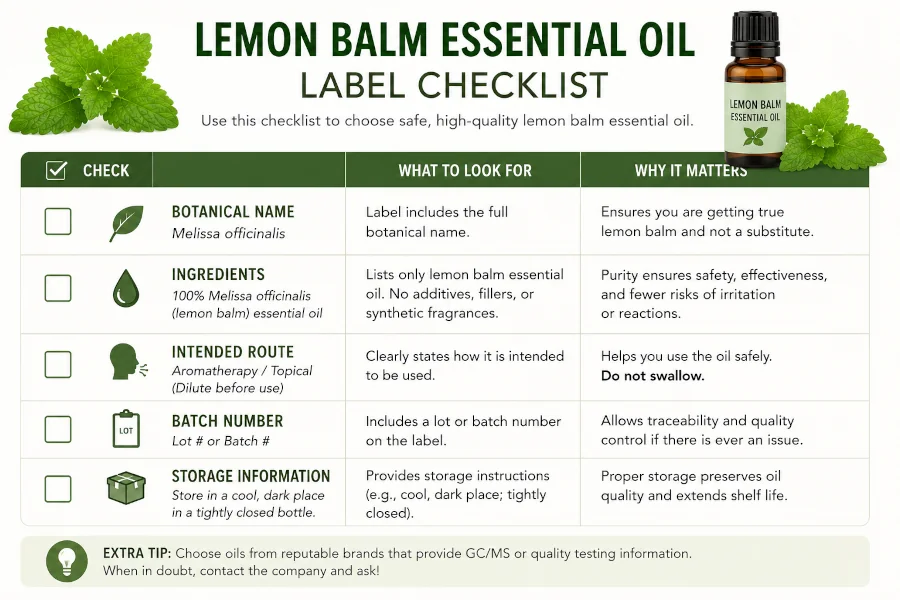
Essential-oil products are not interchangeable. Poison Control warns that these products are not well regulated and that it can be hard to know exactly what a bottle contains. Avoid choosing a product because the label uses vague phrases such as “therapeutic grade.” Look for traceable details instead. [Poison Control, n.d.]
- The botanical name Melissa officinalis on the label.
- A clear ingredient list, including any carrier oil or fragrance ingredients.
- Directions for the route you plan to use: inhalation or topical use.
- A lot or batch number, company contact details, and storage instructions.
- A sealed bottle with a legible label and a child-resistant storage plan at home.
Do not buy a product that promises to treat cancer, lower blood pressure, detoxify the liver, reverse memory loss, or replace prescribed care. Those claims go beyond the clinical evidence for lemon balm essential oil. [Cîmpeanu et al., 2026]
Realistic expectations
Lemon balm essential oil may make a room smell pleasant and may help some people feel calmer during a relaxation routine. Small studies give researchers a reason to keep studying it. They do not establish a cure, a standard dose, or a reason to delay medical care. [NCCIH, n.d.] [Pasyar et al., 2025] [Sinaei et al., 2024]
Talk with a healthcare professional if anxiety or poor sleep lasts more than a couple of weeks, affects daily life, or is getting worse. For cold sores, ask about a standard treatment or a properly formulated topical product rather than experimenting with concentrated oil.
| Health Disclaimer: This page is for education only. It does not diagnose, treat, cure, or prevent a medical condition, and it is not a substitute for advice from a qualified healthcare professional. Essential oils can cause adverse effects. Ask a clinician or pharmacist before using lemon balm essential oil if you are pregnant, breastfeeding, treating a child, taking medication, or managing a health condition. See the site’s medical advice disclaimer for more information. |
Frequently Asked Questions
Can you ingest lemon balm essential oil?
No. Do not swallow lemon balm essential oil. Essential oils are concentrated products, and ingestion can be dangerous. A lemon balm tea or oral herbal product is a different preparation. Follow a clinician’s advice before using any oral supplement.
Can you put lemon balm essential oil directly on a cold sore?
No. Do not place undiluted essential oil on your lips, mouth, or a cold sore. A small clinical trial studied a standardized 1% dried lemon balm leaf-extract cream, not DIY essential oil. Ask a pharmacist or clinician about a suitable product.
Is lemon balm essential oil the same as lemon balm extract?
No. Essential oil is the volatile aromatic fraction of the plant. Leaf teas, capsules, liquid extracts, and standardized creams contain different compounds and have different evidence behind them.
Does lemon balm essential oil help with anxiety?
It may support relaxation for some people. A small 2025 trial in adults receiving hemodialysis found lower anxiety scores after inhalation aromatherapy, but that does not establish it as a treatment for an anxiety disorder.
Can lemon balm essential oil help you sleep?
Possibly, as part of a calming bedtime routine. A small trial in mothers of preterm infants reported better sleep-quality scores after inhalation aromatherapy, while NCCIH says rigorous aromatherapy research for insomnia remains limited.
Who should avoid lemon balm essential oil?
Avoid self-treatment during pregnancy or breastfeeding and for children. Ask a clinician first if you have asthma, fragrance sensitivity, thyroid disease, take medication, or have had reactions to essential oils. Never swallow the oil.
References
- European Medicines Agency. “Melissae folium – herbal medicinal product.” Official herbal summary. → View source
- European Medicines Agency. “Community herbal monograph on Melissa officinalis L., folium.” Official monograph PDF, 2013. → View source
- National Center for Complementary and Integrative Health. “Aromatherapy.” → View source
- Poison Control. “Essential oils: Poisonous when misused.” → View source
- Operation Supplement Safety. “Essential oils: Are they safe to ingest?” → View source
- Cîmpeanu C, et al. Review of Melissa officinalis evidence and preparation-dependent effects. Plants, 2026. → View source
- Pasyar N, et al. “The effectiveness of Melissa officinalis L. essential oil inhalation on anxiety and symptom burden of hemodialysis patients: a randomized trial study.” BMC Complementary Medicine and Therapies, 2025. → View source
- Sinaei P, et al. “The Effect of Inhalation Aromatherapy with Lemon Balm (Melissa officinalis) Essential Oil on Sleep Quality in Mothers of Preterm Infants in the Neonatal Intensive Care Unit.” The Open Public Health Journal, 2024. → View source
- Koytchev R, et al. “Balm mint extract (Lo-701) for topical treatment of recurring herpes labialis.” Phytomedicine, 1999. → View source
- Schnitzler P, et al. “Antiviral activity of Melissa officinalis oil against herpes simplex virus type 1 and type 2.” Phytomedicine, 2008. → View source
