Wild balm (Melittis melissophyllum) is a woodland plant in the mint family that European folk healers have used for centuries — mainly to bathe wounds, settle the nerves, and brew a mild spring tonic. The name causes a lot of confusion. Wild balm is not closely related to lemon balm, it doesn’t share that plant’s pleasant lemon scent, and its active compounds run in a different direction.
Here’s the honest version. The plant has a long record of folk use across central and southern Europe, modern labs have confirmed it contains genuinely active plant chemicals, but there are essentially no human trials testing whether it treats anything. That makes it interesting, not proven — and it makes the safety questions worth taking seriously before you brew it or put it on your skin.
Wild balm isn’t lemon balm — or bee balm
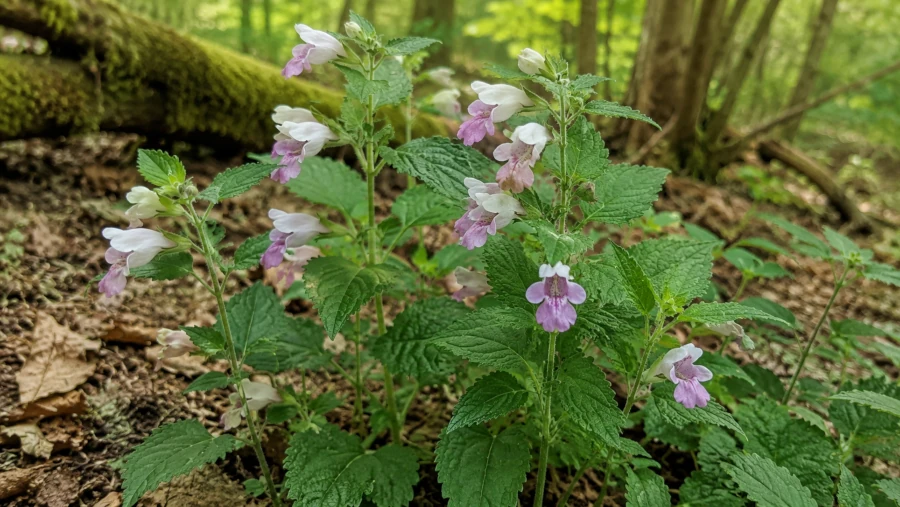
Botanically, wild balm is the only species in its genus, Melittis, in the mint family (Lamiaceae; older books call the family Labiatae) [Wikipedia: Melittis]. Its English common name is bastard balm. It grows in oak and beech woodland and shady field edges across central and southern Europe, from Britain and Portugal east to Ukraine and Turkey. The plant sends up upright stems to around 50 cm, with toothed, deeply veined leaves and large two-lipped flowers — white or pink, often blotched with purple — that open in late spring. Healers used the whole above-ground plant and left the root alone.
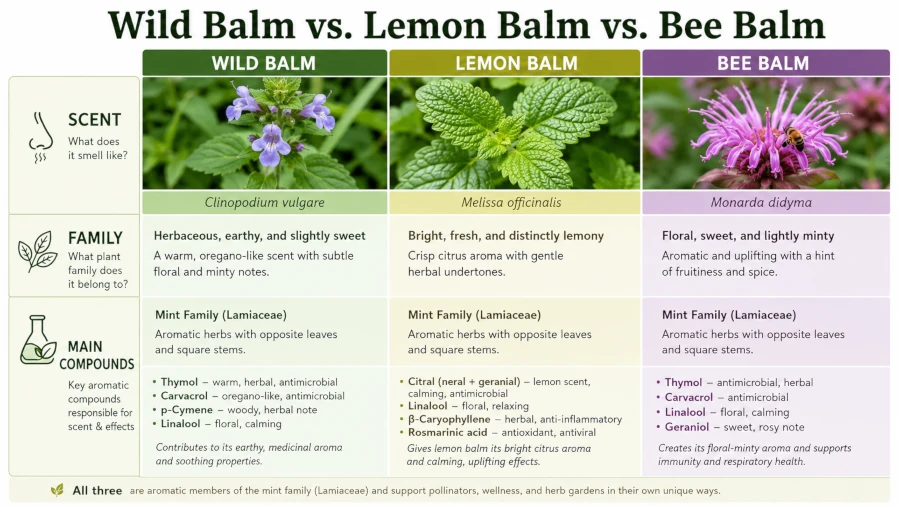
The species name melissophyllum means “balm-leaved,” because the foliage resembles true balm. That resemblance is where the kinship ends. Lemon balm (Melissa officinalis) and the bee balms (Monarda) owe their bright, minty smell to volatile oils like citral. Crush a wild balm leaf and you get something closer to fresh hay or cut grass, sometimes called faintly unpleasant. That smell is your first clue to its chemistry: it comes largely from coumarin, the compound behind the scent of hay and sweet woodruff.
| Wild balm | Lemon balm | Bee balm | |
| Botanical name | Melittis melissophyllum | Melissa officinalis | Monarda spp. |
| Scent | Faint, hay-like | Strong lemon | Minty, citrus |
| Main actives | Coumarin, iridoids, flavonoids | Citral, rosmarinic acid | Thymol, carvacrol oils |
| Traditional role | Wound washes, mild tonic | Calming, digestive | Cold and throat remedies |
What’s actually inside wild balm
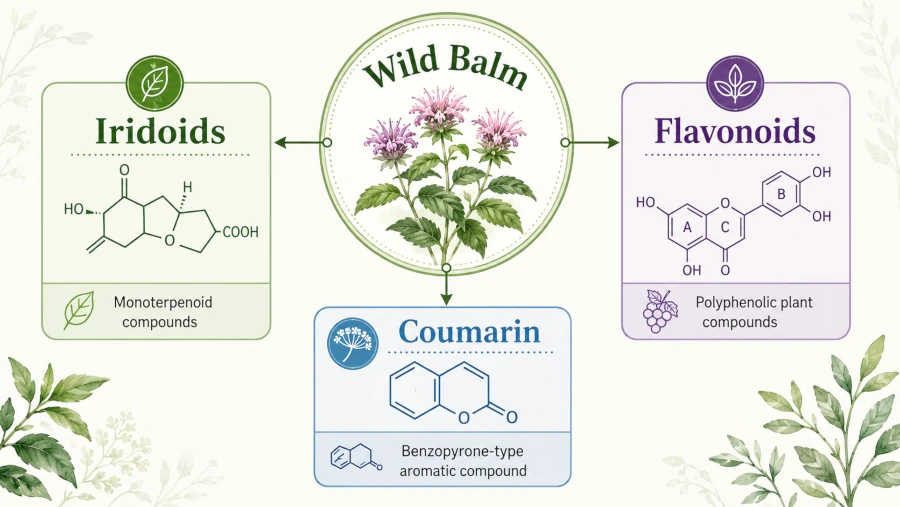
For a plant with so little clinical research behind it, wild balm has been picked apart chemically in real detail. Three groups of compounds stand out.
Iridoid glycosides. The aerial parts contain harpagide and 8-O-acetyl-harpagide — the same iridoids found in devil’s claw, an herb studied for inflammation and joint pain — along with melittoside, monomelittoside, and ajugoside. One iridoid, allobetonicoside, was first identified in this very plant [PLoS ONE, 2018]. These compounds are the main reason researchers think the plant’s traditional anti-inflammatory use has a plausible chemical basis.
Flavonoids. Wild balm carries luteolin, apigenin, rutin, quercetin and related flavonoids — antioxidant plant pigments also common in foods like grapes (Vitis vinifera) and many culinary herbs. The amount shifts with the seasons: researchers measuring Polish plants in May versus September found flavonoid levels in the flowers peaked in spring at roughly 260–270 mg per 100 g of dried material and dropped sharply by autumn [Skrzypczak-Pietraszek & Pietraszek, 2014].
Coumarin and phenolic acids. Alongside phenolic acids such as p-coumaric and p-hydroxybenzoic acid, the plant contains coumarin — the source of that hay-like smell, and the single most important compound for thinking about safety [USDA ARS, Dr. Duke’s DB].
What people have traditionally used wild balm for
Most of wild balm’s reputation comes from ethnobotanical records and old herbals rather than the clinic. It was once listed in the French Pharmacopoeia but is no longer an official medicine anywhere. The traditional uses fall into a few groups:
- A spring “depurative” and mild diuretic — a cleansing tonic taken seasonally in parts of central Europe [USDA ARS].
- A gentle sedative for nervousness and trouble sleeping.
- Digestive complaints and cramping, used as an antispasmodic.
- To bring on or ease menstruation (an emmenagogue) — though old texts rate it weaker than lemon balm for this, and herbs such as parsley were used the same way.
- Externally, as a vulnerary: compresses to soothe bruises, sprains, and minor wounds — a role it shares with other skin herbs like white birch and black alder.
Keep one thing in mind throughout: “traditionally used for” is a statement about history, not proof that it works.
What modern research actually shows
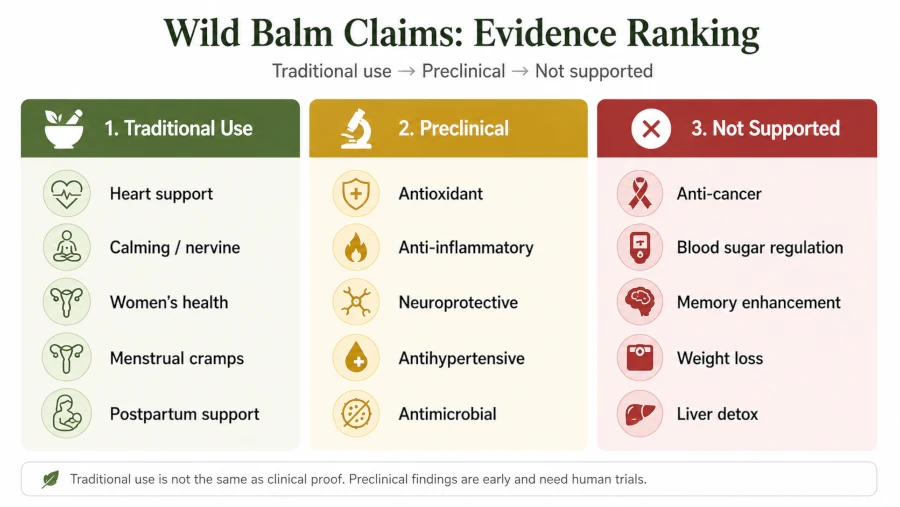
Strip away the folklore and the evidence is thin, though not empty. Almost all of it sits at the test-tube or animal stage.
Antioxidant activity (lab and animal)
A team at the University of Novi Sad in Serbia tested wild balm leaf extracts and found they neutralised free radicals in standard lab assays and supported the body’s own antioxidant enzymes in treated animals [Rašeta et al., 2011]. The effect lines up with the plant’s luteolin and apigenin content. This is a plausible mechanism, not a demonstrated health benefit in people.
Wound healing (early animal data)
The most-cited wound evidence is a rat study from the Medical University of Białystok in Poland, presented as a conference abstract in 2017. In burn and diabetic-wound models, water and alcohol extracts reduced inflammation, increased collagen, and closed wounds a few days faster than untreated controls, with antimicrobial activity the authors compared to the antiseptic chlorhexidine [Kepka, 2017]. That sounds encouraging, but it is an unpublished conference abstract in rodents, and the authors themselves called for safety testing and standardisation before any human use.
The honest gap
There are no controlled human trials of wild balm for any condition. We don’t have data on effective doses in people, real-world benefits, or long-term safety. Anyone claiming it “treats” or “cures” something is going well past what the evidence supports.
| Claim | Evidence level | What it rests on |
| Antioxidant activity | Early / preclinical | In-vitro assays and animal studies only |
| Helps minor wounds heal | Early / animal | One unpublished rat conference abstract |
| Anti-inflammatory effect | Plausible mechanism | Iridoid (harpagide) content; no human trials |
| Sedative, digestive, diuretic | Traditional use | Folk records and old herbals, no clinical data |
| Treats or cures any disease | Not supported | No human evidence of any kind |
Traditional preparations — and why “traditional” doesn’t mean “safe”
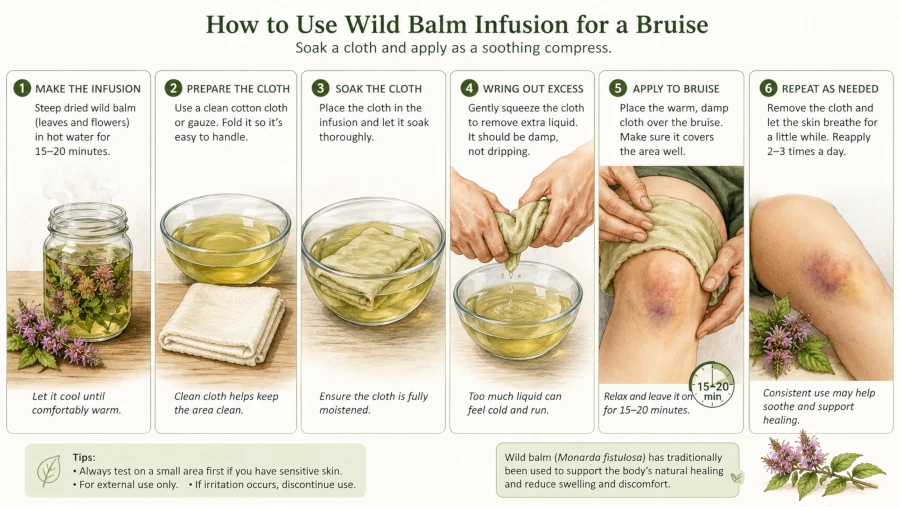
For completeness, here is how wild balm has been prepared in European herbal practice. None of this is a dosing recommendation, and no health authority has set a safe or effective dose.
- Infusion (tea): roughly 20–30 g of the dried plant steeped in a litre of water, taken as up to three cups a day, sometimes sweetened with honey.
- External wash or compress: a stronger infusion — up to about 60 g per litre — soaked into a cloth and laid on bruised or sprained skin.
These numbers come from herbal compendiums, not clinical studies. Because the plant contains coumarin and has never been through human safety testing, treat internal use especially carefully and talk to a qualified professional first.
Safety, side effects, and who should avoid wild balm
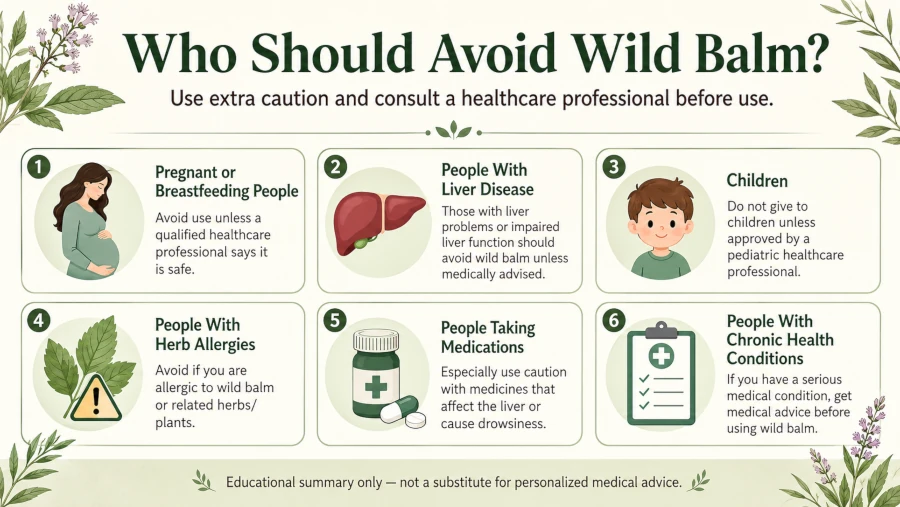
The biggest safety questions with wild balm have less to do with its traditional uses and more to do with one compound and one missing dataset: coumarin, and the near-total absence of human safety research.
Coumarin and your liver
Wild balm is described as coumarin-rich, and that matters. In high or prolonged doses, coumarin can damage the liver. European food-safety regulators (EFSA) set a tolerable daily intake of just 0.1 mg per kilogram of body weight, and France’s food-safety agency advises people with a history of liver disease to avoid coumarin-heavy foods and supplements [ANSES, 2024]. Nobody has measured how much coumarin ends up in a cup of wild balm tea, so the safe assumption is caution — particularly if you have liver problems or drink heavily.
Pregnancy and breastfeeding
Avoid it. Wild balm’s traditional use to stimulate menstruation is a warning sign in pregnancy, and there is no safety data in pregnancy or while breastfeeding.
Blood thinners and surgery
Coumarin-containing plants are routinely flagged for caution with anticoagulant medicines. The parent compound coumarin is only a weak blood thinner on its own, but the sensible course is not to combine wild balm with drugs like warfarin and to stop using it well before any planned surgery. Check with the prescriber.
Allergies and skin reactions
As a mint-family plant, wild balm can trigger allergic reactions in susceptible people. If you use a compress, test it on a small patch of skin first.
It is not a treatment for serious wounds
Traditional skin use was for minor bruises and sprains only. Don’t put herbal washes on deep, gaping, dirty, or infected wounds, on animal or human bites, or on anything more than a very minor burn. Those need proper medical care.
Children and foraged material
There isn’t enough safety data to support giving wild balm to young children. And because it’s wildcrafted rather than standardised, there’s a real risk of misidentifying the plant or using contaminated material — don’t forage it unless you can identify it with certainty.
When to stop and get medical help
- A wound or bruise with spreading redness, warmth, pus, or fever — signs of infection.
- Severe swelling, or a bruise after a hard knock that isn’t improving, which can hide a fracture or deeper bleed.
- Yellowing skin or eyes, dark urine, pain in the upper-right abdomen, or unusual tiredness — possible signs of liver trouble that warrant prompt attention.
| Health Disclaimer This article is for general education and information only. It is not medical advice and is not a substitute for diagnosis or treatment from a qualified health professional. Wild balm has not been evaluated in human clinical trials, and no safe or effective dose has been established. Do not use it to self-treat a medical condition. If you are pregnant or breastfeeding, take prescription medication (especially blood thinners), have liver disease, or are considering wild balm for a child, talk to a doctor or pharmacist before using any herbal preparation. Seek urgent care for signs of infection, a serious injury, or possible liver problems. |
Frequently asked questions
Is wild balm the same as lemon balm?
No. They sit in different genera and have different chemistry. Wild balm (Melittis melissophyllum) smells faintly of hay rather than lemon, and leans on coumarin and iridoids instead of the citral that gives lemon balm its scent.
Does wild balm actually heal wounds?
Early animal research is promising — rat studies suggest extracts may speed wound closure — but there are no human trials. Treat it as a traditional remedy, not a proven wound treatment, and never use it on deep, dirty, or infected wounds.
Can I drink wild balm tea every day?
There is no established safe dose, and the plant’s coumarin content is a real reason to be cautious about regular internal use, especially if you have liver concerns. Check with a professional before making it a habit.
Is wild balm safe during pregnancy?
There’s no safety data, and its traditional use to stimulate menstruation means it should be avoided in pregnancy and while breastfeeding.
Why does wild balm smell like hay instead of lemon?
That hay-like or coumarin scent reflects its actual chemistry. It is a useful way to tell wild balm apart from the lemon-scented true balms it’s often confused with.
References
- USDA Agricultural Research Service. Dr. Duke’s Phytochemical and Ethnobotanical Databases — Melittis melissophyllum. → View source
- Rašeta M, et al. Antioxidant Activities of Melittis melissophyllum L. (Lamiaceae). Molecules. 2011;16(4):3152–3167. doi:10.3390/molecules16043152. → View source
- Skrzypczak-Pietraszek E, Pietraszek J. Seasonal changes of flavonoid content in Melittis melissophyllum L. (Lamiaceae). Chem Biodivers. 2014;11(4):562–570. doi:10.1002/cbdv.201300148. → View source
- Skrzypczak-Pietraszek E, et al. Enhanced accumulation of harpagide and 8-O-acetyl-harpagide in Melittis melissophyllum L. agitated shoot cultures. PLoS ONE. 2018;13(8):e0202556. doi:10.1371/journal.pone.0202556. → View source
- Kepka S. The therapeutic benefits of Melittis melissophyllum extracts in wound healing [conference abstract]. Medicinal & Aromatic Plants; 2017. (Rat study; unpublished abstract.) → View source
- ANSES (French Agency for Food, Environmental and Occupational Health & Safety). Beware of overconsumption of herbal supplements containing coumarin. → View source
- AGES (Austrian Agency for Health and Food Safety). Coumarin. → View source
- Wikipedia. Melittis (taxonomy and native range). → View source
