
The foods that cause flatulence are mostly the ones your small intestine can’t fully break down: beans and lentils, cruciferous vegetables like broccoli and cabbage, dairy if you don’t digest lactose well, some fruits, and the sugar-free sweeteners that end in “-ol.” When these slip into your large intestine undigested, the bacteria living there ferment them and release gas. [NIDDK, 2024].
Gas is normal. Passing it roughly 13 to 21 times a day is typical, and most people belch up to about 30 times a day as well. [NIDDK, 2024] It becomes worth acting on when it’s painful, frequent enough to disrupt your day, or paired with warning signs like weight loss or blood in your stool.
This isn’t a list of foods to quit. Beans, vegetables, and whole grains sit near the top because they’re high in fiber — and fiber is good for you. The aim is to find your own triggers, change how you prepare and pace those foods, and know the rare moments when gas points to something a doctor should check.
Where intestinal gas actually comes from
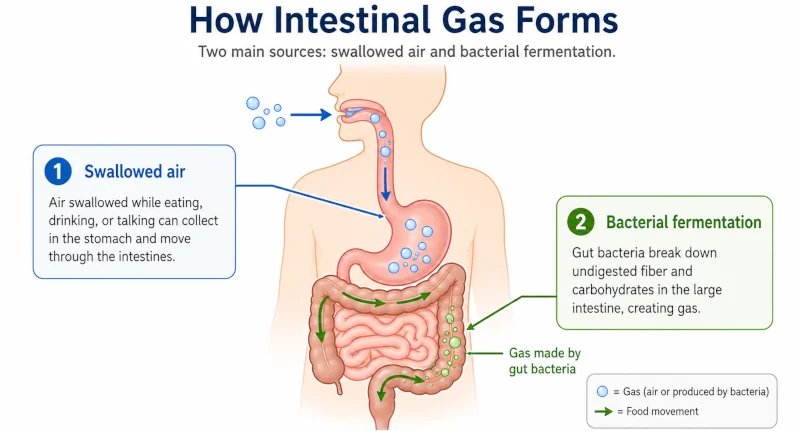
Gas reaches your gut two ways. [NIDDK, 2024]
The first is swallowed air. You take in a little every time you eat or drink, and more when you chew gum, suck on hard candy, sip carbonated drinks, eat fast, smoke, or wear loose dentures. Most of it comes straight back up as a belch.
The second source — the one food drives — is bacterial fermentation. Your small intestine doesn’t absorb every carbohydrate. Whatever passes through reaches the large intestine, where trillions of bacteria break it down and give off hydrogen, carbon dioxide, and sometimes methane. [NIDDK, 2024] These hard-to-absorb carbohydrates are often grouped under the label FODMAPs.
Here’s a detail that surprises people: gas from plant fiber is usually odorless. The smell comes mostly from sulfur compounds, which is why foods like onions, garlic, and eggs produce the worst-smelling gas rather than the most of it. [Better Health Channel, 2023]
The main foods that cause flatulence
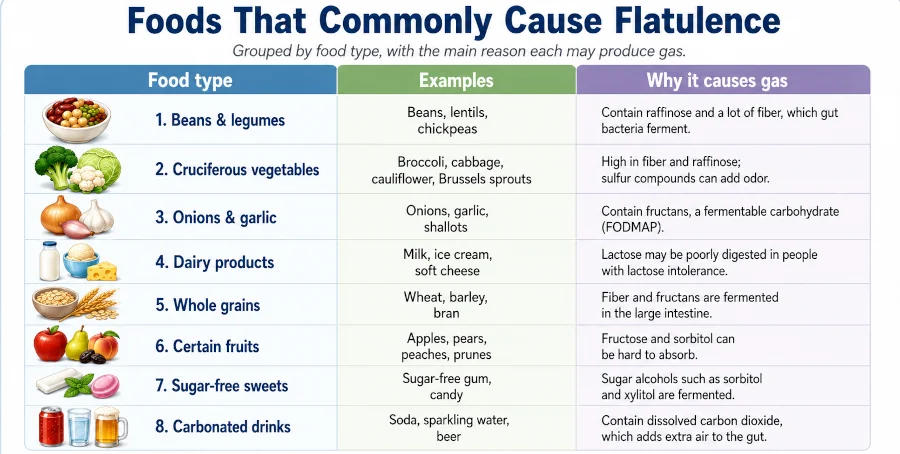
Most everyday gas traces back to a handful of food groups. The table sums them up; the notes after it cover the ones people ask about most.
| Food group | Common examples | Why it makes gas |
| Legumes | Beans, lentils, chickpeas, split peas | Contain raffinose and other sugars humans can’t fully digest, so gut bacteria ferment them. |
| Cruciferous vegetables | Broccoli, cauliflower, cabbage, kale, Brussels sprouts | High in fiber and raffinose; fermented in the large intestine. |
| Dairy (if lactose intolerant) | Milk, ice cream, soft cheese | Undigested lactose is fermented when lactase enzyme is low. |
| High-fiber & whole grains | Bran, oats, whole wheat, peas | Fiber that resists absorption is broken down by bacteria, especially if added too fast. |
| High-fructose fruit & drinks | Apples, pears, peaches, fruit juice, soda | Excess fructose and high-fructose corn syrup are poorly absorbed by many people. |
| Sugar alcohols | Sorbitol, mannitol, xylitol, erythritol (sugar-free gum & candy) | Sweeteners ending in “-ol” pass to the colon largely undigested. |
| Carbonated & fast-eaten foods | Soda, beer, gum, eating in a hurry | Add swallowed air rather than fermentation gas. |
Beans, lentils, and other legumes
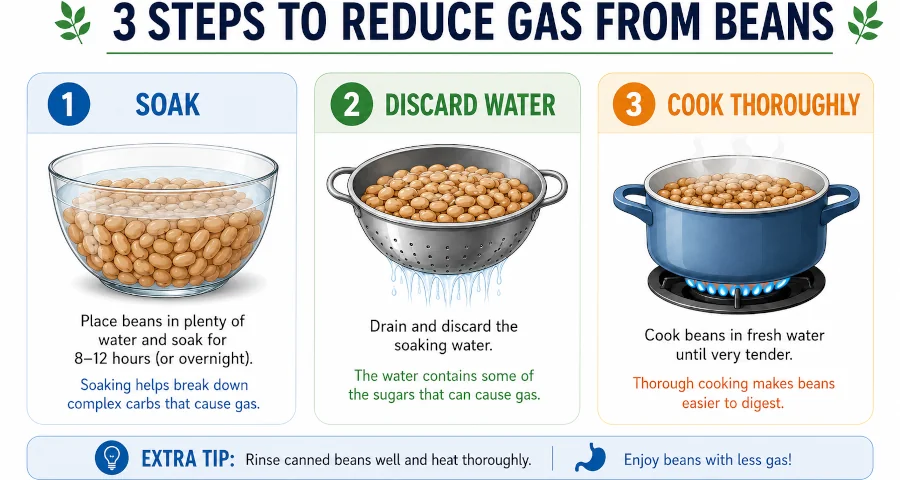
Legumes are the classic culprit because they carry raffinose, a sugar humans lack the enzyme to split. It travels intact to the colon, where bacteria feast on it. You don’t have to give beans up. Soaking dried beans and discarding the soak water, rinsing canned beans, and cooking them thoroughly removes some of the gas-producing sugars. An over-the-counter enzyme called alpha-galactosidase (sold as Beano) can also help break raffinose down before your gut bacteria get to it. [Cleveland Clinic, 2023]
Cruciferous vegetables
Broccoli, cauliflower, cabbage, kale, and Brussels sprouts combine fiber with raffinose, so they ferment much like beans. [NIDDK, 2024] Cooking them rather than eating them raw, and keeping portions modest in a single meal, tends to ease the effect. These vegetables are nutrient-dense, so cut back only as much as your comfort requires.
Dairy, if you don’t digest lactose
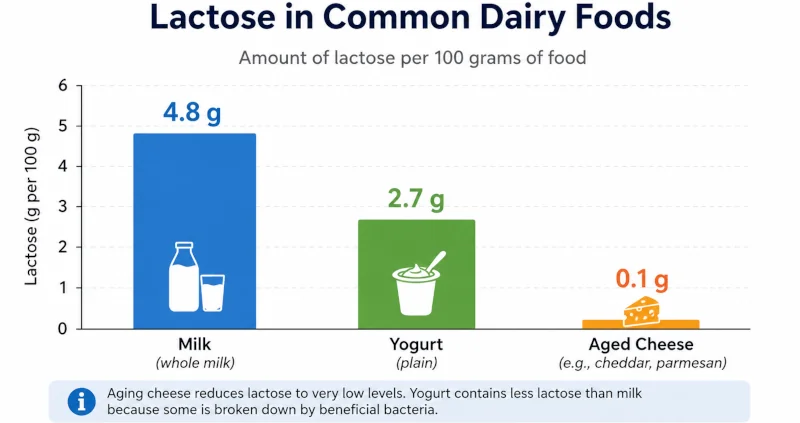
Milk causes gas mainly in people who are lactose intolerant — and that’s a large share of adults. Roughly two-thirds of the world’s adult population has some reduced ability to digest lactose, though how many actually get symptoms varies widely by ancestry and by how much dairy they eat at once. [StatPearls, 2024] When lactose isn’t broken down, it ferments. Yogurt with live cultures and aged hard cheeses contain less lactose and are usually tolerated better, and lactase drops or tablets let many people enjoy dairy without the aftermath. [NIDDK, 2024]
Fiber, fructose, and sugar alcohols
Three more groups round out the list. High-fiber foods and whole grains feed gut bacteria by design — helpful, but a sudden jump in fiber overwhelms the system, so add it slowly over a couple of weeks. [NIDDK, 2024] Fructose, the natural sugar in apples, pears, and peaches and the added sweetener in many sodas and juices, is poorly absorbed by some people. And sugar alcohols — sorbitol, mannitol, xylitol, erythritol — found in sugar-free gum and candy reach the colon almost untouched, which is why “sugar-free” can mean “gas-prone.”
Foods and habits that may reduce gas
No food reliably stops gas, but several habits and ingredients have real or plausible support.
Pace and portion matter most. Eating slowly, chewing well, and having smaller, more frequent meals all cut down on both swallowed air and the fermentation load hitting your colon at once. [NIDDK, 2024]
Yogurt with live and active cultures is often suggested for supporting healthy digestion. The evidence for probiotics easing gas is mixed — some people notice a difference, others don’t — so treat it as worth trying rather than guaranteed.
Several culinary herbs have a long traditional use as carminatives, meaning they’re thought to ease gas and cramping. Of these, peppermint has the strongest human evidence: peppermint oil can relieve bloating and pain in irritable bowel syndrome. Fennel, anise, and sage are widely used as after-meal teas, but high-quality human trials are limited, so think of them as gentle, low-risk options rather than proven treatments.
What about charcoal, simethicone, and supplements?
Drugstore shelves are full of anti-gas products. They differ in how much evidence backs them.
- Simethicone (Gas-X, Mylanta) breaks up gas bubbles. It’s widely sold and generally safe, though studies on how well it works are modest.
- Activated charcoal is marketed for gas, but the evidence is mixed and it can reduce absorption of medications taken around the same time — a real reason to check with a pharmacist first.
- Alpha-galactosidase (Beano) targets the sugars in beans and vegetables and has reasonable support for those specific foods.
- Lactase products help only with lactose-related gas.
For safety, talk with your doctor before starting any supplement, probiotic, or alternative remedy — especially if you take other medication. [NIDDK, 2024]
How to find your own triggers
Gas is personal. A food that bothers one person leaves another fine. The practical approach is to keep a short diary of what you eat and when symptoms show up, then test one suspected food at a time by removing it for a week or two and watching for change. [NIDDK, 2024]
If symptoms are severe or you’ve been diagnosed with IBS, a clinician may suggest a low-FODMAP diet — a structured, temporary plan that strips out the most fermentable carbohydrates and reintroduces them in steps. Because it’s restrictive, it works best with a registered dietitian rather than as a long-term diet on your own. [NIDDK, 2024]
When gas is a warning sign
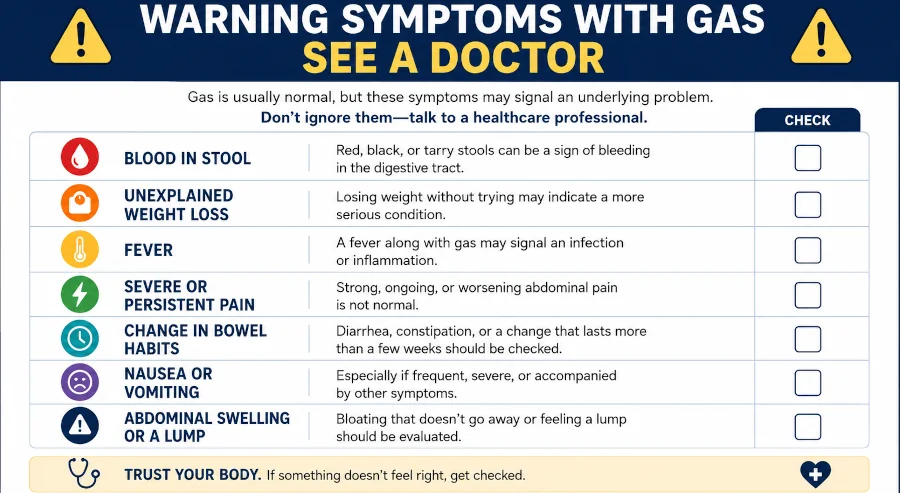
Most gas needs no medical attention. See a doctor, though, if it comes with any of these:
- Unintended weight loss
- Blood in your stool, or black, tarry stools
- Persistent or worsening abdominal pain
- Ongoing diarrhea or constipation, or a clear change in your usual bowel habits
- Vomiting, fever, or symptoms that wake you at night
Excess gas can occasionally be a sign of an underlying condition such as celiac disease, irritable bowel syndrome, or gastroparesis, which is why a pattern that won’t settle deserves a check-up. [Mayo Clinic, 2023] And don’t assume chest or upper-abdominal pain is “just gas” — if it’s severe or unfamiliar, get it evaluated rather than waiting.
Some groups should be more cautious before overhauling their diet: people who are pregnant or breastfeeding, anyone with IBS or inflammatory bowel disease, people managing diabetes, and anyone with a history of bowel obstruction. Concentrated herbal oils and supplements aren’t well studied in pregnancy, so culinary amounts of fennel or peppermint tea are one thing, but check with your clinician before using concentrated products.
| Health Disclaimer This article is for general education only and is not medical advice, diagnosis, or treatment. It is not a substitute for care from a qualified health professional who knows your history. Gas and bloating are usually harmless, but they can sometimes signal a condition that needs evaluation. If you are pregnant or breastfeeding, take regular medication, or have a digestive condition such as IBS, celiac disease, or inflammatory bowel disease, talk to your doctor or a registered dietitian before making major diet changes or starting any supplement. Seek prompt care for the red-flag symptoms described above. |
Frequently asked questions
Which foods cause the most gas?
Beans and lentils, cruciferous vegetables (broccoli, cauliflower, cabbage), dairy for people who are lactose intolerant, high-fructose fruits and drinks, and sugar-free products made with sorbitol or xylitol top the list. [NIDDK, 2024]
Why is my gas so smelly?
Odor comes from sulfur, not fiber. Foods like onions, garlic, eggs, and meat tend to produce stronger-smelling gas, while fiber-driven gas is usually close to odorless. [Better Health Channel, 2023]
Do beans really cause gas, and can I prevent it?
Yes — raffinose in beans ferments in the colon. Soaking and discarding the water, rinsing canned beans, cooking them well, and using an alpha-galactosidase enzyme (Beano) all reduce the effect. [Cleveland Clinic, 2023]
Can yogurt or probiotics reduce gas?
They might. Yogurt with live cultures is lower in lactose and easier to tolerate than milk, and some people find probiotics help. The research is mixed, so it’s worth a trial rather than a sure fix. [NIDDK, 2024]
When should I see a doctor about gas?
If gas comes with weight loss, blood in your stool, persistent pain, or a lasting change in bowel habits, see a doctor — these can point to a treatable condition. [Mayo Clinic, 2023]
References
- National Institute of Diabetes and Digestive and Kidney Diseases (NIDDK). Symptoms & Causes of Gas in the Digestive Tract. 2024. → View source
- NIDDK. Eating, Diet, & Nutrition for Gas in the Digestive Tract. 2024. → View source
- NIDDK. Treatment for Gas in the Digestive Tract. 2024. → View source
- Mayo Clinic. Gas and gas pains — Symptoms & causes. 2023. → View source
- Harvard Health Publishing. Gas (flatulence) A to Z. → View source
- Better Health Channel (Victoria State Government). Flatulence. 2023. → View source
- Cleveland Clinic. Gas and Gas Pain. 2023. → View source
- Catanzaro R, et al. Lactose Intolerance. StatPearls (NCBI Bookshelf). 2024. → View source
