
Lady’s mantle has a long résumé in European folk medicine and a very short one in clinical research. The lady’s mantle plant (Alchemilla vulgaris) is rich in tannins, compounds with a drying, tightening (astringent) effect, and that chemistry lines up with most of its traditional uses: loose stools, minor mouth sores, small skin wounds, and painful or heavy periods [ESCOP, 2013] [Kanak et al., 2022].
Here is the honest summary. One small study run by a manufacturer suggests a lady’s mantle gel may help ordinary mouth ulcers heal faster [Shrivastava & John, 2006]. A European scientific monograph supports its traditional use for mild, nonspecific diarrhea [ESCOP, 2013]. Nearly everything else — including the women’s-health reputation behind its name — rests on tradition and laboratory work. And reliable safety data are thin, which matters more than any benefit if you’re pregnant or take regular medication [Natural Medicines, 2020].
Lady’s mantle at a glance
| Fact | Detail |
| Botanical name | Alchemilla vulgaris L., also sold as Alchemilla xanthochlora. Botanists treat it as a cluster of closely related microspecies rather than one tidy species [Vlaisavljević et al., 2019] [ESCOP, 2013]. |
| Other name | Lion’s foot [Kanak et al., 2022] |
| Plant family | Rosaceae, the rose family |
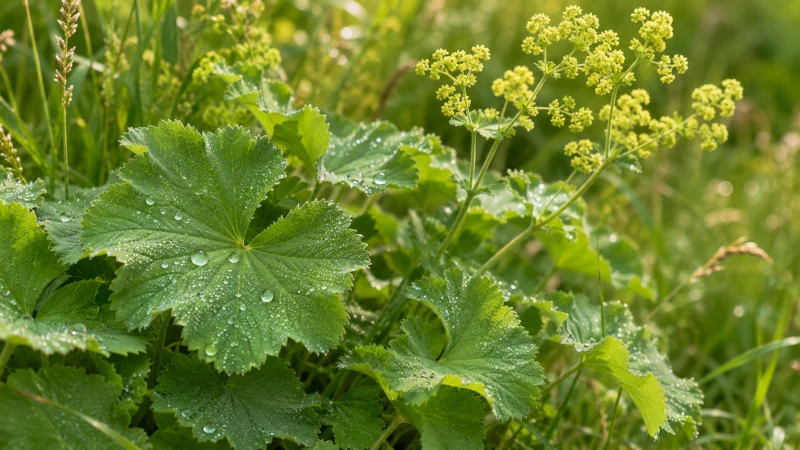
| What it looks like | A low perennial about 30–50 cm tall, with lobed, kidney-shaped to semicircular leaves and clusters of small yellow-green flowers from June to September [Vlaisavljević et al., 2019] |
| Where it grows | Grasslands, roadsides and mountain slopes; the genus occurs mostly across Europe and Asia [Kanak et al., 2022] |
| Part used | The flowering above-ground parts [ESCOP, 2013] |
| Main active compounds | Tannins built from gallic and ellagic acid, plus flavonoids such as quercetin [Kanak et al., 2022] |
What gives lady’s mantle its effects
In laboratory experiments, lady’s mantle extracts show astringent, antibacterial, antioxidant and anti-inflammatory activity, and animal studies show faster wound healing [ESCOP, 2013]. Those results explain why the plant earned its place in folk medicine. They don’t tell you how much it helps a person, and for most uses no one has measured that.
Keep the genus problem in mind, too. There are roughly 1,000 Alchemilla species, and for many years they were all lumped together as Alchemilla vulgaris [Kanak et al., 2022]. Studies don’t always test the same plant, and products don’t always contain the same one.
Lady’s mantle plant benefits, graded by the evidence
| Use | What the evidence shows | Evidence grade |
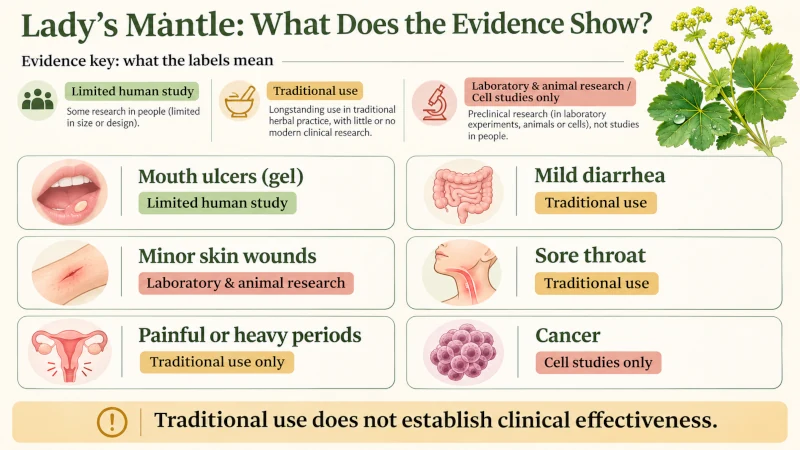
| Minor mouth ulcers (gel) | One open-label, manufacturer-sponsored study of 48 people found faster healing than no treatment | Limited |
| Mild, nonspecific diarrhea | Recognized in a European scientific monograph on the basis of tradition and tannin content; no clinical trials named | Traditional use |
| Minor wounds, skin irritation | Laboratory and animal studies | Preclinical only |
| Sore throat (gargle) | Traditional use; no trials found | Traditional use |
| Painful or heavy periods | Long folk use; no controlled human trials found | Traditional use only |
| Fibroids, endometriosis, infertility, PCOS | Folk claims; no human evidence | Insufficient |
| Cancer | Cell-culture studies only | Preclinical; not a treatment |
Mouth ulcers: the one use with human data
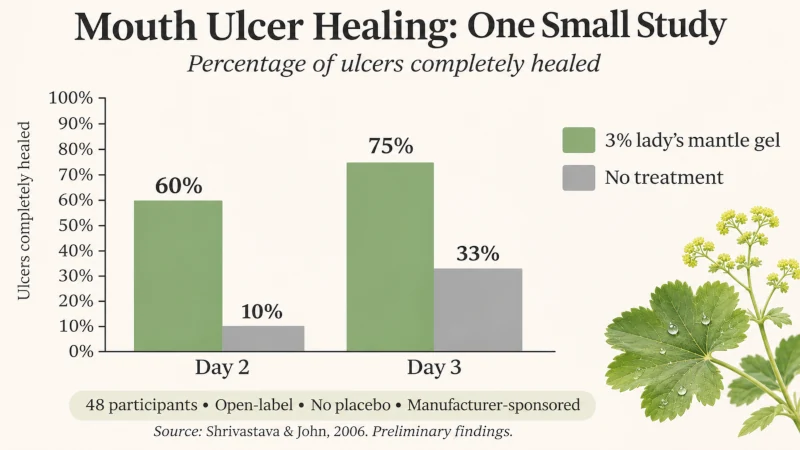
This is the only use where the European monograph’s summary points to clinical data in people [ESCOP, 2013]. In an open-label study, 48 otherwise healthy people aged 4 to 44 applied a gel containing 3% lady’s mantle extract in glycerine to common minor mouth ulcers three times a day. About 60% healed completely within two days and 75% within three, compared with roughly 10% and 33% of people who used nothing [Shrivastava & John, 2006].
Hold that result loosely. There was no placebo, participants knew what they were using, and the product’s developer sponsored the study and employed its authors [Shrivastava & John, 2006]. The gel also paired the extract with glycerine, so the study can’t separate the two. A ready-made lady’s mantle mouth gel is a reasonable thing to try on an ordinary canker sore; it isn’t proven. For other options, including rinses tested against standard mouthwashes, see our look at herbal mouth rinses and what the evidence shows.
Mild diarrhea: traditional use, recognized in Europe
ESCOP, the European Scientific Cooperative on Phytotherapy, lists nonspecific diarrhea and gastrointestinal complaints as lady’s mantle’s therapeutic indications [ESCOP, 2013]. That judgment rests largely on the plant’s tannins and long use. The only human clinical data named in the monograph’s summary are for mouth ulcers, so treat this as a traditional remedy for a mild, short-lived problem.
For an ordinary bout of loose stools, fluids matter more than any herb. Replacing lost water and salts comes first, and bland, easy foods make recovery more comfortable — our guide to foods that help with diarrhea covers what to eat, what to skip, and the warning signs that mean it’s time to call a doctor. Ongoing diarrhea, colitis, or persistent stomach pain needs a diagnosis, not a tea.
Minor wounds and skin irritation
Washes and compresses for cuts and sores are a traditional use, and lab and animal studies suggest lady’s mantle preparations can speed wound healing [ESCOP, 2013]. We found no published human trials of lady’s mantle on skin wounds. For a scrape, cleaning it well matters most; if you want a botanical, calendula has a somewhat deeper research record for minor skin complaints — see our evidence-graded guide to calendula.
Sore throat
Gargling a tannin-rich tea for a scratchy throat is a traditional practice, and reviews repeat the claim that Alchemilla species ease sore-throat symptoms [Kanak et al., 2022]. We found no clinical trials testing it. If you want a gargle with controlled trials behind it, sage is the better-studied choice: here’s what the trials show for sage and sore throats.
Periods and women’s health: the reputation outruns the research
This is what the plant is famous for, and where the evidence is weakest. In Southeast European folk medicine, lady’s mantle is used for painful or scanty periods, menopausal complaints, vaginal discharge, polycystic ovaries and even infertility; in Serbia, one folk name for it translates literally as “Lady’s mantle” [Vlaisavljević et al., 2019]. Reviews list painful periods and heavy menstrual bleeding among its traditional uses [Kanak et al., 2022]. We found no controlled human trials for any of them.
If cramps are what brought you here, ginger has the most human evidence among herbs, and heat, regular exercise and over-the-counter anti-inflammatory painkillers have more support still. Our guide to herbs for menstrual cramps lays out the doses that were actually studied.
Heavy bleeding, pain that’s getting worse, or pain outside your period deserves a checkup rather than a home remedy. Endometriosis, fibroids, pelvic inflammatory disease and sexually transmitted infections are among the causes of this kind of pain [MedlinePlus, 2026], and all of them are treatable once identified.
Cancer: test-tube findings only
In one laboratory study, lady’s mantle extracts slowed the growth of breast, cervical, ovarian and prostate cancer cells in culture [Vlaisavljević et al., 2019]. Cells in a dish are a long way from a person. No human study shows lady’s mantle prevents or treats cancer, and it should never replace cancer care.
Don’t use it as a vaginal wash
Some herbal sources recommend strong lady’s mantle decoctions as vaginal washes for discharge. Skip that advice. Doctors recommend against douching with any liquid, herbal or not. Douching upsets the vagina’s normal balance of bacteria and acidity, and it’s linked to bacterial vaginosis, yeast infections, pelvic inflammatory disease, sexually transmitted infections, and problems during pregnancy [Office on Women’s Health, 2025].
Unusual discharge, a bad smell, itching, burning, or pain when you urinate can signal an infection that needs a diagnosis. Douching before a visit can make it harder for your clinician to find the cause [Office on Women’s Health, 2025]. Washing the outside of the vagina with warm water is all the cleaning it needs.
How to use lady’s mantle (and why there’s no dose here)
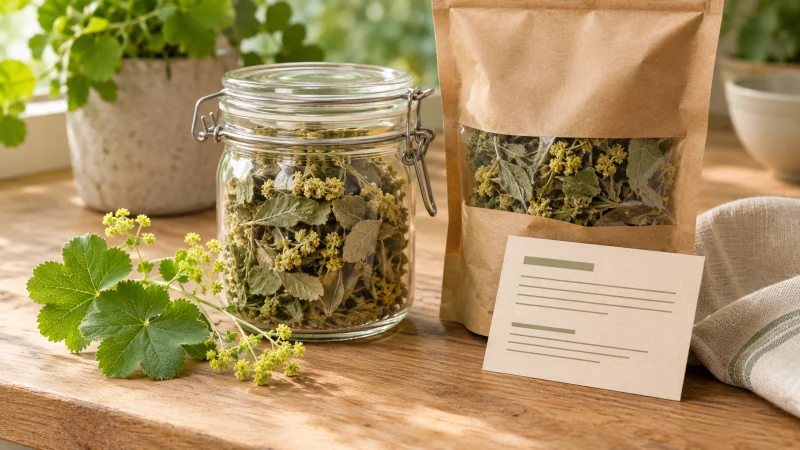
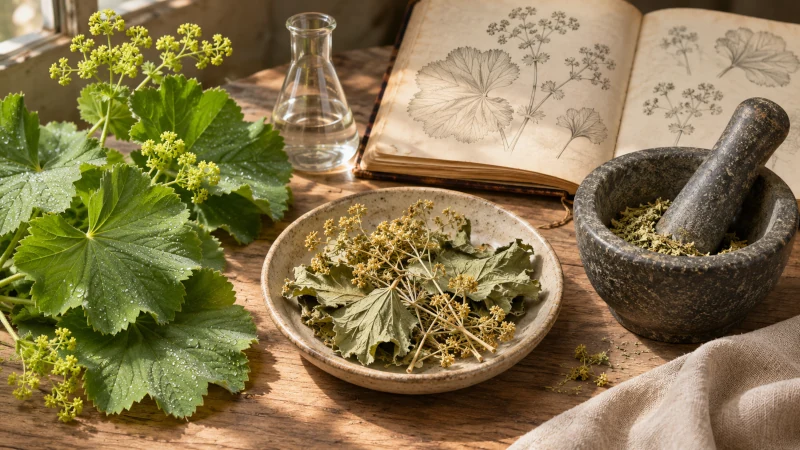
Lady’s mantle is sold as dried herb for tea, as tinctures and capsules, and as an ingredient in mouth gels. Here’s the catch: there isn’t enough reliable information to set an appropriate dose [Natural Medicines, 2020]. Traditional recipes vary widely, and none has been tested for safety or effect, so we’re not going to invent a number.
If you decide to try it:
- Match the product to the use. For a mouth ulcer, a ready-made gel is closer to what was actually studied than homemade tea.
- Follow the product label, and keep it short-term. If things aren’t improving within a few days, or they get worse, stop and get checked.
- Buy from companies that test for contaminants. European regulators named lady’s mantle among the ten herbal ingredients most affected by contamination with pyrrolizidine alkaloids — liver-damaging compounds from weeds harvested alongside the crop — and called for routine testing [EMA, 2016]. Look for third-party testing on the label.
- Leave children out of it unless a clinician who knows the child agrees.
Side effects, interactions, and who should avoid it
The honest answer is that lady’s mantle’s side effects aren’t well known. There isn’t enough reliable information to say whether it’s safe taken by mouth or applied to the skin, or what side effects it might cause [Natural Medicines, 2020]. In the mouth-ulcer study the gel was well tolerated [Shrivastava & John, 2006], and ESCOP’s summary describes good tolerability for that topical preparation [ESCOP, 2013]. That’s reassurance about one product dabbed on a mouth sore for a few days — not about weeks of strong tea.
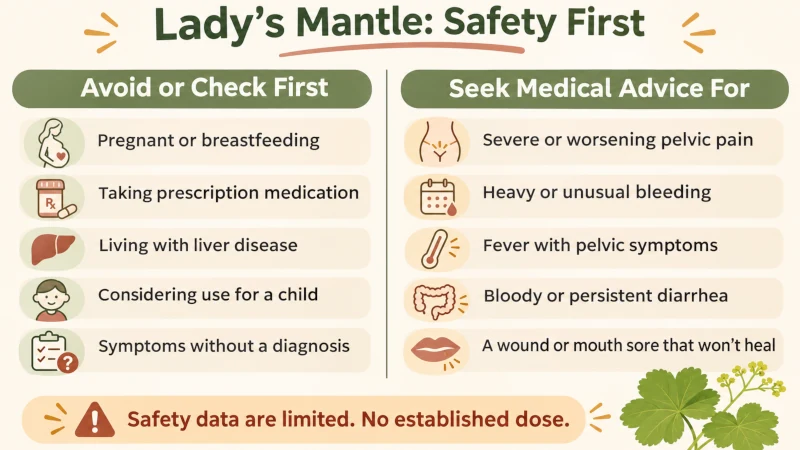
No drug interactions are documented. That reflects missing research rather than proven safety [Natural Medicines, 2020].
Avoid lady’s mantle, or check with a clinician first, if you:
- Are pregnant or breastfeeding. There isn’t enough reliable information to know whether it’s safe, so the cautious advice is to avoid it [Natural Medicines, 2020].
- Take any prescription medication. With no interaction data either way, a pharmacist is the right person to ask [Natural Medicines, 2020].
- Have liver disease. Use only products tested for pyrrolizidine alkaloids, which damage the liver at high exposure, and talk to your doctor first [EMA, 2016].
- Are treating a child. Safety in children hasn’t been studied.
- Have symptoms that haven’t been diagnosed — especially ongoing pelvic pain, abnormal bleeding, or persistent diarrhea.
When to see a professional instead
Contact a clinician promptly if you have:
- Fever with pelvic pain, increased or foul-smelling vaginal discharge, or sudden severe pelvic pain — especially if your period is more than a week late and you’ve been sexually active [MedlinePlus, 2026].
- Period pain that occurs outside your period, starts more than five days before it, continues after it ends, comes with blood clots, or doesn’t improve after three months of treatment [MedlinePlus, 2026].
- Vaginal itching, burning, pain when urinating, or discharge that smells bad [Office on Women’s Health, 2025].
- Diarrhea with blood, high fever, or signs of dehydration, or diarrhea that won’t settle — see the warning signs in our diarrhea guide.
- A mouth sore that isn’t healing or keeps coming back, or a wound that is deep, won’t stop bleeding, or shows spreading redness, warmth, pus or fever.
Get emergency help for swelling of the face, lips or throat, or trouble breathing after using any herbal product.
| HEALTH DISCLAIMER: This article is for general education. It isn’t medical advice and can’t replace a diagnosis or treatment plan from a qualified clinician who knows your history. Lady’s mantle is a traditional remedy with limited human research, no established dose, and little safety data. Talk with your doctor or pharmacist before using it if you are pregnant, breastfeeding, trying to treat a child, managing a health condition, or taking any medication. Don’t use it as a vaginal wash. If you have severe or worsening pain, heavy bleeding, fever, or signs of dehydration, seek medical care promptly. |
Frequently Asked Questions
What is lady’s mantle used for?
Traditionally, for mild diarrhea, minor mouth sores and skin wounds, sore throats, and painful or heavy periods. A European monograph supports its use for mild, nonspecific diarrhea on traditional grounds [ESCOP, 2013], and one small study supports a topical gel for minor mouth ulcers [Shrivastava & John, 2006]. The other uses haven’t been tested in people.
Is lady’s mantle tea safe to drink?
Nobody can say with confidence. There isn’t enough reliable information to establish its safety or a proper dose [Natural Medicines, 2020]. If you try it, keep it short-term, choose a tested product, and skip it if you’re pregnant, breastfeeding or taking medication without checking with a pharmacist first.
Does lady’s mantle help with heavy or painful periods?
It’s widely used for that in European folk medicine [Vlaisavljević et al., 2019], but we found no controlled human trials. Ginger, heat and anti-inflammatory painkillers have better evidence for cramps. Heavy bleeding or worsening pain should be checked by a clinician.
Does lady’s mantle work for mouth ulcers?
Possibly. In one open-label study of 48 people, a 3% lady’s mantle gel healed minor mouth ulcers faster than no treatment, but the study had no placebo and was run by the product’s developer [Shrivastava & John, 2006].
Can I use lady’s mantle while pregnant or breastfeeding?
It’s best avoided. There isn’t enough reliable information to know whether it’s safe during pregnancy or breastfeeding [Natural Medicines, 2020].
References
- ESCOP (European Scientific Cooperative on Phytotherapy). Alchemillae herba (Lady’s mantle) monograph summary. View source
- Shrivastava R, John GW. Treatment of aphthous stomatitis with topical Alchemilla vulgaris in glycerine. Clinical Drug Investigation. View source
- Vlaisavljević S, Jelača S, Zengin G, Mimica-Dukić N, Berežni S, Miljić M, Dajić Stevanović Z. Alchemilla vulgaris agg. (Lady’s mantle) from central Balkan: antioxidant, anticancer and enzyme inhibition properties. View source
- Kanak S, Krzemińska B, Celiński R, Bakalczuk M, Dos Santos Szewczyk K. Phenolic composition and antioxidant activity of Alchemilla species. Plants (Basel). 2022;11(20):2709. doi:10.3390/plants11202709. PMID 36297733. View source
- Natural Medicines Comprehensive Database (consumer version), via WebMD. Alchemilla: overview, side effects, precautions, dosing. View source
- Office on Women’s Health, U.S. Department of Health and Human Services. Douching. View source
- MedlinePlus Medical Encyclopedia. Painful menstrual periods. View source
- European Medicines Agency, Committee on Herbal Medicinal Products. Public statement on contamination of herbal medicinal products/traditional herbal medicinal products with pyrrolizidine alkaloids. View source


