Sage has been credited with curing nearly everything since at least the 16th century, when a Spanish physician reportedly told plague survivors that a week of sage tea would restore their fertility and repopulate the town. Most of that reputation is folklore.
A smaller, more interesting story survives modern testing: in controlled trials, common sage eases menopausal hot flashes, calms an acute sore throat, and shows early promise for memory and blood sugar. The health benefits of sage are real but specific — and the same compound that makes the plant pharmacologically active, thujone, is also why concentrated sage is not something to take casually for months.
So here is the honest version, sorted by how good the evidence is.
What sage actually is
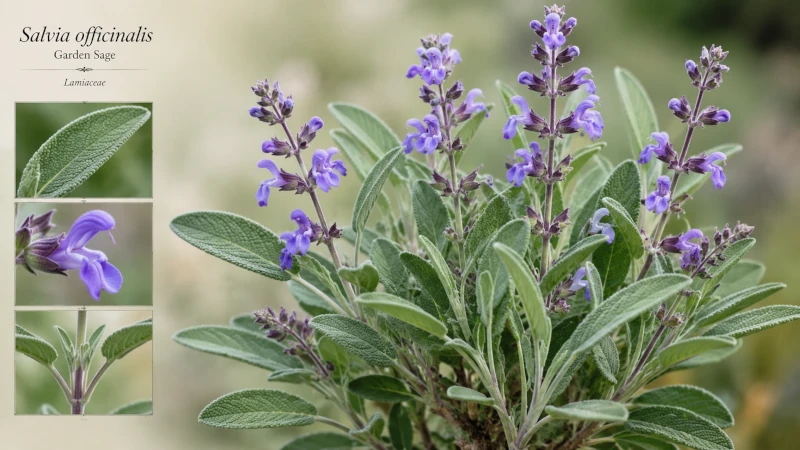
Common sage, or garden sage (Salvia officinalis), is a gray-green Mediterranean shrub in the mint family, alongside rosemary, thyme, and oregano. Its botanical name comes from the Latin salvere, “to heal” — a clue to how long people have leaned on it [WebMD, 2024].
The activity comes from two groups of compounds. The essential oil is rich in thujone, camphor, and 1,8-cineole, which carry the antimicrobial and aromatic punch (and the safety concerns). Separately, sage is dense in phenolic antioxidants — rosmarinic acid and carnosic acid chief among them — plus flavonoids like luteolin and apigenin [Ghorbani & Esmaeilizadeh, 2017].
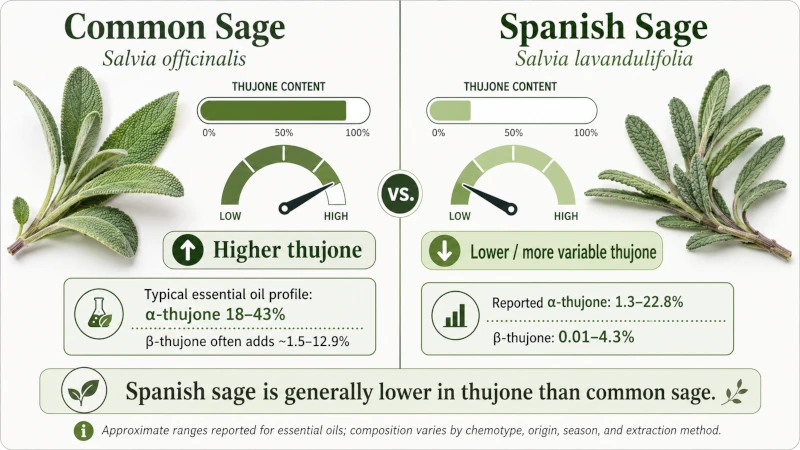
One distinction matters for the rest of this article: Spanish sage (Salvia lavandulaefolia) is a close relative with little to no thujone. Several memory studies used it precisely because it’s gentler, and it’s often the better choice for anyone planning to take sage daily. It isn’t the only relative worth knowing, either — clary sage is a different Salvia prized more for its aroma than for the uses covered here.
The nutrition is real, but it is not the point
A teaspoon of ground sage delivers roughly 10% of a day’s vitamin K, plus traces of vitamin A and minerals like magnesium and zinc [USDA, 2019]; [Signos, 2024]. That sounds impressive until you remember you eat sage by the pinch, not the cup. As a nutrient source, the spice on your shelf barely registers.
What is worth paying attention to is the concentration of plant compounds — the rosmarinic and carnosic acids — which are what researchers actually study, usually as teas or standardized extracts rather than as seasoning. When people talk about sage “doing” something, they almost always mean those.
Where the evidence for sage is strongest
Menopausal hot flashes and night sweats
This is sage’s best-supported use. In a Swiss trial, 69 menopausal women took a once-daily tablet of fresh sage extract for eight weeks; both the frequency and intensity of hot flashes fell significantly, with the heaviest flashes dropping the most [Bommer et al., 2011]. Several smaller Iranian randomized trials using 100 mg sage tablets reported similar drops in hot flashes and night sweats [Dadfar & Bamdad, 2019].
A 2023 systematic review and meta-analysis pulled the controlled trials together and found sage significantly reduced how often hot flashes happened, though its effect on how severe they were did not reach statistical significance [Kargozar et al., 2023]. That is a measured, useful finding: sage looks like a reasonable option to raise with your clinician, particularly if hormone therapy is not suitable for you — not a guaranteed fix, and not a replacement for one. Worth knowing too: the standout early trial was open-label and industry-run, so the evidence is promising rather than airtight.
Sore throats and acute pharyngitis
If you have ever gargled sage tea for a scratchy throat, the science is on your side. A double-blind, placebo-controlled trial found that a 15% sage spray reduced throat pain noticeably more than placebo, with relief showing up within the first two hours [Hubbert et al., 2006]. A separate double-blind trial found a sage-and-echinacea spray worked about as well as a conventional chlorhexidine/lidocaine spray for acute sore throats [Schapowal et al., 2009].
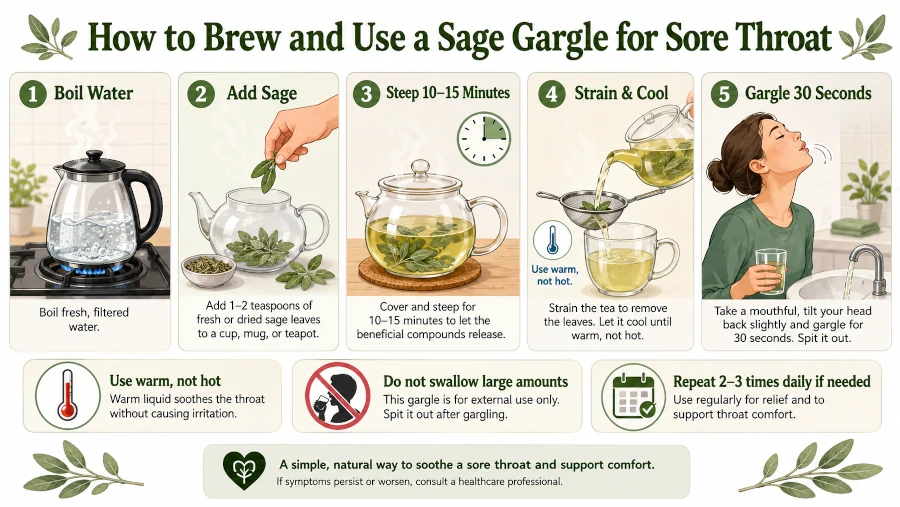
Practically, that makes a cooled sage gargle or a sage throat spray one of the better-justified home remedies here — useful for symptom relief while a typical viral sore throat runs its course. It’s often paired with other soothing herbs; a cup of peppermint tea alongside won’t treat the infection, but the menthol can make a raw throat feel less raw.
Memory and mental sharpness
Sage’s old nickname was “thinker’s tea,” and a handful of small studies give that some footing. In one placebo-controlled crossover trial, healthy older adults given a single dose of sage extract showed better recall through the day, while the placebo group declined as expected [Scholey et al., 2008]. A 2017 review of the trials concluded that sage can acutely sharpen memory, attention, and mood in healthy adults, and that an extract improved cognition over four months in people with mild-to-moderate Alzheimer’s disease [Lopresti, 2017].
The honest caveat: these studies are small, short, and use different preparations, so this sits in the promising-but-early column. Much of the cognition work used low-thujone Spanish sage, which is the form to look for if memory is your goal. Sage isn’t the only mint-family herb studied this way — rosemary has been looked at for memory and alertness too, and the two are often discussed together.
Blood sugar and cholesterol
Here the original “proven hypoglycemic” claim overshoots, but there is something to it. In a three-month randomized trial, 80 people with type 2 diabetes and high cholesterol took 500 mg of sage extract three times daily; their fasting glucose, HbA1c, LDL, and triglycerides fell while HDL rose, compared with placebo [Kianbakht & Hashem Dabaghian, 2013]. A 2022 meta-analysis of the diabetes trials found broadly similar, modest benefits [Ghadimi et al., 2022].
The trials are small and mostly from one region, so treat this as encouraging, not settled. And it cuts both ways: because sage can lower blood sugar, taking it alongside diabetes medication can push you too low. That is a conversation with your prescriber, not a reason to adjust doses yourself.
Health benefits of sage: Oral health
Consistent with the throat findings, a small randomized trial found a sage mouthwash reduced cavity-causing Streptococcus mutans in dental plaque [Beheshti-Rouy et al., 2015], and a split-mouth trial found a sage gel reduced gum bleeding and pocket depth when added to standard periodontal care [Alqahtani et al., 2024]. Limited evidence, but it points the same direction.
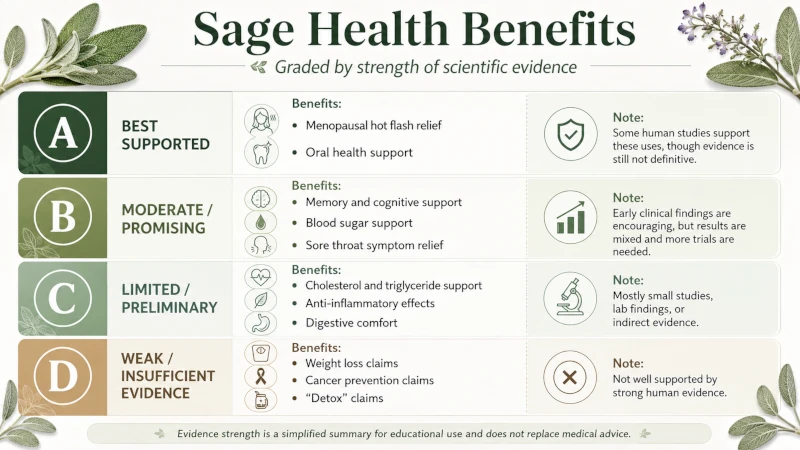
The evidence at a glance
| Use | What the evidence shows | Strength |
| Menopausal hot flashes | RCTs and a meta-analysis show fewer hot flashes | Moderate |
| Sore throat / pharyngitis | Placebo-controlled trials show faster pain relief from sage spray or gargle | Moderate |
| Memory (short-term) | Small trials show modest, mostly short-term gains | Early / promising |
| Blood sugar & cholesterol | Small RCTs show modest improvements in type 2 diabetes | Promising / limited |
| Oral health (plaque, gums) | Small trials support a sage rinse as an add-on | Limited |
| Fertility, depression, hair growth | Traditional use only | No good evidence |
Traditional uses the evidence does not back
Plenty of sage’s historical reputation simply has not held up, and it is worth being clear about which claims to retire.
Sage as a fertility booster — the plague-survivor story — has no clinical support. Its use for depression, low blood pressure, “nervous exhaustion,” and vertigo is traditional, not backed by human trials. Claims that sage grows hair, clears dandruff, or heals wounds, ulcers, and abscesses are folklore or rest on lab-dish findings that haven’t been shown to work on people. Sage is also traditionally used to dry up breast milk during weaning, but there’s no good evidence it reliably does so — and that same reputation is a reason for nursing mothers to be cautious (more below). If mood and mental energy are what you’re after, foods that support the nervous system are a more grounded starting point than sage.
A long list of traditional uses is a reason to study a plant. It is not proof the plant works.
How to use sage (and how much is too much)
| Form | Typical use | Notes |
| Culinary herb | Seasoning, by the pinch | Safe; enjoy freely |
| Tea / infusion | A few cups daily, short-term | Steep dried leaves 5–15 min |
| Gargle or throat spray | Sore throat relief | Best-supported home use |
| Standardized extract / tablets | 100–500 mg, depending on goal | The forms used in trials |
| Essential oil | Aromatherapy only | Never swallow it |
Medicinal sage preparations contain thujone, European regulators set a low daily thujone ceiling and recommend limiting concentrated, medicinal sage to roughly two weeks at a time — not a month [EMA, 2012]. Culinary amounts do not come close to that ceiling, so cooking with sage is a different question entirely from taking high-dose extracts for months.
Safety, side effects, and who should avoid sage
For most people, sage as food or the occasional cup of tea is safe. The cautions apply to concentrated forms — strong teas taken daily, extracts, tablets, and above all the essential oil.
Thujone is the reason. At high doses it is neurotoxic and can trigger seizures, and there are case reports of children having seizures after swallowing sage oil [Lachenmeier & Walch, 2017]. This is why sage essential oil should never be taken internally.
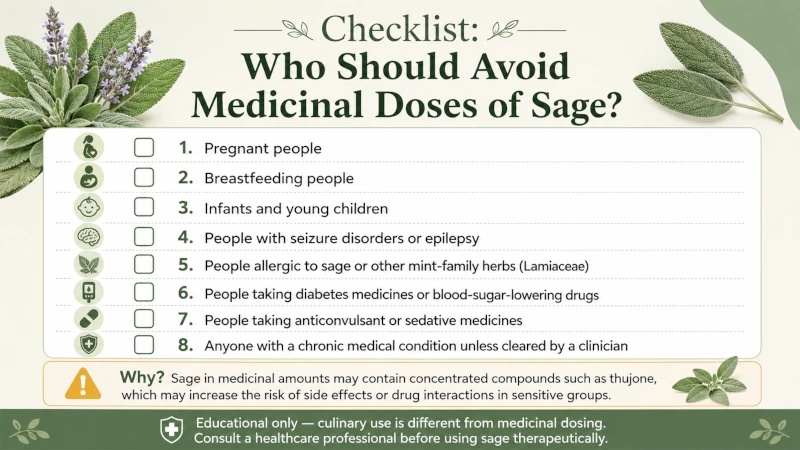
Be cautious or avoid medicinal-strength sage if you are:
- Pregnant. Sage in medicinal amounts is considered possibly unsafe; thujone may stimulate uterine contractions [NCCIH, 2020]. (This is the opposite of the old advice to take sage to bring on labor — do not.) Culinary amounts are fine.
- Breastfeeding. Little is known, and sage may reduce milk supply, so avoid medicinal doses while actively nursing [NCCIH, 2020]; [e-lactation, 2021].
- Living with epilepsy or a seizure disorder. Thujone can lower the seizure threshold; skip concentrated sage [WebMD, 2024].
- Taking diabetes medication. Sage can add to blood-sugar lowering and risk hypoglycemia — monitor and coordinate with your doctor [Kianbakht & Hashem Dabaghian, 2013].
- Managing a hormone-sensitive condition (certain breast, uterine, or ovarian cancers, endometriosis). Sage has mild estrogen-like activity, so use caution [WebMD, 2024].
Possible side effects at high or prolonged doses include dizziness, rapid heart rate, and — with very large amounts — vomiting. People allergic to other mint-family plants can react to sage too. If you take any prescription medication, check with a pharmacist or doctor before starting a sage supplement.
Red flags: when to skip the home remedy and call a professional
A sage gargle is fine for an ordinary sore throat, but see a clinician if a sore throat comes with a high fever, white patches on the tonsils, trouble breathing or swallowing, drooling, or it lasts more than about a week — those can signal strep or another infection that needs treatment. For menopause, get checked for any unusual or post-menopausal bleeding rather than self-treating. And never use sage in place of prescribed medication for diabetes or any other condition.
| Health Disclaimer: This article is for general education and is not medical advice, diagnosis, or treatment, and it is not a substitute for guidance from a qualified healthcare professional who knows your history. Herbs and supplements can interact with medications and are not right for everyone. If you are pregnant, breastfeeding, managing a health condition, or taking any medication, talk with your doctor or pharmacist before using sage in medicinal amounts. If you have severe or worrying symptoms, seek care promptly. |
Frequently Asked Questions
Is it safe to take sage every day?
In food and as an occasional cup of tea, yes. For concentrated forms — strong daily teas, extracts, or tablets — the cautious approach is short courses of about two weeks rather than continuous long-term use, because of thujone. Spanish sage (Salvia lavandulaefolia), which is essentially thujone-free, is the better pick for ongoing daily use.
Does sage really help with hot flashes?
The evidence is reasonably good. Controlled trials and a 2023 meta-analysis show sage extract reduces how often hot flashes occur, though the effect on severity is less certain [Kargozar et al., 2023]. It is a fair option to discuss with your clinician, especially if hormone therapy is not suitable for you.
Can I use sage tea for a sore throat?
Yes — this is one of sage’s best-supported uses. Placebo-controlled trials found sage sprays relieve throat pain within hours [Hubbert et al., 2006]. A cooled, strong sage tea used as a gargle is a sensible home version for a typical viral sore throat.
Is sage safe during pregnancy or breastfeeding?
Cooking with sage is fine. Medicinal amounts are not recommended in pregnancy, because thujone may stimulate the uterus, and are best avoided while breastfeeding, since sage may reduce milk supply [NCCIH, 2020].
What is the difference between common sage and Spanish sage?
Common sage (Salvia officinalis) contains thujone; Spanish sage (Salvia lavandulaefolia) contains little or none. For flavor and short-term remedies, common sage is standard. For daily, longer-term supplement use — particularly for memory — Spanish sage is the safer choice.
Can sage lower blood sugar?
Small trials suggest sage extract can modestly lower fasting glucose and HbA1c in people with type 2 diabetes [Kianbakht & Hashem Dabaghian, 2013]. That is a potential benefit and a caution at once: combined with diabetes medication, it can drop blood sugar too far, so coordinate with your doctor.
References
- National Center for Complementary and Integrative Health (NCCIH). Sage: Usefulness and Safety. 2020. View source
- WebMD. Sage — Uses, Side Effects, and More. 2024. View source
- Bommer S, Klein P, Suter A. First time proof of sage’s tolerability and efficacy in menopausal women with hot flushes. Advances in Therapy. 2011;28(6):490–500. View source
- Kargozar R, et al. The Effect of Salvia officinalis on Hot Flashes in Postmenopausal Women: A Systematic Review and Meta-Analysis. 2023. View source
- Hubbert M, et al. Efficacy and tolerability of a spray with Salvia officinalis in the treatment of acute pharyngitis. Eur J Med Res. 2006;11(1):20–26. View source
- Schapowal A, et al. Echinacea/sage or chlorhexidine/lidocaine for treating acute sore throats: a randomized double-blind trial. Eur J Med Res. 2009;14(9):406–412. View source
- Scholey AB, et al. An extract of Salvia (sage) with anticholinesterase properties improves memory and attention in healthy older volunteers. Psychopharmacology. 2008. View source
- Lopresti AL. Salvia (Sage): A Review of its Potential Cognitive-Enhancing and Protective Effects. Drugs in R&D. 2017;17:53–64. View source
- Kianbakht S, Hashem Dabaghian F. Improved glycemic control and lipid profile in hyperlipidemic type 2 diabetic patients consuming Salvia officinalis L. leaf extract. Complement Ther Med. 2013;21(5):441–446. View source
- Ghadimi M, et al. The effect of Salvia officinalis on blood glycemic indexes and lipid profile in diabetic patients: a systematic review and meta-analysis. 2022. View source
- Ghorbani A, Esmaeilizadeh M. Pharmacological properties of Salvia officinalis and its components. J Tradit Complement Med. 2017;7(4):433–440. View source
- Beheshti-Rouy M, et al. The antibacterial effect of sage extract (Salvia officinalis) mouthwash against Streptococcus mutans in dental plaque. Iran J Microbiol. 2015;7(3):173–177. View source
- Alqahtani A, et al. Clinical Effectiveness of Salvia officinalis in Periodontitis: A Split-Mouth Randomized Controlled Trial. 2024. View source
- e-lactation. Sage (Salvia officinalis) and breastfeeding. 2021. View source
- U.S. Department of Agriculture, FoodData Central. Spices, sage, ground. 2019. View source
