
A few plant extracts can ease the aching, heaviness and ankle swelling that come with varicose veins. None of them will make the veins themselves disappear. Among the herbs for varicose veins, standardized horse chestnut seed extract has the strongest research behind it, with red vine leaf and butcher’s broom extracts a step behind. Most of the other plants on traditional lists have little or no human evidence, and a couple are unsafe to take by mouth.
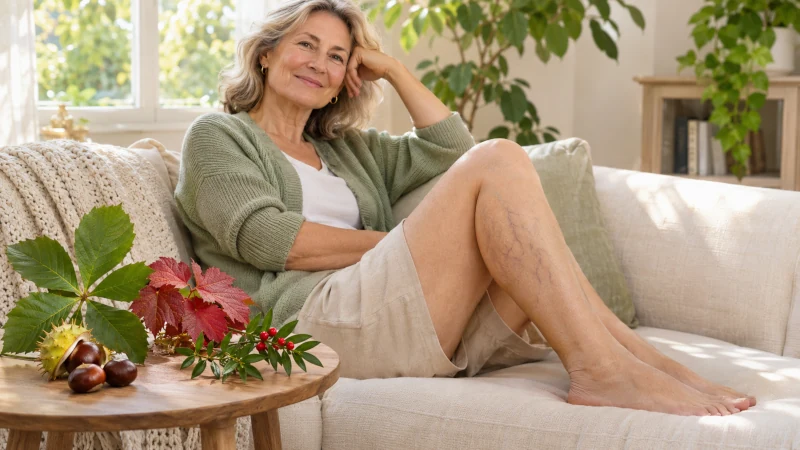
Below is what each herb can realistically do, how to use the useful ones safely, and which leg symptoms need a doctor rather than a supplement.
What herbs can and can’t do for varicose veins
Varicose veins are swollen, twisted veins just under the skin, usually on the legs. They can ache, itch or feel heavy, and the ankles may swell. Symptoms tend to be worse after standing for a long time and ease when you rest with your legs raised [NHS].
The cause is mechanical. Small valves inside leg veins normally keep blood moving up toward the heart. When the valves stop closing well, blood pools, the vein stretches, and fluid seeps into the surrounding tissue. When this goes on long-term, doctors call it chronic venous insufficiency, or CVI [Martinez-Zapata, 2020].
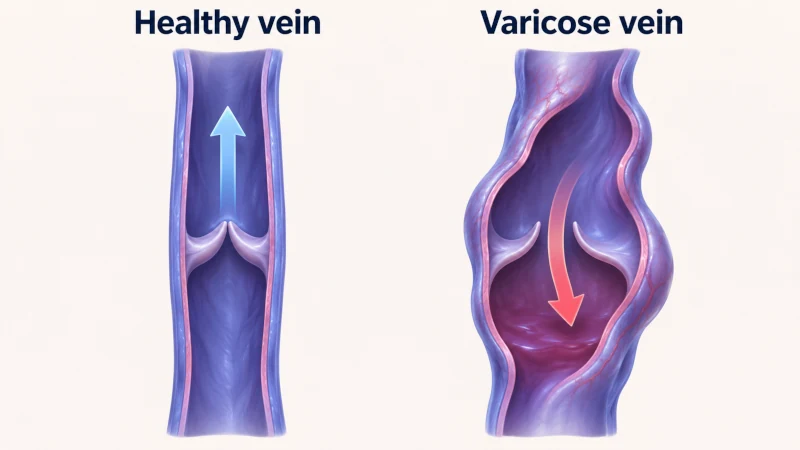
Herbs can’t repair a valve. What the better ones appear to do is tighten vein walls slightly and reduce leakage from small vessels, which shows up in trials as less swelling and fewer symptoms. A 2020 Cochrane review pooled 56 placebo-controlled trials of “phlebotonics”, mostly plant flavonoids such as rutosides plus a few herbal extracts.
These products probably reduce lower-leg swelling slightly. They made little or no difference to quality of life, may not help leg ulcers heal, and caused a few more side effects than placebo, mainly stomach upset [Martinez-Zapata, 2020].
So the honest expectation is some relief from heavy, puffy legs. Visible veins stay visible.
The best herbs for varicose veins, ranked by evidence
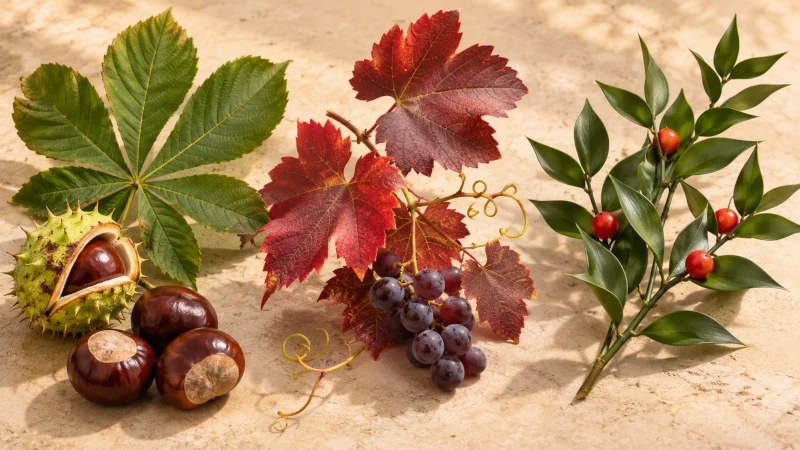
| Herb | What it may help | Evidence | Main caution |
| Horse chestnut seed extract (standardized) | Leg pain, swelling, itching from CVI | Moderate. Cochrane review of 17 randomized trials; short-term only | Raw seeds, bark, leaves and flowers are poisonous. Use only standardized extract |
| Red vine leaf extract | Leg swelling and heaviness | Limited to moderate. Several placebo-controlled trials, almost all of one branded extract | Results may not apply to other grape-leaf products |
| Butcher’s broom | Heaviness, pain, swelling | Limited to moderate, but mainly for a combination product with hesperidin and vitamin C | Evidence for the herb on its own is thin |
| Sweet clover (yellow melilot) | Heavy, uncomfortable legs | Traditional use only. No firm trial evidence | Contains coumarins; caution with blood thinners and liver disease |
| Bilberry | Traditionally, heavy legs and fragile capillaries | Insufficient. Not clearly shown to help any condition | Fruit is fine as food; leaves may be unsafe in high doses |
| Witch hazel (on the skin) | Soothing irritated skin | Does not treat varicose veins | Don’t drink it |
Horse chestnut seed extract
This is the one with real trial data. A Cochrane review of 17 randomized controlled trials looked at oral horse chestnut seed extract standardized to escin (also spelled aescin), its main active compound.
Compared with placebo, the extract improved leg pain, swelling and itching. In six of seven placebo-controlled trials that measured leg pain, pain fell significantly more with the extract. Across six trials, lower-leg volume dropped by about 32 ml more than with placebo. One trial suggested it may work about as well as compression stockings [Pittler & Ernst, 2012].
The reviewers still called for larger, more rigorous trials, and the studies were short. Side effects were usually mild and infrequent: stomach complaints, dizziness, nausea, headache and itching [Pittler & Ernst, 2012]. The U.S. National Center for Complementary and Integrative Health reads the evidence the same way [NCCIH, 2025].
In Europe, standardized horse chestnut seed extract has “well-established use” status for chronic venous insufficiency, which is a higher bar than traditional use. The EU monograph dose is a standardized dry extract supplying 21 mg of triterpene glycosides (measured as protoaescigenin) twice a day, and it notes that it may take at least four weeks to notice a benefit [EMA, 2020]. U.S. supplement labels usually list escin content instead, so stick to a product that states its standardized escin content and follow its label.
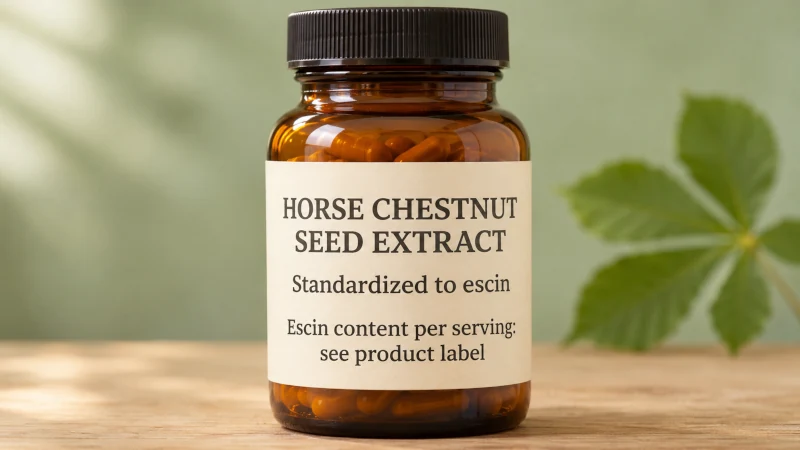
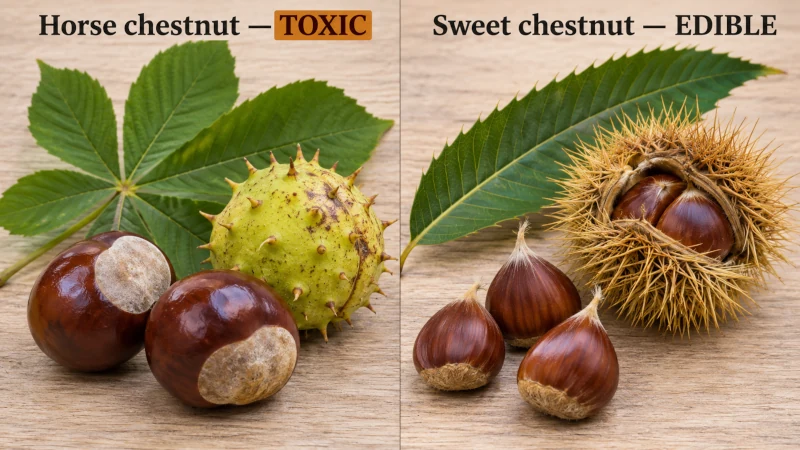
Safety first: never make horse chestnut tea or home remedies. The raw seeds, bark, flowers and leaves are unsafe to take by mouth because they contain a toxic compound. Only standardized seed extracts with that compound removed are considered likely safe, and studies have used them for up to 12 weeks [NCCIH, 2025]. Some older herbal books recommend a decoction of the bark or leaves. Skip that advice.
Horse chestnuts are also easy to confuse with the edible sweet chestnuts sold for roasting. They are different trees, and the horse chestnut is not food. See our guide to sweet chestnuts and their toxic look-alike.
Blood thinners are where sources disagree. The EU monograph lists no known drug interactions [EMA, 2020]. Memorial Sloan Kettering’s herb database, however, notes that aesculin, a coumarin-type compound in horse chestnut, may add to the effect of warfarin, aspirin and other blood thinners, and advises checking that your product is aesculin-free [MSKCC]. The interaction hasn’t been proven in people, but if you take any blood thinner, talk to your doctor or pharmacist first.
Red vine leaf extract
Extract from the red autumn leaves of the grapevine (Vitis vinifera) is the second-best-studied option. In a 12-week trial of 260 people with early-stage CVI, once-daily doses of 360 mg or 720 mg of a red vine leaf extract called AS 195 reduced lower-leg volume compared with placebo, with few and mostly mild side effects [Kiesewetter, 2000]. A later 84-day trial in 248 patients found about 20 ml less leg volume than placebo, and tolerability similar to placebo [Rabe, 2011].
Twenty milliliters is a modest change, roughly four teaspoons of fluid spread across the lower leg. And nearly all of this research tested one branded, manufacturer-supported extract, so a generic grape-leaf capsule may not behave the same way. Our red vine leaf and grapevine guide covers the plant in more detail.
Butcher’s broom
Butcher’s broom (Ruscus aculeatus) is a spiny Mediterranean shrub. Most of the research on it doesn’t test the herb alone. It tests a European combination product that pairs Ruscus root extract with hesperidin methyl chalcone (a citrus flavonoid) and vitamin C.
A 2003 meta-analysis of 20 placebo-controlled trials of that combination reported improvements in CVI symptoms [Boyle, 2003], and a 2017 systematic review of double-blind trials found less leg pain, heaviness, feeling of swelling and tingling than with placebo [Int Angiol, 2017].
Those results look good, but the combination was studied mainly with manufacturer support, and they don’t tell you much about a plain butcher’s broom capsule. The butcher’s broom guide goes into dosing and safety.
Sweet clover (yellow melilot)
European regulators accept melilot for relieving discomfort and heaviness of the legs from minor circulation problems, but only on the basis of long-standing traditional use. The studies they reviewed lacked objective measures, so no firm conclusion about effectiveness was possible. It’s meant for adults only, should be stopped and checked by a doctor if symptoms last more than two weeks, and can cause stomach upset or allergic reactions [EMA].
Melilot also contains coumarin compounds, which raises questions about bleeding risk with blood thinners and about the liver. Our sweet clover guide covers those cautions. If you take an anticoagulant or have liver disease, skip it.
Bilberry
Bilberry fruit is rich in anthocyanins, the pigments that make it dark blue, and it has a long history as a remedy for heavy legs and fragile capillaries. Modern evidence hasn’t caught up: NCCIH says bilberry hasn’t been clearly shown to help any health condition.
The fruit is safe in food amounts, and extracts up to 160 mg a day for six months appear well tolerated, but the leaves may be unsafe in high doses or with long-term use [NCCIH, 2024]. Eating bilberries or blueberries is fine; just don’t expect them to treat your veins. More in our bilberry guide.
Witch hazel
Witch hazel is a skin astringent. Dabbed on, it can soothe itchy or irritated skin, and it’s a reasonable option for hemorrhoids, which are swollen veins too. It won’t shrink varicose veins, and it shouldn’t be swallowed. Our witch hazel guide explains what it does and doesn’t do.
Creams and gels in general have weak support. The 2020 Cochrane review couldn’t find a single trial of a topical phlebotonic that met its standards [Martinez-Zapata, 2020]. A cooling gel may feel nice, but most of the relief probably comes from the massage and raising your legs while you apply it.
Herbs on old lists you can skip
Older herbals often list Italian cypress, hazel leaves, ginkgo, knotweed and rue as vein remedies. None has reliable human evidence for varicose veins. Ginkgo also affects bleeding, especially alongside blood thinners. Rue is genuinely risky: it can cause serious poisoning, should never be used in pregnancy, and its sap can burn the skin in sunlight. Leave it out entirely.
What works better than any herb

The everyday measures doctors recommend outperform supplements, and they cost little. The NHS suggests [NHS]:
- Raising your legs when you can, for example lying down with your feet on pillows
- Regular walking or other exercise, which works the calf muscle “pump” that pushes blood upward
- Keeping to a healthy weight, and not standing or sitting still for long stretches
- Moisturizing dry, itchy skin and protecting your legs from cuts and bumps
Compression stockings are the standard conservative treatment for CVI [Pittler & Ernst, 2012]. You wear them during the day and take them off at bedtime [NHS]. If they feel uncomfortable, ask about a different fit or pressure rather than giving up on them.
When veins are painful or getting worse, procedures can close or remove them. Endothermal ablation, which seals the vein with heat, is usually the first choice. Foam sclerotherapy and surgery are other options [NHS]. If herbs help you feel better while you wait for an appointment, that’s a fine use for them. They’re not a reason to put the appointment off.
How to use vein herbs safely
- Buy standardized extracts only. For horse chestnut, the label should state the escin content. Never use raw seeds, bark, leaves or flowers [NCCIH, 2025].
- Give it a fair trial, then reassess. Horse chestnut may take four weeks or more to help; longer-term use should be agreed with a doctor [EMA, 2020].
- Expect mild side effects in some people: upset stomach, headache, dizziness or itching [Pittler & Ernst, 2012].
- Check with a doctor or pharmacist first if you take any medicine, especially warfarin, aspirin, clopidogrel or another blood thinner [MSKCC].
- Pregnancy and breastfeeding: safety hasn’t been established, so these herbs aren’t recommended unless your doctor approves [EMA, 2020].
- Not for children and teens: use under 18 isn’t recommended [EMA, 2020].
- Heart or kidney disease: leg swelling can come from the heart or kidneys rather than the veins. Get it checked before treating it yourself [EMA, 2020].
- Gels and creams: don’t apply them to broken skin, ulcers or near the eyes [EMA, 2020].
When leg symptoms need medical care
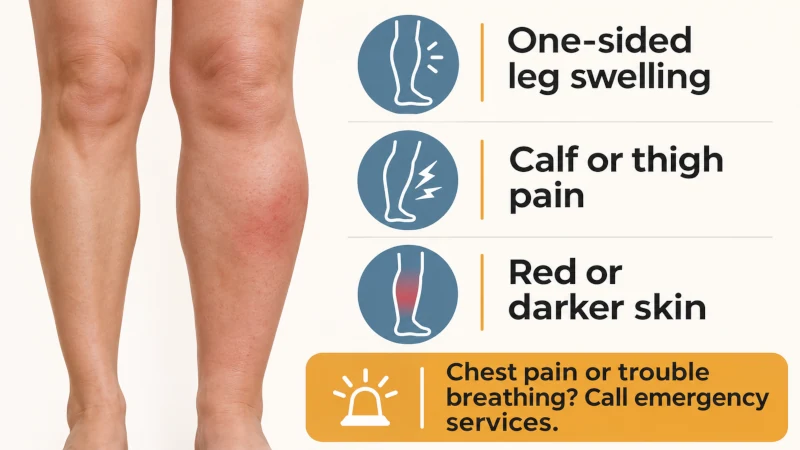
Varicose veins are usually harmless, but a few symptoms mean something else may be going on.
Call 911 (or your local emergency number) if you have leg pain or swelling and you feel short of breath or have chest pain. A clot may have traveled to the lungs [NHS DVT]. Get same-day medical advice if one leg becomes swollen with throbbing pain in the calf or thigh, or the skin there turns red or darker. These can be signs of deep vein thrombosis, a blood clot [NHS DVT]. Also seek urgent help if a varicose vein bleeds [NHS].
Book a doctor’s appointment if a sore on your leg hasn’t healed after two weeks, your veins are getting worse, or pain, itching or swelling is bothering you [NHS]. The same goes for a vein that becomes hot, red and tender, hardened skin, or severe pain [EMA, 2020].
Inflamed veins (phlebitis) and leg ulcers need a proper diagnosis. Compresses and herbal washes can’t treat them, and putting off care can let an ulcer get worse or hide a clot.
HEALTH DISCLAIMER: This article is for general education and isn’t a substitute for advice, diagnosis or treatment from a qualified healthcare professional. Herbal products can cause side effects and interact with medicines. Talk to your doctor or pharmacist before trying any herb for varicose veins, especially if you are pregnant or breastfeeding, take a blood thinner or other regular medicine, have heart, kidney or liver disease, or are scheduled for surgery.
Frequently Asked Questions
Can herbs get rid of varicose veins?
No. The better-studied extracts can ease aching, heaviness and swelling, but no herb has been shown to close or shrink a varicose vein. Procedures such as endothermal ablation or sclerotherapy are what remove them [NHS].
Which herb is best for varicose veins?
Standardized horse chestnut seed extract has the most evidence, from a Cochrane review of 17 trials showing less leg pain and swelling than placebo in the short term [Pittler & Ernst, 2012]. Red vine leaf and butcher’s broom combination products come next.
How long does horse chestnut take to work?
The European monograph says it may take at least four weeks to notice a benefit [EMA, 2020]. If nothing has changed after a month or two, it probably isn’t going to help you.
Is it safe to take horse chestnut with blood thinners?
Sources differ. The European monograph reports no interactions [EMA, 2020], while Memorial Sloan Kettering cautions that products containing aesculin may increase bleeding risk [MSKCC]. Ask your doctor or pharmacist before combining them.
Do herbal creams for varicose veins work?
There’s little good evidence. A Cochrane review found no topical phlebotonic trials that met its quality criteria [Martinez-Zapata, 2020]. Raising your legs and gently massaging them while you apply a gel may be doing most of the work.
References
- Boyle P, Diehm C, Robertson C. Meta-analysis of clinical trials of Cyclo 3 Fort in the treatment of chronic venous insufficiency. View source
- European Medicines Agency, HMPC. View source
- European Medicines Agency. Meliloti herba – herbal medicinal product. View source
- Efficacy of Ruscus extract, HMC and vitamin C, constituents of Cyclo 3 fort®, on improving individual venous symptoms and edema: View source
- Kiesewetter H, Koscielny J, Kalus U, et al. Efficacy of orally administered extract of red vine leaf AS 195 (folia Vitis viniferae) View source
- Martinez-Zapata MJ, Vernooij RWM, Simancas-Racines D, et al. Phlebotonics for venous insufficiency. View source
- Memorial Sloan Kettering Cancer Center. Horse chestnut. About Herbs database. View source
- National Center for Complementary and Integrative Health. Bilberry. View source
- National Center for Complementary and Integrative Health. Horse chestnut. View source
- NHS. Deep vein thrombosis (DVT). View source
- NHS. Varicose veins. View source
- Pittler MH, Ernst E. Horse chestnut seed extract for chronic venous insufficiency. View source
- Rabe E, et al. Efficacy and tolerability of a red-vine-leaf extract in patients suffering from chronic venous insufficiency: View source


