
If you’re wondering what the heather plant actually does for your health, here’s the honest answer up front: heather (Calluna vulgaris) has a long folk history as a urinary and astringent remedy, and modern lab work has found real bioactive compounds behind that reputation — arbutin, flavonoids like hyperoside, chlorogenic acid, and tannins. But almost all of the research so far has been done in test tubes and on animals.
There are no strong human trials showing that drinking heather tea treats a urinary tract infection or any other condition. So the useful way to think about heather plant benefits is: promising traditional remedy, interesting chemistry, thin clinical proof, and a few genuine safety cautions worth knowing before you brew a cup.
That’s the whole picture in a paragraph. The rest of this article fills in the detail — what heather is, what each claimed benefit is actually based on, how people traditionally use it, and when it’s a bad idea.
What is the heather plant?
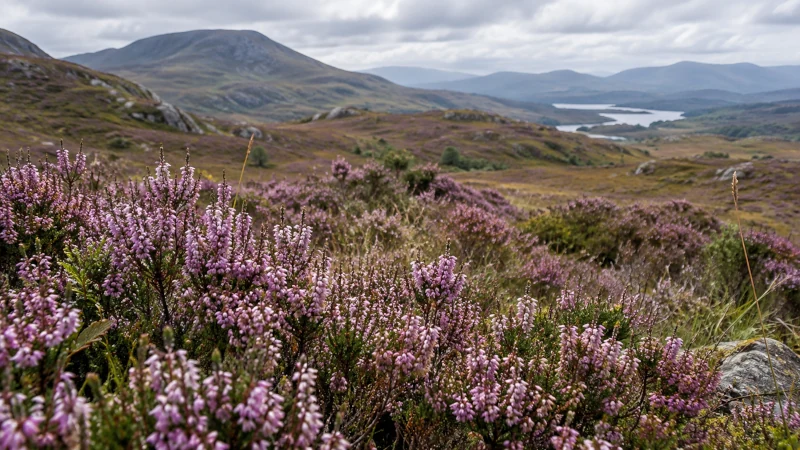
Heather is a low, wiry evergreen shrub in the Ericaceae family — the same family as blueberries, cranberries, and bearberry. It’s the plant behind those sweeping purple-pink moors in Scotland and across northern Europe, and it flowers in late summer, which is when bees turn it into a dark, distinctive honey.
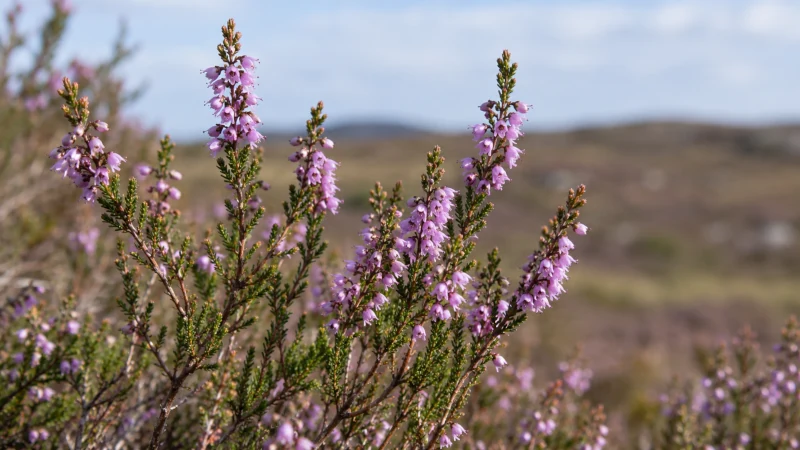
A few quick facts worth having:
| Scientific name | Calluna vulgaris (L.) Hull |
| Common names | Common heather, ling, Scotch heather |
| Family | Ericaceae |
| Native range | Europe and parts of North America; grows in dense stands on acidic, uncultivated ground |
| Part used | The flowering tops (flower clusters and small branches) |
The medicinal tradition uses the flowering tops, usually dried and brewed as a tea or decoction.
Heather plant benefits: what the evidence actually shows
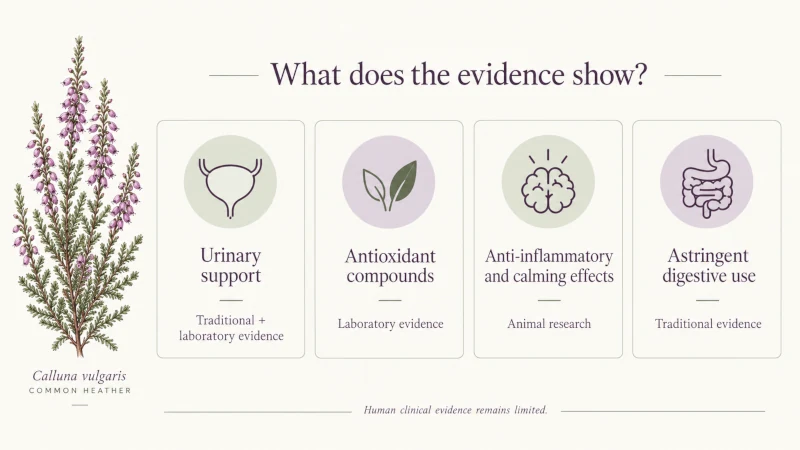
Rather than list every claim ever made for heather, it’s more useful to sort them by how much evidence stands behind each one.
Urinary tract support (the main traditional use)
This is heather’s headline reputation, and it’s worth understanding exactly where it comes from.
The whole plant contains arbutin, a compound that the body converts to hydroquinone, which can act as a mild urinary antiseptic. This is the same mechanism that makes heather’s cousin, bearberry (uva ursi), a traditional bladder remedy [NIDDK, 2020]. Heather really does contain arbutin — one analysis measured it directly, finding about 1.25% in a water extract of the herb [Koshovyi, 2020]. So the chemistry is real, not folklore.
There’s also direct lab evidence. In a 2014 study, water, ethanol, and acetone extracts of heather were tested against bacteria that commonly cause urinary infections — Escherichia coli, Enterococcus faecalis, and Proteus vulgaris. The water extract was the most active, inhibiting bacterial growth at concentrations of roughly 2.5 to 20 mg/mL, with Proteus the most sensitive [Vučić, 2014].
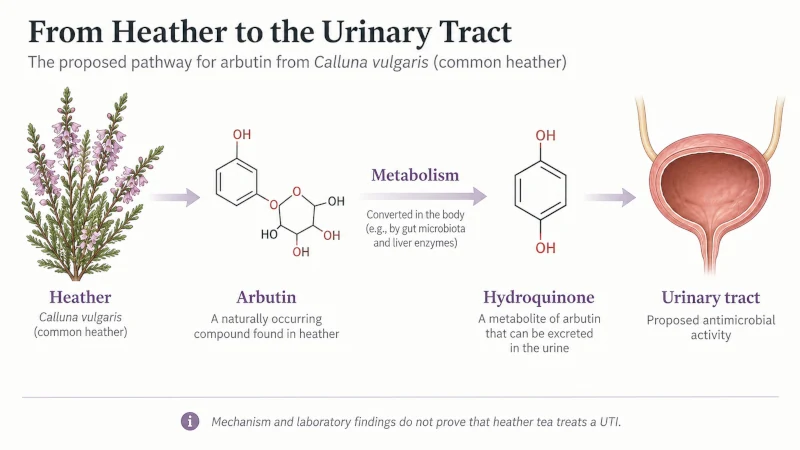
Here’s the honest caveat. That study was done in a petri dish, not in people. “Inhibits bacteria in a lab” is a long way from “clears a urinary infection in your bladder.” The arbutin-to-hydroquinone antiseptic effect also appears to depend on urine being alkaline, and it isn’t reliably present in ordinary conditions [NIDDK, 2020]. No clinical trial has shown that heather tea cures or prevents a UTI.
Treat urinary support as a traditional use with plausible chemistry behind it — not a proven treatment. If you have a genuine urinary infection, heather is not a substitute for medical care (more on the warning signs below). For a fuller look at which urinary herbs actually hold up to scrutiny, our guide to herbal remedies for the urinary system walks through the evidence herb by herb.
Antioxidant compounds
Heather is genuinely rich in plant antioxidants. Detailed profiling of wild heather found total phenolic content in the range of 42 to 55 mg/g, dominated by chlorogenic acid, with hyperoside as the main flavonol and a useful load of proanthocyanidins [Kaunaite, 2022]. These are the same broad families of compounds that make berries and green tea antioxidant-rich.
What this means in practice is more modest than it sounds. A high antioxidant content in the plant tells you about its chemistry, measured in a lab — it doesn’t automatically translate into a measurable health benefit when you drink a cup of tea. It’s a reasonable reason to consider heather a source of beneficial plant compounds, not evidence that it prevents any disease.
Anti-inflammatory and calming effects (early animal research)
A 2020 study went further than chemistry and tested heather extracts in rats and mice. The extracts showed anti-inflammatory and antimicrobial activity, and — more unexpectedly — anti-anxiety and antidepressant-like effects, with a 70% hydroethanolic extract the most active [Koshovyi, 2020].
These are interesting early findings, and they hint at why heather has been used as a mild calming herb. But animal studies are a starting point, not a conclusion. Effects in rodents given concentrated extracts frequently fail to reproduce in humans drinking tea, and there are no human trials here. File this under “promising, unproven.”
Astringent action for diarrhea
Heather’s tannins and proanthocyanidins give it astringent properties — tannins bind proteins and tighten tissue, which is the traditional rationale for using astringent herbs to firm up mild diarrhea [Kaunaite, 2022]. This is a long-standing folk use with a sensible mechanism, but again without clinical trials in people. For occasional mild digestive upset it fits the traditional pattern; it is not a treatment for persistent or severe diarrhea, which needs medical attention.
How heather is traditionally used
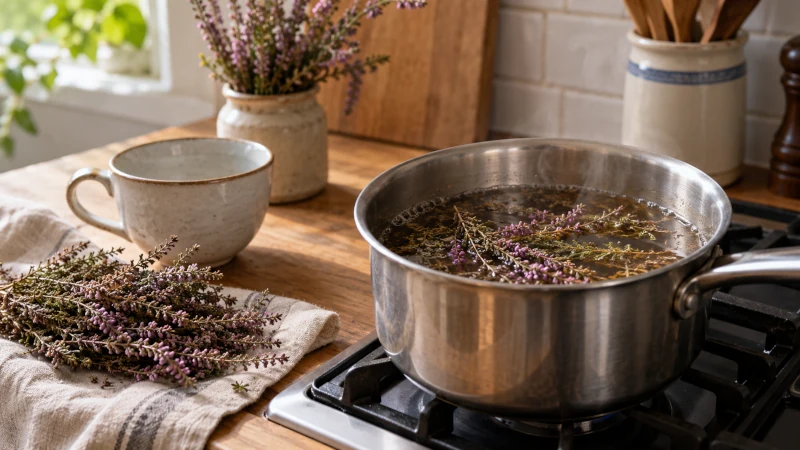
The traditional preparation is simple. A decoction is made using roughly 50 grams of flowering tops or small branches per liter of water, boiled for about ten minutes, and taken as up to three or four cups a day, often sweetened with honey [Pamplona-Roger, 2000].
Two practical notes. First, sweetening with honey adds sugar, which matters if you’re managing blood sugar — and honey should never be given to infants under one year. Second, keep your expectations calibrated to the evidence above: heather tea is a mild traditional remedy, not a fast-acting medicine. If you’re using it hoping to shift a urinary infection and symptoms aren’t clearly improving within a day or two, that’s a signal to stop self-treating and see a clinician, not to drink more.
Safety, side effects, and interactions
Heather is not among the herbs that have raised major safety alarms, and it has a long history of food and beverage use. But “traditional and generally gentle” is not the same as “risk-free,” and the arbutin content is the reason to pay attention.
The concern is hydroquinone, the compound arbutin becomes. Regulators treat it cautiously: hydroquinone is considered potentially carcinogenic, which is why authoritative sources advise that arbutin-containing urinary herbs be used only in short courses, not taken continuously [NIDDK, 2020]. For heather’s close relative uva ursi, which is far higher in arbutin, the European Medicines Agency recommends use for no more than one week at a time [EMA/HMPC, 2018]. Heather has less arbutin, but the same principle — short-term use rather than daily long-term consumption — is the prudent default, especially because heather itself has almost no formal safety testing.
Realistic side effects from ordinary tea use are few and usually mild — the main practical issue is that concentrated tannins can cause stomach upset or nausea in some people. Because rigorous interaction studies on heather don’t exist, caution around combining it with prescription medicines is sensible; talk to a pharmacist or doctor if you take regular medication.
Who should avoid heather
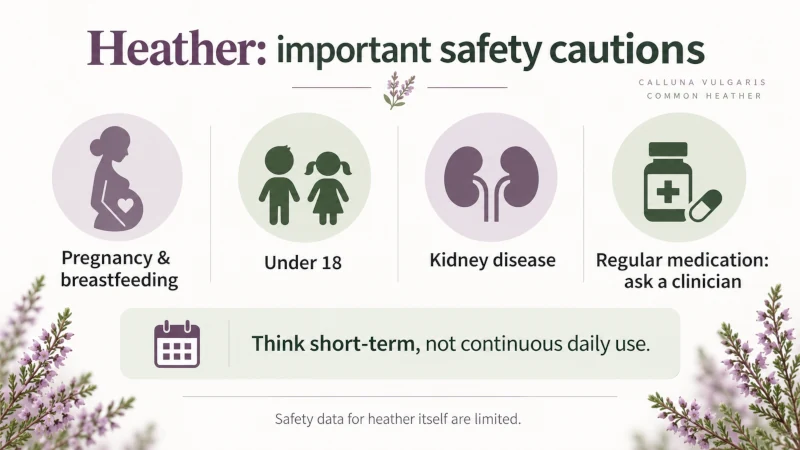
Guidance for arbutin-containing urinary herbs is consistent, and it’s the best available guide for heather:
- Pregnant and breastfeeding people. Safety hasn’t been established, and regulators advise against use during pregnancy and lactation for uva ursi; the breastfeeding database likewise recommends avoiding it because of a lack of data and potential toxicity [EMA/HMPC, 2018; NICHD LactMed, 2024].
- Children and adolescents. Use in those under 18 is not recommended for this class of herb [EMA/HMPC, 2018].
- Anyone with kidney disease. Kidney disorders are a specific contraindication for uva ursi, and the same caution applies to heather [EMA/HMPC, 2018].
- People managing blood sugar should account for any honey used to sweeten it.
If you take regular medication, have a chronic condition, or are unsure, check with a healthcare professional before starting heather — that’s the safe default whenever an herb is new to you.
When to see a doctor: urinary red flags
Because heather is most often reached for as a urinary remedy, this matters. Do not try to self-treat with heather — see a clinician promptly — if you have any of the following:
- Fever, chills, or pain in your back or side (possible kidney infection)
- Blood in your urine
- Nausea and vomiting alongside urinary symptoms
- Symptoms that don’t improve within a day or two, or that keep coming back
- A urinary infection during pregnancy, or in a child, or in a man
- Any severe or rapidly worsening symptoms
Most urinary tract infections need antibiotics, and an untreated kidney infection can become serious. Herbal remedies are, at most, a supporting comfort measure — not a replacement for diagnosis and treatment.
| Health Disclaimer: This article is for education and general information only. It is not medical advice and is not a substitute for diagnosis or treatment from a qualified healthcare professional. Heather has not been proven to treat, cure, or prevent any disease, and the U.S. Food and Drug Administration has not evaluated these statements. If you are pregnant, breastfeeding, have a medical condition (including kidney disease), take prescription medication, or are treating a suspected infection, talk to your doctor or pharmacist before using heather or any herbal remedy. Seek prompt medical care for the urinary warning signs listed above. |
Frequently Asked Questions
Is heather safe to drink as a tea?
For most healthy adults, occasional heather tea is generally well tolerated and has a long history of use. The main cautions are to use it short-term rather than daily and long-term (because of its arbutin content), and to avoid it in pregnancy, breastfeeding, childhood, and kidney disease. If you take regular medication, check with a pharmacist first.
Does heather actually work for urinary tract infections?
There’s plausible chemistry — heather contains arbutin, which converts to a mild urinary antiseptic — and lab studies show its extracts can inhibit UTI-causing bacteria [Vučić, 2014; Koshovyi, 2020]. But there are no human trials proving it treats a UTI, and most infections need antibiotics. It’s a traditional supportive remedy, not a cure.
What’s the difference between heather and uva ursi (bearberry)?
They’re relatives in the same plant family and share the arbutin mechanism, but bearberry contains much more arbutin and has been studied more as a urinary remedy. You can compare them in our articles on uva ursi and the bearberry plant.
How much heather tea can I drink?
The traditional decoction is up to three or four cups a day, short-term [Pamplona-Roger, 2000]. Given the arbutin content, it’s wiser to treat it as a short course rather than a daily long-term habit, and to stop if symptoms you’re treating don’t improve.
Are there other herbs used for the urinary tract?
Yes — several, with varying evidence. Beyond bearberry and uva ursi, traditional urinary herbs include buchu leaves and couch grass. As with heather, most rest on tradition and lab work rather than clinical trials.
References
- Vučić DM, Petković MR, Rodić-Grabovac BB, et al. In vitro activity of heather [Calluna vulgaris (L.) Hull] extracts on selected urinary tract pathogens. Bosn J Basic Med Sci. 2014;14(4):234–238. DOI: 10.17305/bjbms.2014.40 (PMID 25428676; PMC4333975). View source
- Koshovyi O, Starchenko G, Hrytsyk A, Raal A. Phytochemical Profile and Pharmacological Activities of Water and Hydroethanolic Dry Extracts of Calluna vulgaris (L.) Hull. Herb. Plants. 2020;9(6):751. DOI: 10.3390/plants9060751. View source
- Kaunaite V, Vilkickyte G, Raudone L. Phytochemical Diversity and Antioxidant Potential of Wild Heather (Calluna vulgaris L.) Aboveground Parts. Plants. 2022;11(17):2207. DOI: 10.3390/plants11172207. View source
- National Institute of Diabetes and Digestive and Kidney Diseases (NIDDK). Uva Ursi. LiverTox: Clinical and Research Information on Drug-Induced Liver Injury. Updated 2020. View source
- European Medicines Agency, Committee on Herbal Medicinal Products (HMPC). European Union herbal monograph on Arctostaphylos uva-ursi (L.) Spreng., folium. 30 January 2018. View source
- Drugs and Lactation Database (LactMed). Uva Ursi. National Institute of Child Health and Human Development (NICHD). Revised December 2024. View source


