
Uva ursi has one real claim to fame, and it’s a narrow one. The leaves of this low-growing evergreen have been brewed for bladder infections for centuries, and European regulators still accept bearberry leaf as a traditional remedy for the burning and frequent urination of a mild, recurring bladder infection in adult women [EMA, 2018]. That is the honest core of uva ursi benefits. The longer lists you’ll find online — kidney stones, diabetes, hemorrhoids, heavy periods, postpartum healing — rest on folklore, not human studies.
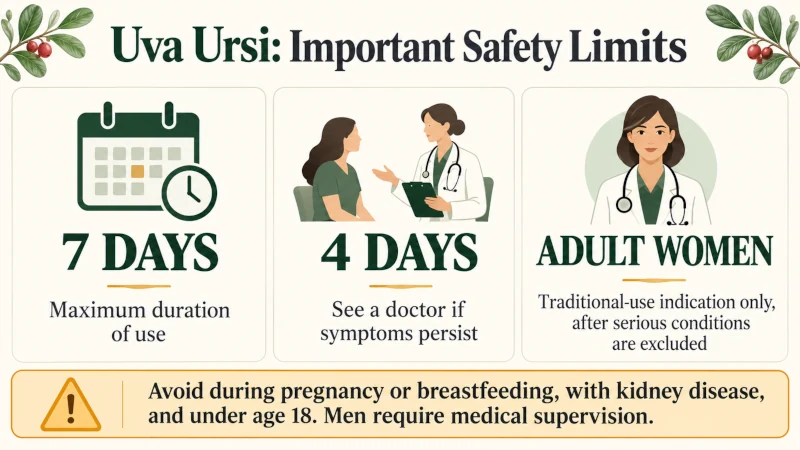
Even the urinary use is shakier than old herbals suggest. The two largest trials found that uva ursi either didn’t ease symptoms better than a placebo or left women with more symptoms than an antibiotic did [Moore et al., 2019] [Gágyor et al., 2021]. It also comes with firm limits: a week at most, adult women only, and not at all during pregnancy, while breastfeeding, or with kidney disease [EMA monograph, 2018].
What uva ursi is
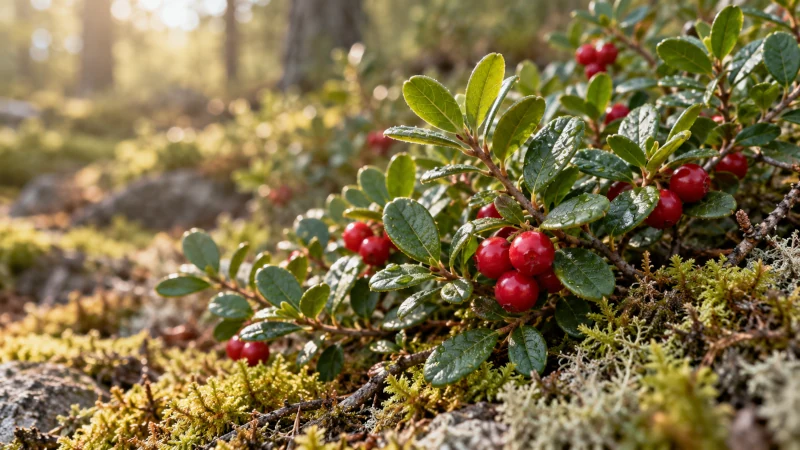
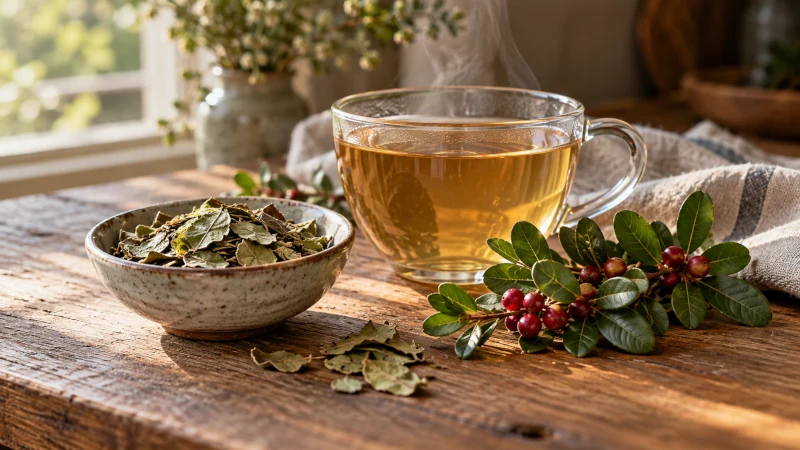
Uva ursi (Arctostaphylos uva-ursi) is a small creeping shrub of cold northern climates, also sold as bearberry or kinnikinnick. Its Greek and Latin names both mean “grape of the bear,” after the red berries bears eat [LiverTox, 2020]. Only the leaves are used as medicine.
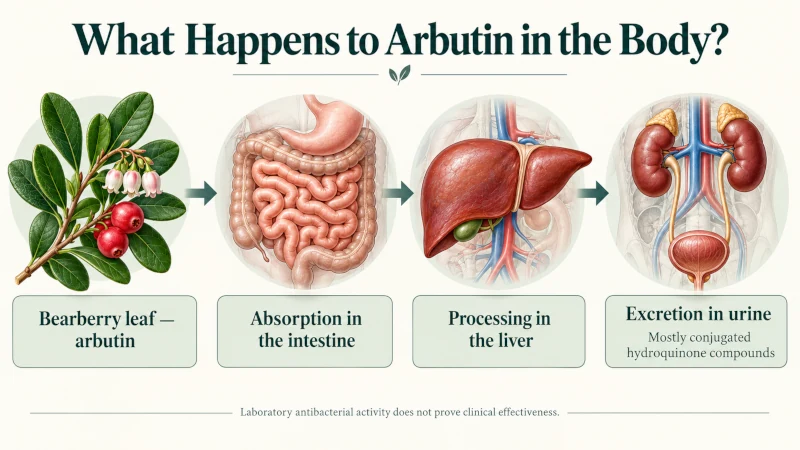
Those leaves contain arbutin and related hydroquinone compounds, along with tannins, gallic acid, ursolic acid, and flavonoids [LiverTox, 2020]. Arbutin is the one that matters. Your body turns it into hydroquinone compounds that leave through the urine, and hydroquinone has shown antibacterial action in laboratory studies [EMA, 2018]. The tannins account for the leaves’ bitter, astringent taste, and for the queasy stomach some people get.
Uva ursi benefits at a glance
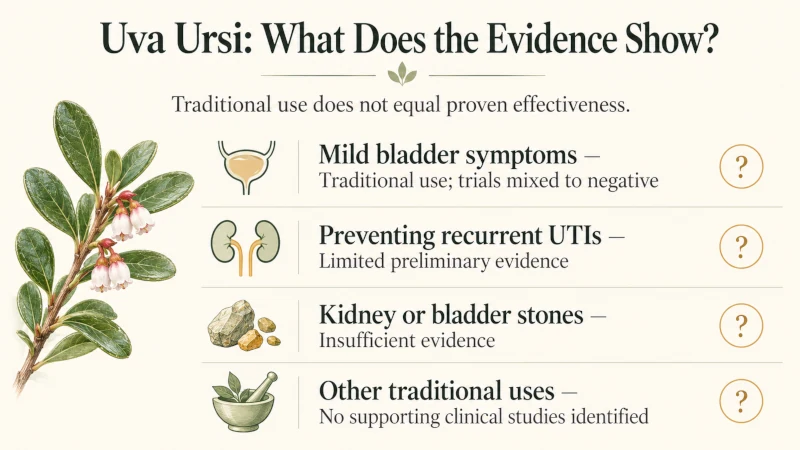
Here is how each common claim holds up against the evidence.
| Claimed benefit | What the evidence shows | Evidence grade |
| Easing symptoms of a mild bladder infection (women) | Accepted in the EU on traditional use; two randomized trials did not show symptom relief | Traditional use; trials mixed to negative |
| Preventing repeat bladder infections | One small 1993 study of a combination product; not confirmed by a larger trial | Limited, preliminary |
| Kidney or bladder stones | No human studies found; kidney disorders are a reason not to take it | Insufficient |
| Diabetes, diarrhea, dysentery, heavy periods, hemorrhoids | No clinical studies found | Traditional claim only |
| Postpartum baths, vaginal douches, post-surgery bleeding | No clinical studies found; the EU monograph covers oral use only | Traditional claim only |
Does uva ursi work for bladder infections?
Why European regulators still allow it
In 2018, the European Medicines Agency’s herbal committee concluded that bearberry leaf can be used for symptoms of mild, recurrent lower urinary tract infections in women, once a doctor has ruled out anything serious [EMA, 2018]. The basis was traditional use: at least 30 years of use, 15 of them in the EU, plus an effect the committee judged plausible. The same summary is candid that clinical-trial evidence was insufficient and that no clinical studies of bearberry leaf on its own were available. Laboratory evidence of antibacterial activity carried the argument [EMA, 2018].
What the trials found
Since then, two well-run trials have tested uva ursi in women with suspected bladder infections. Neither is encouraging.
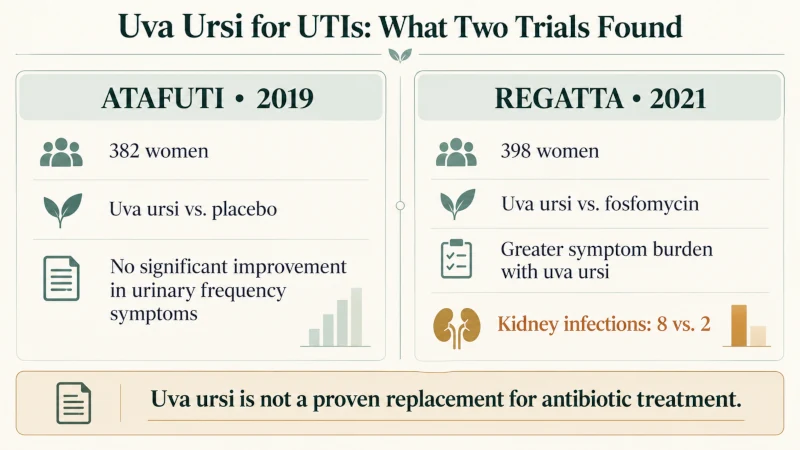
In the UK’s ATAFUTI trial, 382 women aged 18 to 70 took uva ursi extract or a placebo, and every woman also had a backup antibiotic prescription. Frequency symptoms on days 2 to 4 were no different between the groups. Slightly fewer women taking uva ursi ended up using their antibiotic (39.9% versus 47.4%), but that gap was within the range of chance [Moore et al., 2019].
Germany’s REGATTA trial compared uva ursi (two 105 mg tablets three times a day for five days) with a single dose of the antibiotic fosfomycin in 398 women across 42 family practices. Women who started on uva ursi used 63.6% fewer antibiotic courses over the next four weeks, which is what you’d expect when an antibiotic isn’t the first treatment. They paid for it. Their total symptom burden ran about 36% higher, and eight developed a kidney infection (pyelonephritis), compared with two in the antibiotic group. That difference fell just short of statistical significance, but the investigators concluded that uva ursi led to more symptoms and more safety concerns than fosfomycin [Gágyor et al., 2021].
Taken together, the trials suggest uva ursi does little for symptoms, and that using it to put off an antibiotic carries a small but real risk of the infection reaching the kidneys. NIH’s LiverTox database reaches a similar verdict: despite long traditional use, there is no convincing medical evidence that uva ursi treats urinary tract infections or urinary symptoms [LiverTox, 2020].
Preventing repeat infections
The prevention case rests on one small, old study. In a 1993 trial, 57 women with frequent cystitis took a uva ursi product or a placebo for one month. Over the following year, none of the 30 treated women had cystitis, compared with 5 of the 27 on placebo [LiverTox, 2020]. The dose wasn’t reported, and a later review lists the product as a combination of herbs rather than uva ursi alone [de Arriba et al., 2013]. We found no larger trial confirming the result. Since uva ursi isn’t meant for repeated or long-term use, it doesn’t fit a prevention plan anyway.
For prevention options with stronger evidence, such as cranberry products and simply drinking more water, see our guide to herbal remedies for the urinary system.
Kidney stones and other traditional uses
Older herbals, including an earlier version of this page, recommended pairing uva ursi with marshmallow root to clear kidney and bladder stones. No human studies support that, and the EU monograph lists kidney disorders as a reason not to take uva ursi at all [EMA monograph, 2018]. If stones are your concern, fluids and diet have far better support; our guide to foods that cause kidney stones explains what helps for each stone type.
Other traditional uses — sitz baths after childbirth, vaginal douches, stopping bleeding after surgery, and treating hemorrhoids, heavy periods, dysentery, chronic diarrhea, or diabetes — trace back to the leaves’ astringent tannins. We found no clinical studies for any of them, and the EU monograph covers oral use for urinary symptoms only [EMA monograph, 2018]. Diabetes, persistent diarrhea, heavy bleeding, and vaginal infections each need a diagnosis, not an astringent.
How uva ursi works — and the urine pH question
After you swallow it, arbutin is absorbed in the small intestine, processed by the liver, and excreted in urine mostly as bound (conjugated) hydroquinone, with only a small amount in free form [de Arriba et al., 2013]. The free form is thought to do the antibacterial work.
The classic explanation adds that free hydroquinone is released mainly when urine is alkaline [LiverTox, 2020], which is why herbal guides often tell users to keep their urine alkaline [PeaceHealth, 2015]. A review written by employees of a bearberry-product manufacturer disputes this, citing the company’s own research finding that urine pH made no difference [de Arriba et al., 2013]. The question isn’t settled. Some guides go further and suggest baking soda to make urine alkaline. That adds a lot of sodium, and PeaceHealth’s monograph warns people with high blood pressure against it [PeaceHealth, 2015]. Don’t start it without a clinician’s advice.
How uva ursi is taken
The earlier version of this page warned against boiling uva ursi because its active ingredients are “volatile oils.” That isn’t accurate. Arbutin is a glycoside, not an essential oil [LiverTox, 2020], and the EU monograph describes tea made with boiling water as well as a cold-water soak [EMA monograph, 2018].
These are the EU traditional-use doses for adult women. Treat them as reference points from a regulatory document, and follow a licensed product’s label or your clinician’s advice.
| Form | Single dose | Daily maximum |
| Dried cut leaf (tea) | 1.5–4 g in 150 ml of boiling water (infusion) or cold water (macerate), 2–4 times a day | 8 g |
| Powdered leaf | 700–1,050 mg twice a day | 1.75 g |
| Dry extract | Amount supplying 100–210 mg hydroquinone derivatives (as arbutin), 2–4 times a day | 840 mg hydroquinone derivatives |
| Liquid extract (1:1) | 1.5–4 ml up to three times a day | 8 ml |
Source: [EMA monograph, 2018]
Two rules matter more than the exact dose. Don’t take uva ursi for more than one week, and see a doctor if symptoms last longer than four days or get worse [EMA monograph, 2018].
US supplements aren’t standardized the way EU herbal medicines are. Capsules commonly come in strengths between 150 and 505 mg [LiverTox, 2020], and not every label states the arbutin content. If you buy a product, choose one that does.
Side effects and safety concerns
Common side effects
Nausea, vomiting, and stomachache are the side effects reported most often [EMA monograph, 2018]. Your urine may turn greenish-brown; that is expected and harmless [EMA monograph, 2018].
At high doses, LiverTox lists ringing in the ears, shortness of breath, and allergic reactions, and, rarely, convulsions, delirium, and cardiovascular collapse [LiverTox, 2020]. Liver injury doesn’t appear to be a problem: LiverTox rates uva ursi an unlikely cause of clinically apparent liver damage [LiverTox, 2020].
The hydroquinone question
This is where the sources genuinely disagree. Hydroquinone is potentially carcinogenic, and a review summarized in LiverTox advises taking uva ursi only in short courses, never chronically [LiverTox, 2020]. The EU monograph notes that adequate genotoxicity testing hasn’t been done [EMA monograph, 2018]. On the other side, the manufacturer-authored review estimated that a standard daily dose exposes you to about 11 µg/kg of free hydroquinone a day, roughly a ninth of the level it calculated as negligible risk, and it found no reported human cases of liver, kidney, or cancer harm [de Arriba et al., 2013]. Both camps land on the same practical advice: standard doses, short courses.
One case report is worth knowing about. A 57-year-old woman who drank uva ursi tea several times a day for three years developed bull’s-eye maculopathy, damage to the center of the retina [LiverTox, 2020]. A single case can’t prove cause, but it is one more reason to keep courses short.
Medication interactions
The EU monograph reports no known drug interactions [EMA monograph, 2018]. PeaceHealth’s older monograph flags a possible problem with diuretic medicines such as spironolactone, because diuretic herbs may add to their effect [PeaceHealth, 2015]. If you take a diuretic, a blood pressure medicine, or several prescriptions, check with your pharmacist first.
Who should not take uva ursi
- Pregnant women. Safety hasn’t been established, and the EU monograph advises against use [EMA monograph, 2018].
- Breastfeeding women. There are no data on transfer into breast milk, and LactMed recommends generally avoiding it [LactMed, 2024].
- Children and teens under 18 [EMA monograph, 2018].
- Men, unless under medical supervision [EMA monograph, 2018]. Urinary infection symptoms in men should be checked by a clinician.
- Anyone with kidney disease or reduced kidney function. This is a formal contraindication [EMA monograph, 2018].
- Anyone allergic to the plant [EMA monograph, 2018].
- Anyone planning to take it daily for prevention. It is a short-course remedy only.
When to see a doctor instead
Bladder infections are common and usually straightforward to treat, but they can spread. Contact a health care professional whenever you have bladder infection symptoms: burning when you urinate, frequent or urgent need to go, lower belly discomfort, or cloudy, bloody, or strong-smelling urine [NIDDK, 2024]. Get care quickly if you notice signs that the infection has reached a kidney [NIDDK, 2024]:
- fever and chills
- nausea or vomiting
- pain in your back, side, or groin

If you’re already taking uva ursi, stop and see a doctor if symptoms worsen or last more than four days, or if you develop fever, painful spasms, or blood in your urine [EMA monograph, 2018]. Pregnant women and men with urinary symptoms should skip self-treatment and be evaluated from the start. Our overview of urinary system diseases explains which urinary problems need medical care.
| HEALTH DISCLAIMER: This article is for general education and is not medical advice, diagnosis, or treatment. Uva ursi is not a substitute for antibiotics when you have a urinary tract infection, and untreated bladder infections can spread to the kidneys. Herbal products can cause side effects and may interact with medicines. Talk with your doctor or pharmacist before using uva ursi, especially if you are pregnant or breastfeeding, have kidney disease, take prescription medicines, or are buying it for someone under 18. Seek care promptly if your symptoms worsen or don’t improve. |
Frequently Asked Questions
Is uva ursi the same as bearberry?
Yes. Uva ursi and bearberry are common names for Arctostaphylos uva-ursi; kinnikinnick is another [LiverTox, 2020]. Products sold under either name use the leaves.
How long can I take uva ursi?
No more than one week, according to the EU monograph, and see a doctor if symptoms continue past four days [EMA monograph, 2018]. It isn’t meant for daily or preventive use.
Can uva ursi cure a UTI?
There’s no good evidence that it can. In two trials it didn’t relieve symptoms better than a placebo, and women who started with it instead of an antibiotic had more symptoms and more kidney infections [Moore et al., 2019] [Gágyor et al., 2021]. Antibiotics remain the standard treatment.
Is uva ursi bad for your kidneys?
No cases of kidney damage at recommended doses have been reported [de Arriba et al., 2013], but kidney disorders are a formal contraindication, so don’t use it if your kidney function is reduced [EMA monograph, 2018].
Why did my urine turn green or brown?
Bearberry leaf can turn urine greenish-brown, a known and harmless effect [EMA monograph, 2018]. Blood in the urine is different and needs medical attention [NIDDK, 2024].
Can men take uva ursi?
The EU monograph doesn’t recommend it for men except under medical supervision [EMA monograph, 2018]. Urinary infection symptoms in men should be checked by a clinician.
References
- LiverTox: Clinical and Research Information on Drug-Induced Liver Injury. Uva Ursi. Bethesda (MD): National Institute of Diabetes and Digestive and Kidney Diseases; View source
- European Medicines Agency, Committee on Herbal Medicinal Products. European Union herbal monograph on Arctostaphylos uva-ursi (L.) Spreng., folium. View source
- European Medicines Agency. Uvae ursi folium — herbal medicinal product (summary of HMPC conclusions; public summary EMA/181295/2018). View source
- Moore M, Trill J, Simpson C, et al. Uva-ursi extract and ibuprofen as alternative treatments for uncomplicated urinary tract infection in women (ATAFUTI): a factorial randomized trial. Clin Microbiol Infect. View source
- Gágyor I, Hummers E, Schmiemann G, Friede T, Pfeiffer S, Afshar K, Bleidorn J. Herbal treatment with uva ursi extract versus fosfomycin in women with uncomplicated urinary tract infection in primary care: a randomized controlled trial. View source
- Garcia de Arriba S, Naser B, Nolte K-U. Risk assessment of free hydroquinone derived from Arctostaphylos Uva-ursi folium herbal preparations. View source
- Drugs and Lactation Database (LactMed). Uva Ursi. Bethesda (MD): National Institute of Child Health and Human Development; View source
- National Institute of Diabetes and Digestive and Kidney Diseases. Symptoms & Causes of Bladder Infection in Adults. View source
- PeaceHealth Health Information Library (TraceGains). Uva Ursi. View source


