
If you’ve read that the saxifrage plant can break up kidney stones, here’s the honest version up front: saxifrage (Saxifraga granulata) is a European wildflower with a long folk reputation for urinary complaints, but there is little solid human research showing it dissolves stones. Its name and its old reputation come from how the plant looks, not from clinical trials. Saxifrage plant remedies may act as a mild diuretic — something that increases urine flow — but that is not the same as treating or curing a stone. This guide explains where the tradition comes from, what the evidence does and doesn’t support, how the herb is used, and the safety points worth knowing before you try it.
What is the saxifrage plant?
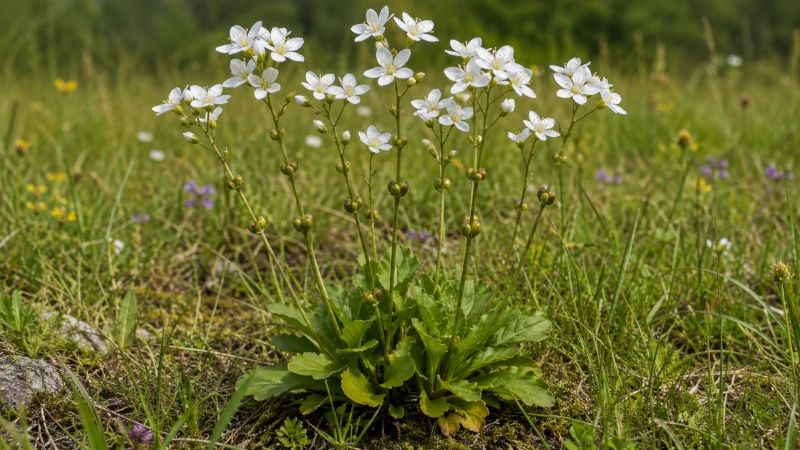
Saxifraga granulata, sometimes called meadow saxifrage or granulate saxifrage, is a small herbaceous plant in the Saxifragaceae family. It grows in damp meadows and mountain grasslands across much of Europe and produces clusters of white flowers in spring. The plant rarely grows taller than about 50 cm and has rounded, toothed leaves near its base. Underground, near the base of the stem, it forms small bead-like bulbils — the feature that gave the plant its name.
People in parts of rural southern Europe have used the root, leaves, and flowers in home preparations for generations, mostly as a tea aimed at the urinary system.
A note on the name and the “stone-breaker” idea
The word saxifrage comes from Latin and literally means “stone-breaker,” from saxum (rock) and frangere (to break). For centuries this was read as proof of a medicinal purpose: the plant must break up stones in the body. The small bulbils at the base of the plant looked like tiny urinary stones, and in the 1500s the physician Andrés de Laguna, commenting on the classical writer Dioscorides, repeated the claim that saxifrage “breaks up stones.”
This kind of reasoning has a name. It’s called the doctrine of signatures — the old belief that a plant’s appearance reveals what it can treat. A walnut looks like a brain, so it was thought to help the brain; saxifrage’s bulbils looked like stones, so it was thought to break stones. It’s a memorable story, but resemblance is not evidence. Modern botanists generally think the Latin name more likely refers to saxifrages growing in rock crevices.
Don’t confuse it with other “saxifrage” plants
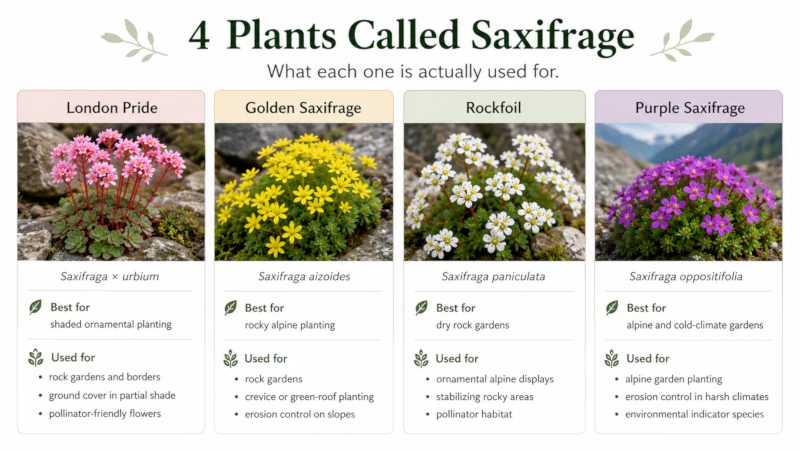
A lot of confusion online comes from the fact that several unrelated plants share the “saxifrage” label:
| Plant | What it actually is | Where the confusion comes from |
| Saxifraga granulata | The European meadow saxifrage in this article | The traditional “stone-breaker” of southern Europe |
| Bergenia ligulata (old name Saxifraga ligulata) | A Himalayan plant, the Ayurvedic “Pashanbheda” | Most lab and clinical “saxifrage and kidney stone” research is about this plant, not S. granulata |
| Saxifraga stolonifera | “Strawberry geranium,” used in Japan for skin | Studied for skin inflammation, not stones |
| Pimpinella saxifraga | “Burnet saxifrage,” actually in the carrot family | Shares the name but is botanically unrelated |
This matters because articles often pin research done on Bergenia ligulata onto European saxifrage as if they were the same plant. They are not.
What is saxifrage traditionally used for?
In European folk practice, Saxifraga granulata has mainly been used as a urinary remedy — to encourage urine flow and, by tradition, to ease the passage of “sand” or small stones and the cramping pain of renal colic. The whole plant, especially the root, contains tannins, resins, plant glycosides, and some vitamin C. Tannins are astringent compounds, and the plant’s reputation as a mild diuretic is consistent with how many traditional “urinary” herbs behave. None of this, on its own, demonstrates a stone-dissolving effect in people.
Does saxifrage actually dissolve kidney stones? What the evidence shows
The short answer is that high-quality human evidence for Saxifraga granulata is essentially absent. There are no well-designed clinical trials showing that meadow saxifrage dissolves kidney stones, shrinks them, or prevents them in people. What exists is long-standing traditional use plus general pharmacological reasoning about diuretic and astringent plant compounds.
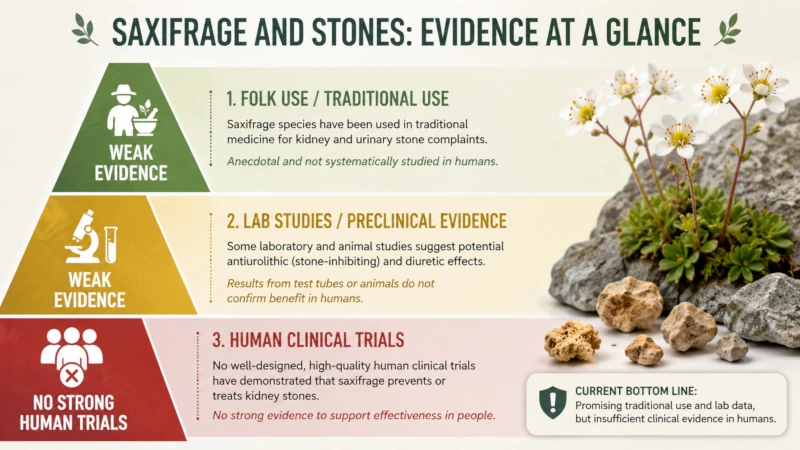
It’s worth being clear about the difference between three things that often get blurred together:
- A diuretic effect (more urine) is plausible for many traditional urinary herbs.
- Helping a small stone pass by increasing urine flow is biologically reasonable, but increased fluid intake of any kind does that — it is not unique to saxifrage.
- Dissolving an existing stone is a strong, specific claim that current evidence does not support for this plant.
Where the strongest “saxifrage” research really comes from
When you find research that seems to support “saxifrage for stones,” it is almost always about Bergenia ligulata (Pashanbheda), the Himalayan plant once classified as Saxifraga ligulata. Reviews of plants used against urinary stones list this species among traditional anti-urolithic herbs, and laboratory and animal studies suggest its compounds may affect calcium-oxalate crystals [Akram & Idrees, 2019]. That is promising early-stage research — but it is mostly in test tubes and animals, and it is about a different plant.
Even for that better-studied relative, human results are underwhelming. A systematic review of clinical studies on plant remedies for stones describes a trial of the multi-herb formula Cystone, which contains Pashanbheda. In stone-forming patients, it produced no significant change in urinary chemistry or stone burden compared with control [Khan et al., 2022]. When the most-studied “saxifrage” plant, inside a complete formula, doesn’t move the needle in a trial, it’s a strong signal to keep expectations modest for a simple meadow-saxifrage tea.
What this means for you
Saxifrage is reasonable to think of as a traditional, mild urinary tea — not as a treatment for kidney stones. If you have stones or symptoms of stones, the herb is not a substitute for diagnosis and proper care. The genuinely effective steps for stones are well established, and they’re covered further down.
How saxifrage is traditionally prepared
In traditional use, saxifrage is taken as a tea. A common preparation is an infusion or decoction using roughly 40 to 60 grams of dried plant per liter of water, with two to three cups a day. These are traditional amounts, not clinically tested doses, and they have not been standardized or tested for safety in formal studies. Herbal teas also vary widely in strength depending on the plant material, so “two cups a day” can mean very different things from one batch to another.
Safety, side effects, and who should avoid it
Saxifrage is not well studied for safety, which is itself a reason for caution. Lack of reported harm in folk use is not the same as proven safety.
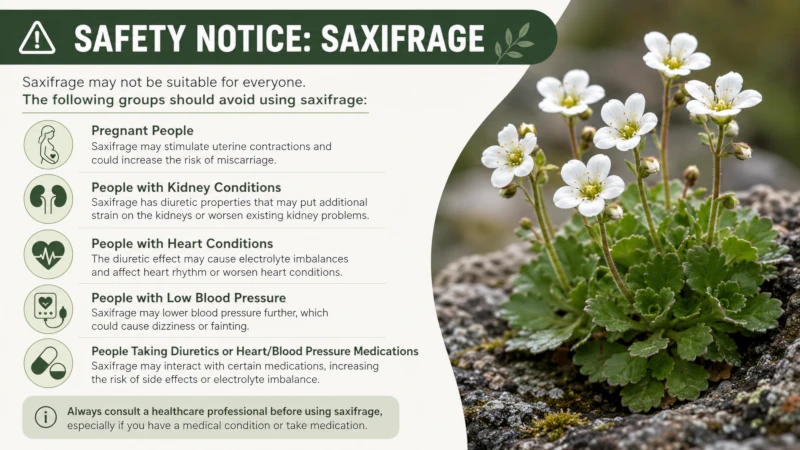
Possible side effects and interactions
- Diuretic effects: Herbs that increase urine output can contribute to dehydration and shifts in electrolytes such as potassium and sodium, especially if you already take a prescription diuretic (“water pill”) or have heart or kidney conditions.
- Tannin content: Tannin-rich plant teas can cause stomach upset or nausea in some people and may reduce absorption of iron and some other nutrients if taken close to meals or supplements.
- Unknown drug interactions: Because the plant has not been formally studied, interactions with prescription medicines are not well characterized. If you take regular medication, treat that as a reason to check with a pharmacist or clinician first.
Who should not use saxifrage without medical advice
- People who are pregnant or breastfeeding — there is no safety data, so it’s best avoided.
- People with reduced kidney function or existing kidney disease, where added diuretic stress and electrolyte shifts carry more risk.
- People with heart failure or who take prescription diuretics or blood-pressure medicines.
- Anyone with a known or suspected kidney stone causing symptoms — this needs medical assessment, not self-treatment.
- Children, unless directed by a clinician.
If you want to support your urinary system with herbs, it’s worth understanding how these remedies work and where their limits are; this overview of herbal remedies for the urinary system gives broader context.
What genuinely helps with kidney stones
If kidney stones are the real reason you’re reading this, the most useful thing this page can do is point you to the steps that are actually backed by evidence. These come from kidney specialists and national health agencies.
- Drink enough fluid. This is the single most important habit. The U.S. National Institute of Diabetes and Digestive and Kidney Diseases recommends six to eight 8-ounce glasses of liquid a day for most people, enough to keep urine pale and to produce a good volume of urine [NIDDK, 2025]. Many specialists frame this as aiming for at least 2 to 3 liters of fluid daily, producing roughly 2 liters of urine [Johns Hopkins Medicine].
- Citrate helps. Citrate stops crystals from clumping into stones. Citrus drinks such as lemonade and orange juice contain it, and doctors sometimes prescribe potassium citrate for people who form stones [NIDDK, 2025].
- Adjust diet to your stone type. For common calcium-oxalate stones, that often means lowering sodium, moderating animal protein, keeping a normal calcium intake (not cutting it), and limiting very high-oxalate foods [NIDDK, 2025].
- Get stones evaluated. Larger stones, or stones that won’t pass, may need a procedure such as shock-wave lithotripsy or ureteroscopy. Stone type also guides prevention, so doctors often analyze a passed stone [Johns Hopkins Medicine].
Diet and fluid changes depend on what kind of stone you form, which is why a stone analysis and a conversation with a clinician matter more than any single herb.
Kidney stone warning signs: when to get medical care
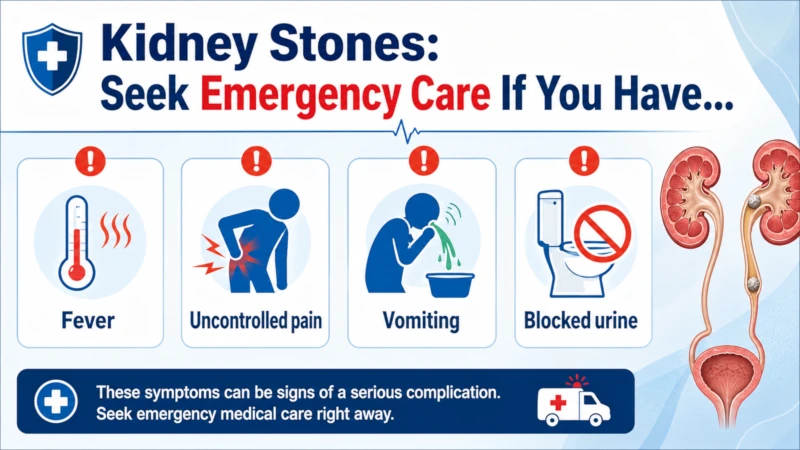
Most stone symptoms warrant a call to a healthcare professional, and some are emergencies. Get medical help right away if you have any of the following [Cleveland Clinic, 2025]; [Healthline, 2025]):
- Fever or chills along with stone symptoms — this can signal an infection behind a blockage, which is a surgical emergency, with or without a high temperature.
- Pain you can’t control with over-the-counter medication, or pain so severe you can’t sit still.
- Persistent vomiting or inability to keep fluids down.
- Little or no urine output, or a complete stop in urine flow.
- Visible blood or blood clots in the urine.
Even without these red flags, intense, wave-like pain in the back, side, or lower belly that spreads toward the groin is reason to be evaluated promptly. Kidney stones are common — about 1 in 10 people will have one — and most are very treatable when addressed early [Cleveland Clinic, 2025].
| HEALTH DISCLAIMER This article is for general education and information only. It is not medical advice and is not a substitute for diagnosis or treatment from a qualified health professional. Saxifrage has not been proven to treat, cure, or prevent kidney stones or any other disease. Do not use it in place of medical care for a suspected stone. If you are pregnant or breastfeeding, take prescription medication, or have a kidney, heart, or other ongoing health condition, talk with your doctor or pharmacist before using saxifrage or any herbal remedy. If you have severe pain, fever, persistent vomiting, blood in your urine, or trouble passing urine, seek medical care right away. |
Frequently Asked Questions
Is saxifrage proven to dissolve kidney stones?
No. There is no solid human evidence that Saxifraga granulata dissolves kidney stones. Its reputation comes from a centuries-old idea that a plant’s appearance reveals its use, not from clinical trials. It may act as a mild diuretic, but increasing urine flow is not the same as dissolving a stone.
Isn’t there research showing saxifrage works?
Most research linked to “saxifrage and kidney stones” is actually about a different plant, Bergenia ligulata (the Ayurvedic Pashanbheda, once called Saxifraga ligulata), and is mostly in lab and animal studies. Even a human trial of a formula containing it showed no significant change in stone burden.
Is saxifrage tea safe to drink?
It hasn’t been formally studied for safety, so caution is sensible. As a diuretic-type herb it could affect hydration and electrolytes, especially alongside prescription water pills or with kidney or heart conditions. People who are pregnant or breastfeeding should avoid it.
What actually works to prevent kidney stones?
Drinking enough fluid to keep urine pale is the most important step, often 2 to 3 liters a day. Citrate from citrus drinks or prescribed potassium citrate helps, along with diet changes matched to your stone type — usually less sodium, moderated animal protein, and normal calcium intake.
When should I see a doctor for a kidney stone?
Seek care promptly for severe or wave-like pain in the back, side, or lower abdomen. Get help right away if you have fever or chills, can’t control the pain, keep vomiting, see blood in your urine, or can’t pass urine — these can signal infection or blockage.
Can I take saxifrage with my regular medications?
Possibly not safely. Because the plant is poorly studied, interactions aren’t well understood, and the diuretic effect can compound that of prescription medicines. Check with a pharmacist or clinician before combining it with any regular medication.
References
- NIDDK. Treatment for Kidney Stones. 2025. View source
- Cleveland Clinic. Kidney Stones: Causes, Symptoms, Diagnosis & Treatment. 2025. View source
- Johns Hopkins Medicine. Kidney Stones. View source
- Mayo Clinic. Kidney stones — Symptoms and causes. 2025. View source
- National Kidney Foundation. Hematuria (Blood in the Urine) in Adults. View source
- Akram M, Idrees M. Progress and prospects in the management of kidney stones and phyto-therapeutic modalities. 2019. View source
- Khan A, et al. Clinical studies of medicinal plants for their antiurolithic effects: a systematic review. Longhua Chinese Medicine. 2022. View source
- Healthline. Kidney Stone Symptoms: 8 Warning Signs. 2025. View source
