
Dates are one of the few naturally sweet foods that earn their reputation as something more than candy. A single Medjool date packs about 1.6 grams of fiber, a useful dose of potassium and copper, and a load of plant antioxidants — all for roughly 66 calories [USDA FoodData Central]. The real benefits of eating dates are strongest where you might not expect them: keeping digestion regular, and standing in for refined sugar without the same sharp blood-sugar spike. A few other claims float around, from easier labour to more energy, and those deserve a more careful look. Here’s what holds up, what’s still uncertain, and who should go easy on them.
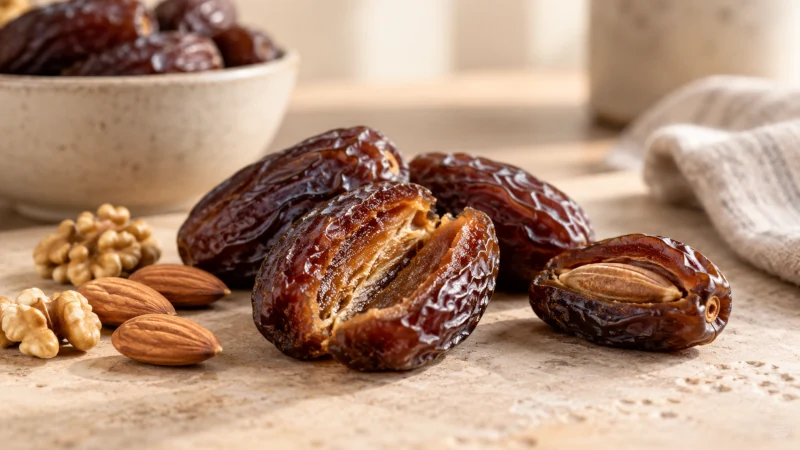
What’s actually in a date
Dates are dried fruit, so the sugar is concentrated — about two-thirds of the weight. That’s the honest headline. But the same drying leaves behind fiber and minerals in amounts that most sweets can’t match.
Here’s what one Medjool date gives you, alongside a 100-gram serving (about four dates), based on USDA data [USDA FoodData Central]:
| Nutrient | Per date (~24 g) | Per 100 g (~4 dates) |
| Calories | 66 | 277 |
| Total sugars | 16 g | 66 g |
| Fiber | 1.6 g | 6.7 g |
| Protein | 0.4 g | 1.8 g |
| Fat | 0 g | 0.15 g |
| Potassium | 167 mg | 696 mg |
| Magnesium | 13 mg | 54 mg |
| Copper | 0.09 mg (~10% DV) | 0.37 mg (~40% DV) |
| Vitamin B6 | 0.06 mg | 0.25 mg |
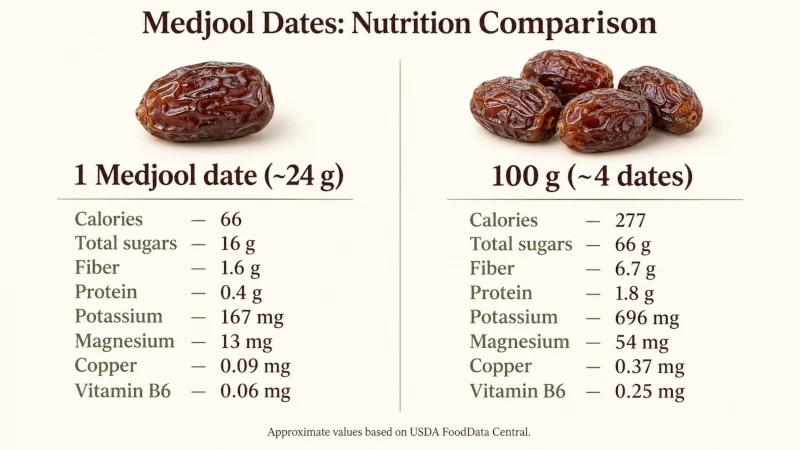
Copper is the quiet standout — a 100-gram serving covers close to 40% of the day’s needs. Potassium and magnesium are solid. Fiber is genuinely useful. What dates are not, despite a common belief, is a strong iron source: a single date carries about 0.2 mg, a small fraction of what you need in a day. And the protein is minimal. Treat dates as a fiber-and-mineral-rich sugar, and you’ll set your expectations correctly.
The benefits of eating dates, graded by evidence
Not every benefit stands on the same footing. Some rest on human trials; others on the fruit’s makeup; a couple are still open questions. Grouped that way, here’s what eating dates can reasonably do for you.
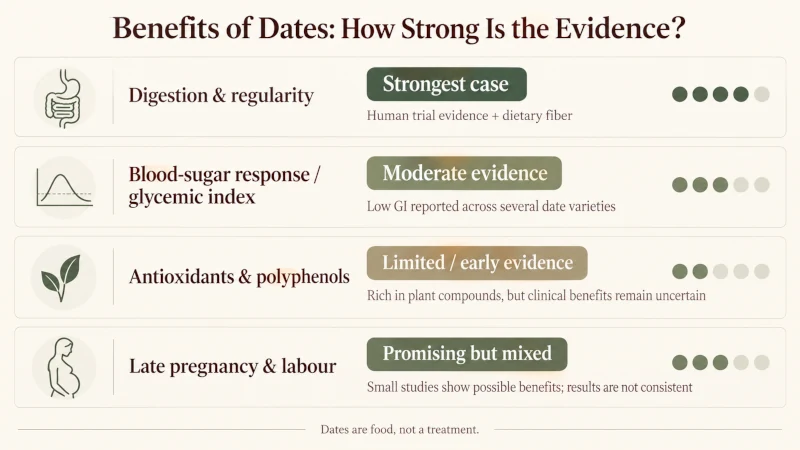
Digestion and regularity — the strongest case
This is where the evidence is most direct. In a small controlled crossover trial, 21 healthy adults ate seven dates a day (about 50 grams) for three weeks. Their bowel movements became more frequent, and — more interesting — the researchers measured lower levels of ammonia and reduced genotoxic activity in stool water, both markers tied to a healthier colon environment [Eid, 2015]. Blood sugar and cholesterol didn’t budge over the three weeks, despite the sugar load.
The mechanism is straightforward. Most of a date’s fiber is insoluble, the kind that adds bulk and speeds transit, and dates also carry prebiotic oligosaccharides that feed beneficial gut bacteria [Jaouhari, 2024]. If you’re prone to constipation, a few dates with water is a reasonable, food-first thing to try.
A sweetener with a low glycemic index — moderate evidence
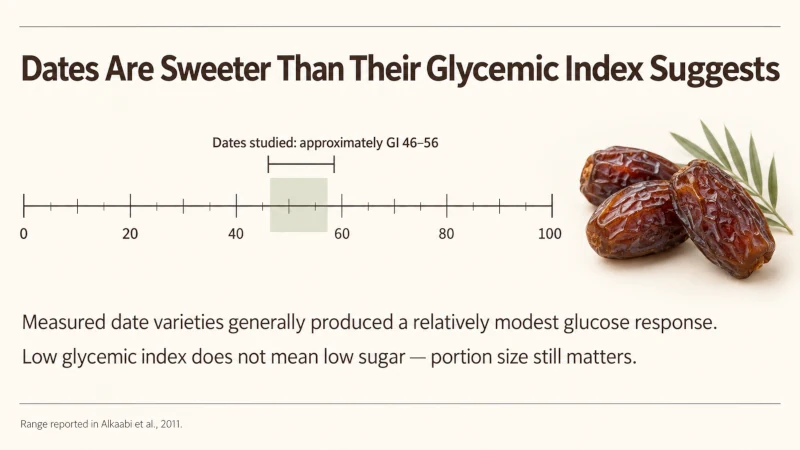
Dates are sweet, so the assumption is that they spike blood sugar. They spike it less than you’d think. When researchers measured the glycemic index of five date varieties, the values landed between about 46 and 56 — in the low range — and, notably, eating dates did not cause significant post-meal glucose surges in people with type 2 diabetes compared with healthy volunteers [Alkaabi, 2011]. Cleveland Clinic puts the figure around 42 [Cleveland Clinic, 2024]. The fiber, and the fact that a date’s sugar is roughly half fructose, likely blunt the rise.
The practical takeaway: as a swap for refined sugar — blended into a smoothie, chopped into oats, or used to sweeten a sauce — dates are a defensible choice. That is not the same as a free pass to eat a dozen, and it does not override individual blood-sugar responses, which vary.
Antioxidants and polyphenols — limited, early evidence
Dates are rich in polyphenols. Chemical analysis of several varieties identified fifteen distinct phenolic compounds, including rutin, ferulic acid, and luteolin, along with measurable antioxidant activity in the lab [Jaouhari, 2024]. Registered-dietitian-reviewed summaries note the same families of antioxidants — flavonoids, carotenoids, and phenolic acids [Healthline]; [Cleveland Clinic]. Compared with many dried fruits, dates sit toward the higher end for antioxidant content.
Here’s the honest limit: a high antioxidant reading in a test tube is not proof of a benefit in your body. These compounds are associated with lower inflammation and better long-term health across whole diets, but that’s a story about eating patterns, not about dates specifically preventing any disease. Enjoy them as part of the antioxidant load a varied diet provides, not as a treatment.
Late pregnancy and labour — promising but mixed
This is the claim that draws the most searches, and it deserves the most care. The idea traces to a small 2011 study: 69 women ate six dates a day for the four weeks before their due date, and 45 did not. The date group arrived at the hospital more dilated (an average of 3.5 cm versus 2.0 cm), went into spontaneous labour more often (96% versus 79%), and needed labour-inducing drugs less often (28% versus 47%) [Al-Kuran, 2011].
Those numbers are encouraging, but one small trial isn’t the whole picture. A later randomized study of 89 women using a different type of date found some benefits — shorter first and third stages of labour, better newborn measures — yet found no significant difference in cervical dilation, one of the headline results from the earlier study. Its authors state plainly that evidence across studies is mixed, and that dose, date variety, and how long women ate them likely explain the disagreement [Ahmed, 2018]. Reviews that pool these trials tend to rate the overall quality of evidence as low [Healthline].
Where that leaves you: eating a few dates in late pregnancy is generally considered safe and may modestly help your body prepare for labour, but it is not a guarantee of a faster or easier birth, and it is no substitute for your prenatal care. Talk to your midwife or doctor before adding them deliberately for this reason, especially if you have gestational diabetes or a high-risk pregnancy.
Potassium, magnesium, and everyday energy — nutrient logic, not a cure
Dates deliver quick carbohydrate plus potassium and magnesium, which is why they’re a popular natural snack before or after exercise, and a traditional pick-me-up during Ramadan fasts. That reasoning is sound: the fruit is a compact source of usable energy and electrolytes. Just don’t stretch it into a medical claim. Dates don’t treat fatigue, and persistent tiredness is worth a conversation with a clinician rather than a dietary fix.
Dates also have a long history as a home remedy for coughs — often simmered in milk — to soothe an irritated throat. That use is traditional, and the soothing feel is plausible for any warm, sweet liquid, but there’s no solid clinical evidence that dates treat a cough or chest cold. If you’re looking at plants for respiratory symptoms, our evidence-graded guide to herbs for the lungs is a more grounded place to start.
What dates won’t do
Dates are food, not medicine. They won’t cure or reverse diabetes, “detox” your body, melt fat, or replace treatment for any condition. They are a nutritious whole food with a couple of well-supported perks and several plausible-but-unproven ones. Held to that standard, they’re an easy addition to a good diet. Sold as a superfood, they’re overhyped.
Safety, side effects, and who should be careful
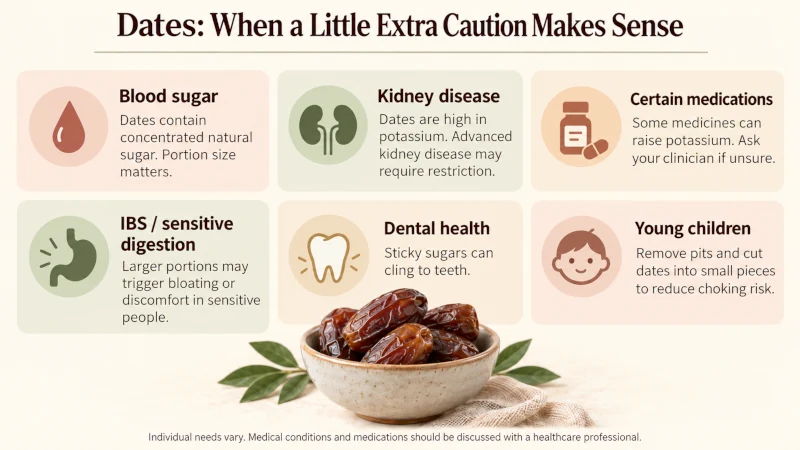
For most people, dates are safe in normal food amounts. The cautions below matter for specific groups.
Blood sugar and portion
A low glycemic index doesn’t mean low sugar. Each date carries about 16 grams of sugar, so a casual handful adds up fast. If you have diabetes or prediabetes, dates can fit — the glycemic data is reassuring [Alkaabi, 2011] — but portion and pairing matter. Keep to one or two, eat them with a source of protein or fat (a few nuts), and watch how your own glucose responds rather than assuming.
Potassium, kidney disease, and medication interactions
Dates are potassium-rich, which is a benefit for most people and a genuine concern for a few. If you have advanced chronic kidney disease, your kidneys may not clear excess potassium, and high-potassium foods like dates can push levels into a dangerous range. The same caution applies if you take medications that raise potassium — including potassium-sparing diuretics (such as spironolactone), ACE inhibitors, or ARBs. This is a correction worth stating clearly: dates are not a smart “low-protein” food for kidney failure, despite that old claim, precisely because of their potassium. If any of this applies to you, ask your doctor before eating dates regularly.
Other cautions: allergy, teeth, IBS, and choking
- Allergy and sulfites. True date allergy is uncommon but possible. Some dried fruits are treated with sulfite preservatives that can trigger reactions in sensitive people, including some with asthma — check the label if that’s you.
- Dental health. Sticky, sugary, and clingy to teeth, dates are a cavity risk if you graze on them without rinsing or brushing.
- IBS and FODMAPs. Dates are relatively high in fructose and fermentable fibers, which can trigger bloating or discomfort in people with irritable bowel syndrome, especially in larger amounts.
- Choking and children. Whole dates contain a hard pit, and even pitted dates are dense and sticky — cut them small for young children, and don’t assume “pitted” means pit-free.
Pregnancy and breastfeeding
Dates in ordinary food amounts are considered safe in pregnancy and while breastfeeding. If you’re eating them deliberately in late pregnancy to prepare for labour, raise it with your midwife or doctor first — particularly with gestational diabetes, where the sugar load needs accounting for.
Red flags — when to see a professional
Dates are a snack, not a treatment, so the warning signs here are about the underlying situation, not the fruit. Seek medical care rather than reaching for a home remedy if you have: a cough lasting more than three weeks, coughing up blood, or shortness of breath; constipation with belly pain, vomiting, or blood in the stool; or unexplained fatigue that doesn’t lift with rest. In pregnancy, any bleeding, reduced fetal movement, or signs of labour warrant a call to your provider, not a dietary adjustment.
How to eat dates
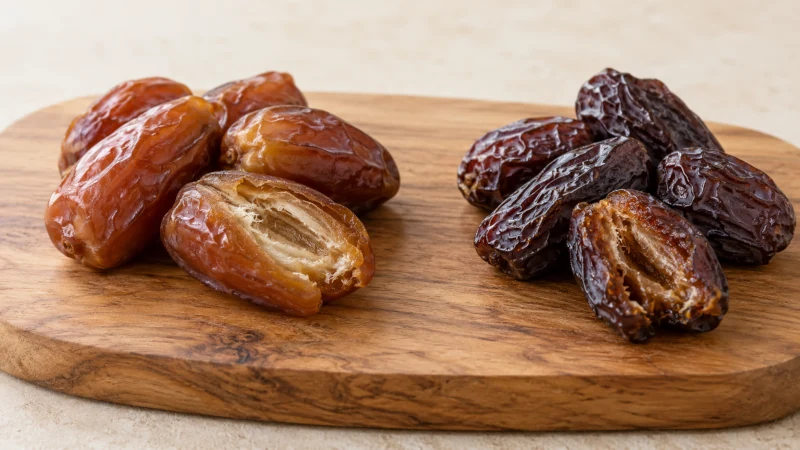
Fresh dates are softer and more delicate than dried; both are nutritious, and dried simply concentrates the sugar and fiber further. A few easy ways to use them:
- As a natural sweetener. Blend pitted dates into smoothies, energy bites, or a sauce in place of refined sugar. Soaking dried dates in warm water for a few minutes softens them for blending.
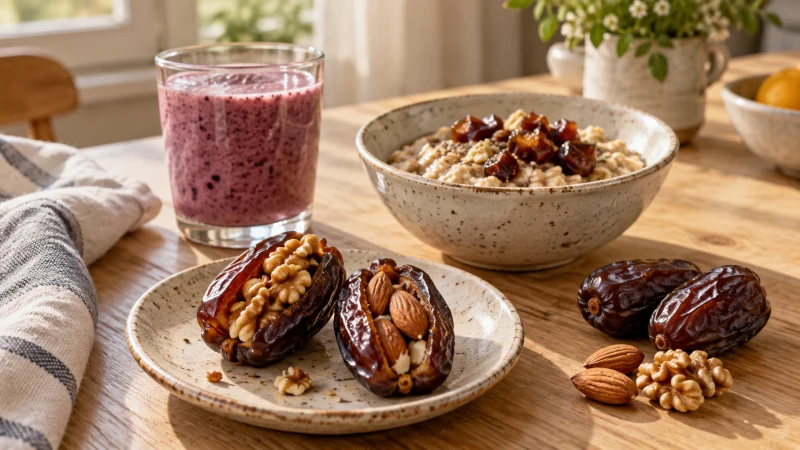
- Paired for balance. Stuff a date with a walnut, almond, or hazelnut. The fat and protein slow the sugar and turn two dates into a satisfying snack.
- In cooking. Chop them into oatmeal, tagines, grain salads, or baked goods.
The traditional remedy of dates simmered in milk for a sore throat is fine to enjoy for comfort, but treat it as a warm drink, not a cure. For a fuller history and folk uses of the fruit, see our companion piece on the medicinal properties of dates.
| Health Disclaimer: This article is for general education and information only. It is not medical advice and is not a substitute for diagnosis or treatment by a qualified healthcare professional. Dates are high in natural sugar and potassium; if you have diabetes, kidney disease, IBS, a food allergy, or take medications that affect potassium, talk to your doctor or a registered dietitian before making dates a regular part of your diet. If you are pregnant or breastfeeding, check with your midwife or doctor before eating dates for any specific health purpose. Never delay or disregard professional medical advice because of something you read here. |
Frequently Asked Questions
Are dates good for you, or just sugar?
Both things are true. Dates are high in natural sugar, but that sugar comes packaged with fiber, potassium, copper, magnesium, and antioxidants that plain sugar lacks — and they have a low glycemic index, around 46–56. Eaten in modest amounts, they’re a nutritious whole food. Eaten by the handful, they’re a concentrated sugar source.
How many dates should I eat a day?
There’s no official limit, but two to four is a sensible everyday range for most people given the sugar and calories. If you have diabetes, start with one or two, pair them with nuts, and see how your blood sugar responds.
Can people with diabetes eat dates?
Often, yes, in controlled portions. Dates have a low glycemic index and, in one study, didn’t cause significant blood-sugar spikes in people with type 2 diabetes. Portion size still matters, and individual responses vary — monitor yours and check with your care team.
Do dates really help with labour?
The evidence is promising but mixed. A small 2011 trial found women who ate six dates daily in the last month of pregnancy were more dilated on arrival and needed less induction, but a later trial found no difference in cervical dilation, and researchers rate the overall evidence as low quality. Dates may modestly help your body prepare, but they don’t guarantee an easier birth — talk to your provider first.
Are dates good for constipation?
Yes, this is one of their better-supported benefits. Their mostly insoluble fiber adds bulk and speeds transit, and a small trial found seven dates a day increased bowel-movement frequency over three weeks.
Who should avoid or limit dates?
People with advanced kidney disease or on potassium-raising medications (because of the potassium), anyone managing blood sugar (portion), people with IBS who react to fermentable fibers, and young children (choking risk from pits and stickiness) should be cautious or check with a professional.
References
- U.S. Department of Agriculture, FoodData Central. Dates, medjool (FDC #168191). View source
- Alkaabi JM, Al-Dabbagh B, et al. “Glycemic indices of five varieties of dates in healthy and diabetic subjects.” Nutrition Journal. 2011;10:59. View source
- Eid N, et al. “Impact of palm date consumption on microbiota growth and large intestinal health: a randomised, controlled, cross-over, human intervention study.” British Journal of Nutrition. 2015. View source
- Al-Kuran O, Al-Mehaisen L, Bawadi H, Beitawi S, Amarin Z. “The effect of late pregnancy consumption of date fruit on labour and delivery.” Journal of Obstetrics and Gynaecology. 2011;31(1):29–31. PMID 21280989. View source
- Ahmed IE, Mirghani HO, Mesaik MA, Ibrahim YM, Amin TQ. “Effects of date fruit consumption on labour and vaginal delivery in Tabuk, KSA.” Journal of Taibah University Medical Sciences. 2018. View source
- Jaouhari Y, et al. “Valorization of Date Fruit (Phoenix dactylifera L.) … Fiber, Oligosaccharides, and Antioxidant Polyphenols.” Molecules. 2024;29(19):4606. View source
- Cleveland Clinic. “Benefits of Dates” (reviewed by Gillian Culbertson, RD, LD). View source
- Healthline. “8 Proven Health Benefits of Dates” (Brianna Elliott, RD). View source
- Dictionary.com. “dactylo-.” View source


