
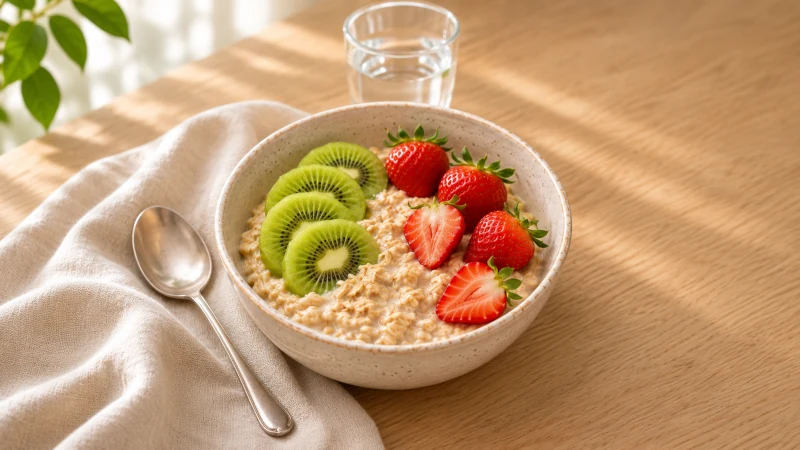
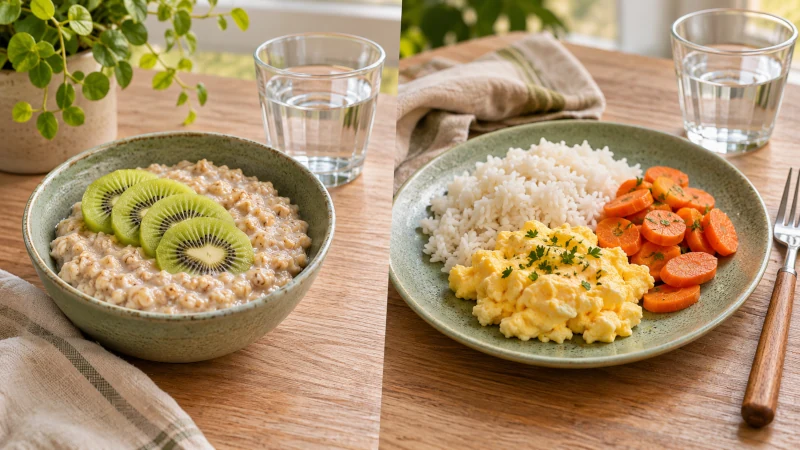
If you live with irritable bowel syndrome, the safest starting point is a plate built from plain, predictable foods: oatmeal, eggs, potatoes, carrots, oranges and kiwifruit, lactose-free milk, and plenty of water, eaten at regular times. Those are the foods to eat with IBS that current guidance points toward most consistently. No single list works for everyone, though, and a few foods often sold as “soothing” (apples, pears, beans and wheat bran among them) are some of the more common triggers.
IBS is a group of symptoms that show up together: repeated belly pain plus changes in bowel movements, which can mean diarrhea, constipation or both. It happens without visible damage to the digestive tract [NIDDK, 2017]. Experts describe it as a problem with how the brain and gut work together [NIDDK, 2017], and certain foods, stress and gut microbes can all set off symptoms [BSG, 2021]. So the aim of eating well with IBS isn’t a cure. It’s fewer bad days, and a diet that stays as broad as your gut will allow.
Start with how you eat, not only what
Before you swap a single ingredient, look at your eating pattern. The UK’s NICE guideline, widely used for first-line IBS advice, suggests the following [NICE, 2017]:
- Eat regular meals and take your time. Avoid skipping meals or leaving long gaps between them.
- Drink at least 8 cups of fluid a day, mostly water or other non-caffeinated drinks such as herbal tea.
- Keep tea and coffee to about 3 cups a day, and cut back on alcohol and fizzy drinks.
- Limit fresh fruit to 3 portions a day, with a portion around 80 grams.
Most of this advice rests on clinical experience and on what’s known about how foods affect the gut, not on head-to-head trials. The British Society of Gastroenterology (BSG) rates the evidence as weak but still strongly recommends offering it to everyone with IBS, along with regular exercise [BSG, 2021]. That pairing is typical in IBS care: low-risk, common-sense steps come first.
The best foods to eat with IBS
Most of the examples below come from Monash University, whose researchers developed the low-FODMAP diet and lab-test foods for their FODMAP content [Monash University, 2026]. FODMAPs are short-chain carbohydrates that draw water into the gut and ferment, producing gas. In a sensitive gut, that can mean pain, bloating and changes in stool [BSG, 2021]. Portion size matters, because some low-FODMAP foods become high-FODMAP in bigger servings. That’s why a few amounts are listed.
Oats and other soluble-fiber foods
Oats are about as close to a consensus food as IBS gets. The kind of fiber matters more than the amount. Soluble fiber, such as psyllium (also called ispaghula), improves overall symptoms and belly pain, while insoluble fiber such as wheat bran can make things worse. Both the BSG and the American College of Gastroenterology (ACG) back soluble fiber based on moderate-quality evidence [BSG, 2021; ACG, 2021]. NICE adds that oats (porridge or oat-based cereal) and linseeds, up to 1 tablespoon a day, may help with gas and bloating [NICE, 2017], and Monash lists oats as a low-FODMAP swap for wheat-based cereals [Monash University, 2026].
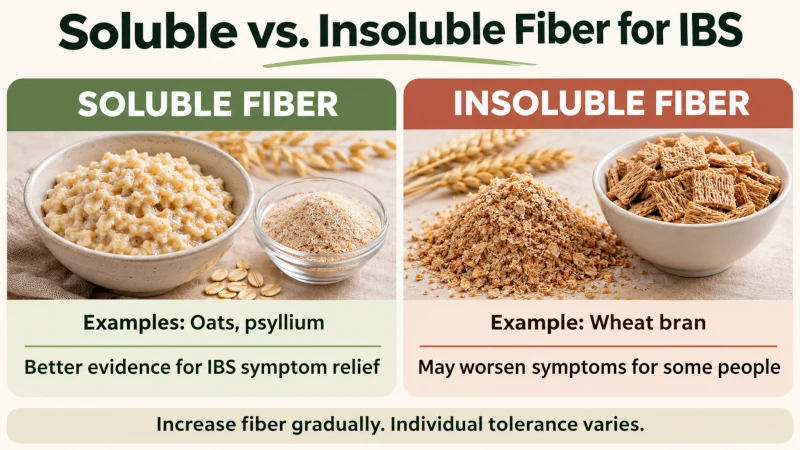
Go slowly. Adding fiber too fast causes gas, which can itself trigger symptoms; NIDDK suggests increasing by 2 to 3 grams a day [NIDDK, 2017]. And not everyone does better with more fiber. Some people feel better eating less of it overall [BSG, 2021], and NICE asks clinicians to review fiber intake and usually reduce it while watching symptoms [NICE, 2017]. “More fiber” and “the right fiber” are different instructions.
Fruits that tend to sit well
Monash’s low-FODMAP fruit choices include cantaloupe (about ¾ cup), green kiwifruit, mandarins, oranges, pineapple and strawberries (about 5 medium) [Monash University, 2026]. Spread fruit across the day instead of eating it in one sitting, and stay within the three-portion ceiling [NICE, 2017].
Apples, apple juice, pears, cherries, mango, nectarines, peaches, plums, watermelon and dried fruit sit on Monash’s high-FODMAP list [Monash University, 2026], and NIDDK names several of the same fruits [NIDDK, 2017]. You’ll still see apples and pears promoted as gentle on the gut because of their pectin. If your gut is FODMAP-sensitive, treat them as foods to test later, not as a starting point.
Vegetables
Carrots, cucumber, lettuce, potatoes, eggplant, green beans, bok choy, green bell pepper, bean sprouts and zucchini (about 65 grams) are Monash’s low-FODMAP picks [Monash University, 2026]. The usual high-FODMAP culprits are onion, garlic, leek, mushrooms, asparagus, artichoke, green peas and red bell pepper [Monash University, 2026]. Cabbage and cauliflower appear on NIDDK’s list too [NIDDK, 2017].
Grains and starches
Breads, breakfast cereals and crackers made from wheat, rye or barley are high-FODMAP [Monash University, 2026]; the fructans in wheat are one reason [BSG, 2021]. Easier swaps include oats, quinoa flakes, gluten-free cornflakes, rice-, corn- or quinoa-based pasta, plain rice cakes, sourdough spelt bread and breads made without wheat, rye or barley [Monash University, 2026]. NICE also suggests cutting back on “resistant starch,” which is common in processed or re-cooked foods [NICE, 2017].
Proteins
Eggs, firm tofu, tempeh and plain cooked meat, poultry and seafood are all low-FODMAP [Monash University, 2026]. That matters, because you’ll sometimes read that meat itself irritates the bowel. The more likely problems are marinades and processed meats, which can hide high-FODMAP ingredients [Monash University, 2026], and large fatty meals, which standard IBS advice suggests reducing [BSG, 2021]. Most beans and lentils are high-FODMAP [Monash University, 2026]. If you love them, they’re a candidate for careful reintroduction later, not a permanent ban.
Dairy you may tolerate
Lactose is a FODMAP. Cow’s milk, regular yogurt, ice cream, custard and soy milk made from whole soybeans are high-FODMAP. Lactose-free milk, almond milk, soy milk made from soy protein, hard cheeses, feta, brie and camembert are low [Monash University, 2026]. In other words, hard cheese is often fine, even though it’s sometimes lumped in with “problem dairy.” If regular yogurt bothers you, a lactose-free version is the logical swap to try.
Nuts, seeds and sweet things
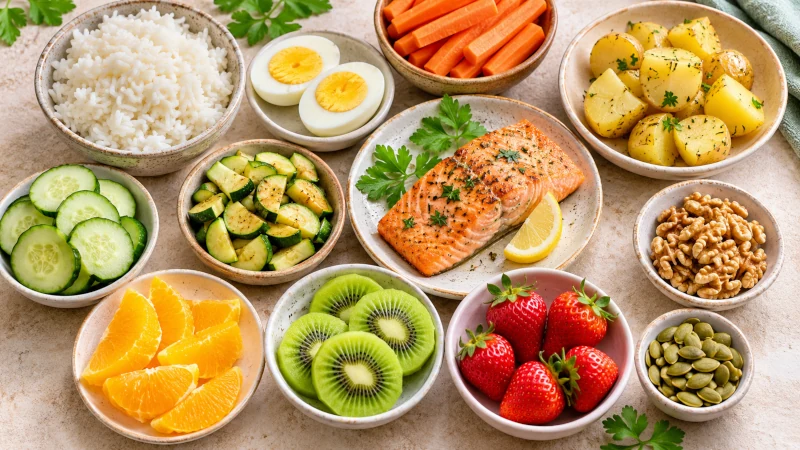
Macadamias, peanuts, walnuts and pumpkin seeds are low-FODMAP; cashews and pistachios are high. Maple syrup, rice malt syrup, table sugar and dark chocolate are low, while honey, high-fructose corn syrup and sugar-free sweets are high [Monash University, 2026]. If diarrhea is a problem, NICE specifically advises avoiding sorbitol, found in sugar-free gum, candy and some diet products [NICE, 2017]. NIDDK flags other sweeteners ending in “-ol,” such as mannitol, xylitol and maltitol [NIDDK, 2017].
Water and other drinks
Water is the backbone: at least 8 cups of fluid a day, with tea and coffee kept to about 3 cups and alcohol and fizzy drinks cut back [NICE, 2017]. Peppermint tea appears to be safe [NCCIH, 2025], but the IBS research is on peppermint oil capsules, not the tea (more on that below).
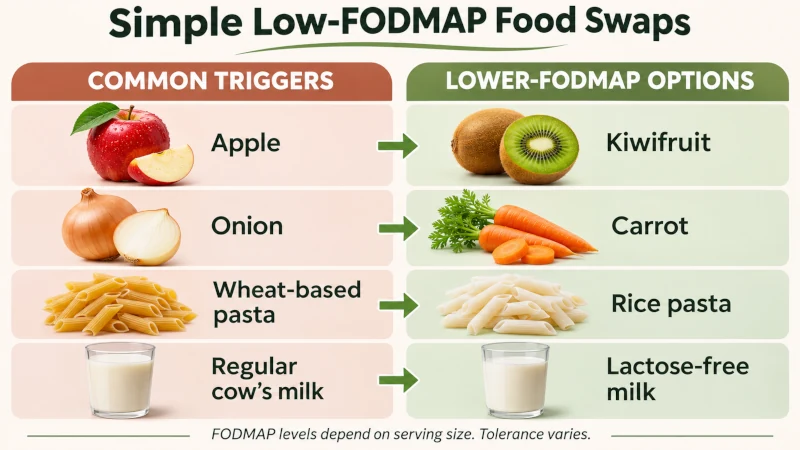
Easier choices vs common triggers
| Food group | Often easier (low-FODMAP) | Common triggers (high-FODMAP) |
| Fruit | Cantaloupe (¾ cup), green kiwifruit, mandarin, orange, pineapple, strawberries (5 medium) | Apples, apple juice, cherries, dried fruit, mango, nectarines, peaches, pears, plums, watermelon |
| Vegetables | Carrot, cucumber, eggplant, green beans, bok choy, green bell pepper, lettuce, potato, bean sprouts, zucchini (65 g) | Artichoke, asparagus, garlic, green peas, leek, mushrooms, onion, red bell pepper |
| Grains | Oats, quinoa flakes, gluten-free cornflakes, rice/corn/quinoa pasta, plain rice cakes, sourdough spelt bread | Wheat-, rye- and barley-based breads, cereals, crackers and snacks |
| Protein | Eggs, firm tofu, tempeh, plain cooked meat, poultry and seafood | Most legumes; some marinated or processed meats |
| Dairy | Lactose-free milk, almond milk, hard cheeses, feta, brie, camembert, soy-protein soy milk | Cow’s milk, yogurt, ice cream, custard, evaporated or condensed milk, whole-soybean soy milk |
| Nuts and sweeteners | Macadamias, peanuts, walnuts, pumpkin seeds; maple syrup, table sugar, dark chocolate | Cashews, pistachios; honey, high-fructose corn syrup, sugar-free candy |
Source: Monash University 3-Step FODMAP Diet sheet [Monash University, 2026]. Tolerance is individual, and portion sizes matter.
Adjusting for constipation or diarrhea
IBS comes in types: mostly constipation (IBS-C), mostly diarrhea (IBS-D) or mixed. The ACG notes that knowing your subtype helps target treatment, and that more than half of people change subtype within a year, so recheck yours from time to time [ACG, 2021].
If constipation dominates, lean on soluble fiber added gradually and plenty of fluid; fiber makes stool softer and easier to pass [NIDDK, 2017]. Our guide to foods that help with constipation ranks options by evidence. Several items there, such as apples, pears, wheat bran and beans, often bother people with IBS, so start with lower-FODMAP choices like oats and kiwifruit.
If diarrhea dominates, avoid sorbitol and ease off caffeine and alcohol [NICE, 2017]. Ask your doctor about a blood test for celiac disease, which the ACG recommends for people with IBS and diarrhea [ACG, 2021]. For short-term bad days, our list of foods that help with diarrhea covers gentle options and rehydration.
Foods that commonly cause trouble
The repeat offenders are wheat bran and other insoluble fiber [BSG, 2021; ACG, 2021], the high-FODMAP foods in the table above, sorbitol and other sugar alcohols, alcohol, fizzy drinks and too much caffeine [NICE, 2017], and large fatty or spicy meals [BSG, 2021]. For a fuller breakdown with swaps, see our guide to IBS foods to avoid and their common triggers.
One thing to skip: elimination diets based on IgG food-sensitivity blood tests. The BSG recommends against them [BSG, 2021], and the ACG doesn’t recommend routine food allergy or sensitivity testing unless symptoms clearly suggest a true food allergy [ACG, 2021].
Gluten, probiotics and yogurt: where the evidence is mixed
Gluten. NIDDK says your doctor may suggest avoiding gluten, and that some people with IBS have more symptoms after eating it even without celiac disease [NIDDK, 2017]. Gastroenterology guidelines are more cautious: both the BSG and the Canadian Association of Gastroenterology recommend against a routine gluten-free diet for IBS, based on very low-quality evidence [BSG, 2021; CAG, 2019]. The BSG suggests that when cutting wheat helps, it may be because of fewer fructans rather than less gluten [BSG, 2021]. The practical path: ask about celiac testing before you change anything, then consider a structured low-FODMAP trial, which targets wheat fructans without requiring a fully gluten-free diet.
Probiotics. Here the guidelines genuinely disagree. The BSG says probiotics as a group may help overall symptoms and pain, though it can’t recommend a specific strain; if you try one, give it up to 12 weeks and stop if nothing improves [BSG, 2021]. The ACG suggests against probiotics for overall IBS symptoms [ACG, 2021]. Both ratings rest on very low-quality evidence. NICE advises taking any probiotic for at least 4 weeks at the manufacturer’s dose while watching the effect [NICE, 2017].
Yogurt. Regular yogurt contains lactose and is on Monash’s high-FODMAP list [Monash University, 2026]. Live-culture yogurt is a reasonable food if you tolerate it, but it isn’t a proven IBS treatment.
When the basics aren’t enough: the low-FODMAP diet
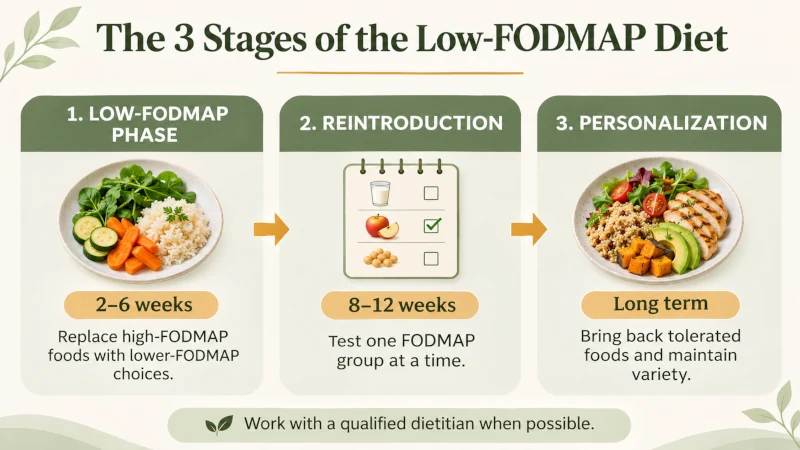
If symptoms persist after general advice, the next step most guidelines describe is a low-FODMAP diet guided by a dietitian [NICE, 2017; BSG, 2021]. The ACG recommends a limited trial, while rating the evidence as very low quality [ACG, 2021]. Monash describes three steps [Monash University, 2026]:
- Low-FODMAP phase (2–6 weeks): swap high-FODMAP foods for low-FODMAP alternatives.
- Reintroduction (8–12 weeks): keep eating low-FODMAP while testing one FODMAP group at a time, eating one challenge food daily for 3 days and noting symptoms.
- Personalization (long term): bring back what you tolerate and limit only what you need to.
About three in four people with IBS improve on the diet; the other quarter don’t, and need to consider other therapies [Monash University, n.d.]. Keep expectations realistic. Trials have mostly tested only the first, restrictive phase, and the benefit looks smaller when the diet is compared with standard dietary advice than with a usual diet [BSG, 2021]. Staying restrictive for a long time can lead to nutritional gaps [ACG, 2021], and the BSG notes possible changes in gut bacteria with unknown long-term effects, plus a risk of overly restrictive eating [BSG, 2021].
If you have a history of disordered eating, the BSG advises screening before any restrictive diet [BSG, 2021]. If you’re pregnant, breastfeeding, underweight, or planning this for a child, involve your clinician or a dietitian before you start. To see how a broader eating pattern fits alongside a FODMAP trial, read our comparison of the anti-inflammatory and low-FODMAP diets for IBS, and our guide to an anti-inflammatory diet for IBS for the long-term side.
Two supplements with evidence: psyllium and peppermint oil
Psyllium (ispaghula)
Psyllium is the soluble fiber with the best IBS evidence, recommended by the BSG, ACG and Canadian guidelines [BSG, 2021; ACG, 2021; CAG, 2019]. The BSG advises starting low, around 3 to 4 grams a day, and building up gradually to avoid bloating [BSG, 2021]. Safety points from the product information [Drugs.com, 2025]:
- Take each dose with a full glass (at least 8 ounces) of liquid. Psyllium can swell and cause choking if taken without enough fluid.
- Take other oral medicines 2 hours before or 2 hours after psyllium, because it can reduce how well they’re absorbed.
- Common side effects are bloating and minor changes in bowel habits.
- Ask a doctor first if you have trouble swallowing, stomach pain, nausea or vomiting, a sudden change in bowel habits lasting more than 2 weeks, or if you’re pregnant or breastfeeding. Some products contain sugar, sodium or phenylalanine, which matters for diabetes, low-salt diets and PKU.
- Stop and call your doctor for rectal bleeding, severe stomach pain or constipation lasting more than 7 days. Labels for laxative use also say not to take it for more than 7 days in a row without medical advice, so agree on a daily IBS plan with your clinician.
Peppermint oil
The ACG suggests peppermint for overall IBS symptoms (a conditional recommendation, low-quality evidence) [ACG, 2021], and the BSG says it may help symptoms and pain (very low-quality evidence) [BSG, 2021]. A 2022 review of 10 studies with 1,030 participants found peppermint oil beat placebo for overall symptoms and belly pain but caused more side effects, mostly mild reflux and indigestion [NCCIH, 2025]. The caveats are real: results came from specific formulations and can’t be assumed for other products, and the largest trial missed its main goal [BSG, 2021].
Possible side effects include heartburn, nausea, abdominal pain, dry mouth and, rarely, allergic reactions. Enteric-coated capsules are designed to reduce heartburn [NCCIH, 2025]. If you already have reflux, talk with your doctor first, since reflux is a common side effect [BSG, 2021]. Peppermint in food amounts is likely safe in pregnancy and breastfeeding, but little is known about medicinal doses [NCCIH, 2025]. If you take any prescription medicine, check with your doctor or pharmacist before starting an herbal product, because some herbs and medicines interact [NCCIH, 2025].
When to see a doctor
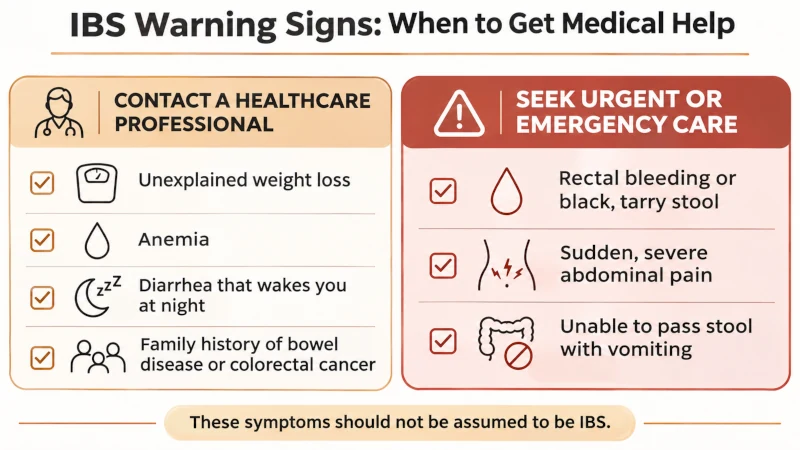
Some symptoms point to a condition other than IBS and need a medical evaluation rather than diet changes. NIDDK lists anemia, bleeding from the rectum, bloody or black, tarry stools and weight loss [NIDDK, 2017]. A family history of celiac disease, colon cancer or inflammatory bowel disease also matters [NIDDK, 2017], as does symptoms starting later in life [ACG, 2021]. Diarrhea that wakes you at night isn’t typical of IBS and may need more testing [BSG, 2021]. See your doctor, too, if diet changes haven’t helped after several weeks or your symptoms change.
Get emergency help (call 911) if you [MedlinePlus, 2026]:
- Vomit blood, or have blood in your stool, especially bright red, maroon or dark and tarry
- Can’t pass stool, especially if you’re also vomiting
- Have sudden, sharp belly pain, or a belly that’s rigid, hard or tender to the touch
- Have chest, neck or shoulder pain, or trouble breathing
- Are pregnant or could be pregnant and have significant belly pain
| HEALTH DISCLAIMER: This article is for general education and isn’t a substitute for medical advice, diagnosis or treatment. IBS symptoms can overlap with other conditions, including celiac disease and inflammatory bowel disease, so talk with a qualified healthcare professional before making major diet changes, starting an elimination diet like low-FODMAP, or taking supplements such as psyllium or peppermint oil. This is especially important if you’re pregnant or breastfeeding, take prescription medicines, have a history of disordered eating, or are making changes for a child. If you notice any of the warning signs above, contact a healthcare provider instead of relying on diet changes. |
Frequently Asked Questions
What should I eat during an IBS flare-up?
No food has been tested as a flare treatment, so lean on what you know you tolerate. Smaller, regular meals built from low-FODMAP staples such as oatmeal, eggs, potatoes, cooked carrots, rice-based foods and lactose-free dairy are a sensible default, with water to drink [Monash University, 2026; NICE, 2017]. Hold off on alcohol, fizzy drinks, sugar-free sweets and big fatty meals [NICE, 2017; BSG, 2021]. Any red-flag symptom means calling your doctor.
Is oatmeal good for IBS?
For many people, yes. Oats provide soluble fiber, the type guidelines favor for IBS, and Monash lists them as low-FODMAP [BSG, 2021; Monash University, 2026]. NICE notes oats may help with gas and bloating [NICE, 2017]. Start with a modest bowl and increase gradually.
Is yogurt good for IBS?
It depends. Regular yogurt contains lactose and is high-FODMAP [Monash University, 2026], so a lactose-free version may sit better. The evidence for probiotics is mixed, with the BSG and ACG reaching different conclusions [BSG, 2021; ACG, 2021].
Should I go gluten-free if I have IBS?
Not routinely. The BSG and the Canadian Association of Gastroenterology recommend against a gluten-free diet for IBS [BSG, 2021; CAG, 2019], though some people do feel better with less gluten [NIDDK, 2017]. Ask about celiac testing first.
How long until diet changes help?
Give it several weeks. NIDDK says you may need to change what you eat for several weeks to see whether symptoms improve [NIDDK, 2017], the first low-FODMAP phase runs 2 to 6 weeks [Monash University, 2026], and the BSG suggests reviewing a treatment after about 3 months and stopping it if it hasn’t helped [BSG, 2021].
Is peppermint tea as good as peppermint oil for IBS?
Not as far as the research shows. The IBS studies used peppermint oil, often in enteric-coated capsules. Peppermint tea appears to be safe, but there isn’t enough evidence to say whether peppermint leaf helps any health condition [NCCIH, 2025].
References
- American College of Gastroenterology: Lacy BE, Pimentel M, Brenner DM, Chey WD, Keefer LA, Long MD, Moshiree B. ACG Clinical Guideline: Management of Irritable Bowel Syndrome. View source
- British Society of Gastroenterology: Vasant DH, Paine PA, Black CJ, et al. British Society of Gastroenterology guidelines on the management of irritable bowel syndrome. Gut. View source
- Canadian Association of Gastroenterology: Moayyedi P, Andrews CN, MacQueen G, et al. Canadian Association of Gastroenterology Clinical Practice Guideline for the Management of Irritable Bowel Syndrome (IBS). View source
- Drugs.com (Cerner Multum). Psyllium: Uses, Side Effects & Warnings. View source
- MedlinePlus Medical Encyclopedia. Abdominal pain. View source
- Monash University. Treating IBS with a 3-Step FODMAP Diet (info sheet). View source
- Monash University. Starting the FODMAP diet. n.d. View source
- National Center for Complementary and Integrative Health (NCCIH). Peppermint Oil. View source
- National Institute for Health and Care Excellence (NICE). Irritable bowel syndrome in adults: diagnosis and management View source
- National Institute of Diabetes and Digestive and Kidney Diseases (NIDDK). Irritable Bowel Syndrome (IBS). View source
- NIDDK. Eating, Diet, & Nutrition for Irritable Bowel Syndrome. View source
- NIDDK. Symptoms & Causes of Irritable Bowel Syndrome. View source
- NIDDK. Diagnosis of Irritable Bowel Syndrome. View source


