
If someone has just handed you an ultrasound result with a number on it, here’s the short version: gallstones range from about the size of a grain of sand to the size of a golf ball. [NIDDK, 2017] That’s the whole spectrum. Where your stone sits on it is worth knowing — but it answers a smaller part of the “should I worry?” question than most people expect.
The thing almost nobody tells you is that size and danger don’t move in a straight line. A tiny 3 mm stone can trigger a genuine emergency, while a large stone can sit quietly for years. So this page does two jobs: it gives you a size chart you can actually picture, and then it tells you the part that matters more — what your particular size does and doesn’t predict.
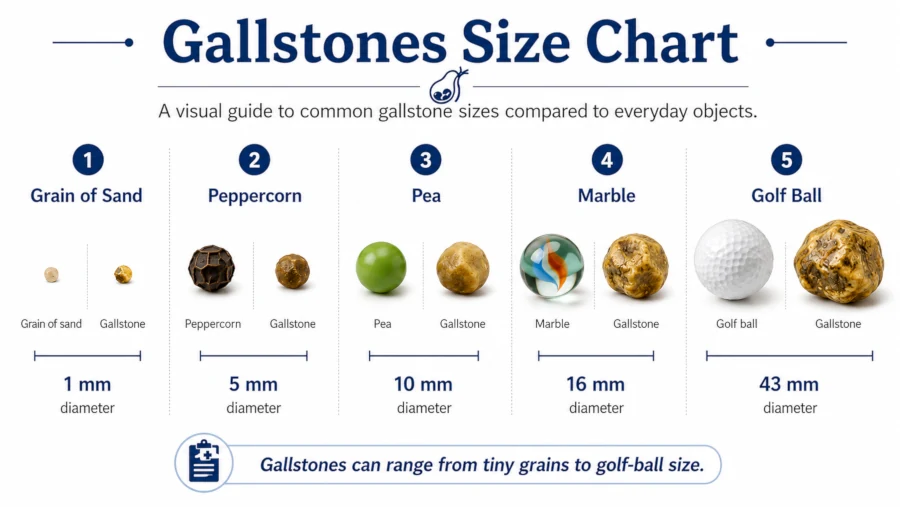
Gallstones size chart: a scale you can picture
Ultrasound reports measure stones in millimetres, which is hard to feel anything about. Here’s a rough translation into everyday objects, so a number on a page becomes a picture in your head.
| Everyday comparison | Approx. size | What it usually means in practice |
| Grain of sand, or “sludge” | Under ~2 mm | Frequently silent. But tiny stones move easily, and many small ones can add up to trouble. |
| Peppercorn | ~2–5 mm | Small enough to slip into a bile duct — which is why this size carries a specific risk. |
| Pea to small marble | ~5–15 mm | A very common size to see on a scan. Can still lodge in a duct and cause pain. |
| Marble | ~15–30 mm | Less likely to pass on its own; more likely to be dealt with surgically if it’s causing symptoms. |
| Up to a golf ball | ~30 mm and above | Rarely passes. Stones at the top of this range carry their own separate concern. |
Treat this as a way to visualise a measurement, not as an official medical grading system. There’s no universal chart where each millimetre band comes with a fixed diagnosis. Your gallbladder can also hold one big stone, hundreds of small ones, or a mix of both at once. [NIDDK, 2017]
How to read your ultrasound measurement
Ultrasound is the standard, first-choice test for gallstones, and it’s good at showing how big they are, where they are, and how many there are. [NHS, 2025] One honest caveat: an ultrasound measurement is a close estimate, not a caliper reading. A stone reported as 5 mm might be a couple of millimetres either way. For most decisions that margin doesn’t change anything — but near an important threshold, your doctor may want a repeat scan or another type of imaging to be sure.
Why size alone doesn’t tell you how dangerous a stone is
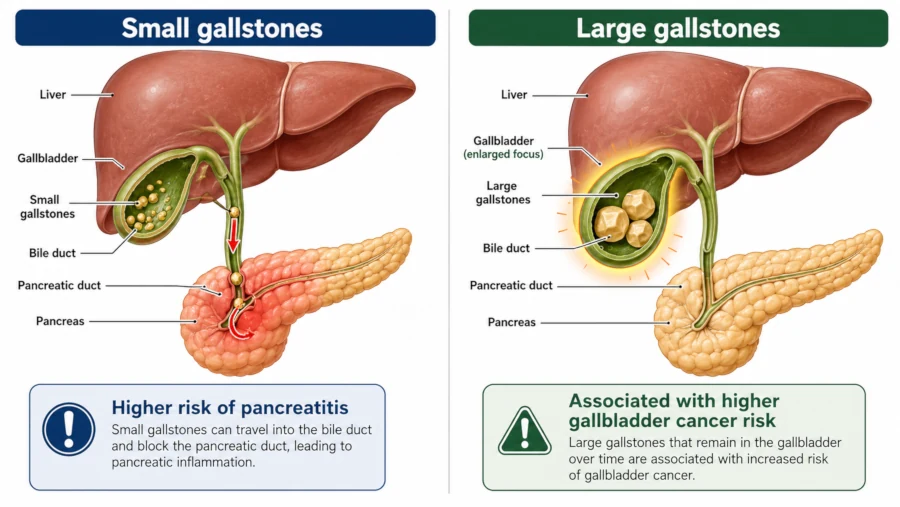
Small stones and the pancreatitis risk
Small stones are not the “safe” ones. Because they’re small enough to escape the gallbladder and travel into the bile duct, they can lodge where the bile and pancreatic ducts drain — and set off acute pancreatitis, a serious, sometimes life-threatening inflammation of the pancreas.
The evidence here is specific rather than vague. In a study of patients who’d had their gallbladders removed, having at least one stone smaller than 5 mm was linked to more than a four-fold increase in the odds of turning up with acute biliary pancreatitis (odds ratio about 4.5). [Diehl et al., Arch Intern Med, 1997] That’s a single observational study, so it shows association rather than proof of cause — but it’s a well-known finding, and it’s the reason a report showing “just small stones” is not automatically reassuring.
Large stones and the cancer link
At the other end, very large stones carry a different, longer-term concern. Pooled observational evidence links stones of 3 cm (30 mm) or larger with a substantially higher risk of gallbladder cancer — in one much-cited analysis, roughly nine times the risk seen with stones under 1 cm. [Int J Surg review, 2020] Two things to hold in mind: gallbladder cancer is uncommon to begin with, so a large multiplier still describes a low absolute risk for most people; and this is an association from observational data, not a verdict on any individual. It’s simply why a doctor may treat a big stone more actively even when it isn’t hurting.
The takeaway isn’t “panic at both ends.” It’s that no size is a free pass, and the honest summary is the one surgeons tend to repeat: how you feel matters more than the number.
What gallstones are actually made of
Gallstones fall into two broad types, and the difference is more than academic — it affects whether non-surgical options are even on the table.
Cholesterol stones are the common ones, making up roughly three-quarters to four-fifths of gallstones, and they’re usually yellow-green from hardened cholesterol. [NIDDK, 2017] [Mayo Clinic, 2025] Pigment stones are darker — brown or black — and form when bile carries too much bilirubin, the pigment your body makes when it breaks down red blood cells. [Mayo Clinic, 2025] Pigment stones show up more often in people with cirrhosis, bile-duct infections, or blood conditions such as sickle cell disease. [NIDDK, 2017] Some people carry a mix of both.
Only cholesterol stones can sometimes be dissolved with medication, and even then only in specific situations — which is why the type matters when treatment comes up.
Why gallstones form, and who’s more likely to get them
Stones form when the chemistry of bile tips out of balance — typically when bile holds more cholesterol than it can keep dissolved, when there’s too much bilirubin, or when the gallbladder doesn’t empty completely and bile sits and concentrates. [Mayo Clinic, 2025]
Some things raise the odds. You’re more likely to develop gallstones if you’re over 40, female, living with obesity, or eating a diet high in fat and low in fibre; a family history and conditions such as diabetes or Crohn’s disease also push risk up. [NHS, 2025] Extra estrogen — from pregnancy, hormone therapy, or the combined pill — plays a role too, and rapid weight loss is one of the clearest triggers of all. [NIDDK, 2017]
Symptoms — and the warning signs that mean get help now
Most gallstones cause nothing at all. These “silent” stones are common and usually need no treatment. [NHS, 2025] Trouble starts when a stone blocks a duct.
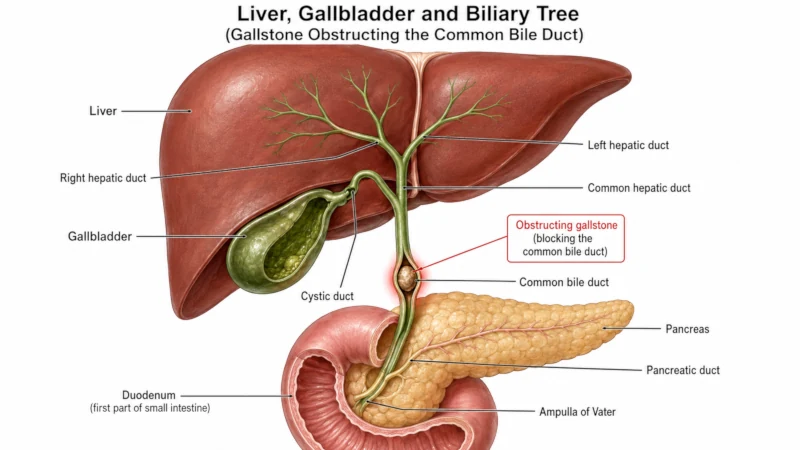
The classic episode is biliary colic: a severe, constant pain in the upper-right or middle of your abdomen that lasts longer than 30 minutes and can stretch to hours, sometimes spreading to your back or right shoulder, often with nausea. [NHS, 2025] Attacks tend to follow fatty meals and frequently show up in the evening or overnight.
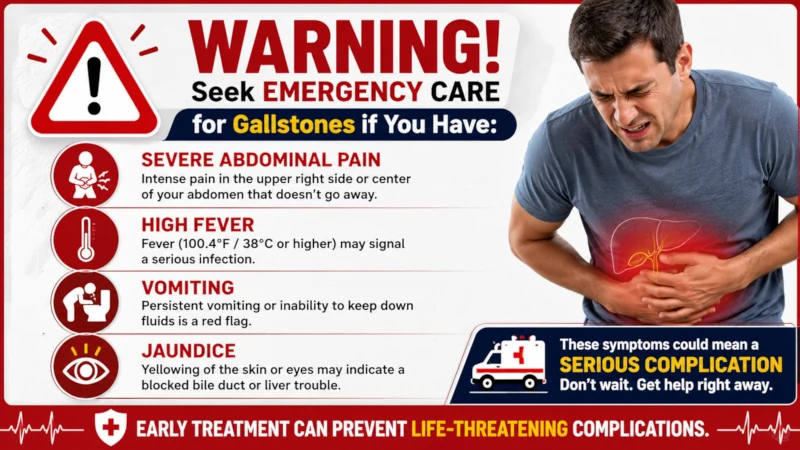
Some symptoms, though, are not “wait and see” — they point to a blocked duct, infection, or inflammation of the gallbladder or pancreas, and they need urgent care.
| Call 911 (or 999 in the UK) or go to the emergency department if you have: sudden, severe pain in your abdomen pain spreading from your abdomen to your back, with vomiting a very high temperature, or you feel hot, cold, or shiveryyellowing of your skin or the whites of your eyes (jaundice) Source: NHS, 2025 |
Left untreated, a blocked duct can lead to serious infection or inflammation of the gallbladder, liver, or pancreas — and can become life-threatening. [NIDDK, 2017] If in doubt, get seen. Gallstone pain that lasts more than a few hours, or comes with fever or jaundice, is a reason to act, not to tough it out.
How size and symptoms shape treatment
Here’s where size returns to the story — but usually as a supporting character behind symptoms.
If your stones aren’t causing symptoms, the usual approach is watchful waiting; many people never need anything more. [NHS, 2025] When stones are causing symptoms or complications, the standard treatment is surgery to remove the gallbladder — a cholecystectomy, almost always done with keyhole (laparoscopic) surgery, often as a day case. [NIDDK, 2017] You can live a normal life without a gallbladder; bile simply flows straight from the liver into the intestine.
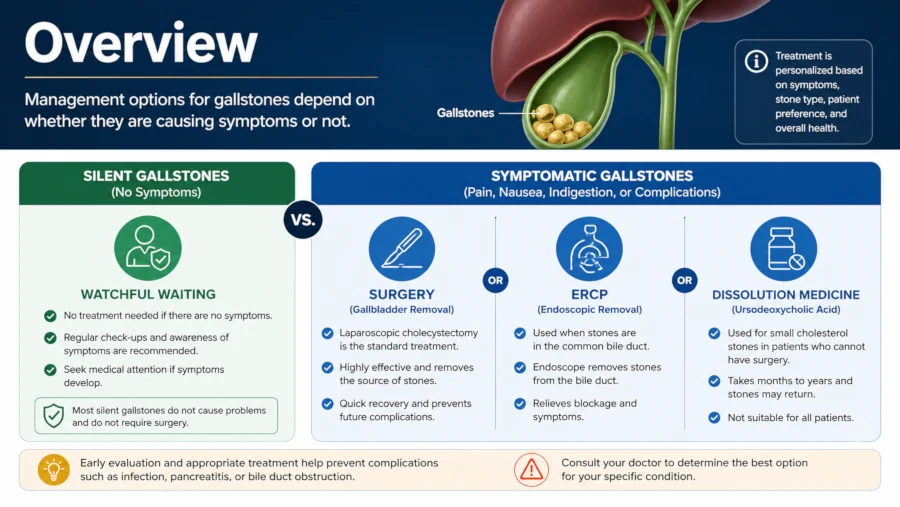
Size and type steer the non-surgical options:
- A stone stuck in the common bile duct is often cleared with ERCP, a scope procedure that widens the duct opening so the stone can pass. [NHS, 2025]
- Small cholesterol stones, in people who can’t have surgery, can sometimes be dissolved with oral bile-acid medicines (ursodiol or chenodiol). These work best on small cholesterol stones, can take months to years, and the stones may return. [NIDDK, 2017]
- Shock-wave lithotripsy (breaking stones apart with sound waves) exists but is used only rarely, sometimes alongside dissolution medicine. [NIDDK, 2017]
One thing no size chart should let you believe: no food, herb, tea, or “flush” dissolves a gallstone or clears a blocked duct. Diet is about comfort and lowering the odds of future stones — not treatment.
Lowering your risk of more stones
If you want to reduce the chance of new stones forming, the useful moves are unglamorous and well supported. Build meals around fibre, whole grains, and healthy unsaturated fats rather than fried food, pastry, and sugar; keep a healthy weight; and if you need to lose weight, do it gradually, because fast weight loss and long fasts both make stones more likely. [NIDDK, 2017] [NHS, 2025]
Food choices can also make day-to-day life more comfortable. If you’re wondering which foods sit well, our guides to foods to eat with gallstones and a broader gallbladder-friendly diet list are practical starting points, and a low-fat fruit like a banana is an easy example — we cover whether bananas are fine with gallstones separately. None of these prevent or cure stones; they support a sensible pattern around them.
When to talk to a doctor
See a doctor if you’re getting repeated bouts of upper-abdominal pain, pain after fatty meals, or any of the warning signs above. If you’ve been told you have gallstones and you’re unsure what your size means for you, that’s a reasonable question to bring to your GP or a gastroenterologist — especially if a stone is at the larger end, if you have many small ones, or if you have another condition that raises your risk. The measurement on your report is a starting point for that conversation, not the end of it.
| Health Disclaimer: This article is for general education and is not medical advice, a diagnosis, or a treatment plan. Gallstones can cause complications that need urgent care, and no food, supplement, or home remedy prevents, dissolves, or treats them. The right course of action depends on your symptoms, stone type, and overall health, so decisions about monitoring, medication, or surgery should be made with a qualified clinician who knows your history. If you have sudden or severe abdominal pain, a high temperature, persistent vomiting, or yellowing of your skin or eyes, seek emergency care now rather than waiting. |
Frequently Asked Questions
What size of gallstone is dangerous?
There isn’t a single “danger” size. Counterintuitively, stones under about 5 mm carry a notably higher risk of triggering acute pancreatitis because they can slip into a duct, [Diehl et al., 1997] while stones of 3 cm or more are linked with a higher (though still uncommon) risk of gallbladder cancer. [Int J Surg review, 2020] Symptoms matter more than the number.
What size gallstone needs surgery?
Symptoms drive that decision far more than size. When gallstones cause pain or complications, the usual treatment is gallbladder removal, whatever the stone’s size; when they’re silent, watchful waiting is common. [NHS, 2025] [NIDDK, 2017] A very large stone or many small ones may tip a doctor toward acting sooner.
Are small gallstones better than large ones?
Not necessarily. Small stones travel more easily and are the ones more often behind gallstone pancreatitis. [Diehl et al., 1997] “Small” doesn’t mean “harmless.”
How are gallstones measured?
Almost always by abdominal ultrasound, which shows size, number, and location. [NHS, 2025] The measurement is a close estimate, so a stone near an important size threshold may be re-checked.
Can a large gallstone be dissolved without surgery?
Usually no. Dissolution medicines work only on small cholesterol stones, take months to years, and stones can come back. [NIDDK, 2017] Large stones, pigment stones, and stones causing symptoms are generally treated surgically.
Do gallstones need treating if they aren’t causing symptoms?
Often not. Silent gallstones are common and frequently need no treatment, though your doctor may keep an eye on them. [NHS, 2025]
References
- National Institute of Diabetes and Digestive and Kidney Diseases (NIDDK). “Definition & Facts for Gallstones.” NIH, last reviewed November 2017. View source
- NIDDK. “Treatment for Gallstones.” NIH, last reviewed November 2017.View source
- NHS. “Gallstones.” nhs.uk, page last reviewed 11 August 2025. View source
- Mayo Clinic. “Gallstones — Symptoms & Causes.” Reviewed 2025. View source
- Diehl AK, Holleman DR Jr, Chapman JB, Schwesinger WH, Kurtin WE. “Gallstone size and risk of pancreatitis.” Archives of Internal Medicine. 1997;157(15):1674–1678. PMID 9250228. View source
- “Best evidence topic: Does the presence of a large gallstone carry a higher risk of gallbladder cancer?” International Journal of Surgery (best-evidence review), 2020. View source
- Medical News Today. “Gallstone sizes and shapes.” View source
