
Wild yam has a big reputation: natural progesterone, menopause relief, a remedy for cramps. The truthful version is smaller. The best-designed trial of wild yam cream found it worked no better than a placebo for menopause symptoms, and your body can’t turn wild yam into hormones [Komesaroff, 2001]; [MSKCC, 2025]. If you were hoping for amazing wild yam benefits, you deserve a straight account of which claims rest on human studies, which come only from lab dishes and rats, and who should leave it on the shelf.
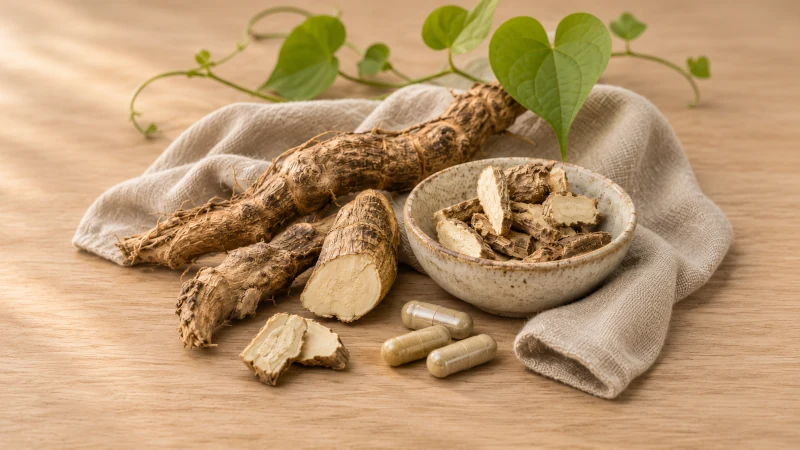
- Quick take: It is not a hormone. Wild yam contains diosgenin, which chemists can turn into progesterone in a lab. Your body can’t [MSKCC, 2025].
- Menopause: a wild yam cream did no better than placebo; the Menopause Society does not recommend yam creams for hot flashes [NAMS, 2023].
- Everything else — cramps, arthritis, blood sugar, cholesterol, cancer — rests on traditional use or animal and lab studies.
- Skip it if you are pregnant or breastfeeding, have a hormone-sensitive condition, a clotting disorder or kidney disease, or take estrogen.
What wild yam is — and how it differs from the yams you eat
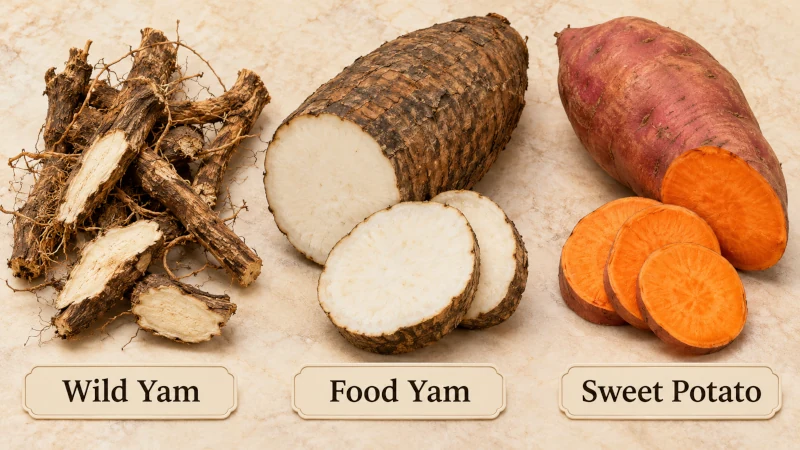
“Wild yam” usually means Dioscorea villosa, a plant whose root is dried and sold as capsules, powders, teas, tinctures and creams. Its old folk names — colic root, rheumatism root — tell you what people traditionally used it for: stomach cramps and achy joints [MSKCC, 2025].
It isn’t the starchy yam you roast for dinner, and it certainly isn’t the orange “yam” in most US grocery stores, which is usually a sweet potato. Food yams have their own nutrition story, covered in our guide to the health benefits of yams.
One complication matters for everything below: “wild yam” gets used loosely for several Dioscorea species. One of the more encouraging menopause trials used D. alata (purple yam), not D. villosa [Hsu, 2011]. When a product cites a study, check that it’s the same plant.
Can your body turn wild yam into progesterone?
No. This is the claim most wild yam products lean on, so it’s worth being clear. Wild yam contains diosgenin, a plant steroid that drug makers have used as a raw material to produce synthetic progesterone in the lab. There is no evidence the human body can make that conversion [MSKCC, 2025], and wild yam itself contains no hormones [WebMD].
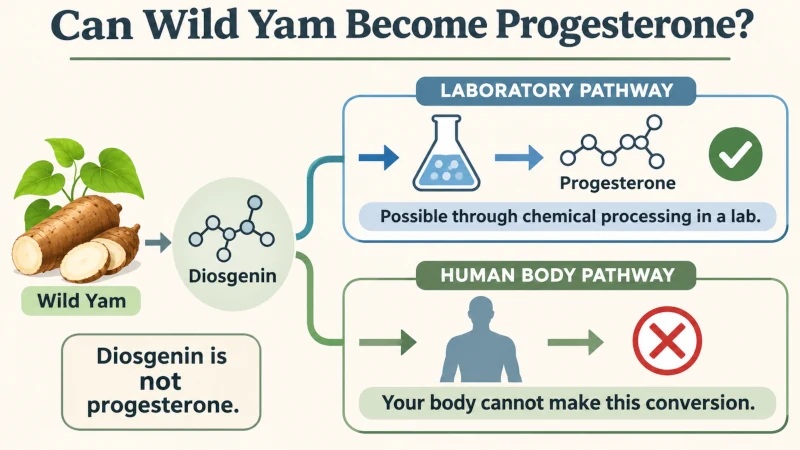
Researchers have checked this directly. In a placebo-controlled trial, women who used wild yam cream for three months showed no change in blood or saliva progesterone, estradiol or FSH [Komesaroff, 2001].
That has a practical consequence. The Menopause Society notes that tested yam creams often contain no yam extract at all, and it raises concern about adulteration with undisclosed steroids [NAMS, 2023]. So if a “wild yam” cream seems to act like a hormone, the question to ask is what else is in the jar.
One nuance: in cell studies, wild yam and diosgenin show weak estrogen-like activity [MSKCC, 2025]. That isn’t the same as supplying hormones, but it is the reason for caution if you have a hormone-sensitive condition.
Wild yam benefits: what the research shows
Here is each popular claim, matched to the best evidence behind it.
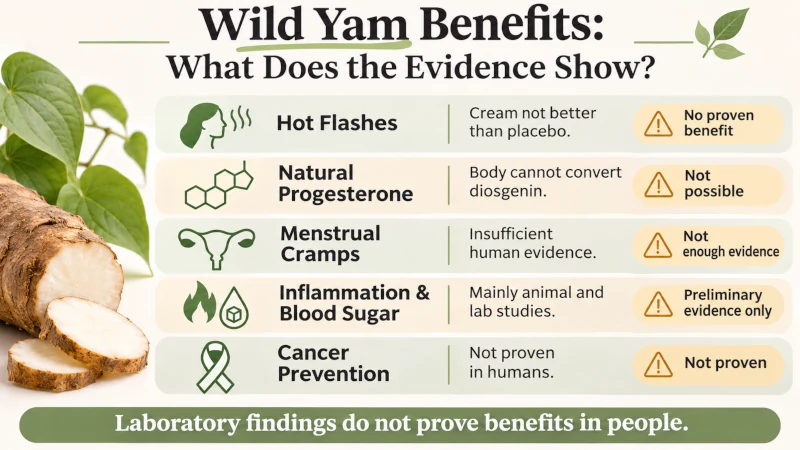
| Claim | Best evidence available | Verdict |
| Relieves hot flashes and night sweats (cream) | One small placebo-controlled trial (23 women): no better than placebo [Komesaroff, 2001] | Not supported; not recommended [NAMS, 2023] |
| Eases menopause symptoms (oral extract) | One 12-month trial of 50 women using D. alata, a different species [Hsu, 2011] | Limited; not replicated |
| Natural source of progesterone | Lab chemistry only; no conversion in the body [MSKCC, 2025] | False |
| Menstrual cramps, PMS, muscle spasms | Traditional use; no controlled human trials [RxList] | Insufficient evidence |
| Arthritis and inflammation | Animal studies [MSKCC, 2025] | Insufficient evidence |
| Blood sugar and cholesterol | Animal studies [MSKCC, 2025]; [Drugs.com] | Insufficient evidence |
| Cancer protection | Cell studies only [MSKCC, 2025] | No evidence it prevents or treats cancer |
| Osteoporosis, libido, fertility | No good human studies [RxList] | Insufficient evidence |
Menopause symptoms
The most quoted study is also the most sobering. Twenty-three healthy women with troublesome menopause symptoms used wild yam cream for three months and a placebo cream for three months, in random order, without knowing which was which. Both creams nudged some flushing and sweating scores slightly; there was no difference between them. Cholesterol, blood sugar and hormone levels didn’t budge either. The good news is that nobody had significant side effects [Komesaroff, 2001].
A Taiwanese trial tells a more hopeful story, with caveats. Fifty women took either a placebo or two 12 mg sachets a day of a standardized Dioscorea alata extract for a year. The yam group’s total menopause scores fell significantly, mostly in psychological symptoms such as anxiety, nervousness and insomnia [Hsu, 2011]. It is one trial, of a different species, taken by mouth, so it says little about the D. villosa capsules and creams sold in the US.
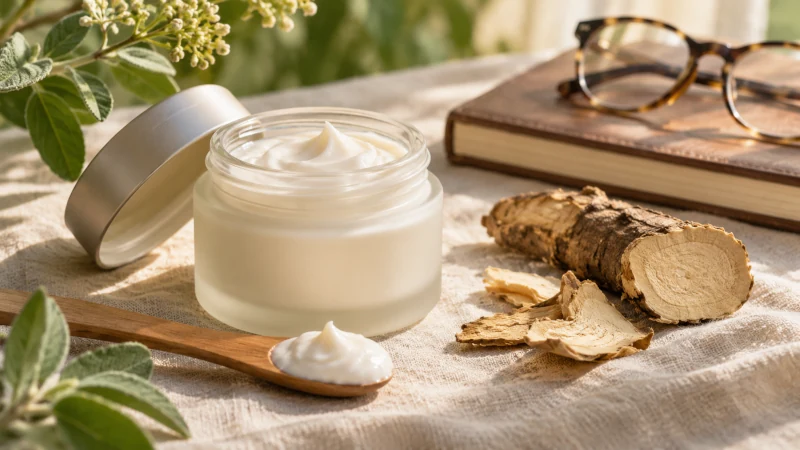
Weighing that evidence, the Menopause Society’s 2023 position statement rates yam creams as not recommended for hot flashes [NAMS, 2023]. If hot flashes are wrecking your sleep or your workday, you have options that do work: hormone therapy remains the most effective treatment for healthy women around menopause, and nonhormone options with good evidence include cognitive behavioral therapy, clinical hypnosis, certain antidepressants (SSRIs and SNRIs), gabapentin and fezolinetant [NAMS, 2023]. A clinician can help you weigh which fits you. For a broader look at plants used in women’s health, see our guide to herbs for women.
Cramps, spasms and digestion
Nineteenth-century American Eclectic physicians used wild yam as an antispasmodic [Drugs.com], and that tradition explains its reputation for period pain, colic and an unsettled stomach. Tradition is all it has so far. These uses haven’t been tested in controlled human trials, and painful periods and PMS are both rated as having insufficient evidence [RxList]. The same goes for coughs [MSKCC, 2025].
If cramps are your reason for looking, other herbs have more trial data behind them — our guide to herbs for menstrual cramps ranks them by evidence. For bloating and gut comfort, see these digestive supplements.
Inflammation, blood sugar and cholesterol
In animal models, wild yam extracts have shown anti-inflammatory, pain-reducing and blood-sugar-lowering effects [MSKCC, 2025], and diosgenin lowered cholesterol in rats [Drugs.com]. Those are reasons to keep studying the plant, not reasons to take it. Supporting evidence for rheumatoid arthritis in people is lacking [MSKCC, 2025].
The closest human data come from food, not supplements: in a small uncontrolled study, postmenopausal women who ate about 390 g of yam a day for 30 days had higher estrone and SHBG levels, with no change in estradiol [Drugs.com]. If cholesterol is the goal, several supplements with better cholesterol evidence are worth discussing with your doctor first.
Cancer claims
Wild yam extracts have shown activity against breast cancer cells in lab dishes, but Memorial Sloan Kettering is explicit that this does not mean wild yam can prevent or treat cancer [MSKCC, 2025]. The same lab work found weak estrogen-like effects, which is why people with hormone-sensitive cancers are told to check with their oncologist before taking it. Diet patterns with real cancer evidence are covered in our cancer-preventing diet guide.
How wild yam is sold and what to expect
You’ll find wild yam as capsules and powders, loose tea, liquid tinctures and creams. There isn’t enough research to set a dose [RxList], so labels vary, and the FDA has not reviewed wild yam for safety or effectiveness [WebMD]. Chemical content also shifts with growing conditions, harvest timing, processing and brand, so one bottle may not behave like the next [WebMD].
A few practical points if you decide to try it:
- Don’t eat it raw. Raw wild yam contains chemicals that can cause serious side effects; cooked or processed forms are usually well tolerated [WebMD].
- Read cream labels closely. Some “wild yam” creams contain added progesterone or no yam at all [NAMS, 2023]. A cream with added hormones is a hormone product, with hormone risks.
- Set honest expectations. Don’t expect hormone effects. If you try it for cramps or digestion, track your symptoms and stop if nothing changes after a few weeks.
- Tell your pharmacist. Bring the bottle, especially if you take any estrogen-containing medicine.
Side effects and safety
Common side effects
Most people tolerate typical amounts. Large amounts can cause vomiting [RxList], and some people report nausea, headaches or digestive upset; creams can irritate the skin [Medical News Today, 2023]. Allergic reactions are uncommon but serious. Stop and get emergency help if you notice trouble breathing, swelling of the face or throat, trouble swallowing, hives or fainting [WebMD].
The kidney question
In a rat study, animals fed wild yam extract for 28 days showed no sudden organ damage but did develop increased kidney scarring (fibrosis) and liver inflammation. The researchers suggested long-term use may be best avoided, especially by people with reduced kidney function or those taking drugs that affect the kidneys [Wojcikowski, 2008]. Rats aren’t people, and this hasn’t been shown in humans, but it’s a reason not to take wild yam for months on end — and to talk to your doctor first if you have kidney or liver problems [WebMD].
Medication interactions
Here the major references disagree, and you should know that. The Natural Medicines data published on RxList rate a moderate interaction with estrogens: because wild yam may act a little like estrogen, it might reduce the effect of estrogen pills such as conjugated estrogens (Premarin), ethinyl estradiol and estradiol [RxList]. Drugs.com, by contrast, finds no well-documented interactions [Drugs.com], and WebMD says interactions simply haven’t been studied well [WebMD].
“Not well studied” is not the same as “safe.” If you use hormone therapy or a birth control pill containing ethinyl estradiol, ask your pharmacist or prescriber before adding wild yam.
Pregnancy and breastfeeding
There isn’t enough reliable safety information, so avoid wild yam while pregnant or breastfeeding [RxList]. It isn’t known whether it passes into breast milk [WebMD]. You may see herbal sources claim wild yam boosts fertility, or on the other side that it triggers contractions; neither claim has good human evidence [RxList]. The missing safety data are reason enough to skip it.
Who should avoid wild yam
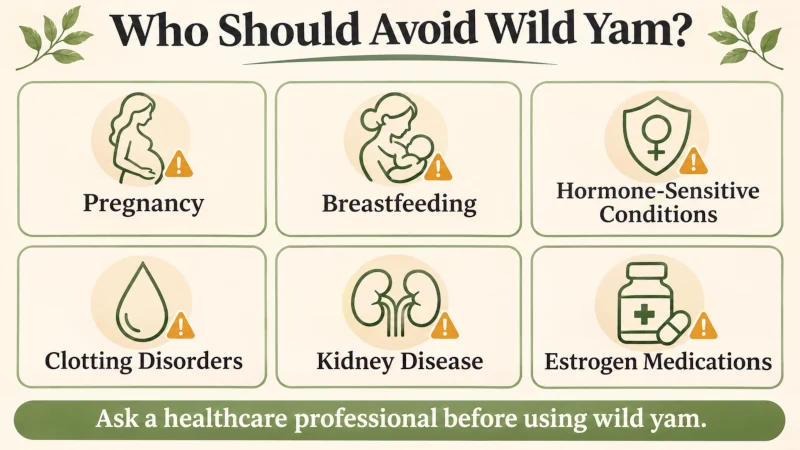
- People who are pregnant, trying to conceive with medical help, or breastfeeding [RxList].
- Anyone with a hormone-sensitive condition — breast, uterine or ovarian cancer, endometriosis or uterine fibroids — because of possible estrogen-like effects [RxList]; [MSKCC, 2025].
- People with protein S deficiency or another clotting disorder. One case report describes a retinal vein clot three days after a combination product containing wild yam, dong quai, red clover and black cohosh [RxList].
- People with kidney disease or reduced kidney function [Drugs.com]; [Wojcikowski, 2008].
- Children, since safety in young children hasn’t been established [Medical News Today, 2023].
- Anyone allergic to wild yam or other ingredients in the product [WebMD].
When to talk to a professional
Talk to a doctor or pharmacist before starting wild yam if you take estrogen, hormone therapy or birth control pills, have kidney or liver problems, or have ever had a hormone-sensitive cancer. Make an appointment too if menopause symptoms are disrupting your sleep, mood or work — effective treatments exist, and you don’t have to grind through it on an unproven herb. New pelvic pain, unusually heavy or irregular bleeding, or any bleeding after menopause should be checked by a clinician rather than treated at home.
Get urgent care for signs of a severe allergic reaction: difficulty breathing, swelling of the lips, face or throat, or fainting [WebMD].
HEALTH DISCLAIMER: This article is for general education and is not a substitute for medical advice, diagnosis or treatment. Herbal supplements can affect medications and health conditions, and their contents vary between brands. Talk with a qualified healthcare professional before using wild yam — especially if you are pregnant or breastfeeding, take hormone therapy or other prescription medicines, or have a hormone-sensitive, clotting or kidney condition.
Frequently Asked Questions
Does wild yam contain progesterone?
No. Wild yam contains diosgenin, which can be turned into progesterone only in a laboratory; the body can’t do the conversion [MSKCC, 2025]. Some creams sold as “wild yam” have progesterone added, which makes them hormone products [NAMS, 2023].
Does wild yam cream work for hot flashes?
The best trial found it no better than placebo after three months [Komesaroff, 2001], and the Menopause Society does not recommend yam creams for hot flashes [NAMS, 2023].
Is it safe to take wild yam every day?
No standard dose exists, and long-term safety in people hasn’t been studied. A 28-day rat study found kidney scarring [Wojcikowski, 2008], so ongoing daily use isn’t a good idea without medical advice.
Can wild yam help with PMS, fertility or libido?
There isn’t enough evidence to say it does [RxList]. Because pregnancy safety is unknown, avoid it if you are trying to conceive.
Can I take wild yam with birth control or hormone therapy?
Sources disagree. One major database rates a moderate interaction with estrogens [RxList], while another finds no documented interactions [Drugs.com]. Check with your pharmacist first.
Is wild yam the same as sweet potato or the yams I cook?
No. Wild yam (Dioscorea villosa) is a medicinal root, not a dinner vegetable, and the orange “yams” in US stores are usually sweet potatoes. See our guide to the health benefits of yams for food yams.
References
- Memorial Sloan Kettering Cancer Center. Wild Yam. About Herbs. View source
- Komesaroff PA, Black CV, Cable V, Sudhir K. Effects of wild yam extract on menopausal symptoms, lipids and sex hormones in healthy menopausal women. View source
- Hsu CC, Kuo HC, Chang SY, Wu TC, Huang KE. The assessment of efficacy of Diascorea alata for menopausal symptom treatment in Taiwanese women. View source
- The North American Menopause Society. The 2023 nonhormone therapy position statement of The North American Menopause Society. View source
- Wojcikowski K, Wohlmuth H, Johnson DW, Gobe G. Dioscorea villosa (wild yam) induces chronic kidney injury via pro-fibrotic pathways. View source
- WebMD. Wild Yam: Overview, Uses, Side Effects, Precautions, Interactions. View source
- RxList. Wild Yam: Health Benefits, Side Effects, Uses, Dose & Precautions (Natural Medicines data). View source
- Drugs.com. Wild Yam (professional monograph). View source
- Kandola A; reviewed by Wilson DR. What are the health benefits of wild yam? Medical News Today. View source


