
Nature’s Way Sambucus Elderberry Gummies combine black elderberry extract with vitamin C, vitamin D3, and zinc in a chewable daily supplement. Here’s the short answer most people want: the vitamins and zinc help your immune system run normally, and elderberry may take a little off the length of a cold or flu once you’re sick. But the elderberry research is small and mixed, and it used different products at much bigger doses than a gummy provides. For most healthy adults and kids 4 and up, Sambucus Elderberry Gummies are a reasonable, low-risk choice. They won’t make you cold-proof, and they don’t replace a flu shot.
What’s in one serving of Sambucus Elderberry Gummies
A serving is two gummies. Here’s what the current label lists [Nature’s Way Sambucus Immune Gummy label, 2026]:
| Ingredient | Per 2 gummies | % Daily Value |
| Vitamin C (ascorbic acid) | 90 mg | 100% |
| Vitamin D3 (cholecalciferol) | 30 mcg (1,200 IU) | 150% |
| Zinc (zinc citrate) | 7.5 mg | 68% |
| Black elderberry (Sambucus nigra) extract, standardized to anthocyanins | 50 mg (made from 3,200 mg of elderberries) | Not established |
| Added sugars | 3 g | 6% |
| Calories | 20 | n/a |
The rest is organic tapioca syrup, cane sugar, water, pectin, natural flavors, sodium citrate, citric acid, and beeswax. The gummies are gluten-free and made without gelatin or artificial colors. Because they contain beeswax, they’re vegetarian, not vegan.
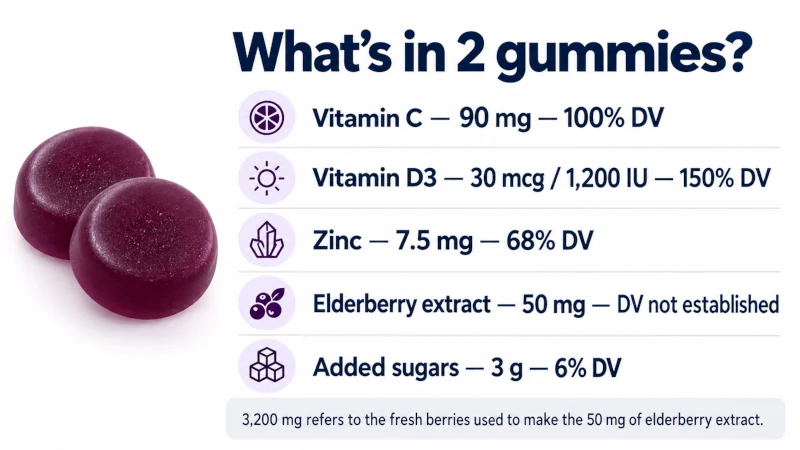
Two details on that label trip people up. The “3,200 mg” refers to the fresh berries used to make the extract; the gummy itself contains 50 mg of extract. And formulas change over time, so check the Supplement Facts panel on the bottle you actually own.
What the research says about elderberry
Elderberry has a long history in folk medicine for colds and flu [NCCIH elderberry fact sheet, 2024]. The real question is whether a supplement changes anything you’d notice. The fair answer: possibly a little, for symptoms you already have, with a lot of uncertainty.
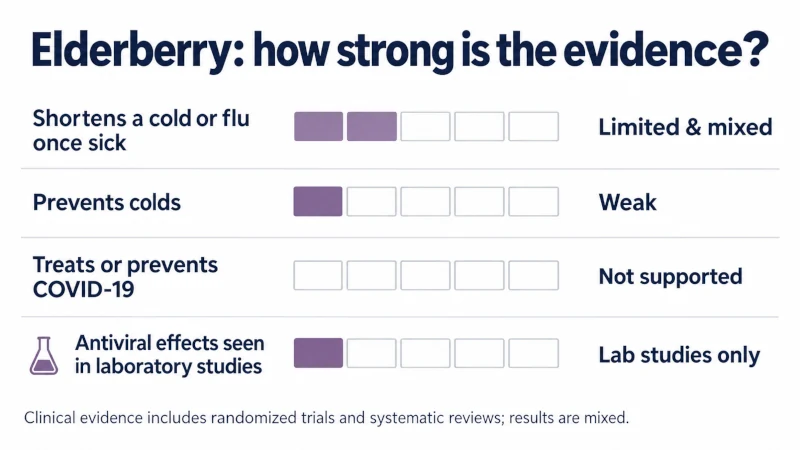
| Question | What the studies show | Strength of evidence |
| Does it shorten a cold or flu? | Small early trials showed faster relief; a later US trial found no benefit | Limited and mixed |
| Does it prevent colds? | Trials haven’t shown fewer colds | Weak, not supported |
| Does it help with COVID-19? | No good evidence | Not supported |
| Antiviral or antioxidant effects? | Seen in lab and cell studies | Early, lab only |
Colds and flu: promising early trials, then a miss
The study quoted most often is a 2004 Norwegian trial of 60 adults with flu-like symptoms. Those who took 15 mL of elderberry syrup four times a day for five days felt better about four days sooner than the placebo group. The authors said the finding still needed confirming in a larger study [Zakay-Rones et al., 2004].
A 2019 meta-analysis pooled four small randomized trials, 180 people in total, and found elderberry substantially reduced upper respiratory symptoms [Hawkins et al., 2019]. Encouraging, but 180 people is a thin base.
Then came a tougher test. In a 2020 double-blind trial at three US emergency departments, 87 people with confirmed flu took elderberry extract or a placebo. Recovery took the same time in both groups: 8.6 days with elderberry and 8.7 with placebo. The researchers found no evidence elderberry helped [Macknin et al., 2020].
Independent reviewers who graded the whole body of evidence concluded elderberry may shorten colds and flu, but the evidence is uncertain [Wieland et al., 2021].
Does it prevent colds? Probably not
This matters because the gummies are sold for everyday use. The closest thing to a prevention trial followed 312 people on long-haul flights who took elderberry extract or a placebo before and after travel. Slightly fewer people in the elderberry group caught a cold (12 versus 17), but the difference wasn’t statistically significant. The colds they did get were shorter: 57 total sick days versus 117 in the placebo group [Tiralongo et al., 2016]. A 2021 systematic review concluded elderberry may not lower your risk of catching a cold [Wieland et al., 2021].
The dose gap
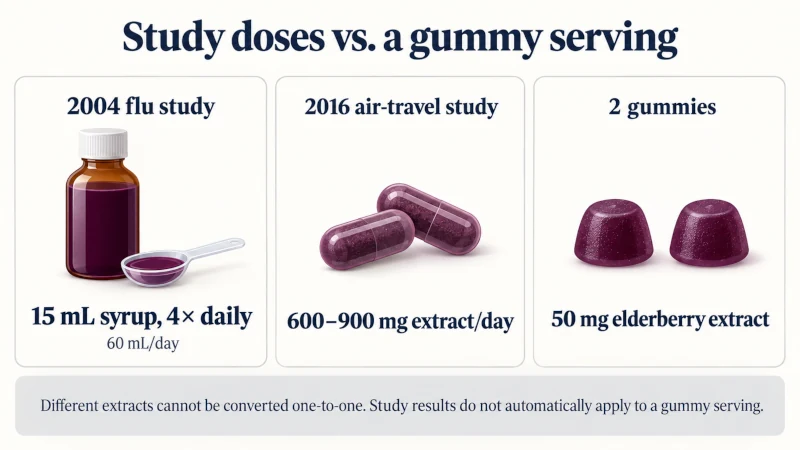
The trials used different elderberry products, and far more of them than one serving of gummies. The air travelers took 600 to 900 mg of extract a day [Tiralongo et al., 2016], and the Norwegian flu study used 60 mL of syrup daily [Zakay-Rones et al., 2004]. A two-gummy serving has 50 mg of extract [Nature’s Way Sambucus Immune Gummy label, 2026]. Extracts are made differently, so you can’t convert those numbers one-to-one. It does mean the trial results don’t automatically apply to a gummy, and we found no published clinical trial of this specific product.
COVID-19 and lab studies
Elderberry has been promoted for COVID-19, but there’s no good evidence it helps, and the FDA and Federal Trade Commission have acted against companies making those claims [NCCIH elderberry fact sheet, 2024]. Some people also worried elderberry might overstimulate the immune system. A systematic review found no studies linking it to harmful inflammatory reactions, though the data are limited [Wieland et al., 2021].
In lab dishes, a standardized elderberry extract has blocked influenza viruses and some respiratory bacteria [Krawitz et al., 2011]. That’s a reason to keep studying it, not proof it works the same way in your body.
What the vitamin C, zinc, and vitamin D add
The nutrients are the most predictable part of the gummy. All three are needed for normal immune function. What they can’t do is push a well-nourished immune system beyond normal.
Vitamin C. In the general population, taking at least 200 mg a day doesn’t lower your odds of catching a cold. Taken regularly, it shortens colds modestly, by about 8% in adults and 14% in children, while starting it after symptoms appear doesn’t seem to help [NIH ODS vitamin C fact sheet, 2025]. The gummy’s 90 mg sits below the 200 mg used in those trials. For a deeper look, see what vitamin C can and can’t do for your immune system.
Zinc. Zinc lozenges or syrups started early in a cold can shorten it by about two days. But those trials used 45 to 300 mg a day, mostly as lozenges that dissolve slowly in the mouth and throat, and zinc doesn’t appear to prevent colds [NIH ODS zinc fact sheet, 2026]. A swallowed gummy with 7.5 mg is a different thing.
Vitamin D3. Here the gummy mainly fills a gap. Most Americans get less vitamin D from food than recommended. The 1,200 IU per serving is above the adult recommendation of 600 to 800 IU and well under the adult upper limit of 4,000 IU [NIH ODS vitamin D fact sheet, accessed 2026].
None of this outweighs sleep, a varied diet, and vaccination. If you’d rather start with your plate, here are foods that support your immune defenses.
How to take Sambucus Elderberry Gummies
The directions are simple: adults and children 4 and older chew two gummies a day, and the label says not to exceed that [Nature’s Way Sambucus Immune Gummy label, 2026]. Doubling up when you feel run down isn’t a labeled use, and it doubles the zinc and vitamin D along with the elderberry.
- Any time of day works. Nature’s Way says to take them whenever fits your schedule. There’s no evidence that morning dosing works better.
- Daily use is how they’re sold. Just keep expectations realistic, since evidence that daily elderberry prevents illness is weak.
- Add up your other supplements. If you also take a multivitamin, vitamin D, or zinc lozenges, count the totals. Adult upper limits from all sources are 2,000 mg of vitamin C, 40 mg of zinc, and 4,000 IU (100 mcg) of vitamin D [NIH ODS vitamin C fact sheet, 2025] [NIH ODS zinc fact sheet, 2026] [NIH ODS vitamin D fact sheet, accessed 2026].
- Store them like medicine. They look and taste like candy, so keep them out of children’s reach.
- Keep your flu shot. A gummy is not a substitute for vaccination.
Are Sambucus Elderberry Gummies safe for kids?
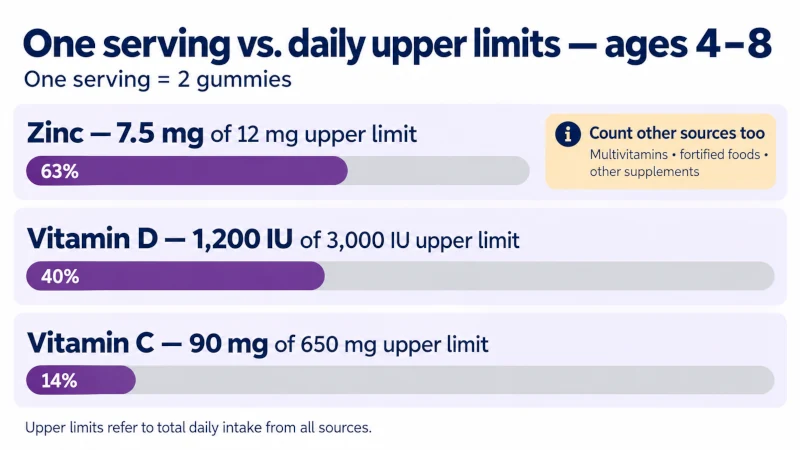
The regular gummies are labeled for children 4 and older at the same two-gummy serving adults take, and they aren’t formulated for children under 4 [Nature’s Way Sambucus Immune Gummy label, 2026]. There’s no smaller child dose.
For a child aged 4 to 8, one serving provides:
- 7.5 mg of zinc, against an upper limit of 12 mg a day [NIH ODS zinc fact sheet, 2026]
- 30 mcg (1,200 IU) of vitamin D, against an upper limit of 75 mcg (3,000 IU) [NIH ODS vitamin D fact sheet, accessed 2026]
- 90 mg of vitamin C, against an upper limit of 650 mg [NIH ODS vitamin C fact sheet, 2025]
On its own, that’s within limits. The problem is stacking. A children’s multivitamin, zinc-fortified cereal, and an extra serving “because they’re sick” can push a young child past 12 mg of zinc, and too much zinc over time interferes with copper [NIH ODS zinc fact sheet, 2026].
Check with your child’s doctor first if your child takes other supplements or medication or has a chronic health condition. And don’t give children the Sleep + Immune version. It contains melatonin and is labeled for adults only [Nature’s Way Sleep & Immune Gummies label, 2026].
Side effects, interactions, and who should avoid them
Side effects
Most people tolerate commercial elderberry products well in short-term use. Stomach upset and allergic reactions are reported, but infrequently [MSKCC About Herbs: Elderberry, 2023]. In the 312-person travel trial, adverse events were low and none could be tied directly to elderberry [Tiralongo et al., 2016].
There are rare case reports of acute pancreatitis and autoimmune hepatitis in people taking elderberry supplements [MSKCC About Herbs: Elderberry, 2023]. Single cases can’t prove elderberry caused them, but stop taking it and call your doctor if you develop severe belly pain, yellowing skin or eyes, or dark urine.
Stop immediately and get help if you notice hives or swelling of the face or lips. Call 911 for trouble breathing.
Medication interactions
Tell your doctor or pharmacist about any supplement you take, including this one [NCCIH elderberry fact sheet, 2024]. The interactions worth knowing:
- Diabetes medicines, diuretics, and laxatives. Elderberry may add to their effects. For diabetes medicines and diuretics, the clinical importance hasn’t been established [MSKCC About Herbs: Elderberry, 2023].
- Certain antibiotics. Zinc can reduce absorption of quinolone (such as Cipro) and tetracycline antibiotics. Take the antibiotic at least 2 hours before or 4 to 6 hours after zinc. Zinc also interferes with penicillamine [NIH ODS zinc fact sheet, 2026].
- Thiazide diuretics, orlistat, statins, and steroids. These interact with vitamin D. With thiazides, the concern is high blood calcium, especially in older adults [NIH ODS vitamin D fact sheet, accessed 2026].
- Autoimmune conditions and immune-suppressing drugs. Elderberry hasn’t been well studied in people with autoimmune disease or those taking immune-suppressing medicine after a transplant. Nature’s Way’s own Sleep + Immune label asks people with autoimmune conditions to check with a healthcare professional first [Nature’s Way Sleep & Immune Gummies label, 2026]. Ask your doctor before using either product.
Pregnancy and breastfeeding
Here, sources disagree, which tells you something on its own. NCCIH says little is known about whether elderberry is safe during pregnancy or breastfeeding [NCCIH elderberry fact sheet, 2024]. Memorial Sloan Kettering goes further and lists pregnancy and breastfeeding as reasons to avoid it [MSKCC About Herbs: Elderberry, 2023]. The regular gummy label asks pregnant and nursing people to check with a healthcare professional, and the Sleep + Immune label says not to use it at all during pregnancy or nursing [Nature’s Way Sambucus Immune Gummy label, 2026] [Nature’s Way Sleep & Immune Gummies label, 2026]. The cautious choice is to skip elderberry supplements unless your doctor or midwife approves them.
Raw elderberries are a different story
Raw or unripe elderberries, and the plant’s leaves and stems, contain substances that can release cyanide and cause nausea, vomiting, and severe diarrhea. Cooking removes the problem [NCCIH elderberry fact sheet, 2024]. Commercial extracts are processed, so this is mainly a concern if you’re tempted to make a homemade remedy from wild berries.
Can you take them with Sambucus Sleep + Immune gummies?
Nature’s Way also sells Sambucus Sleep + Immune Gummies. Two of those gummies contain 3 mg of melatonin, 100 mg of L-theanine, lemon balm and passionflower extracts, 50 mg of vitamin C, 7.5 mg of zinc, and 50 mg of elderberry extract. They’re for adults only, taken 30 to 60 minutes before bed [Nature’s Way Sleep & Immune Gummies label, 2026].
Nothing shows that pairing the two products improves results. If a healthy adult takes both on the same day, the combined 15 mg of zinc and 140 mg of vitamin C stay under adult upper limits [NIH ODS zinc fact sheet, 2026] [NIH ODS vitamin C fact sheet, 2025]. But you’re also doubling the elderberry extract, which has no established daily amount. And the melatonin version can make you drowsy. The label warns against driving, alcohol, and other sedatives, and asks people with depression, dementia, diabetes, a blood-clotting or seizure disorder, or who take medication to check with a healthcare professional first [Nature’s Way Sleep & Immune Gummies label, 2026].
If poor sleep is the real problem, start with the evidence on melatonin and other natural sleep aids rather than a combination gummy.
When to see a doctor instead
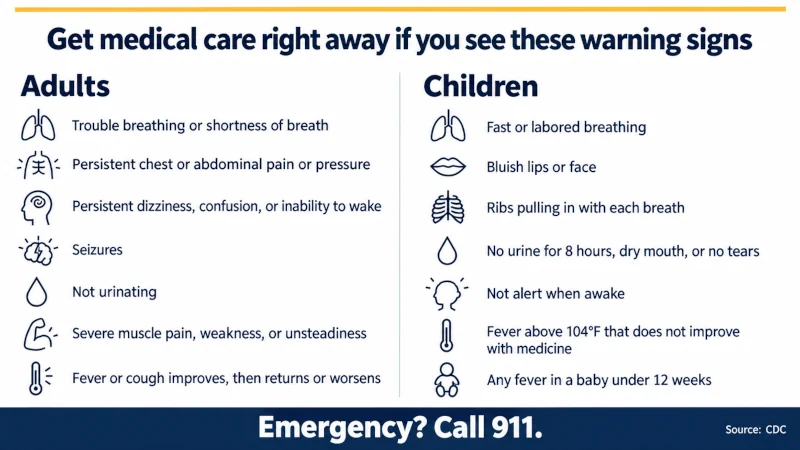
Most people with flu recover in a few days to less than two weeks, but some develop complications such as pneumonia [CDC signs and symptoms of flu, 2024]. No supplement should delay care. Go to urgent care or the ER, or call 911 in an emergency, if an adult has any of these warning signs [CDC signs and symptoms of flu, 2024]:
- Difficulty breathing or shortness of breath
- Persistent pain or pressure in the chest or abdomen
- Persistent dizziness, confusion, or can’t be woken
- Seizures
- Not urinating
- Severe muscle pain, weakness, or unsteadiness
- Fever or cough that improves, then returns or gets worse
- A chronic condition that’s getting worse
In children, also watch for fast or labored breathing, bluish lips or face, ribs pulling in with each breath, signs of dehydration (no urine for 8 hours, dry mouth, no tears), not being alert when awake, a fever above 104°F that doesn’t come down with fever medicine, or any fever in a baby younger than 12 weeks [CDC signs and symptoms of flu, 2024].
Adults 65 and older, children under 5, pregnant people, and anyone with asthma, diabetes, or heart disease face higher risk of flu complications, so call your doctor early rather than waiting it out [CDC signs and symptoms of flu, 2024]. For older adults, our guide to respiratory illness in older adults covers the quieter warning signs.
| Health Disclaimer: This article is for general education and is not medical advice. Elderberry gummies are dietary supplements. The FDA does not approve supplements before they’re sold, and they are not intended to diagnose, treat, cure, or prevent any disease. Talk with your doctor or pharmacist before using them if you’re pregnant or breastfeeding, giving them to a child, taking medication, or managing a health condition. Never use a supplement in place of medical care for a serious illness. |
Frequently Asked Questions
Do Sambucus Elderberry Gummies actually work?
The vitamin C, vitamin D, and zinc support normal immune function. Elderberry itself may modestly shorten a cold or flu, but results are mixed: small trials looked positive, while a larger US trial found no benefit. No trial has tested this specific gummy.
How many Sambucus gummies should I take a day?
Two gummies a day for adults and children 4 and older. The label says not to exceed that, including when you feel sick.
Can I take elderberry gummies every day?
The product is designed for daily use, and the label amounts are within adult and child upper limits on their own. Just count any other supplements with zinc or vitamin D, and know that daily elderberry hasn’t been shown to prevent colds.
Can kids take Sambucus Elderberry Gummies?
The regular gummies are labeled for ages 4 and up at two gummies a day. Don’t give extra servings, check totals if your child takes a multivitamin, and never give children the Sleep + Immune version, which contains melatonin.
Is it safe to take elderberry gummies while pregnant or breastfeeding?
Safety isn’t established, and major sources disagree on how cautious to be. Skip them unless your doctor or midwife says otherwise.
Do elderberry gummies help with COVID-19?
No. There’s no good evidence elderberry prevents or treats COVID-19.
References
- Nature’s Way. Sambucus Elderberry Immune Gummy: Supplement Facts, directions, and safety information. Nature’s Way Brands, LLC; accessed September 25, 2026. https://naturesway.com/products/sambucus-gummies
- Nature’s Way. Sambucus Sleep & Immune Gummies: Supplement Facts, directions, and safety information. Nature’s Way Brands, LLC; accessed September 25, 2026. https://naturesway.com/products/sambucus-sleep-immune-gummies
- National Center for Complementary and Integrative Health. Elderberry: Usefulness and Safety. NIH; last updated November 2024. https://www.nccih.nih.gov/health/elderberry
- Zakay-Rones Z, Thom E, Wollan T, Wadstein J. Randomized study of the efficacy and safety of oral elderberry extract in the treatment of influenza A and B virus infections. Journal of International Medical Research. 2004;32(2):132–140. PMID 15080016. https://doi.org/10.1177/147323000403200205
- Hawkins J, Baker C, Cherry L, Dunne E. Black elderberry (Sambucus nigra) supplementation effectively treats upper respiratory symptoms: a meta-analysis of randomized, controlled clinical trials. Complementary Therapies in Medicine. 2019;42:361–365. PMID 30670267. https://doi.org/10.1016/j.ctim.2018.12.004
- Macknin M, Wolski K, Negrey J, Mace S. Elderberry extract outpatient influenza treatment for emergency room patients ages 5 and above: a randomized, double-blind, placebo-controlled trial. Journal of General Internal Medicine. 2020;35(11):3271–3277. PMID 32929634. https://doi.org/10.1007/s11606-020-06170-w
- Wieland LS, Piechotta V, Feinberg T, et al. Elderberry for prevention and treatment of viral respiratory illnesses: a systematic review. BMC Complementary Medicine and Therapies. 2021;21:112. PMCID PMC8026097. https://doi.org/10.1186/s12906-021-03283-5
- Tiralongo E, Wee SS, Lea RA. Elderberry supplementation reduces cold duration and symptoms in air-travellers: a randomized, double-blind placebo-controlled clinical trial. Nutrients. 2016;8(4):182. PMID 27023596. https://doi.org/10.3390/nu8040182
- Krawitz C, Mraheil MA, Stein M, et al. Inhibitory activity of a standardized elderberry liquid extract against clinically-relevant human respiratory bacterial pathogens and influenza A and B viruses. BMC Complementary and Alternative Medicine. 2011;11:16. PMID 21352539. https://doi.org/10.1186/1472-6882-11-16
- Memorial Sloan Kettering Cancer Center. About Herbs: Elderberry. Last updated March 27, 2023. https://www.mskcc.org/cancer-care/integrative-medicine/herbs/elderberry-01
- NIH Office of Dietary Supplements. Vitamin C: Fact Sheet for Health Professionals. Updated July 31, 2025. https://ods.od.nih.gov/factsheets/VitaminC-HealthProfessional/
- NIH Office of Dietary Supplements. Zinc: Fact Sheet for Health Professionals. Updated January 6, 2026. https://ods.od.nih.gov/factsheets/Zinc-HealthProfessional/
- NIH Office of Dietary Supplements. Vitamin D: Fact Sheet for Health Professionals. Accessed September 25, 2026. https://ods.od.nih.gov/factsheets/VitaminD-HealthProfessional/
- Centers for Disease Control and Prevention. Signs and Symptoms of Flu. Reviewed August 26, 2024. https://www.cdc.gov/flu/signs-symptoms/index.html


