
If you’re trying to get pregnant and someone has suggested acupuncture, here’s the honest answer first: the best-designed studies haven’t found that it raises your chances of having a baby, whether you use it alongside in vitro fertilization (IVF) or for polycystic ovary syndrome (PCOS). That’s not what many clinic websites say about acupuncture for fertility, so below is where that conclusion comes from, what acupuncture can reasonably offer, and how to keep it safe if you decide to try it.

| At A GLANCE: In the largest sham-controlled trials — 824 women having IVF and 1,000 women with PCOS — acupuncture did not raise live birth rates.Early studies that looked impressive were small and usually compared acupuncture with no treatment at all.With a licensed practitioner and sterile single-use needles, acupuncture is generally low-risk, but it does have side effects, mainly bruising and discomfort.If you find it calming, it can be a comfort measure. It shouldn’t replace or delay a fertility evaluation. |
What acupuncture for fertility involves
Acupuncture comes from traditional Chinese medicine. A practitioner places very thin, sterile needles at chosen points on the body and leaves them in for a short time. Some add a mild electrical current (electroacupuncture) or gentle heat from burning dried herbs near the skin (moxibustion).
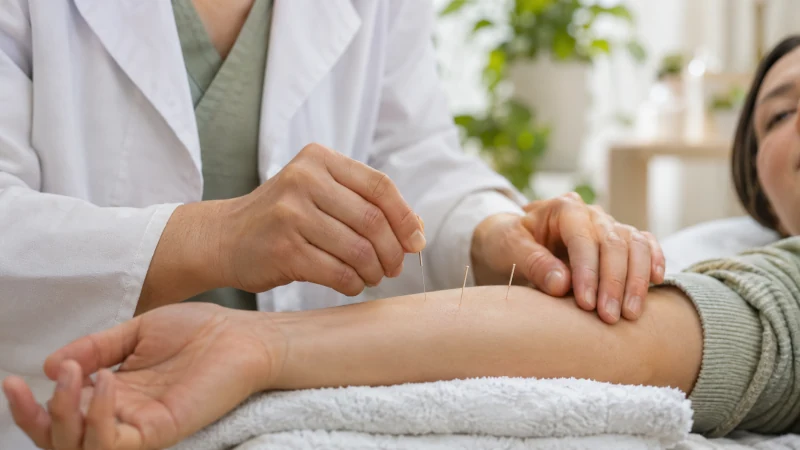
Traditional theory describes this as restoring the flow of energy, or qi. Researchers have tested more measurable ideas, such as better blood flow to the uterus or lower stress hormones. A plausible mechanism still has to show up as more babies, though, and that is where the evidence falls short.
People tend to use acupuncture for fertility in one of two ways: a course of regular sessions in the months before trying to conceive or starting treatment, or a few sessions timed around IVF egg collection and embryo transfer. Most of the strong research covers the second pattern, plus one very large trial in women with PCOS.
What the research on acupuncture for fertility shows
The outcome that matters in fertility research is live birth: did more people take home a baby? A positive pregnancy test or an early ultrasound is encouraging, but some of those pregnancies end in miscarriage. Judged by live births, the best trials agree with each other.
| Study | Who took part | Compared with | Live birth result |
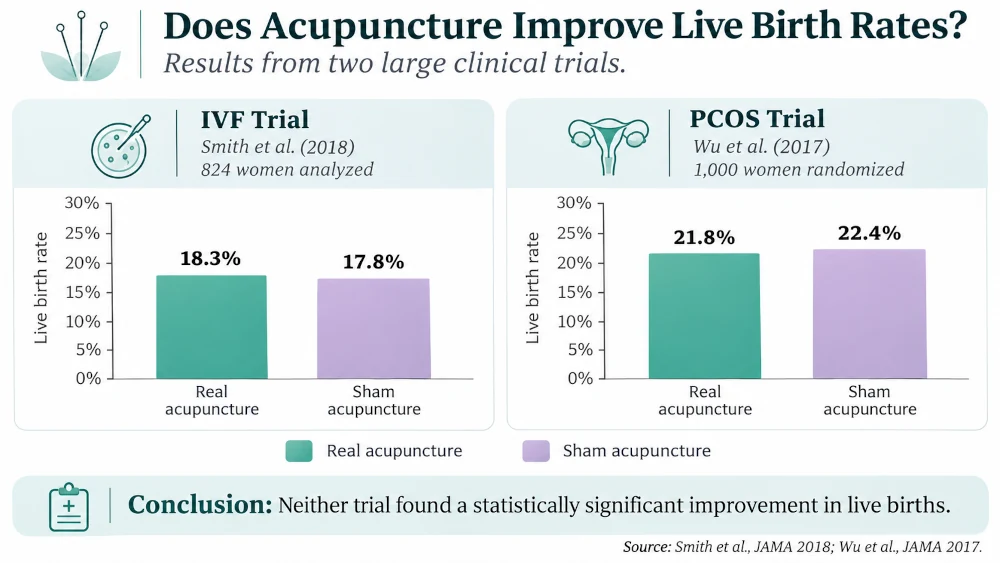
| Smith et al., 2018 (JAMA) | 824 women in a fresh IVF cycle, 16 clinics in Australia and New Zealand | Sham acupuncture | 18.3% vs 17.8% — no significant difference [Smith et al., 2018] |
| Wu et al., 2017 (JAMA) | 1,000 women with PCOS in China | Sham acupuncture | 21.8% vs 22.4% — no significant difference [Wu et al., 2017] |
| Cheong et al., 2013 (Cochrane) | 20 trials of women having IVF | Sham or no acupuncture | No evidence of benefit; evidence rated low quality [Cheong et al., 2013] |
| Zhang et al., 2025 (Cochrane) | 9 trials, 1,606 women with PCOS | Sham acupuncture and other comparisons | No clear difference vs sham; low certainty [Zhang et al., 2025] |
Acupuncture alongside IVF
The most rigorous test so far randomized 848 women having a fresh IVF cycle. Half had acupuncture once during ovarian stimulation and twice on transfer day, before and after the embryo was placed. The other half had a sham treatment: a needle that didn’t pierce the skin, placed away from true acupuncture points. Live birth rates were 18.3% and 17.8% — a gap small enough to be chance. Clinical pregnancy rates didn’t differ significantly either [Smith et al., 2018].
Critics note that three sessions is fewer than many acupuncturists recommend, and the trial authors list the short course as a limitation. That’s a fair reason for more research. It isn’t evidence that longer courses work.
Reviews and guidelines land in the same place. A Cochrane review of 20 trials found no evidence that acupuncture around egg collection or embryo transfer improves live birth or pregnancy rates, although its literature search ended in 2013 [Cheong et al., 2013]. The American Society for Reproductive Medicine’s embryo-transfer guideline states there is fair evidence that acupuncture around transfer does not improve live births [ASRM Practice Committee, 2017].
NCCIH, part of the US National Institutes of Health, summarizes a 2021 review of six sham-controlled studies with 2,507 participants that found no difference in pregnancy or live birth rates [NCCIH, 2022]. And a 2026 review of ten common IVF “add-ons” found either no effect or inconclusive results for acupuncture, after setting aside dozens of trials over trustworthiness concerns [Lensen et al., 2026].
One detail from the 2018 trial cuts the other way. Among women who became pregnant, miscarriage was more common in the acupuncture group (22.8% vs 11.6%), but the difference fell just short of statistical significance [Smith et al., 2018], and the Cochrane review found no effect on miscarriage [Cheong et al., 2013]. It is most likely noise. It’s also a reminder that “natural” doesn’t automatically mean “can only help.”
Acupuncture for PCOS and ovulation
PCOS is one of the most common causes of infertility, usually because ovulation is irregular or absent. Acupuncture has been promoted for PCOS on the idea that it might help restart ovulation.
The largest trial randomized 1,000 women with PCOS to real or sham acupuncture, each paired with either clomiphene (a standard ovulation medicine) or a placebo pill. Acupuncture didn’t change live birth rates: 21.8% with real acupuncture versus 22.4% with sham. Clomiphene did, at 28.7% versus 15.4% with placebo [Wu et al., 2017]. A smaller US trial of 84 women also found similar ovulation rates with true and sham needling [Pastore et al., 2011].
A 2025 Cochrane update pooling nine trials reached the same conclusion — no clear difference from sham for live birth, ovulation, or pregnancy — and judged that acupuncture probably causes more adverse events than sham [Zhang et al., 2025]. If you have PCOS and want to conceive, medication that induces ovulation has the evidence behind it.
IUI, unexplained infertility, and male fertility
Research here is thin. The 2013 Cochrane review found no trials of acupuncture alongside intrauterine insemination (IUI) or ovulation induction [Cheong et al., 2013]. For male infertility, NCCIH describes a 2020 review of 12 studies on sperm quality as too inconsistent and too low in quality to support firm conclusions [NCCIH, 2022]. Claims that acupuncture “improves egg quality” or “balances hormones” enough to produce pregnancies aren’t backed by trials that counted births.
Why some studies look so positive
The big success numbers quoted online mostly trace back to early, small studies. A 2002 German trial of 160 IVF patients reported clinical pregnancy in 42.5% of women given acupuncture before and after embryo transfer, compared with 26.3% of women given nothing extra [Paulus et al., 2002]. That works out to a relative increase of roughly 60%, and figures like it still circulate. A 2008 meta-analysis of seven trials, mixing sham and no-treatment controls, also found higher pregnancy rates with acupuncture around transfer [Manheimer et al., 2008].
Those results didn’t hold up for clear reasons. Many early trials compared acupuncture with no treatment, so the acupuncture group also got extra attention, rest, and reassurance; only a sham control separates those effects from the needles themselves. The trials were small, and small trials swing widely by chance. Several measured pregnancy rather than live birth. When larger sham-controlled trials followed, the advantage disappeared.
Where acupuncture may still fit
Plenty of people say their acupuncture appointment was the calmest hour of the week during fertility treatment. Treatment is stressful, and feeling looked after has value on its own terms.

The research on stress relief specifically is limited. The 2018 IVF trial planned to measure anxiety and quality of life but didn’t report those results in its main paper [Smith et al., 2018]. The ASRM guideline cites a trial of ear acupuncture around transfer that reported lower anxiety, but that is a single study [ASRM Practice Committee, 2017].
A fair way to think about it: if you enjoy acupuncture, can afford it, and see a licensed practitioner, it’s a reasonable comfort measure — closer to a massage or a yoga class than to a fertility treatment. Don’t let it take money or months away from care that works. If you’re also weighing supplements for stress and anxiety, run each one past your fertility clinic first, since a product that’s fine at other times may not suit a treatment cycle or early pregnancy.
Is acupuncture safe while you’re trying to conceive?
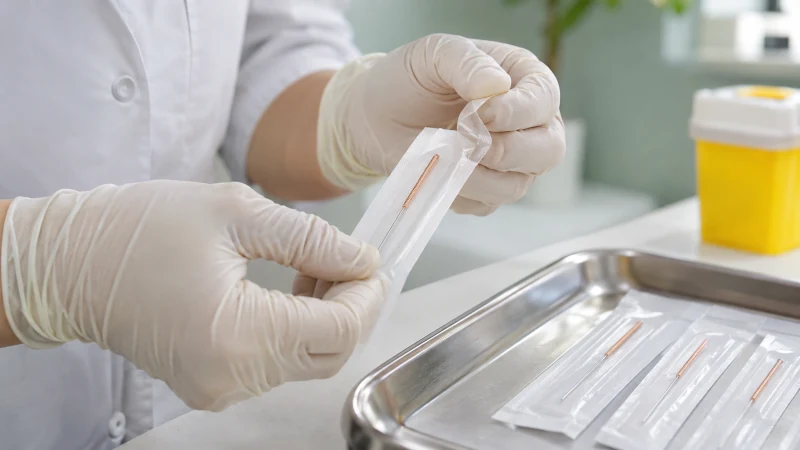
In trained hands, acupuncture is generally low-risk. Relatively few complications have been reported, and the serious ones — infections, punctured organs, and nerve injury — have mostly come from non-sterile needles or poor technique. In the US, the FDA requires acupuncture needles to be sterile and labeled for single use [NCCIH, 2022].
Common side effects
“No side effects” isn’t accurate. In the 2018 IVF trial, bruising (5.0% vs 1.3%) and discomfort on transfer day (10.3% vs 4.9%) were more common with real acupuncture than with sham, though events were mild [Smith et al., 2018]. In the PCOS trial, bruising (7.4% vs 1.8%) and diarrhea (5.0% vs 1.6%) were more common [Wu et al., 2017]. The 2025 Cochrane review also lists vaginal bleeding, weight gain, fatigue, dizziness, nausea, and small blood collections under the skin among reported effects [Zhang et al., 2025].
Who should be cautious
- People who take blood thinners or bleed easily. Acupuncture may not be safe for you [NHS, 2026]. Tell your acupuncturist about every medicine you take, including anything your fertility clinic prescribes.
- Anyone with a skin infection or skin condition where needles would go [NHS, 2026].
- Anyone who is or might be pregnant, including during the two-week wait after transfer. Tell your practitioner. Trials of acupuncture around embryo transfer haven’t shown clear harm [Cheong et al., 2013], but that isn’t the same as proof that every point and technique is safe in early pregnancy.
- Anyone offered herbal formulas with their sessions. Herbal medicines can interact with prescription drugs, including warfarin and the combined pill, and the NHS advises avoiding them while pregnant or breastfeeding [NHS, 2026]. Some herbs sold for fertility, such as false unicorn root, have no supporting trials and aren’t considered safe in pregnancy; see also these herbs to avoid during pregnancy. Don’t start an herb during a treatment cycle without your fertility team’s approval.
Choosing a practitioner
Most US states license acupuncturists, and in most of them that means certification by, or passing the exams of, the National Certification Commission for Acupuncture and Oriental Medicine. Requirements vary by state [NCCIH, 2018]. Before you book, ask whether the practitioner is licensed in your state, whether they use sterile single-use needles, and whether they’ll schedule around your clinic’s appointments. Then tell your fertility team you’re having acupuncture — NCCIH advises telling all your providers about any complementary approach you use [NCCIH, 2022].
Cost, timing, and number of sessions
No research supports a particular number of sessions for fertility. The IVF trial used three; the PCOS trial used a much longer course. Neither raised birth rates [Smith et al., 2018; Wu et al., 2017]. Be wary of packages that ask you to prepay for many weeks on the promise of better odds.
Prices vary by region and practitioner, and fertility acupuncture is often paid out of pocket. Check with your insurer before you start, and ask the practitioner for the total cost of any plan they propose. If you’re having IVF, coordinate with your clinic so sessions don’t clash with monitoring visits or the transfer itself.
When to see a fertility specialist
Acupuncture shouldn’t delay a medical workup; NCCIH specifically warns against using it to put off seeing a provider [NCCIH, 2022]. The CDC suggests seeing a provider [CDC, 2024]:
- after a year of trying if you’re under 35 and your periods are regular
- after six months of trying if you’re 35 or older
- sooner if you’re older than 40
Don’t wait at all if you have irregular or absent periods, endometriosis or very painful periods, a history of pelvic inflammatory disease, known or suspected problems with the uterus or fallopian tubes, or more than one miscarriage. For male partners, early evaluation makes sense after testicular injury, hernia surgery, chemotherapy, or with sexual dysfunction [CDC, 2024]. While you wait for an appointment, eating well before and during pregnancy is a useful, low-risk focus.
| Get medical help promptly if… You’re having IVF and notice rapid weight gain (more than 10 pounds in 3 to 5 days), severe belly pain or swelling, shortness of breath, much less urine than usual, or nausea and vomiting that won’t stop. These can be signs of ovarian hyperstimulation syndrome [MedlinePlus, n.d.].After an acupuncture session you have sudden chest pain or trouble breathing, or a needle site turns red, hot, and painful with a fever. Serious complications such as punctured organs and infections are rare, but they do happen [NCCIH, 2022]. |
| HEALTH DISCLAIMER: This article is for general information and isn’t a substitute for advice from your own doctor, fertility specialist, or pharmacist. Fertility care depends on your age, history, test results, and treatment plan. Talk with your fertility team before adding acupuncture, herbs, or supplements to a treatment cycle, and tell every practitioner about all the medicines and remedies you use. If you are pregnant, think you might be, or are breastfeeding, check with your clinician before starting any complementary therapy or herbal product. |
Frequently Asked Questions
Does acupuncture improve IVF success rates?
Not according to the strongest evidence. In a trial of 824 women, live birth rates were 18.3% with acupuncture and 17.8% with sham treatment [Smith et al., 2018], and ASRM guidance says acupuncture around embryo transfer does not improve live births [ASRM Practice Committee, 2017].
Can acupuncture help me ovulate if I have PCOS?
Large trials haven’t shown it. In 1,000 women with PCOS, real and sham acupuncture produced similar live birth rates, while clomiphene raised them [Wu et al., 2017]. A 2025 Cochrane review found no clear difference from sham for ovulation [Zhang et al., 2025].
When should I start acupuncture before IVF?
There’s no evidence-based timing that improves results, because no schedule tested so far has raised birth rates [Smith et al., 2018; Cheong et al., 2013]. If you choose acupuncture for comfort, plan it with your clinic so it fits around monitoring and transfer.
Is acupuncture safe during the two-week wait or early pregnancy?
It’s generally low-risk with a licensed practitioner using sterile single-use needles [NCCIH, 2022], and trials around embryo transfer haven’t shown clear harm [Cheong et al., 2013]. Tell your practitioner you may be pregnant, and skip any herbal formulas unless your clinician approves them [NHS, 2026].
Does insurance cover acupuncture for fertility?
It depends on your plan, and many people pay out of pocket. Ask your insurer directly, and ask the acupuncturist for the full cost of any treatment plan before you commit.
References
- Smith CA, de Lacey S, Chapman M, et al. Effect of acupuncture vs sham acupuncture on live births among women undergoing in vitro fertilization: View source
- Cheong YC, Dix S, Hung Yu Ng E, Ledger WL, Farquhar C. Acupuncture and assisted reproductive technology. View source
- Practice Committee of the American Society for Reproductive Medicine. Performing the embryo transfer: a guideline. View source
- National Center for Complementary and Integrative Health. Acupuncture: What You Need To Know. View source
- Lensen S, et al. Safety and effectiveness of ten common in-vitro fertilisation add-ons: a systematic review and meta-analysis. View source
- Wu XK, Stener-Victorin E, Kuang HY, et al.; PCOSAct Study Group. View source
- Pastore LM, Williams CD, Jenkins J, Patrie JT. True and sham acupuncture produced similar frequency of ovulation and improved LH to FSH ratios in women with polycystic ovary syndrome. View source
- Zhang GS, Lim ECN, Cheng NCL, Lim CED. Acupuncture for polycystic ovary syndrome. View source
- Paulus WE, Zhang M, Strehler E, El-Danasouri I, Sterzik K. Influence of acupuncture on the pregnancy rate in patients who undergo assisted reproduction therapy. View source
- Manheimer E, Zhang G, Udoff L, et al. Effects of acupuncture on rates of pregnancy and live birth among women undergoing in vitro fertilisation: systematic review and meta-analysis. View source
- NHS. Herbal medicines and complementary therapies. View source
- National Center for Complementary and Integrative Health. Credentialing, Licensing, and Education. View source
- Centers for Disease Control and Prevention. Infertility FAQs. View source
- MedlinePlus Medical Encyclopedia. Ovarian hyperstimulation syndrome. View source
- MedlinePlus Medical Encyclopedia. In vitro fertilization (IVF). View source


